

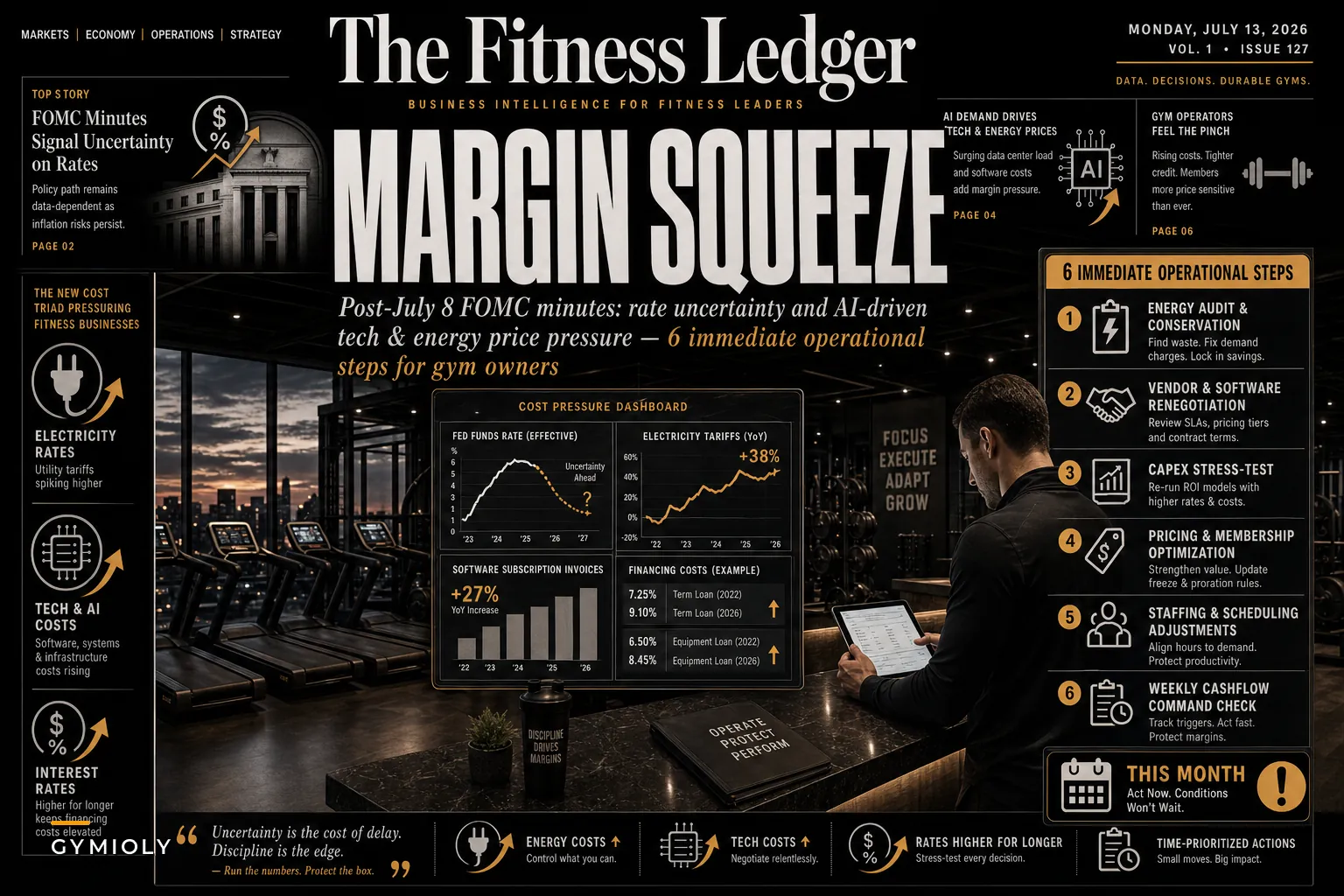

The Federal Reserve just dropped their June meeting minutes, and buried in the usual economic commentary was something worth paying attention to: policymakers are split on where interest rates go next, and they specifically called out AI infrastructure investments driving up tech hardware and electricity prices. For gym owners already juggling equipment financing, vendor contracts, and summer utility bills, this creates an operational squeeze from three directions at once.
The triple threat hitting gym budgets right now
The Fed's split on rates means financing costs for a new cable machine or studio expansion could swing significantly in either direction over the next 12 months. Meanwhile, the AI boom they're flagging isn't just about ChatGPT — it's pushing up prices for the booking systems, member management platforms, and analytics tools gyms rely on daily.
Then there's electricity. Data centers powering AI infrastructure need massive cooling, and they're competing with your 24/7 facility for grid capacity. A gym owner in Phoenix mentioned their July electric bill jumped 18% year-over-year, and that was before this latest Fed commentary.
The real problem is that most gyms already operate on thin margins. A 2-3% swing in operational costs can mean the difference between expanding your yoga studio and cutting part-time trainer hours.
Step 1: Lock down your electricity exposure immediately
Pull your last 12 months of utility bills. If you're month-to-month on commercial electricity rates, you're exposed to whatever happens next with grid demand.
End appointment chaos and boost attendance.
Gymioly streamlines booking, confirms sessions, and manages memberships effortlessly.
- Unified class and membership management
- Automated member notifications
- Trainer scheduling and availability
No credit card required
Contact your utility provider about fixed-rate plans. Yes, you might pay slightly above current spot rates, but predictability matters more than marginal savings when margins are already tight. A CrossFit box in Houston locked in a 24-month rate last February and avoided a 22% spike that hit variable-rate customers in June.
For 24-hour facilities, implement zone-based HVAC scheduling. Nobody needs the entire facility at 68 degrees at 3 AM when three members are on treadmills. Smart thermostats with occupancy sensors can cut overnight cooling costs noticeably — estimates typically land somewhere in the 30% range depending on your setup.
If you have EV charging stations for members, switching from free to paid charging — even $3-5 per session — helps offset rising electricity costs while keeping the amenity intact.
Step 2: Renegotiate vendor contracts before the price hikes hit
Your software vendors are facing the same pressures. Their infrastructure costs are climbing, their developers cost more, and in this rate environment, investors want better returns. Price increases are coming.
Pull every vendor contract — member management systems, booking platforms, payment processors, digital marketing tools. Look for these red flags:
Auto-renewal clauses with price escalation provisions. These let vendors bump rates at renewal without real negotiation. A boutique studio chain found their booking platform contract allowed 8% annual increases — they renegotiated to a 3% cap before the next renewal cycle.
Month-to-month agreements. Flexibility sounds appealing, but vendors can change pricing with 30 days notice. Annual contracts with locked rates protect you through this period.
Tiered pricing that penalizes growth. Some platforms charge more as you add members. You need pricing that scales with revenue, not headcount.
Reach out to vendors now about multi-year agreements at current rates. Most will take guaranteed revenue over the risk of churn, especially smaller SaaS companies.
Step 3: Build a dynamic CAPEX forecast with rate scenarios
Standard annual CAPEX planning assumes financing costs stay roughly stable. That assumption is basically off the table right now.
Build three scenarios for every equipment purchase or facility upgrade planned over the next 18 months:
| Scenario | Base Rate Assumption | Monthly Payment Impact | Decision Trigger |
|---|---|---|---|
| Best Case | Rates drop 75 basis points | -12% payment reduction | Execute all planned purchases |
| Base Case | Rates stay flat | Current payment levels | Execute priority purchases only |
| Worst Case | Rates rise 100 basis points | +15% payment increase | Defer non-essential, lease vs buy analysis |
For each piece of equipment on the list, calculate the break-even member usage required at different financing costs. That new functional training rig might make sense at 5% financing but becomes a real problem at 8%.
One thing that catches gym owners off guard: equipment financing often lags Fed rate moves by 3-6 months. If you genuinely need equipment, the window to lock current rates is narrower than it looks.
Step 4: Audit your tech stack before prices go up
Before costs rise, figure out what you're actually using. Most gyms pay for features that nobody touches.
Run utilization reports on every software platform. That advanced analytics module costing $200/month? If staff hasn't logged in for 60 days, cut it. The social media scheduling tool that posts twice a month? Either use it properly or drop it.
Start with the highest-cost subscriptions and unused seats to find quick savings.
Check for overlap between platforms. Gyms frequently end up paying for duplicate functionality — member communication through both their booking system and a separate email platform, for example. Consolidating typically saves somewhere between 20-30% on software spend, sometimes more.
Also worth checking: subscriptions tied to former employees. It's more common than you'd think — project management accounts, design tools, things nobody's accessed in months but still billing every cycle.
Step 5: Stress-test your membership pricing against cost inflation
Rising operational costs eventually force pricing decisions. Timing matters a lot here.
Model your break-even member count across different cost scenarios:
-
Current costs vs current pricing
-
5% cost increase vs current pricing
-
10% cost increase vs current pricing
-
15% cost increase vs current pricing
For each scenario, figure out how many additional members you'd need to maintain margins without raising prices. If those numbers feel unrealistic given your market, you need a pricing strategy now — not after costs actually spike.
Consider targeted adjustments before going to across-the-board increases:
-
Add-on services (towel service, premium locker rentals)
-
Peak-hour pricing differentials
-
Contract length incentives (larger discounts for annual prepay)
-
Corporate account minimum commitments
The framing matters. Members tend to accept specific fee additions more readily than general price hikes. "Due to increased electricity costs, we're adding a $3 monthly facility fee" lands differently than "membership prices are going up 5%."
Step 6: Create operational triggers for rapid adjustment
Static planning doesn't hold up well in volatile environments. You need clear thresholds that initiate specific operational changes.
Define them explicitly:
-
If electricity costs exceed X% of revenue → implement emergency conservation measures
-
If equipment financing rates hit Y% → shift to used equipment or lease options
-
If software costs grow Z% quarter-over-quarter → initiate vendor consolidation
Document the exact actions for each trigger. When electricity costs hit your threshold, what happens? Reduced operating hours? Modified class schedules? Adjusted HVAC settings? Specificity matters — vague plans fall apart under pressure.
Build monitoring into your weekly routine. Every Monday, check:
-
Current Fed funds rate and futures pricing
-
Utility rate announcements
-
Vendor price change notifications
-
Equipment financing rate sheets
This isn't excessive — it's just operational discipline when conditions are shifting this fast.
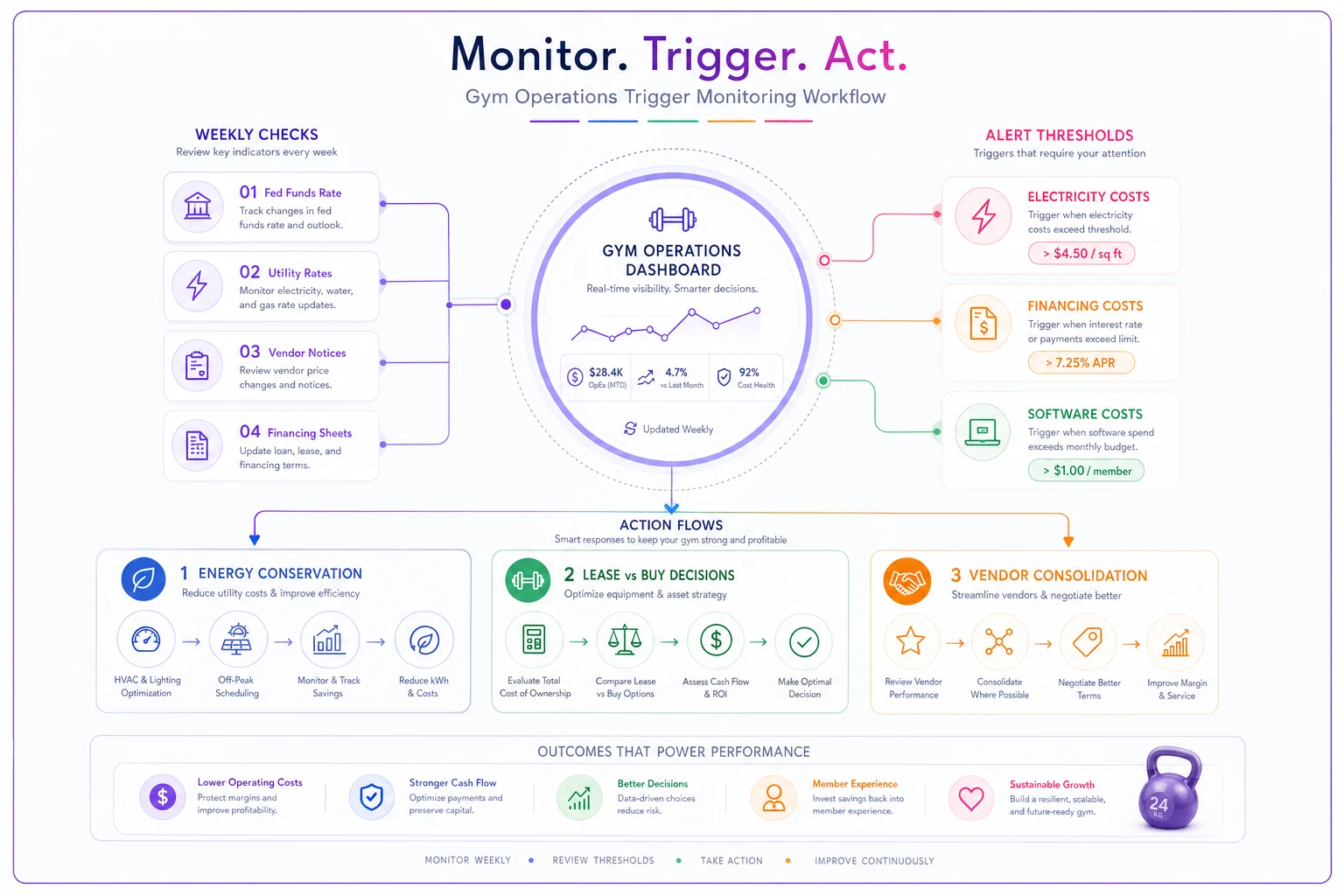
Here's a simple visualization of the monitoring and trigger workflow.
When the moving pieces get too complex to manage manually
Managing vendor contracts, dynamic pricing models, utilization tracking, and cost scenarios across multiple variables gets unwieldy fast. Spreadsheets and manual tracking tend to break down exactly when you need them most.
Modern gym management platforms with built-in automation handle a lot of this by centralizing contract management, flagging utilization problems automatically, and running scenario modeling without requiring someone to rebuild formulas every week. The value isn't that they replace judgment — it's that they cut out the manual data-gathering so owners can focus on decisions rather than assembly.
That said, the technology only helps if the operational foundation is already in place. Software doesn't fix a poorly structured vendor contract or a CAPEX plan built on a single rate assumption.
Act now, not when the bills arrive
According to CNBC's coverage, the Fed's indecision could persist through year-end. Tech and energy price pressures tied to AI infrastructure aren't going away quickly either.
The gyms that come out of this period in better shape won't be the ones who predicted the future correctly — they'll be the ones who locked in what they could control, built realistic scenarios for what they couldn't, and set up clear triggers before costs forced reactive decisions.
Your members don't follow FOMC minutes. They care about clean facilities, working equipment, and consistent class schedules. Maintaining those standards while navigating cost volatility is the actual operational challenge here — and it's harder than it sounds when you're reacting instead of planning ahead.
The Fed may be split on rates, but sitting on the fence with your operational strategy isn't a viable option. Lock in what you can, build your scenarios, and give your business something to work from when the next bill lands.
The Fed may be split on rates, but sitting on the fence with your operational strategy isn't a viable option. Lock in what you can, build your scenarios, and give your business something to work from when the next bill lands.
Ready to elevate your gym operations?
Join 2,000+ gyms using Gymioly to reduce admin overhead, improve member experience, and grow revenue.