


No-shows hurt differently when you're running group fitness classes. An empty reformer machine means lost revenue, sure, but it also means someone on your waitlist missed their shot, your instructor prepped for 12 people and got 8, and the energy in the room just isn't the same.
Most gym owners go straight to stricter policies. They bump the cutoff from 12 hours to 24. They add fees. They threaten to pull booking privileges. Members still ghost.
The problem usually isn't the policy itself—it's how you communicate it. The difference between a 15% no-show rate and a 3% one almost always comes down to messaging cadence, enforcement consistency, and how you frame the whole thing from day one.
The cancellation policy that nobody reads (and why that's your fault)
Your cancellation policy probably lives in three places: buried in the membership agreement, mentioned once during onboarding, and posted somewhere on your website that nobody visits. Members see it exactly once—when they're excited about joining and definitely not reading the fine print.
Then six months later they ghost a Saturday morning spin class and act surprised when you charge them $15.
The most effective studios don't necessarily have stricter policies. They have better policy communication. Here's what actually works:
Initial policy framing during onboarding: Instead of: "We have a 12-hour cancellation policy with a $15 late cancel fee" Try: "Our classes cap at 12 people to keep quality high. When someone doesn't show, another member missed their workout. We protect everyone's access with a 12-hour cancellation window—it helps us open spots for waitlisted members who actually want to be there." The difference is explaining the why behind the policy, not just reciting the rule.
Building your three-tier reminder system
Studios with the lowest no-show rates send three distinct reminder types, each doing something different psychologically.
End appointment chaos and boost attendance.
Gymioly streamlines booking, confirms sessions, and manages memberships effortlessly.
- Unified class and membership management
- Automated member notifications
- Trainer scheduling and availability
No credit card required
48-hour reminder (the planning nudge) "Hey Sarah! You're registered for Power Yoga this Thursday at 6:30am with Jamie. Reply YES to confirm you're still planning to come, or click here to cancel if your plans have changed." This isn't about stopping last-minute cancellations—it's about catching the people who forgot they booked or whose schedules shifted. Around 8% of members will cancel here, and that's fine. These are legitimate cancellations that free up spots with plenty of notice.
24-hour reminder (the commitment moment) "Tomorrow's 6:30am Power Yoga is confirmed! Class is full with 3 people waitlisted. If you can't make it, please cancel now so another member can grab your spot. After tonight at 6:30pm, late cancellations will be charged $15." This message does three things: confirms the booking, creates social pressure by mentioning the waitlist, and clearly states the fee deadline. Last chance for a free cancellation.
2-hour reminder (the accountability text) "See you soon for Power Yoga at 6:30am! Isabella is teaching today and has a great flow planned. The studio is at 72° this morning—don't forget your water!" This one assumes they're coming. Specific details make the class feel real. You're not talking about cancellation anymore—you're just getting them in the door.
Visualizing the reminder flow helps align your team on timing and messaging tone.
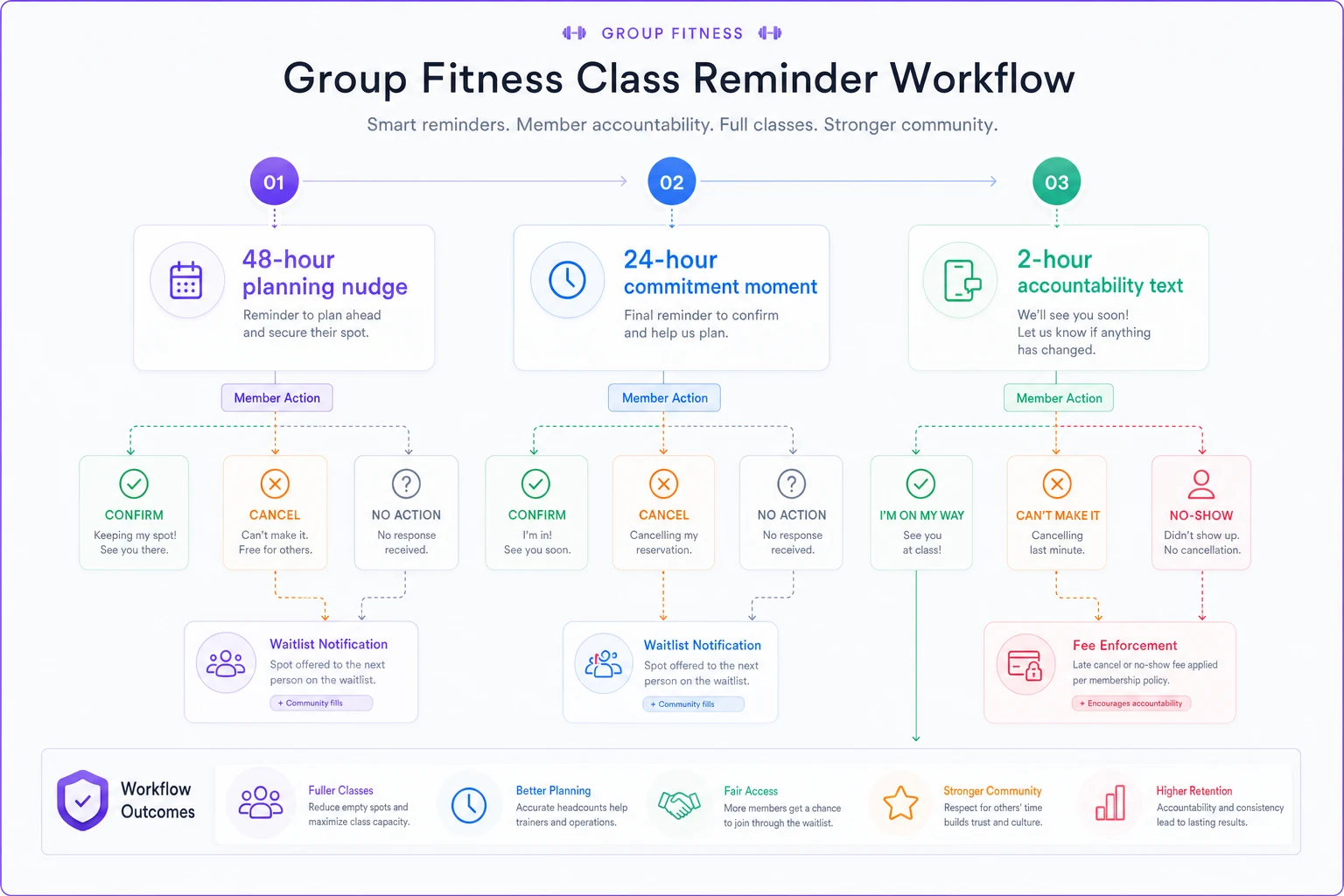
The three messages work together: early planning, commitment, then a final assumption of attendance to reduce friction at the door.
The waitlist system that creates natural urgency
Waitlists do more than capture overflow demand. Managed well, they create social pressure and perceived value that actually reduces no-shows.
Here's the waitlist messaging sequence that works:
When someone joins a waitlist: "You're #3 on the waitlist for Thursday's 6:30am Power Yoga. We typically see 1-2 spots open up, so keep your morning free! We'll text you immediately if something opens."
When they move up: "Update: You're now #1 on the waitlist for tomorrow's Power Yoga! There's a solid chance a spot will open. We'll let you know by 10pm tonight if you're in."
When they get in: "You're IN for tomorrow's 6:30am Power Yoga! A spot just opened and it's yours. Please confirm within 2 hours or we'll release it to the next person."
That two-hour confirmation window matters more than most studios realize. It stops the cascade problem where someone gets pulled off the waitlist but doesn't see the notification until morning—creating another no-show in the process.
Enforcement scripts that maintain relationships
The hard part isn't writing the policy. It's enforcing it without burning the relationship. Your front desk staff needs real language for these moments, not vague guidelines.
First offense: "Hi Mark, I noticed you missed yesterday's bootcamp. Since it was past the cancellation window there's normally a $15 fee—but since this is your first time, I'm waiving it today. Just a heads up for next time: you can cancel up to 12 hours before class with no charge. The app makes it easy, or you can always call us."
Second offense (where most gyms lose members): "Hey Mark, looks like we had another late cancellation yesterday. I need to apply the $15 fee this time, which will show on your next billing. I know things come up—if morning classes aren't working well with your schedule, we could look at evening options?" That schedule pivot is worth keeping. You're enforcing the policy while trying to actually solve the problem underneath it.
Chronic offender intervention: "Mark, looking at last month, I'm seeing a pattern of late cancellations. Instead of just keep charging fees, let's figure out what's going on. Are you booking too far ahead? Would a different class time work better? We'd rather have you in class than collecting fees."
When waiving a first fee, note it in the member record with the reason—this makes later enforcement consistent and defensible.
The language matters: you're trying to enforce while offering solutions. That keeps members engaged rather than pushed away.
The incentive structure that rewards good behavior
Penalizing bad behavior only goes so far. Studios with the best attendance rates also reward members who consistently show up.
Monthly attendance recognition: "Congrats! You attended 18 of your 20 booked classes last month—that's a 90% rate! You've earned a guest pass to bring a friend to any class this week."
Waitlist priority for reliable members: Track attendance rates in your system. Members with 90%+ attendance over the last 60 days get automatic waitlist priority. You don't need to announce it publicly—just run it quietly. Reliable members get better access, and members with chronic cancellations naturally sink down the list.
The "perfect month" reward: "Amazing—you attended every class you booked in October (12 classes, zero cancellations). Your reward: priority booking opens 2 days early for November." This creates a cycle where your most committed members get the best access to popular classes, which makes them take their bookings even more seriously.
Technology and the human touch balance
Operational software makes the biggest difference not by replacing human interaction, but by handling the repetitive stuff so your staff can actually focus on the relationship moments.
A solid platform handles the automated pieces:
-
Sends the three-tier reminder sequence without anyone on staff doing it manually
-
Tracks no-show patterns and flags chronic offenders
-
Manages waitlist movements and notifications
-
Applies fees consistently
-
Generates attendance reports for rewards programs
That frees your team for the moments that actually need a human—having the difficult conversations, helping members find better class times, recognizing good attendance in a way that doesn't feel like a robot sent it.
Even when reminders are system-generated, they should sound like they're coming from your studio. Most booking platforms let you customize message templates. Spend the time to rewrite them in your voice. It matters more than people think.
Reading the warning signs before they become problems
Members rarely go from perfect attendance to chronic no-shows overnight. There's usually a pattern you can catch early.
Early warning signals:
-
Bookings increase but attendance stays flat (booking aspirationally)
-
Switching from regular class times to random ones
-
More last-minute cancellations just inside the window
-
Booking popular classes far ahead then cancelling
When you see this, a quick check-in makes a real difference: "Hey Sarah, noticed you've had to cancel a few morning classes lately—everything okay? Would afternoon classes work better right now?"
Roughly 40% of the time, this surfaces something real—an injury, a schedule change, feeling intimidated in a certain class—that you can actually help with.
The monthly audit that keeps everything running
Once a month, pull these numbers:
| Metric | Target | Action if Below |
|---|---|---|
| Overall attendance rate | >85% | Review reminder timing |
| No-show rate | <5% | Check policy enforcement |
| Waitlist conversion | >60% | Adjust notification timing |
| Late cancel rate | <8% | Review 24-hour messaging |
| Repeat offender % | <10% | Intervene individually |
If attendance drops below 85%, your reminder system needs work. If no-shows climb past 5%, enforcement has gotten inconsistent somewhere. Low waitlist conversion usually means people aren't seeing notifications fast enough.
The repeat offender percentage is the one to watch most closely. Those members need individual attention, not more automated messages.
Making this work in your studio
Start with the reminder sequence. That alone will knock no-shows down noticeably in the first month. Get those three messages right—48 hours, 24 hours, 2 hours—before you touch anything else.
Then fix the waitlist management. Clear communication about position and fast notification when spots open will handle most of your fill-rate issues.
Enforcement comes last. Once members are getting proper reminders and waitlist communication, enforcement gets easier because nobody can genuinely claim they didn't know.
The rewards layer is optional but worth adding. Even a simple monthly email recognizing perfect attendance creates positive pressure. Members start taking bookings more seriously when they know someone's paying attention.
Train your staff on the conversation scripts. They need to feel confident enforcing policies without blowing up relationships. Role-play the hard scenarios. Give them the actual words to use. Make sure they know when to escalate and when to let something go.
Studios stuck at 15-20% no-show rates usually aren't doing anything dramatically wrong—they're just not doing these things consistently. Reminders go out sometimes. Fees get applied occasionally. Waitlists get managed when someone remembers. The gap between mediocre attendance and good attendance isn't one big fix. It's doing a lot of small things, every time, without skipping steps.
That's where operational software becomes genuinely useful—maintaining this kind of consistency manually across hundreds of members and thousands of bookings is nearly impossible to sustain long-term. But the software only works as well as the system behind it. Someone still needs to write the messages, set the policies, train the staff, and handle the exceptions. The technology makes sure it all happens every time, exactly the way you designed it.
Ready to elevate your gym operations?
Join 2,000+ gyms using Gymioly to reduce admin overhead, improve member experience, and grow revenue.