



Running a single-location gym feels manageable until you realize every member follows a completely different path through your business. The new member who signed up yesterday needs totally different attention than the regular who's been coming for three years. The person who just froze their account requires different handling than someone whose card declined two months running.
Most gym owners deal with these situations reactively. A member complains about not getting properly onboarded, so you scramble to create a welcome process. Someone cancels citing poor communication, so you stack on more touchpoints. A wave of members goes inactive, so you launch a desperate win-back campaign with discounts that tank your margins.
The gyms that actually scale past 500 members without burning out their owners? They map the entire member lifecycle into documented processes before problems arise. Not because they love paperwork, but because they understand that operational consistency drives retention better than any marketing campaign.
Why member lifecycle operations break down at scale
When you're managing around 200 members, you can keep most of it in your head. You remember that Mike just started and needs his goal-setting session. You know Sarah's been MIA for two weeks and probably needs a check-in. The personal touch feels natural because everything flows through you.
Somewhere around 400-500 members, things start slipping. Staff handle situations differently. The new trainer you hired doesn't know to follow up with trial members on day three. Your front desk person freezes accounts without documenting why, leaving you clueless when the member returns six months later. Members fall through cracks you didn't even know existed.
The breakdown is gradual. First you notice more members canceling in their second month. Then you realize half your "active" members haven't shown up in six weeks. Monthly recurring revenue looks healthy on paper, but actual gym usage tells a different story. By the time you see the pattern, you've already lost thousands in lifetime value from members who churned unnecessarily.
What makes this especially painful for single-location gyms is that you're competing against boutique studios with ultra-personalized service and big chains with sophisticated retention systems — simultaneously. You need the operational consistency of the chains and the personal touch of the boutiques, with a fraction of the resources.
Mapping the four critical lifecycle stages
Every member interaction falls into one of four stages, and each stage needs completely different processes, handoffs, and decision criteria. Miss one and the whole lifecycle falls apart.
End appointment chaos and boost attendance.
Gymioly streamlines booking, confirms sessions, and manages memberships effortlessly.
- Unified class and membership management
- Automated member notifications
- Trainer scheduling and availability
No credit card required
Stage 1: Lead to Trial Most gyms actually have decent processes here, mostly because it directly impacts immediate revenue. You've probably got a tour script, maybe even a follow-up sequence for people who don't convert. But the handoff from marketing to operations often breaks here.
Stage 2: Trial to Active Member The make-or-break window most gyms completely botch. This isn't just showing someone where the bathrooms are. It's about establishing usage patterns, building social connections, and creating early wins that lock in long-term retention.
Stage 3: Active to At-Risk The silent killer stage where profitable members quietly disengage. Most gyms don't even track this properly, let alone have processes for it. By the time someone formally cancels, they've usually been mentally gone for months.
Stage 4: Inactive to Reactivated The forgotten goldmine. Reactivating past members costs roughly a fifth of what it takes to acquire new ones, yet most gyms either ignore them completely or blast generic "we miss you" emails that get immediately deleted.
The lifecycle itself isn't complicated. What gets messy is the operational layer underneath it — the handoffs, the tracking, the actual execution when three staff members each think someone else is handling it.
Lead capture to trial conversion: The pre-member pipeline
Before someone becomes a member, they exist in this weird operational limbo. They're not quite a customer but more than a random contact. How you handle this stage determines not just whether they join, but what kind of member they become.
The typical gym lead flow looks deceptively simple: someone inquires, gets a tour, maybe does a trial, then either signs up or doesn't. But operationally, this involves multiple handoffs, each with potential failure points.
Start with inquiry response time. The standard "we'll get back to you within 24 hours" kills conversions. People inquiring about gym memberships are usually in a motivated state that fades fast. You need processes that trigger immediate responses even outside business hours — template replies for common inquiry types, clear escalation paths for complex questions, and documented handoff protocols between whoever receives the inquiry and whoever books the tour.
Tour scheduling needs more structure than "come in whenever." Set availability windows that align with your best tour-givers' schedules. Document which staff can give tours for which membership types. Create contingency protocols for when your best salesperson calls in sick. Small details, but they compound into conversion rate differences that actually matter.
The trial offer decision tree rarely gets documented, yet it causes endless confusion. Can front desk staff offer free trials? Discounted weeks? Who approves exceptions? Without clear guidelines, you get inconsistent offers that confuse prospects and frustrate staff. Build a simple decision matrix: if the prospect says X, we offer Y, approved by Z.
| Prospect Situation | Offer Type | Approval Required |
|---|---|---|
| First inquiry, no objections | Standard 3-day trial | Front desk |
| Price objection | Intro week discount | Manager on duty |
| Referral from existing member | Free week trial | Front desk |
| Corporate inquiry | Custom rate + trial | Owner/manager |
| Returning former member | Reactivation rate | Manager |
Small decision rules like this eliminate most of the confusion and keep offers consistent across staff.
Here's a simple visual of the lead-to-trial workflow that matches the processes above.
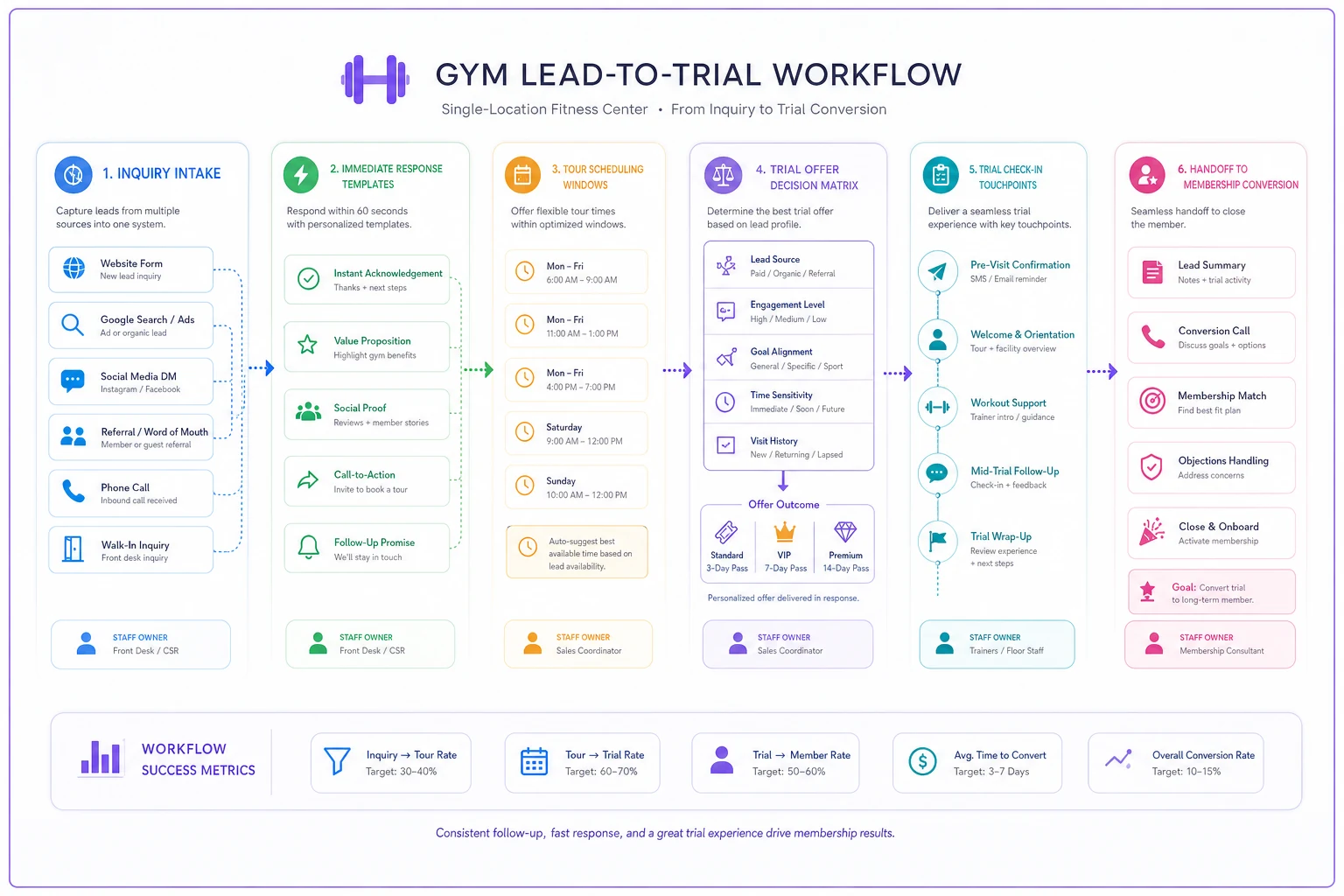
Use this flow to audit where your process currently breaks and who owns each step.
Trial member activation: The 14-day make or break window
Once someone starts a trial, you've got roughly two weeks to establish patterns that predict long-term retention. Most gyms waste this window on generic welcome emails, then hope the member figures everything out themselves.
The operational challenge is that trial members need high-touch service, but you can't assign dedicated handlers to each one. The solution is systematic handoffs between staff, each responsible for specific touchpoints.
-
Day 1 — Assigned to whoever's working when the trial member first visits. Ensure the member actually works out (not just wanders around), introduce them to at least one regular, and document any specific goals or concerns. That documentation needs to be accessible to all staff, not buried in someone's notebook.
-
Days 2–4 — Check-in protocol. Not a sales call — a quick wellness check. Did they find everything okay? Any equipment questions? This can be systematized through text templates, but someone needs to own reviewing and responding to replies.
-
Day 7 — Conversion conversation. By now you should have real data on their usage, preferences, and friction points. The conversation practically scripts itself when you've collected this information systematically. The person conducting it needs access to all previous touchpoint notes plus clear authority on what membership offers they can extend.
-
Day 14 — Decision point. Member either converts or exits the trial sequence. Either way, the outcome gets documented.
The handoff from trial to full member is where a lot of gyms drop the ball. The salesperson celebrates the close and moves on. Meanwhile, the new member shows up for their first "real" visit and gets treated like they've been coming for years. You need a documented transition protocol that preserves continuity of experience across that boundary.
Active member monitoring: Catching decline before it becomes churn
Most members who cancel have been mentally gone for weeks before they actually pull the trigger. They gradually reduce visits, stop engaging with staff, slowly disconnect from your community. By the time they formally cancel, recovery is nearly impossible.
The operational challenge is identifying at-risk members before they've mentally checked out. This requires systematic tracking of engagement signals beyond just check-ins — class bookings, program participation, even how members interact with staff at the front desk.
Create engagement buckets based on visit frequency. Members who normally come three or four times per week but drop to once need different interventions than members who consistently come once per week. The first is a warning sign; the second might be perfectly stable. Your playbook needs different protocols for each scenario.
Usage pattern breaks matter more than absolute numbers. A member who always attends Monday morning spin but misses two weeks in a row needs attention even if they're still coming other days. These breaks often signal life changes that, if not addressed, lead to cancellation.
Staff observations need systematic capture. Your trainers and front desk people notice things — members who seem frustrated, people who mentioned injuries, folks whose schedules changed. Without a system to document and act on these observations, the intelligence just evaporates. Build simple reporting mechanisms that don't feel like extra paperwork but capture critical member state information.
Interventions can't be one-size-fits-all. A high-value long-term member showing decline patterns might warrant a personal call from the owner. A newer budget member might get an automated check-in with class recommendations. Document who makes these decisions and what triggers each type of intervention.
The reactivation sequence: Mining your dormant member list
Inactive members are the most underutilized asset in most gym operations. These people already know your location, your equipment, your culture. They've already overcome the psychological barrier of joining a gym. Yet most gyms either ignore them completely or blast desperate discount offers that train members to cancel and wait for deals.
The first operational requirement is clean data segmentation. Not all inactive members are equal. Someone who was a member for two years and left six months ago needs completely different handling than someone who joined, came twice, and disappeared.
-
Long-term members who left recently
-
Short-term members who never really activated
-
Seasonal patterns (people who consistently freeze for summer)
-
Payment failures versus voluntary cancellations
-
Members who left with specific complaints versus silent departures
Each segment needs its own message sequence, offer structure, and success metrics. A long-term member who left might respond to updates about new equipment or programming. A never-activated member might need a completely fresh start with modified onboarding.
Timing matters more than message. Reactivation attempts in the first month after cancellation feel desperate. Month six might be too late. The sweet spot usually falls somewhere between months two and four, when the member has had time to try alternatives and realize what they're missing.
The handoff for returning members is critical. Nothing kills reactivation momentum faster than treating someone like a complete stranger when they come back. They need modified onboarding that acknowledges their history while addressing whatever caused them to leave — which means you need information systems that actually preserve member history and staff who know how to handle returns.
Documentation that actually gets used
The best operational playbook in the world is worthless if staff doesn't follow it. Most gym SOPs fail because they're either too complex to use in real-time or too vague to be useful. The sweet spot is documentation that guides decisions without requiring constant manual lookup.
Start with trigger-based checklists. Instead of "Member Onboarding Process — 47 Steps," create contextual guides like "New Trial Member Just Walked In" or "Member Asking About Freezing Account." Each checklist should fit on a single page and follow an if-then format that walks staff through decisions.
Keep checklists to one page and in the place decisions get made so staff actually use them.
Handoff protocols need explicit ownership transfer. "Front desk informs trainer" is too vague. Instead: "Front desk sends Slack message to @trainer-on-duty with member name and specific goal mentioned during tour." Clear ownership, clear action, clear channel.
Decision trees should live where decisions get made. The membership freeze policy shouldn't be in a binder in the back office — it should be a laminated flowchart at the front desk. Trial conversion talking points shouldn't be buried in a training manual; they should be on the tablet your sales staff actually carries.
Close your feedback loops. When a staff member flags an at-risk member, what actually happens next? Who follows up? How do they know if the intervention worked? Without closing these loops, staff stop flagging issues because nothing seems to happen with the information.
Technology coordination without the integration nightmare
Modern gym operations run across multiple systems — member management, payment processing, class scheduling, communication tools, maybe an app platform. The theoretical answer is "integrate everything." The practical reality is that integrations break, data gets messy, and you spend more time fixing tech than running your gym.
The operational playbook needs to account for system boundaries. Document what information lives where and who has access to it. Your class booking system might not talk to your payment processor, but staff needs to know how to manually reconcile no-shows with billing issues.
Build manual bridges for critical handoffs. If your CRM doesn't automatically flag when someone hasn't visited in two weeks, create a weekly report process where someone pulls that data and initiates outreach. It's not elegant, but it's reliable. AI-powered operational software can help here — platforms built for gym and fitness businesses increasingly handle these monitoring tasks automatically, flagging at-risk members and triggering staff notifications without someone manually pulling reports. Worth evaluating if you're spending significant time on this manually.
Establish data ownership rules. Who can update member contact info? Who approves billing adjustments? Who has access to historical member notes? Without clear ownership, you get duplicate data, conflicting information, and staff afraid to make necessary updates.
The notification cascade needs careful design. When a member's payment fails, who gets notified and in what order? Does the member get an automated email immediately, or does staff attempt personal contact first? These seem like minor details until you lose a longtime member over a clumsy payment retry sequence.
Measuring what drives retention (not just what's easy to track)
Most gyms track the obvious: monthly revenue, total members, maybe churn rate. But the operational metrics that actually predict gym health get ignored because they're harder to measure.
| Metric | Why It Matters | How to Track |
|---|---|---|
| Activation rate (30/60 day) | Predicts long-term retention better than signup numbers | Weekly report from member management system |
| Engagement distribution | Reveals if you're running two different businesses | Monthly check-in data review |
| Staff interaction frequency | Correlates strongly with retention | Manual logging or front desk notes |
| Complaint resolution speed | Impacts lifetime value directly | Complaint log with timestamps |
| Trial-to-member conversion rate | Reveals tour and onboarding effectiveness | Weekly sales review |
Activation rate matters more than signup rate. What percentage of new members are still actively visiting after 30 days? After 60? A gym signing up 50 members per month with 40% activation is in worse shape than one signing up 30 with 70% activation — but you'd never know looking at standard reports.
Engagement distribution reveals operational problems. If 20% of your members generate 80% of your check-ins, you're essentially running two different businesses: a small group of dedicated users and a large group of people essentially donating membership fees. Your operations need to address both groups differently.
Staff interaction frequency predicts retention better than visit frequency in most cases. Members who regularly interact with staff — even briefly — stick around longer than those who slip in and out anonymously. Measuring this requires systematic tracking of non-transactional interactions, which most gyms have never thought to build.
Complaint resolution speed impacts lifetime value directly. A complaint resolved within 24 hours often strengthens loyalty. The same complaint festering for a week leads to cancellation and bad reviews. Track not just what complaints arise but how quickly they actually get resolved.
The scaling decision framework
Every operational process that works at 300 members starts creaking at 500 and breaks at 1,000. The playbook needs built-in scaling triggers that prompt process updates before things fall apart.
Hire triggers should be operational, not just financial. "We can afford another trainer" is the wrong framework. "Check-in wait times exceed three minutes during peak hours" or "new member onboarding has a backlog exceeding one week" — those are operational triggers that justify additional headcount.
Process complexity scales non-linearly. A five-step onboarding process with three staff members has 15 potential handoff points. Add one staff member and you're at 20. Add another step and you're at 24. Your playbook needs simplification triggers that prompt process redesign before complexity becomes unmanageable.
Technology adoption thresholds are fairly predictable. Manual member check-in works fine under 200 members. Manual class booking gets painful around 300. Manual billing reconciliation starts breaking around 500. Document these thresholds so you can budget for technology upgrades before operations grind to a halt.
Building enforcement into daily operations
The best SOPs mean nothing without consistent execution. Expecting staff to memorize and perfectly execute complex processes is unrealistic — enforcement needs to be built into the operation itself.
Make the right way the easy way. If you want staff to document member interactions, give them a two-click template, not a blank paragraph field. If you want consistent tour routes, paint footsteps on the floor. If you want timely follow-ups, set automated reminders and don't rely on memory.
Create visible accountability without micromanagement. Post weekly metrics where staff can see them: trial conversion rate, member check-ins, class attendance. Focus on team metrics, not individual blame. When everyone sees trial conversions drop to 30%, the team naturally tightens up the process.
Embed quality checks into existing workflows rather than adding separate audits. The person processing a membership freeze also verifies the reason is documented. The trainer starting a session confirms new members have completed onboarding. The front desk person closing the shift reviews any unresolved member issues from the day.
Rotate process ownership to maintain engagement. The person who owns member onboarding this quarter might own class scheduling next quarter. It prevents burnout and blind spots while building operational understanding across the whole team.
From playbook to daily execution
The gap between having SOPs and actually following them usually comes down to translation. Beautifully documented processes need to become muscle memory, and that requires more than training sessions.
Run scenario-based practice during slow periods. Instead of reviewing "the member complaint process," work through actual scenarios: "A member says the shower was cold this morning. Walk me through exactly what you do." These run-throughs reveal gaps between documentation and reality faster than any audit.
Build short operational huddles into the daily rhythm — five-minute stand-ups where staff quickly reviews any member issues from yesterday, anyone who needs special attention today, any process confusion worth clarifying. These catch problems before they compound.
Create process champions for each lifecycle stage. Someone owns lead conversion, someone else owns new member activation, another person owns retention protocols. Not extra jobs, just point people who keep their area tight.
The feedback mechanism needs to be frictionless. Staff won't write lengthy process improvement suggestions, but they might drop quick notes in a Slack channel. "The trial conversion script doesn't address people worried about commitment" is actionable feedback that actually improves the playbook.
Common failure points and prevention protocols
Even with solid SOPs, certain operational failures repeat themselves across gyms. Documenting these and building prevention protocols saves you from learning every lesson the hard way.
The holiday coverage scramble: December 20th is not when you figure out holiday staffing. Your playbook needs holiday protocols finalized by November, including who covers what, how member communications change, and what services might be modified.
The new hire information void: New staff consistently struggle with the same undocumented tribal knowledge. Where do we keep extra toilet paper? Who do we call when the card reader breaks? Build a "stuff nobody tells you" guide that covers the actual questions new hires ask in their first two weeks.
The class cancellation cascade: One instructor calls in sick and triggers a chain reaction of scheduling changes, member notifications, and substitute scrambling. Document the exact cascade — who gets called in what order, how members get notified, what the minimum notice thresholds are.
The equipment failure firefight: A broken treadmill during peak hours isn't just a maintenance issue, it's an operational disruption requiring member communication, workout adjustments, and potentially schedule changes. The response protocol should be practiced, not improvised on the spot.
The billing dispute black hole: Member billing issues often bounce between staff members, each adding partial information until the original problem is lost. Create a single-source billing issue log with required fields that capture full context in one place.
Making the playbook sustainable
The gym operations playbook you build today will be partially obsolete in six months. Member preferences shift, new competition opens nearby, staff turns over. The playbook needs built-in evolution mechanisms.
Schedule quarterly process reviews tied to specific metrics. If trial conversion drops below 50%, review that process. If member complaints about cleanliness spike, examine those protocols. Let data trigger reviews rather than arbitrary calendar dates.
Keep a process debt log. Just like technical debt in software, operational processes accumulate shortcuts and workarounds over time. Document these compromises so you can address them systematically rather than letting them compound into bigger problems.
Build learning loops from both failures and wins. When a member who seemed disengaged suddenly becomes a regular, document what changed. When a reliable member unexpectedly cancels and your early warning systems didn't catch it, figure out why. These edge cases refine your playbook better than any theoretical planning session.
Version control your SOPs. Not complex software — just simple dates and change logs. "Member Onboarding v3.2 — Updated March 2024 — Added equipment orientation checkpoint" tells future staff what changed and when, which matters more than most owners realize.
Someone needs to own continuous improvement. Collect feedback, identify patterns, propose updates, and make sure changes actually get communicated. Without ownership, the playbook becomes a dusty document nobody trusts because it stopped reflecting reality.
The competitive advantage of operational excellence
Single-location gym owners often assume they can't compete with big chains on operations. The chains have corporate playbooks, sophisticated systems, regional managers focused on optimization. But smaller gyms have real advantages that properly documented operations can amplify.
You can adapt faster. When a process isn't working, you can change it tomorrow — not after three committee meetings and corporate approval. But that only works if you have documented processes to adapt from. Trying to change undocumented chaos just creates different chaos.
You can personalize within structure. SOPs provide consistency, but your size allows customization. Document the standard member journey, then build in flexibility points where staff can adapt to individual needs. Big chains can't do this even when they want to.
You can maintain culture through staff transitions. When key people leave, they usually take institutional knowledge with them. But if their workflows are documented, new staff can maintain service quality while bringing fresh energy. The culture survives because it's embedded in process, not just in people.
Operational excellence gets you out of constant firefighting mode. When member interactions follow documented pathways, handoffs happen systematically, and problems get caught early through monitoring protocols — you stop spending your days handling crises and can actually focus on growth. The gyms that thrive long-term aren't necessarily the ones with the best equipment or locations or marketing budgets. They're the ones that deliver consistent member value, and that consistency comes from mapped, repeatable processes that staff can execute without constant owner intervention.
Building your implementation roadmap
Creating a comprehensive gym operations playbook feels overwhelming when you look at everything that needs documentation. Start with whatever's causing the most pain right now and build outward from there.
If you're losing trials, start with the conversion process. If members keep churning after two months, focus on activation protocols. If staff seems confused about basic procedures, begin with daily operational standards. Pick one lifecycle stage, get it documented and working, then expand.
Perfect documentation that nobody follows is worthless. Simple, clear processes that get executed consistently beat elaborate playbooks that gather dust. Your gym operations playbook should be a living tool that evolves with the business — not a monument to theoretical best practices.
The investment pays off through reduced owner stress, better staff confidence, improved member experiences, and ultimately a more valuable business. Whether you're planning to run your gym for decades or eventually sell it, documented operations are the foundation everything else builds on.
Ready to elevate your gym operations?
Join 2,000+ gyms using Gymioly to reduce admin overhead, improve member experience, and grow revenue.