

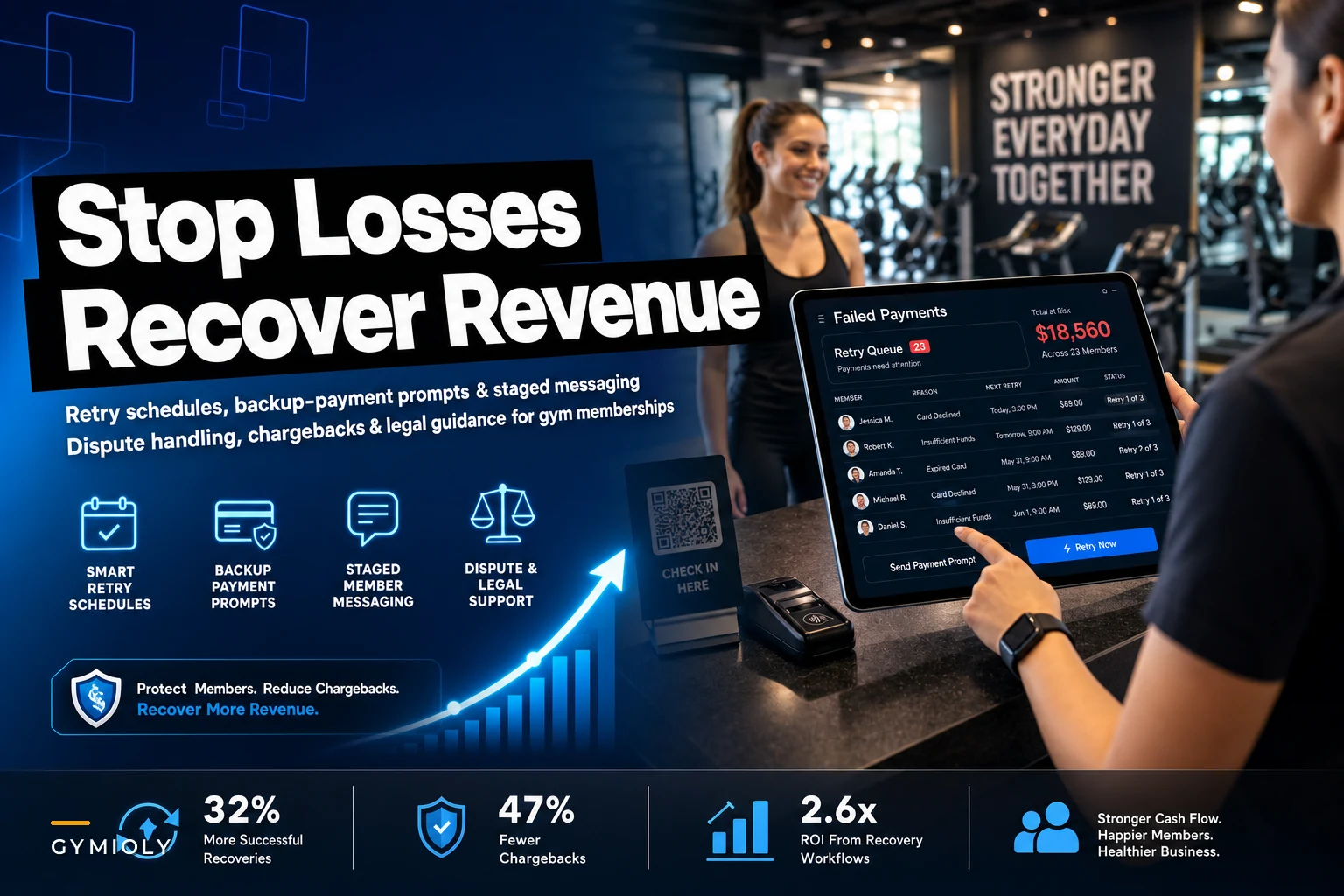

Failed payments are bleeding gyms dry. Not dramatically — it's a slow leak that compounds month after month until you pull billing reports one afternoon and realize you're down $40,000 in annual revenue from members who actually wanted to stay.
Most gym owners only discover the problem during a cash crunch. They expect to find cancellations. Instead, they find something worse — active members whose payments have been failing for months with zero follow-up from anyone on the team.
And the damage goes beyond the missing revenue. Members whose payments fail often start ghosting entirely, avoiding the gym out of embarrassment. Staff burn hours on awkward collection calls. The members you do recover frequently cancel anyway because the whole experience left them feeling harassed.
Why gym payment failures hit differently than other businesses
Gym memberships create a genuinely strange payment failure dynamic. Unlike a streaming service where a declined card means immediate lockout, gyms operate on trust. Members keep showing up, using equipment, attending classes — all while their payment sits in failed status for weeks.
This creates an operational mess. You can't just cut off access without creating a confrontation at the front desk. Members get defensive when approached about money in public. Staff feel awkward having those conversations. And the longer you let it sit, the harder recovery gets.
The psychology shifts around the 10-day mark. Members who would've updated their card immediately on day one start rationalizing by day ten. "I barely used the gym this month anyway." By day 30, they've mentally written off the debt, and any recovery attempt feels like an attack rather than a reminder.
Traditional collection approaches make it worse. Aggressive dunning emails, repeated calls, threatening termination — these might recover some revenue but almost guarantee the member churns. You need a recovery system that preserves the relationship while actually getting you paid.
The 21-day recovery framework that actually works
PAYMENT FAILURE RECOVERY WORKFLOW
End appointment chaos and boost attendance.
Gymioly streamlines booking, confirms sessions, and manages memberships effortlessly.
- Unified class and membership management
- Automated member notifications
- Trainer scheduling and availability
No credit card required
[Payment Fails] | v [Day 1-3: Gentle Nudge]
-
4-hour first contact
-
Assume technical error
-
Low-friction update link
Resolved? --YES--> [Done] |NO v [Day 4-7: Problem-Solving]
-
Expand channels (SMS + Email)
-
Acknowledge issue without judgment
-
Flag for front desk
Resolved? --YES--> [Done] |NO v [Day 8-14: Backup Payment]
-
Try secondary payment method
-
Retry at different times/days
-
Payroll-cycle timing
Resolved? --YES--> [Done] |NO v [Day 15-21: Preservation Phase]
-
Offer 3 options
update / pay now / freeze
-
Relationship-first messaging
-
Hard deadline set
Resolved? --YES--> [Done] |NO v [Escalate: Freeze or Escalation Protocol]
Days 1-3: The gentle nudge phase
The first 72 hours decide whether you recover the payment cleanly or enter full collection mode. Immediate contact matters here, but it has to be non-threatening.
Send the first notification within 4 hours of failure. Not end of day, not tomorrow — within 4 hours. Members are most likely to update payment info when they still remember the transaction that triggered the decline. Every hour you wait, recovery rates drop.
Your day one message should assume technical error, not financial trouble: "Hey [Name], looks like your payment didn't process this morning — probably just a card glitch or expiration. Here's a quick link to update your info: [LINK]. Takes 30 seconds and keeps your membership active without interruption."
Avoid words like "failed," "declined," "insufficient funds," or "past due." These trigger defensive responses immediately. Keep the tone helpful.
Day two shifts slightly: "Quick heads up — your payment still hasn't gone through. Sometimes banks flag recurring charges as suspicious. You might want to check if your bank blocked it. Update your card here: [LINK] or reply if you need help."
Day three adds a little urgency: "Final reminder before the weekend — your membership payment needs attention. Update your payment method here: [LINK] to avoid any interruption to your access next week."
Days 4-7: The problem-solving phase
Members who haven't responded by day four need a different approach. They're either ignoring you, genuinely embarrassed about funds, or haven't seen the messages yet.
This is the point where you expand channels. SMS if you've only used email. Email if you've only texted. But don't bombard — one message per channel during this window.
The messaging shifts toward acknowledging that something might actually be wrong, without judgment: "Hey [Name], wanted to check if everything's okay with your membership. If your card expired or you need to push your payment date back a few days, just let us know. We can work with you — reply to this message or call us at [PHONE]."
This phase should also trigger an internal flag for staff. Not a stop-access alert — just a prompt so the next time this member checks in, front desk can casually mention the payment update.
Days 8-14: The backup payment phase
Week two is a turning point. Members actively avoiding payment have usually made that decision by now. But plenty of people are still just procrastinating.
This is where backup payment methods do the heavy lifting. Gyms that collect a secondary payment method at signup recover roughly 40% more failed payments than those relying on a single card.
Day 8 message: "Hi [Name], since your primary card hasn't worked, would you like us to try your backup payment method? Reply YES to process on your [CARD TYPE ending in XXXX] or click here to add a different card: [LINK]"
During this window, try different retry times too. If the original failure was Monday morning, retry Wednesday evening or Friday afternoon. A lot of payment failures are temporary balance issues that clear up around payday.
Days 15-21: The preservation phase
Week three is about keeping the member, not just recovering the money. Most gyms make the mistake of threatening termination here. The gyms with the best retention do the opposite — they offer options.
"[Name], we want to keep you as a member. Since your regular payment hasn't worked, here are three options:"
-
Update your payment method
[LINK]
-
Pay for just this month to stay active
[LINK]
-
Temporarily freeze your membership until you're ready
[LINK]
"Please choose one by [DATE] to maintain your member benefits and rate."
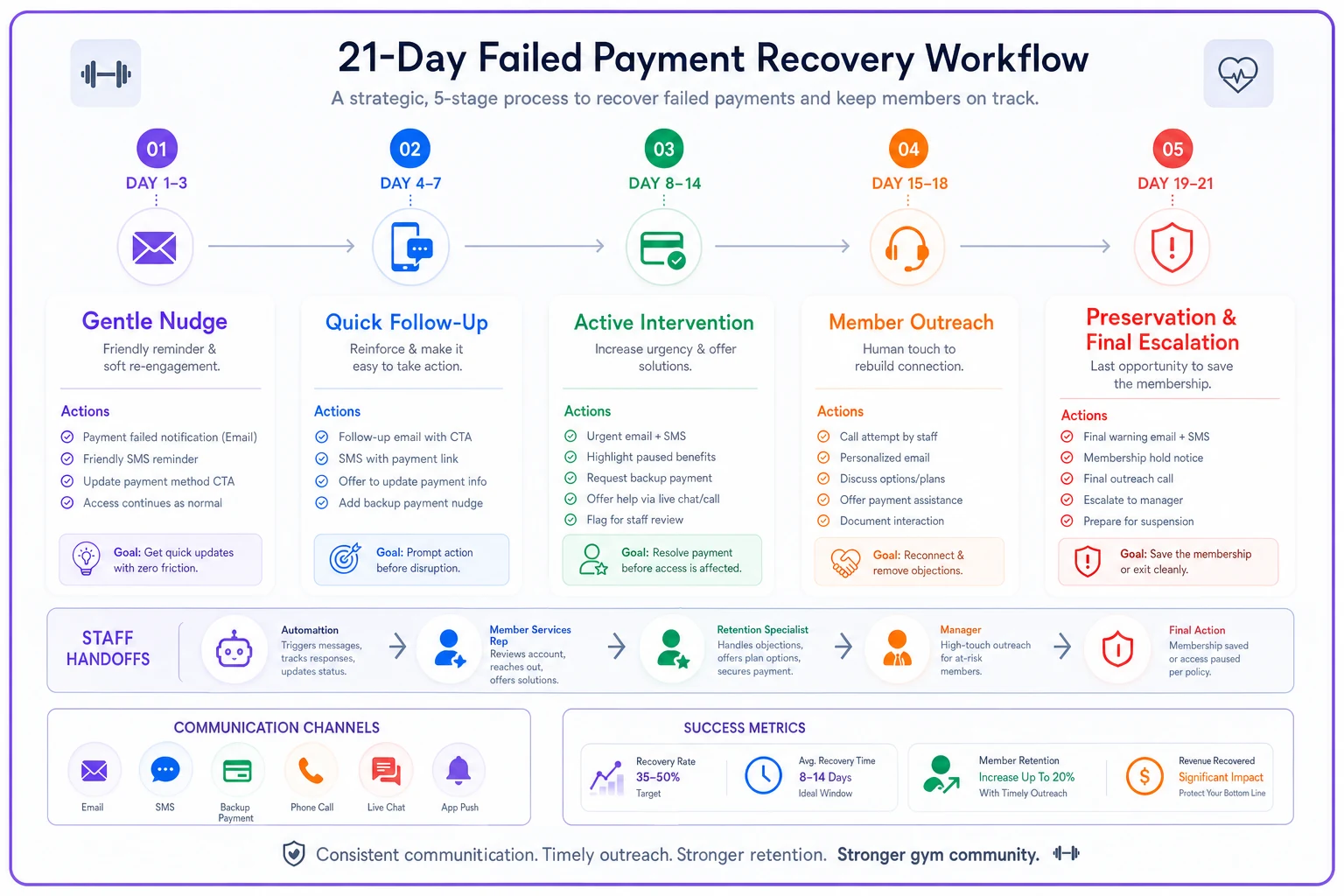
Visualize the staged escalation and handoffs.
Message templates that preserve relationships
The specific words you use matter more than most gym owners realize. Small phrasing choices dramatically shift recovery rates.
What kills recovery rates:
-
"Your payment has been DECLINED"
-
"PAST DUE NOTICE"
-
"Your account is DELINQUENT"
-
"FINAL NOTICE before termination"
-
"We will be forced to send this to collections"
What actually improves recovery rates:
-
"Looks like your payment didn't go through"
-
"Quick payment update needed"
-
"Your membership needs attention"
-
"Help us keep your membership active"
-
"Let's find a solution that works"
Three principles hold across the best recovery messages.
Assume positive intent. Frame failures as technical issues or honest mistakes. Members respond completely differently when they don't feel accused of something.
Offer solutions, not ultimatums. Every message should give them multiple ways to resolve it — update payment, delay billing, freeze membership, or just talk to someone.
Connect back to their reason for joining. "Don't let a payment hiccup interrupt your fitness momentum" lands better than "PAY NOW or lose access."
Retry scheduling that maximizes recovery
Random retry attempts waste opportunities. Strategic scheduling accounts for bank behavior, payroll cycles, and how member balances actually move throughout the month.
The optimal retry schedule:
| Retry Attempt | Timing | Reason |
|---|---|---|
| Initial | Original billing date | Standard attempt |
| Retry 1 | +2 days, different time | Clears temporary NSF |
| Retry 2 | +5 days, evening | Catches direct deposits |
| Retry 3 | +8 days, early morning | Different processing window |
| Retry 4 | +15 days, original time | Bi-weekly payroll cycle |
| Retry 5 | +20 days, afternoon | Final attempt before escalation |
Never retry at the exact same time of day. Banks process payments differently throughout the day, and balances fluctuate. A morning attempt that fails might succeed in the evening.
Skip Mondays and Fridays when possible. Monday processing backs up from weekend transactions. Friday attempts often fail because spending has already happened against available funds.
The sweet spots tend to be Tuesday around 6pm, Wednesday early morning, Thursday mid-afternoon — highest available balances and fastest processing windows.
Chargeback prevention and response protocols
Chargebacks cost more than the lost revenue alone. Each dispute runs $25-100 in fees, damages your merchant account standing, and can push your processing rates up permanently.
Prevention starts at signup. Get explicit acknowledgments that protect you later:
-
Member explicitly agrees to recurring billing
-
Member acknowledges cancellation policy
-
Member confirms the business name appearing on their statement
-
Member receives immediate email confirmation with all terms
Your billing descriptor matters more than most gyms think. "FIT-4765829" generates far more chargebacks than "POWERHOUSE GYM MONTHLY." Include your phone number in the descriptor if your processor allows it.
When chargebacks hit anyway, speed is everything. You have 7-10 days to respond with evidence. Waiting until day nine usually means losing.
Winning chargeback evidence includes:
-
Signed membership agreement
-
Check-in records showing facility usage
-
Screenshots of member portal access
-
Communication history showing they knew about charges
-
Cancellation policy they agreed to
-
Proof of services rendered during disputed period
Build a response template your team can customize quickly. Every hour counts when fighting a dispute.
Legal boundaries and compliance requirements
Payment recovery walks a real legal tightrope. Aggressive collection tactics expose gyms to lawsuits, regulatory fines, and reputational damage that costs far more than whatever revenue you recovered.
The Fair Debt Collection Practices Act (FDCPA) might not apply directly to gyms collecting their own debts, but violating its spirit creates liability. Never threaten legal action you won't actually take. Never contact members at unreasonable hours. Never discuss debts with third parties.
State-specific gym regulations add another layer. Some states require specific cancellation procedures. Others limit auto-renewal terms. California's auto-renewal laws, for instance, require clear disclosure and easy cancellation — violating those turns payment recovery into a legal problem fast.
Every recovery message should include:
-
Clear identification of your business
-
The amount owed
-
How to dispute the debt
-
Ways to resolve the issue
Document everything. Log calls, save emails, screenshot texts. When a member claims harassment or improper billing, documentation is what protects you.
Think carefully before sending accounts to collections or reporting to credit bureaus. It might recover something, but it guarantees you'll never see that member again — plus whatever damage their negative reviews do to future sales.
Building the operational system that scales
Manual payment recovery destroys profitability at scale. Staff spending two hours a day on payment calls, tracking retry attempts in a spreadsheet, copying and pasting templates — that approach falls apart as soon as your membership grows past a few hundred people.
Gyms that handle this well treat payment recovery as a system, not reactive firefighting. They build workflows that trigger automatically, escalate at the right times, and preserve member relationships without constant staff involvement.
Start with clear ownership. Someone has to own payment recovery as a real responsibility — not an add-on task. That person monitors daily failure reports, adjusts messaging based on what's actually working, and makes sure the process runs consistently even when things get busy.
-
Recovery rate by day (what percentage recover by day 3, 7, 14, 21)
-
Recovery rate by channel (SMS vs email vs phone)
-
Chargeback rate
-
Member retention after recovery
-
Staff time invested per recovered payment
Most gyms that run this analysis discover their manual process costs more in staff time than the revenue it recovers. That calculation flips completely with proper automation.
AI-powered operational software built for gym management handles the entire recovery workflow automatically — properly timed messages, strategic retries, routing exceptions to staff, and maintaining the documentation trail you need for legal protection. The better platforms also learn from your recovery patterns over time, identifying which message variations perform for different member segments and optimizing retry timing based on actual results.
Assign a single owner for payment recovery so messaging and timing stay consistent.
The more practical benefit is what it frees your staff to do. Instead of making uncomfortable payment calls, they're focused on member experience. The system handles the awkward money conversations while your team maintains the relationships that drive long-term retention.
The real cost of ignoring payment recovery
Payment failures look like small individual problems until you calculate the compound effect. A typical 500-member gym sees somewhere between 8-12% monthly payment failures. At $50 average membership, that's potentially $2,500 in failed payments every month.
Without a proper recovery system, gyms typically recover just 30-40% of those failures. That leaves around $1,500 monthly — close to $18,000 annually — in lost revenue from members who actually wanted to keep their memberships.
The hidden costs stack up fast:
-
Staff spending 40+ hours monthly on payment recovery
-
Members who cancel after a bad recovery experience
-
Negative reviews from aggressive collection attempts
-
Merchant account problems from elevated chargeback rates
-
Legal exposure from improper collection practices
But the opportunity cost might actually be the biggest one. Every hour your staff spends chasing payments is an hour not spent on retention, new member sales, or the kind of experience that keeps people coming back. Gyms that get payment recovery off their team's plate consistently refocus that energy on things that actually grow the business.
Moving from reactive to proactive payment management
The gyms doing well despite payment failures aren't just recovering better — they're preventing more failures upfront. They've built systems that catch problems before they become collection issues.
That means proper monitoring, clear escalation paths, and tools that handle the heavy lifting without requiring staff time at every step. When payment recovery becomes a background system instead of daily firefighting, gyms find they can recover more revenue with less effort and actually improve member relationships in the process.
The choice is pretty straightforward: keep losing thousands monthly to payment failures, or build the system that stops the leak. The gyms choosing the system are the ones expanding right now while others are scrambling to hold onto what they have.
Your members joined because they want to change something about their health. Don't let a payment processing failure end that — or cut into the revenue your gym needs to grow.
Ready to elevate your gym operations?
Join 2,000+ gyms using Gymioly to reduce admin overhead, improve member experience, and grow revenue.