


Your gym's lapsed member list holds more revenue potential than your next marketing campaign. Most gyms blast the same "come back for 30% off" email to everyone who quit, whether they left after two weeks or two years. That approach recovers maybe 2-3% of lost members at best, and those who do return often churn again within 60 days.
Gyms actually recovering 15-20% of lapsed members without discounts segment their approach based on why members left and how valuable they were. A re-engagement sequence built around churn patterns and member lifetime value consistently outperforms generic win-back campaigns by 4-5x while keeping pricing intact.
Breaking down your lapsed member segments reveals completely different reactivation opportunities
Pull your membership data from the last 24 months and you'll typically find five distinct lapsed member profiles, each requiring different messaging and timing.
Early churners (0-3 months) represent about 35% of your lapsed base. These members never fully engaged. They signed up during a promotion, came a few times, then disappeared. Average lifetime value sits somewhere around $180-240. Many never attended more than three sessions.
Seasonal dropouts (4-8 months) make up roughly 25% of lapsed members. They joined with specific goals—summer body, wedding prep, post-holiday fitness push—then quit once they achieved them or lost steam. Their LTV typically ranges from $400-800. These members understood your value but lacked long-term commitment.
Established members who left (9+ months) are your goldmine segment, usually around 20% of lapsed members but representing closer to 40% of potential recovered revenue. With LTVs between $1,200-3,000, they knew your gym well, had routines, probably knew staff by name. Something specific drove them away—relocation, injury, financial change, or a service issue that went unaddressed.
Price-sensitive churners cut across all tenure lengths, making up about 15% of lapsed members. They explicitly mentioned cost during cancellation or stopped paying after a rate increase. Reactivating them requires creative value positioning, not discounts.
Life-event departures represent the remaining 5%—pregnancies, injuries, job changes. These members often said they wanted to return "someday" during cancellation. They're usually the easiest to reactivate when timing lines up.
The mistake most gyms make is treating all of these groups identically. A member who quit after two weeks needs completely different messaging than someone who trained with you for two years before leaving.
Timing your reactivation attempts based on churn patterns drives 3x better response rates
The optimal reactivation window varies a lot by segment. Early churners respond best to immediate outreach—within 7-14 days of their last visit. Wait longer and they've already mentally moved on or joined a competitor. Frame it as helping them get back on track, not as a win-back campaign.
End appointment chaos and boost attendance.
Gymioly streamlines booking, confirms sessions, and manages memberships effortlessly.
- Unified class and membership management
- Automated member notifications
- Trainer scheduling and availability
No credit card required
Seasonal dropouts require patience. Mark their original join date and goal timeline, then reach out 2-3 weeks before the next similar cycle. Someone who joined last January for a New Year's push should hear from you in early December, not randomly in July. The message focuses on preparing for their next goal cycle, not dwelling on why they left.
Established members need a cooling-off period. Wait 60-90 days after cancellation before your first reactivation attempt. They made a deliberate decision to leave; immediate outreach feels pushy and a bit desperate. When you do reach out, acknowledge the time gap and focus on what's new or different since they left.
Price-sensitive churners respond best around renewal periods for current members. When you're running member appreciation events or rolling out new included services, that's the right moment to reconnect with price-conscious former members. Show them expanded value, not a discount.
Non-discount reactivation offers that actually work better than price cuts
The most effective reactivation offers add value without cutting price. A "returning member fast-track package" works well for early churners—three personal training sessions, a nutrition consultation, and priority booking for their first month back. The perceived value exceeds $300, but your actual cost stays well under $50 in trainer time.
For seasonal members, create goal-specific return packages. A "Summer Ready Restart" might include a customized 8-week program, weekly check-ins, and access to your nutrition tracking app. You're selling the outcome, not discounting the membership.
Established members respond to "welcome back perks" that acknowledge their history. Restore their previous membership rate if you've raised prices, waive rejoin fees, and give them a "returning member" status that includes booking privileges or locker priority. These cost nothing but feel meaningful.
| Segment | Traditional Discount | Value-Add Offer | Response Rate | Re-Churn Rate (90 days) |
|---|---|---|---|---|
| Early Churners | 20% off first month | Fast-track package | 8% vs 14% | 45% vs 22% |
| Seasonal | 2 months for price of 1 | Goal program access | 11% vs 19% | 38% vs 18% |
| Established | No joining fee | Previous rate + perks | 6% vs 17% | 28% vs 12% |
| Price-Sensitive | 15% ongoing discount | Loyalty rewards program | 9% vs 11% | 52% vs 31% |
Members who return through value-based offers stick around significantly longer than those chasing a deal. They're buying back into your value proposition, not just taking advantage of a promotion.
Building decision trees that prevent reactivation fatigue while maximizing recovery
Not every lapsed member deserves the same effort. Build decision rules based on LTV and engagement history to use your team's time well and protect your brand.
For high-LTV members (over $1,500 lifetime spend), run a five-touch sequence over six months:
-
Personal email from their previous trainer or a manager they knew
-
Phone call at 30 days
-
"What's new" update at 60 days
-
Event invitation at 90 days
-
Final message with a compelling offer at 180 days
Medium-LTV members ($500-1,500) get a three-touch sequence: personal email at 30 days post-churn, value-based offer at 90 days, final attempt at 180 days. These can be partially automated but should still feel personalized based on their history.
Low-LTV members (under $500) receive an automated two-touch sequence—unless they showed strong engagement despite short tenure. If someone attended 20+ times in their only month of membership, treat them like a medium-LTV member regardless of what they spent.
The critical decision rule most gyms miss: stop reactivation attempts after members explicitly opt out or after six months of non-response. Chasing uninterested former members wastes resources and can genuinely damage your reputation with people who are still connected to your community.
The hidden psychology of why members really come back
Members rarely return for the reason you'd expect. Successful reactivations show that life circumstances matter more than offer quality. The member who left due to work stress doesn't come back because you offered free personal training—they return when work settles down and your message gives them an easy excuse to restart.
That insight should shape how you position every message. Instead of "come back and save," try "ready to restart your fitness routine?" Instead of listing everything they're missing, acknowledge that timing matters: "When you're ready to get back into your routine, here's how we can help."
Successful reactivation messages share three things: they acknowledge the member's history without dwelling on their departure, present a clear and simple path to return without overwhelming choices, and create urgency through limited-time value adds rather than fake scarcity.
Social proof helps when used thoughtfully. Sharing stories of members who successfully returned after a break—especially those who hit new goals—resonates more than generic testimonials. A simple "Sarah came back after six months off and just hit her first pull-up" speaks directly to what lapsed members are quietly worried about: starting over.
Operational workflows that scale reactivation without overwhelming staff
Running effective reactivation sequences requires systematic tracking that most gym management systems handle poorly. You need last visit date (not just cancellation date), cancellation reason, lifetime value, peak usage patterns, and class preferences to segment properly.
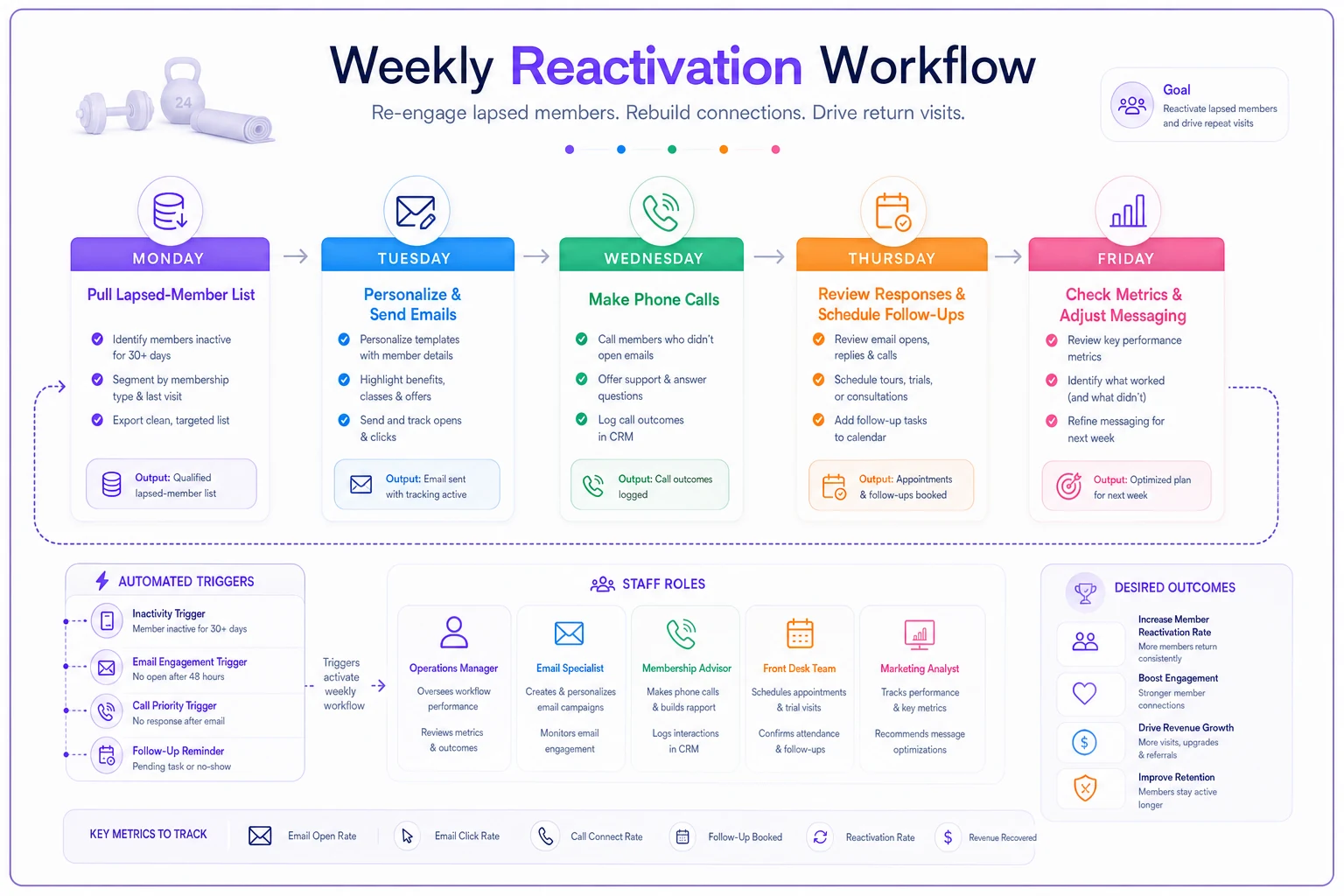
Build a weekly reactivation workflow that takes under two hours. Every Monday, pull the list of members hitting their reactivation window. Tuesday, personalize and send emails to high-value targets. Wednesday, make phone calls to the highest-priority names. Thursday, review responses and schedule follow-ups. Friday, check the week's metrics and adjust messaging.
Have a human review high-value member communications before anything goes out.
Here's a simple visual of the weekly workflow and who owns each step.
Automation handles the heavy lifting. Set up triggered emails based on churn date and segment. Use merge fields to pull in favorite classes, previous trainers, or achievement milestones. But have a human review high-value member communications before anything goes out.
Create reactivation templates for each segment, then train staff to personalize them. A template might read: "[Member name], I noticed you used to attend [favorite class] regularly with [instructor name]. They're launching a new [related program] next month that builds on what you were working on." The bracketed sections get filled with real member data—it takes 30 seconds and reads nothing like a mass email.
Common reactivation mistakes that push lapsed members to competitors
The fastest way to permanently lose a lapsed member is making the return process confusing. If rejoining requires a visit during business hours, new paperwork, or navigating three different staff members, that friction kills conversions. Build a one-click reactivation flow that lets members restart their membership entirely online.
Making members feel guilty about leaving is another quick way to close the door. Phrases like "we noticed you haven't been in" or "you're missing your fitness goals" trigger defensiveness. Former members already feel some guilt about quitting—adding more just reinforces why they haven't come back.
Timing mistakes often hurt more than bad messaging. Reaching out to injured members before they're physically ready wastes the opportunity and can feel tone-deaf. Waiting too long after someone's situation improves—like a new job with better hours—means they've already joined somewhere else.
The worst mistake: offering returning members worse terms than new members. If you're advertising "first month free" for new joins while offering lapsed members "20% off their first month back," you're essentially telling loyal former customers they matter less than strangers. Returning members should always get equal or better offers than someone walking in off the street.
Measuring reactivation success beyond simple return rates
Track three metrics for each campaign: return rate, 90-day retention rate, and recovered LTV percentage. A 15% return rate sounds good until you see that 60% churn again within 90 days and most of them were low-value members. The headline number hides what's actually happening.
Segment performance tells you where to focus. If established members show a 20% return rate with 80% retention while early churners show 10% return with 30% retention, you know where to invest more effort. Calculate cost per successful reactivation—including staff time—to make sure you're generating real ROI and not just activity.
Watch for patterns that predict success. Members who responded to previous outreach but didn't rejoin are roughly 3x more likely to return on the next attempt. Members who froze before canceling show higher reactivation rates than those who quit immediately. Members who participated in challenges or events come back at about 40% higher rates when invited to similar programs.
Setting up tracking systems that capture the right reactivation intelligence
Most gym software tracks membership status but misses the behavioral data that drives good reactivation. You need last workout type, instructor relationships, achievement milestones, social connections, and peak attendance patterns to write messages that actually land.
Build a simple lapsed member dashboard that updates weekly. Track members hitting each reactivation window, response rates by segment, returns by offer type, and re-churn rates at 30, 60, and 90 days. Without this visibility, you're running campaigns blind for months before realizing the messaging isn't working.
The intelligence that matters most comes from exit interviews. When members cancel, ask three questions: what's driving the decision, what would need to change for them to return, and when might their situation allow them to come back. Store those answers with their member record.
AI-powered operational software can systematically track these patterns and automatically trigger the right reactivation sequences at optimal times. Instead of manually managing spreadsheets and calendar reminders, the system identifies when members enter each reactivation window and generates personalized outreach based on their history and segment. That kind of automation ensures high-value opportunities don't slip through the cracks while freeing staff to handle the personal touches that actually convert your most valuable former members.
The compound effect of systematic reactivation on gym economics
A properly executed reactivation system generates more profit than most customer acquisition channels. Acquiring a new member typically costs $50-150 in marketing spend plus staff time. Reactivating a lapsed member costs $10-30 in staff time and system resources. The reactivated member already knows your facility, needs less onboarding, and tends to show 20-30% higher LTV in their second stint.
Over 12 months, a gym with 1,000 lapsed members that reactivates just 10% at full price adds $50,000-80,000 in recovered revenue. These members also frequently become advocates, bringing friends along when they return. A single reactivated member pulling in two or three new members multiplies the revenue impact well beyond the initial win-back.
The institutional knowledge you build through systematic reactivation also feeds back into retention. When you understand why members leave and what brings them back, you can adjust your active member experience before problems compound. The patterns from reactivation analysis regularly surface operational issues affecting your entire membership base—things that wouldn't show up until you started asking the right questions.
A disciplined gym re-engagement sequence becomes a predictable revenue stream rather than a sporadic win-back scramble. You know that every month, a certain percentage of lapsed members will hit their reactivation window, a predictable percentage will return, and those returns generate quantifiable revenue. That predictability lets you plan investments, staff appropriately, and maintain pricing discipline instead of discounting out of desperation.
Gyms that treat reactivation as a systematic process build stronger businesses over time. They maintain relationships with former members, recover real revenue, and learn continuously from both what works and what doesn't.
More importantly, they communicate something to members—active, lapsed, or somewhere in between—that a discount campaign never could: that this gym is a long-term fitness home, not just a transaction.
Gyms that treat reactivation as a systematic process build stronger businesses over time. They maintain relationships with former members, recover real revenue, and learn continuously from both what works and what doesn't.
More importantly, they communicate something to members—active, lapsed, or somewhere in between—that a discount campaign never could: that this gym is a long-term fitness home, not just a transaction.
Ready to elevate your gym operations?
Join 2,000+ gyms using Gymioly to reduce admin overhead, improve member experience, and grow revenue.