

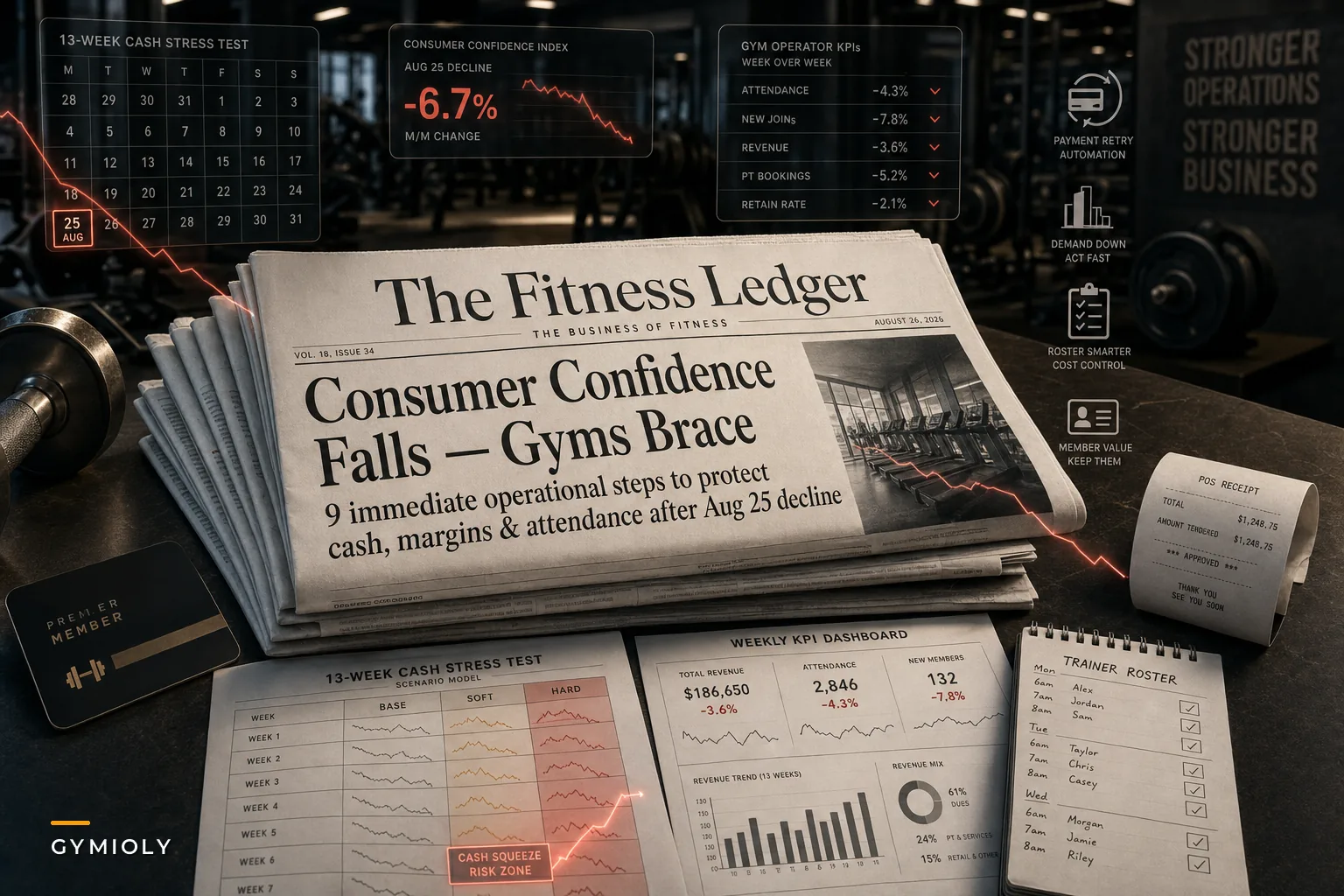

The Conference Board's August read landed at 89.4, the lowest in seven months. The detail that actually matters for gyms isn't the headline number — it's what softened. As Reuters reported, households got more pessimistic about the labor market and about where inflation is headed. That combination — worry about income plus worry about prices — is exactly the psychological setup that makes people quietly cancel a gym membership before they cancel almost anything else.
Fitness is one of the first discretionary line items people cut when they feel financially uncertain, even when they don't actually stop working out. They just decide they'll "do it at home for a while." So a confidence dip like this rarely hits as a dramatic cliff. It shows up as a slow bleed — a few more freezes than usual, trial conversions dropping a point or two, retail going flat, failed payments creeping up because members are juggling which cards to keep active.
The gyms that get hurt aren't the ones facing the slowdown. Every gym faces it. The ones that get hurt are the ones who react in November when the damage is already three months deep.
First, understand the specific shape of the risk
Before touching any levers, it's worth being precise about how this kind of demand shock behaves in a gym — because it's different from a seasonal dip or a price-driven churn wave.
A confidence-driven slowdown hits on three fronts simultaneously:
-
Acquisition softens quietly. Fewer walk-ins, lower ad response, trials that convert slower because prospects "want to think about it." Nothing breaks — it just gets sluggish.
-
The base gets fragile. Existing members don't leave in a panic. They freeze, downgrade, or start missing payments. The sneaky part is that freezes and downgrades don't show up as churn in most dashboards until they roll off.
-
Ancillary revenue dries up first. Personal training packages, retail, supplements, day passes — the highest-margin stuff is usually the first thing someone cuts when they tighten up.
The Conference Board tracks this sentiment shift because their consumer confidence index is a leading indicator, not a lagging one. You're seeing the warning before it becomes revenue. That's the opportunity.
The deeper problem this exposes
Most single-site and small multi-site gyms run on trailing visibility. You find out about a problem when the month closes and the numbers are already bad. Payroll went out, CAPEX orders shipped, marketing ran on autopilot — and then the deposit comes in light and you're scrambling.
End appointment chaos and boost attendance.
Gymioly streamlines booking, confirms sessions, and manages memberships effortlessly.
- Unified class and membership management
- Automated member notifications
- Trainer scheduling and availability
No credit card required
A confidence drop doesn't create this problem. It exposes it. If your operation can't answer "what happens to cash if new joins drop 15% and freezes rise for the next 90 days?" in about ten minutes, that's the real vulnerability. The sentiment shift just makes it matter this quarter instead of next year.
This is why the most valuable move right now isn't a promotion or a retention email. It's running a proper cash stress test — which is what a rolling 13-week cash model is built for. If you already have one, re-run it with pessimistic assumptions. If you don't, that's step one.
The 9 immediate steps
1. Run a pessimistic cash stress test this week — not a forecast, a stress test
There's a real difference. A forecast asks "what do we expect?" A stress test asks "what breaks if things go sideways?" Right now you want the second one.
Model three scenarios over the next 13 weeks:
| Scenario | New joins | Freezes/downgrades | Failed payments | Retail/PT |
|---|---|---|---|---|
| Base | Flat | Normal | Normal | Flat |
| Soft | –12% | +30% | +15% | –10% |
| Hard | –20% | +50% | +25% | –20% |
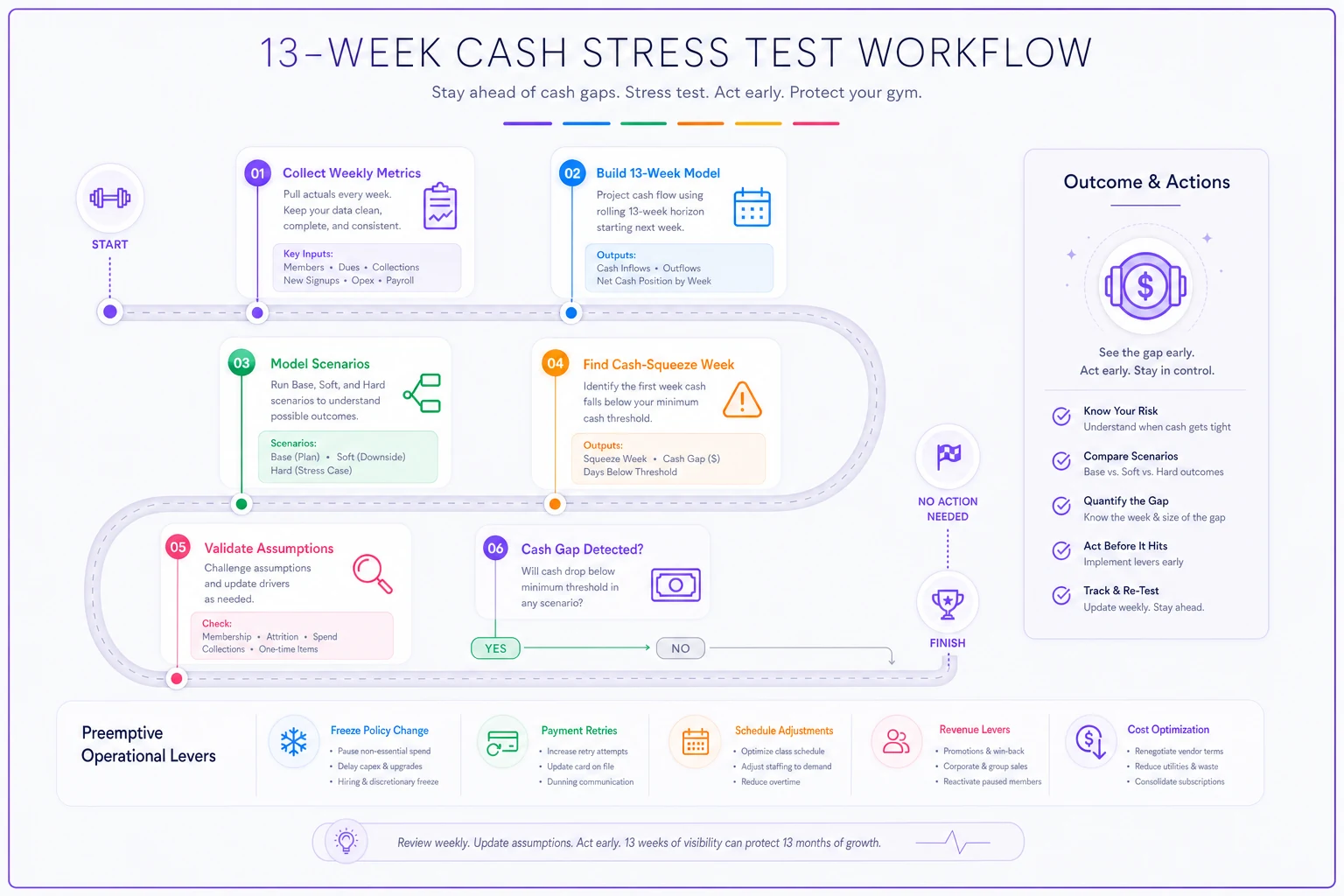
The point isn't precision. It's to find the week where cash gets tight in the "Hard" column, then work backward to figure out which levers you'd pull before you get there. If the model shows a squeeze in week 9, you want those decisions made in week 2, not improvised in week 8.
If you already have a rolling 13-week cash model, re-run it with a pessimistic set of assumptions this week.
Most owners skip this because it feels like busywork when nothing's obviously wrong yet. That's exactly why it works — you do it while you still have options.
2. Freeze the freeze leak
Freezes are the quietest revenue killer in a downturn because they feel member-friendly. And they should stay available — pulling freezes entirely during a confidence dip is a fast way to convert pauses into cancellations. But most gyms run freezes with no structure, which turns a 30-day pause into a 90-day one with no accountability.
-
Cap freeze length (30 days, renewable once with a stated reason).
-
Charge a small monthly hold fee — even $5–$10 keeps the relationship "active" psychologically and covers your fixed cost per member.
-
Set an automatic reactivation date instead of open-ended freezes.
-
Trigger a check-in message two days before reactivation so it doesn't come as a surprise charge. Surprise charges become chargebacks, chargebacks become churn.
A gym running 40-something freezes a month with no hold fee is leaving real money on the table across a fall quarter. The fix is mostly policy wording plus making sure the system enforces reactivation dates rather than relying on staff to remember.
3. Get ahead of failed payments before the declines pile up
When people feel financially pinched, they play card roulette — moving balances, letting cards expire, prioritizing which subscriptions actually clear. Gym dues are right in the crosshairs.
The mistake is treating a failed payment as a billing event instead of a retention event. A declined card is a member who's still here and hasn't decided to leave — that's a save, not a collections situation.
Set up retry logic that respects paydays (retry on the 1st, 3rd, and 15th rather than three days straight), and pair the retry with a warm, non-threatening message. Tone matters enormously here. "Hey, looks like your card didn't go through — happens all the time, here's a quick link to update it" recovers far more than a cold dunning notice.
4. Re-cut the schedule to actual demand, not habit
Labor is your biggest controllable cost, and most gyms overstaff out of routine. During a slowdown, floor traffic thins at predictable hours first — mid-morning and mid-afternoon usually.
Pull the last four weeks of check-in data by hour and overlay it on your current schedule. You'll almost always find shifts staffed for a traffic level that no longer exists. The goal isn't to gut coverage — it's to match your skill mix to actual demand so you're not paying two trainers to stand around during a dead 2pm window.
Small multi-site operators have an extra lever here: cross-schedule so one strong opener or closer covers the thin shift at a nearby location instead of running two half-empty rosters.
5. Reprioritize CAPEX into "must" vs "can wait"
That new turf install or second squat rack can probably wait a quarter. This isn't about slashing everything — deferring maintenance that affects member experience is a false economy. It's about separating spending that retains members from spending that merely expands.
-
Keep anything tied to safety, downtime risk, or a visible daily member touchpoint.
-
Delay capacity expansion, aesthetic upgrades, nice-to-have equipment.
-
Kill for now anything justified by growth assumptions you just wrote down as uncertain in step 1.
6. Shift messaging from acquisition to retention — but don't discount reflexively
The instinct in a slowdown is to blast a discount. Resist it. Discounting during a confidence dip trains your best-paying members to wait for the next deal and compresses margin exactly when you can least afford it.
Retention-focused communication beats price-cutting almost every time. The members most likely to leave in a downturn aren't leaving over $10 — they're leaving because they've drifted, stopped showing up, and the membership now feels like a bill instead of a habit. Reach those people with value and re-engagement, not the whole list with a coupon.
-
Members whose attendance dropped in the last 3–4 weeks (they're pre-churn).
-
People who joined 30–60 days ago and haven't hit the habit yet.
-
Lapsed personal training clients — a check-in beats a fire sale.
7. Protect ancillary revenue with bundling, not price drops
High-margin add-ons get cut first, so the move is to make them feel like part of the core value rather than an extra spend. Bundle a couple of PT sessions into an existing tier for the quarter, or build small value packs that raise perceived value without training people to expect discounts.
A member who'd never buy a standalone $75 session might happily use two sessions that come "included" for the quarter — and a decent chunk of those people convert to paying clients once they've experienced the value. That's retention and ancillary revenue defended in one move.
8. Tighten the trial-to-member conversion window
When prospects are hesitant, a loose trial process loses them. In good times you can afford sloppy follow-up. In a hesitant market, the trial that doesn't get a same-day and next-day touch just evaporates.
Shorten the decision window deliberately. A structured trial with clear check-ins on day 1, day 3, and day 6 converts noticeably better than an open-ended "come whenever" pass — because it removes the ambiguity that a nervous buyer uses as an excuse to delay indefinitely.
9. Set weekly (not monthly) review cadence for the next quarter
Monthly reviews are fine when the environment is stable. In a shifting one, a month is too long to notice a trend and still have room to react. For the fall, move your key numbers to a weekly check:
-
Net member movement (joins minus cancels minus new freezes).
-
Failed-payment recovery rate.
-
Trial conversion rate.
-
Ancillary revenue vs the prior four-week average.
-
Cash position against the week 9 and week 13 markers from your stress test.
Five numbers, fifteen minutes, every Monday. That cadence is what turns "we noticed in November" into "we adjusted in September."
When aggressive cost-cutting is actually a mistake
Not every gym should hunker down. If you're sitting on strong reserves and your local competitors are the ones panicking and slashing prices, a confidence dip can be a market-share opportunity. Some of the best local operators grow during slowdowns because they hold steady on quality while weaker gyms cut staff, let cleanliness slip, and defer maintenance — and members notice.
The decision framework:
-
Play defense (all nine steps, hard) if your cash cushion is thin or you're already running tight margins.
-
Play selective offense (steps 1, 3, 6, 9 plus targeted acquisition) if you have reserves and can absorb a soft quarter to pick up members fleeing worse gyms.
-
Don't gut member experience to save cash if you have any runway at all.
That's how a temporary sentiment dip becomes permanent churn.
A realistic scenario
Take a single-location gym doing roughly $80k–$85k a month, around 620 members, with maybe $6k–$7k of that in PT and retail. Going into a soft fall, they ran the stress test in early September and saw the "Soft" scenario put them in a real cash squeeze around week 10.
Instead of waiting, they did four things: added a $7 monthly freeze hold fee with enforced reactivation dates, moved failed-payment retries onto a payday schedule with a friendly message, trimmed roughly six weekly staff-hours of dead mid-afternoon coverage, and deferred a planned equipment purchase into the following quarter.
None of it was dramatic. But by the time the actual slowdown arrived, freezes were converting back to active memberships at a much higher rate, failed-payment recovery improved meaningfully, and the week-10 cash squeeze the model warned about never materialized. The slowdown still happened — they just weren't caught by it.
The confidence numbers gave them warning. The stress test gave them a target. The operational moves gave them time.
The takeaway
A dip in consumer confidence is a demand signal, not a verdict. The gyms that struggle this fall won't be the ones with a slower market — everyone has that. They'll be the ones who found out too late because their visibility was trailing instead of leading.
Run the stress test, tighten the leaks quietly, protect member experience, and check your five numbers every week. Do that, and the fall slowdown becomes something you managed on purpose rather than something that happened to you.
Ready to elevate your gym operations?
Join 2,000+ gyms using Gymioly to reduce admin overhead, improve member experience, and grow revenue.