



Most gym owners don't run out of money because the business is bad. They run out of money because the timing is bad. Dues clear on the 1st and the 15th, payroll hits on a different cadence, the equipment lease auto-drafts on the 3rd, and the annual insurance renewal lands in a month you weren't watching. On paper the year is profitable. In practice, week 7 is terrifying.
That gap — between "profitable" and "liquid" — is where a rolling 13‑week cash model earns its keep. And if you've never built one for a gym specifically, the standard finance-blog version will actively mislead you, because it ignores the two things that make gym cash flow weird: membership cadence and how tightly your labor cost is bolted to member activity.
This is a systems piece. The point isn't "make a spreadsheet." The point is understanding how membership timing, payroll, and revenue recognition move against each other, where they break as you grow, and how to build a model that tells you when to pull a staffing lever before the shortfall shows up.
The three clocks that never sync
Every single-site gym is running three separate clocks, and they almost never line up.
The membership clock. Recurring dues, annual renewals, PT package purchases, drop-ins, and any non-dues revenue all arrive on their own schedules. Monthly dues cluster around billing dates. Annual paid-in-full members create a big lump in January and a smaller echo when they first signed. New-member intake spikes in Q1 and dies in summer.
The payroll clock. Front desk, trainers, group instructors, cleaning, and you. Some of it is fixed. A lot of it is variable — group class coverage, PT hours, extra desk shifts during the January rush. Payroll usually runs biweekly, which means two or three months a year have a third payroll that quietly wrecks a month you assumed was normal.
The obligation clock. Rent, equipment leases, software, utilities, insurance, loan payments, sales tax remittance. Mostly predictable, but lumpy. Annual or quarterly items are the ones that ambush you.
Cash flow forecasting fails almost always because someone modeled these three clocks as a single smooth monthly average. Averages hide the exact weeks where all three collide. A rolling 13‑week model exists specifically to expose those collisions.
Why 13 weeks? It's one quarter, expressed weekly. Long enough to see annual-renewal echoes and third-payroll months coming. Short enough that your weekly numbers are actual bookings and drafts, not guesses. You re-forecast every week — drop the week that closed, add a new week 13 at the far end. It never goes stale.
Where this breaks as you grow
A gym doing $30k/month can survive on a mental model and a quick glance at the bank balance. The owner is the model. The problem is that mental model stops scaling right around the point where the business gets interesting.
End appointment chaos and boost attendance.
Gymioly streamlines booking, confirms sessions, and manages memberships effortlessly.
- Unified class and membership management
- Automated member notifications
- Trainer scheduling and availability
No credit card required
Here's the progression that tends to repeat:
Stage 1 — Owner-in-the-numbers. One or two payrolls, predictable rent, dues you can practically recite from memory. Cash surprises are rare because there's not much moving.
Stage 2 — The variable-labor trap. You add group classes, hire a couple of trainers on hourly, staff up for January. Now payroll swings by thousands of dollars month to month depending on class fill rates and PT sales. This is where most first cash crunches hit — labor grew variable but the owner is still forecasting it as a fixed number.
Stage 3 — Seasonality compounds. The January surge and the summer trough are real money by now. You over-hire in Q1 for demand that evaporates by May, and you're carrying that payroll into your weakest revenue months. The clocks are fully out of sync and the mental model can't hold it.
The failure point isn't dramatic. It's a slow tightening. You start floating vendor payments a few days. You delay your own draw. You put the sales tax "aside" in your head instead of in a separate account. Then a $6k equipment repair lands in a summer week and suddenly you're staring at a line of credit you swore you'd never touch.
A rolling model doesn't prevent the trough. Nothing prevents the trough. It just means you see the collision in week 3 of your forecast instead of the morning the draft bounces.
Building the model: the actual structure
Skip the generic templates. Here's how to structure a 13‑week model that reflects how a gym actually earns and spends.
Your spreadsheet has columns for weeks 1 through 13, rows grouped into three blocks.
Block 1 — Cash in, by source. Don't lump revenue. Separate:
-
Recurring dues (mapped to actual billing dates, not a monthly average)
-
Annual / paid-in-full renewals (placed in the exact week they draft)
-
PT package sales
-
Drop-ins and day passes
-
Non-dues revenue (retail, café, events)
-
Failed-payment recoveries (yes, model this separately — more below)
Block 2 — Cash out, by category.
-
Fixed payroll (salaried + guaranteed hours)
-
Variable payroll (class coverage, PT hours, extra shifts) — this is your lever row
-
Rent / occupancy
-
Equipment leases and loan payments
-
Software and merchant fees
-
Utilities
-
Insurance, taxes, and other lumpy items (placed in their real weeks)
Block 3 — The reconciliation.
-
Opening cash balance (week 1 = your actual bank balance today)
-
Plus total cash in
-
Minus total cash out
-
Equals closing balance
-
Closing balance carries forward as next week's opening balance
A quick visual of the weekly flow can help teams see where to act.
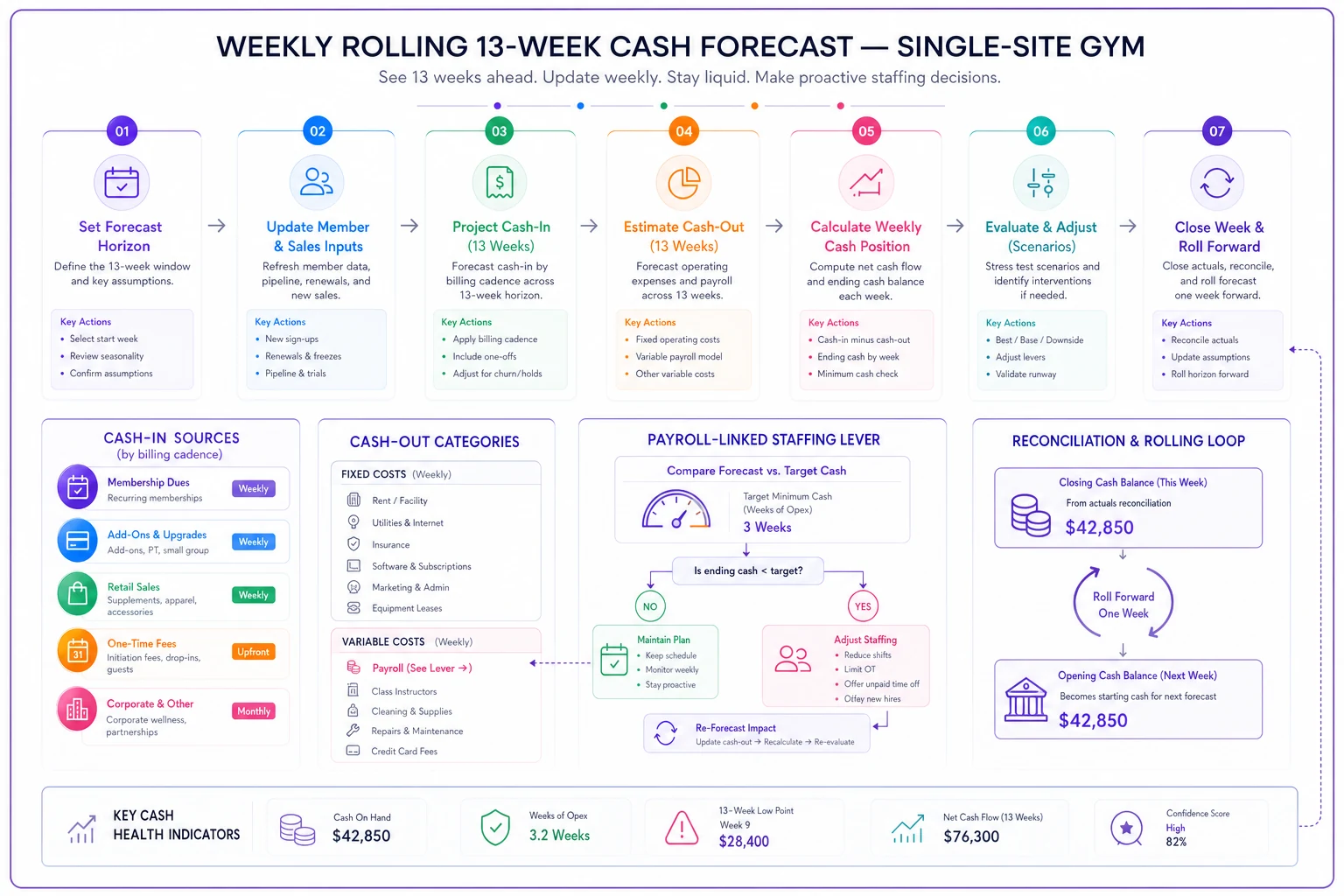
That carry-forward is the whole game. It's what turns a list of numbers into a runway. You're watching that closing-balance row for the week it dips below your minimum cash buffer — the number below which you get nervous. Set that buffer explicitly. For most single-site gyms it's roughly one full payroll plus rent held in reserve.
The single most common modeling mistake: entering recurring dues as one clean monthly number divided by four. Real dues don't work that way. If most members bill on the 1st and 15th, weeks 1 and 3 of a month look fat and weeks 2 and 4 look thin. Flatten that and you'll miss the exact thin weeks where a payroll lands on top of a lean dues week. Those are the weeks that actually hurt.
Tying revenue recognition to the model (and why season-adjusting matters)
Cash timing and revenue recognition are different animals, and gyms blur them constantly.
When a member pays $1,200 for an annual membership in January, you got $1,200 of cash in January. But you earned roughly $100/month across the year. If you run your business off cash timing alone, January feels like a boom and you spend accordingly — then wonder why February through April feel starved. That cash was for services you hadn't delivered yet.
This is why you keep a season-adjusted revenue-recognition worksheet alongside the cash model. Two views of the same business:
-
The cash model answers
will the bank account survive the next 13 weeks?
-
The recognition worksheet answers
am I actually profitable, or am I spending deferred revenue?
Season-adjusting the recognition side means smoothing paid-in-full and multi-month packages across the months they're earned, and applying realistic attrition curves. A January cohort of annual members won't all be showing up actively by August, but you've already been paid — so the recognized-revenue view stays steady while the cash view spikes and dips.
The practical payoff: when you see a big January cash lump, the recognition worksheet reminds you that most of it is spoken for. You don't over-hire against it. This connects directly to how you think about your membership architecture in the first place — if you haven't stress-tested that, the experiment-driven approach to fixing pricing mistakes pairs naturally here, because your price mix determines how lumpy your cash actually is. A gym heavy on paid-in-full annuals has a wildly different cash shape than one on pure monthly recurring.
The payroll-linked staffing levers
This is the part generic cash models skip entirely, and it's the most useful part for a gym.
A 13‑week model that only shows you a shortfall is a smoke detector with no evacuation plan. You want the model wired so that when the closing-balance row dips toward your buffer, you already know which lever to pull and roughly how much cash it frees.
Your variable-payroll row is the lever. Build a small side table mapping each staffing decision to its weekly cash impact and its operational risk:
| Staffing lever | Approx. weekly cash freed | Lead time to act | Member-experience risk |
|---|---|---|---|
| Trim under-filled group classes (merge/cancel low-attendance slots) | $400–$900 | 1–2 weeks | Medium — messaging matters |
| Reduce redundant desk overlap during slow blocks | $300–$600 | 1 week | Low |
| Shift PT from guaranteed hours to session-based pay | $500–$1,500 | 2–4 weeks (contract change) | Medium — trainer churn risk |
| Pause new hiring / delay a planned role | Varies | Immediate | Low short-term |
| Defer owner draw | Full draw amount | Immediate | None (except your own) |
The numbers are illustrative — yours depend on your wage rates and schedule — but the structure is the point. Each lever has a cash value and a cost, and they aren't interchangeable. Deferring your own draw is painless externally but unsustainable past a few weeks. Cutting classes frees real money but touches the member experience directly.
The discipline is defining your lever order before you're in a crunch. When you're calm, decide "if week-6 closing balance drops under buffer, I first trim under-filled classes, then reduce desk overlap, and only then touch PT structure." When you're panicking mid-crunch, you make worse calls.
Two things make these levers actually pullable: knowing which classes are genuinely under-filled, and knowing your true labor cost per revenue block. Neither is a finance question — it's operational data. The reason cash and scheduling belong in the same conversation is that your labor lever is only as good as your attendance and utilization data.
Feeding the model without living in a spreadsheet
The honest problem with 13‑week models: they only work if the numbers are current. Manually updating dues, failed payments, class fills, and payroll every week is exactly the kind of chore that gets skipped by week three. A stale model is worse than no model — it gives you false confidence.
This is where the operational systems already running your gym should be doing the heavy lifting. Your billing system knows the real draft dates and amounts. Your scheduling system knows which classes are filling and which trainers are on the clock. When those feed your cash view automatically instead of you re-keying numbers, the model stays live and you're spending time on the decision, not the data entry.
A few pieces matter more than others:
-
Failed payments distort the model more than most owners realize. A batch of declined cards makes a fat dues week suddenly thin, and recovery cash arrives later — in an unpredictable week. If your model assumes 100% collection, it's lying to you. Model expected recoveries separately, and tighten the actual process; a real failed-payment recovery workflow is the difference between recovering most of that revenue in-cycle versus writing it off.
-
The staffing lever needs live attendance data to be safe to pull. Cutting a class you think is under-filled but is actually holding a loyal group is an expensive mistake dressed up as a saving.
-
The whole model is downstream of your measurables. If your KPIs and reporting cadence are already solid, the cash model is a natural extension rather than a separate universe. It's worth building on top of a real measurables hierarchy with dashboards and cadences, because the weekly cash re-forecast should slot right into a cadence you already run.
Prioritize automating failed-payment and class-fill feeds first — they change weekly cash most and keep the model honest.
The goal isn't a fancier spreadsheet. It's shrinking the gap between something changing in your gym and you seeing its cash consequence. Automating the data feed closes that gap from "next month when I do the books" to "this week's forecast."
A real scenario
A single-site gym, roughly 620 active members, doing somewhere in the low $60k/month range. Healthy on paper — margins were fine, retention was okay.
The pattern: every year, February through April felt like a scramble. The owner would over-staff in January to handle the New Year surge — extra desk shifts, added group classes, two new part-time trainers. All reasonable in the moment. But the January cash lump included a chunk of paid-in-full annuals, so recognized revenue was way lower than the bank balance suggested. By March, the surge members had thinned out, the added classes were running half-empty, and he was carrying an extra $4k–$5k a month in payroll against declining dues weeks. Twice he'd tapped his line of credit in the spring "just to smooth things."
Building the 13‑week model with billing dates mapped to real draft cadence — and a season-adjusted recognition view sitting beside it — the collision was obvious weeks ahead. The added January classes were at low fill by mid-February. Using a pre-decided lever order, he merged the under-filled slots and pulled back the extra desk overlap before the thin March weeks hit, freeing somewhere around $2,500–$3,000 a month without touching PT or the core schedule.
The result wasn't dramatic on the P&L — annual profit barely moved. But he didn't touch the line of credit that spring, kept his own draw intact, and stopped white-knuckling the second quarter every year. That's the actual win: not more money, just no surprises.
When this makes sense — and when it doesn't
Build the full model when: you've got variable labor (hourly trainers, group instructors, flexible desk coverage), meaningful seasonality, any paid-in-full or multi-month products, or you've ever floated a payment or tapped credit to cover a slow week. If two of those are true, you're past the mental-model stage.
You can keep it lightweight when: you're a small operation with flat monthly dues, salaried-only staff, and stable membership. A simple monthly view might genuinely be enough. Don't build machinery you don't need.
This is the wrong priority if your fundamentals are broken. If you're losing members faster than you replace them, or your pricing doesn't actually cover your cost structure, a well-built cash model just documents the decline in higher resolution. Fix the leak first, then forecast the flow. Cash modeling is for managing timing in a fundamentally sound business — it's not a turnaround tool.
The takeaway
Cash crunches at single-site gyms are almost never a profitability problem. They're a timing problem — three clocks running out of sync, a labor cost that grew variable while forecasting stayed fixed, and deferred revenue getting spent as if it were profit. A rolling 13‑week model with billing cadence mapped honestly, a recognition view sitting beside it, and a pre-decided set of staffing levers turns those collisions from ambushes into things you saw coming and handled two weeks early. Build it once, keep it fed, and re-forecast every week. The quarter stops being scary.
Ready to elevate your gym operations?
Join 2,000+ gyms using Gymioly to reduce admin overhead, improve member experience, and grow revenue.