

Most gyms run maintenance on calendar intervals. Every treadmill gets serviced monthly. Every cable machine gets checked quarterly. Makes sense on paper—except equipment doesn't break based on dates. It breaks based on how hard it's actually getting used.
The rowing machine in the corner that gets touched twice a week doesn't need the same attention as three treadmills running 14 hours straight during peak times. Yet most gyms treat them exactly the same. You end up over-maintaining quiet equipment and under-maintaining your workhorses, which is how you get a treadmill dying during the Monday evening rush.
When that happens, you're scrambling to find a repair vendor, members are frustrated, and you're staring at an emergency bill that could've been avoided. That's the cycle most gym operators are stuck in without realizing the root cause is the maintenance model itself.
Why calendar-based maintenance fails in real gym operations
The standard approach most equipment vendors push—monthly or quarterly intervals—assumes uniform usage across all machines. But walk through any gym at 6 PM versus 2 PM and you'll see the problem immediately.
Your leg press might get 200+ uses on a busy Monday but only 40 on Sunday. The assisted pull-up machine sees heavy rotation during personal training blocks but sits idle most mornings. Certain equipment faces concentrated stress during specific classes while others are barely touched. Calendar-based schedules miss all of this.
And the financial hit compounds fast. Emergency repairs typically run 2–3x more than preventive maintenance. A belt replacement during a scheduled visit might cost $180. That same belt failing mid-workout becomes a $400+ emergency call, plus potential liability if someone gets hurt, plus the reputational damage of members walking past out-of-order signs.
Then there's the vendor situation. Most gyms work with 3–5 different equipment suppliers, each with different warranty terms, service requirements, and response windows. Your Life Fitness contract might guarantee 48-hour response while your Precor agreement offers next-day service—but only for certain models. Tracking all that manually becomes a mess, especially as your equipment mix grows over the years.
Building utilization-based preventive schedules that actually work
The shift from calendar-based to usage-based maintenance starts with understanding your actual utilization patterns—and you don't need expensive sensors to do it. Your member check-in data shows peak usage hours. Your group fitness schedule tells you when specific equipment faces heavy load. Even a week of basic observation across different time blocks gives you enough to start building tiers.
End appointment chaos and boost attendance.
Gymioly streamlines booking, confirms sessions, and manages memberships effortlessly.
- Unified class and membership management
- Automated member notifications
- Trainer scheduling and availability
No credit card required
Here's a practical framework that works across different gym sizes:
High-utilization tier (70+ uses per day):
-
Treadmills during peak hours
-
Popular strength equipment near mirrors
-
Anything used in group classes
-
Service interval
Every 3–4 weeks or 1,500 uses
Medium-utilization tier (30–70 uses per day):
-
Secondary cardio equipment
-
Most free weight stations
-
Specialized strength machines
-
Service interval
Every 6–8 weeks or 1,800 uses
Low-utilization tier (under 30 uses per day):
-
Specialized equipment
-
Machines in less-trafficked areas
-
Redundant units
-
Service interval
Every 10–12 weeks or 2,000 uses
The core idea is matching maintenance frequency to stress levels, not to calendar dates. A treadmill running 10 hours daily needs fundamentally different attention than one used 3 hours daily, even if they're the same model bought the same week.
Maintenance tasks should vary by tier too. High-use equipment needs more frequent belt tension checks, lubrication, and calibration. Low-use equipment mainly needs cleaning and basic safety checks. This targeted approach reduces total maintenance time while improving reliability exactly where members notice it most.
A simple table can help you operationalize this across your floor:
| Equipment | Daily Uses | Tier | Maintenance Interval |
|---|---|---|---|
| Treadmill (main bank) | 80–120 | High | Every 3–4 weeks |
| Elliptical (primary) | 50–70 | Medium | Every 6–8 weeks |
| Rowing machine (corner) | 15–25 | Low | Every 10–12 weeks |
| Cable crossover | 60–90 | High | Every 3–4 weeks |
| Spin bikes (class room) | 40–60 | Medium | Every 6–8 weeks |
| Assisted pull-up machine | 20–30 | Low | Every 10–12 weeks |
This takes maybe an hour to put together and immediately changes how your tech allocates time each week.
Vendor SLA templates that protect your operations
Standard vendor contracts favor the vendor. They're full of loopholes—"best effort" response times, exclusions for "normal wear," vague escalation procedures that leave you without recourse when equipment fails at the worst possible moment.
A proper SLA needs specific operational protections built in from the start:
Response time guarantees by severity:
-
Critical (safety issue or multiple units down)
4-hour response
-
High (single popular unit down during peak)
Next business day
-
Standard (single unit, non-peak impact)
48 hours
-
Preventive maintenance
Scheduled within agreed windows
Financial penalties for SLA breaches:
-
Response time miss
10% service credit per day
-
Repeat failures within 30 days
Free service call
-
Extended downtime (5+ days)
Daily credit equal to equipment lease/finance payment
Clear escalation paths:
-
Level 1
Local service tech (must respond within 2 hours)
-
Level 2
Regional service manager (4 hours)
-
Level 3
Account executive (same day)
-
Level 4
VP of Service (next day)
Also nail down coverage definitions in writing. "Comprehensive coverage" means nothing unless you've listed what's actually included—parts, labor, travel time, emergency rates. Define "normal business hours" around your operation, not theirs.
Vendors will push back. They'll say standard contracts can't be modified or that penalties increase costs. But gym contracts are competitive, and most vendors will negotiate when you come in with specific requirements rather than vague complaints. Present these as operational necessities. And require vendors to maintain local inventory for your high-use equipment—a treadmill belt shouldn't take two weeks to arrive when it's a predictable failure point.
CAPEX forecasting beyond simple depreciation schedules
Equipment replacement planning at most gyms falls into one of two approaches: run everything until it dies, or follow arbitrary 5–7 year replacement cycles regardless of actual condition. Neither holds up operationally or financially.
Real CAPEX forecasting means understanding total lifecycle cost, not just purchase price. A $3,000 treadmill with $500 annual maintenance that breaks down quarterly costs more over five years than a $5,000 unit with $200 annual maintenance that rarely fails. The math usually surprises people.
Start by categorizing equipment into replacement horizons:
12-month replacement horizon:
-
Equipment with repeated failures (3+ service calls in 6 months)
-
Units with safety concerns flagged by techs
-
Machines where parts are becoming unavailable
-
Anything past manufacturer end-of-support
24-month replacement horizon:
-
High-use equipment approaching 80% of expected lifespan
-
Units with rising maintenance costs
-
Equipment that no longer meets member expectations
-
Machines requiring obsolete consumables
36+ month replacement horizon:
-
Standard lifecycle replacements
-
Equipment for planned expansions
-
Technology upgrades like screens or connectivity
This categorization gives budget conversations actual substance. Instead of "we need new equipment," you can show exactly why certain replacements are urgent and others can wait—backed by maintenance history and real cost data.
Gyms that time replacements strategically can meaningfully reduce equipment costs. Buying during manufacturer model year transitions, bundling replacements for volume discounts, and negotiating trade-in values for functioning equipment all move the needle. But you can only leverage those opportunities with proper planning horizons.
Stagger purchases across a few months when replacing multiple treadmills—this spreads warranty expirations and prevents simultaneous lapses that create budget spikes. Some manufacturers offer extended warranty pricing that decreases with volume, which is another reason to plan replacements in logical groups rather than one-offs.
The downtime response playbook most gyms discover too late
Equipment failures during peak hours create cascading problems. Members get frustrated, staff scramble, and the whole operation feels chaotic. Most gyms have no documented process for handling these entirely predictable situations.
A solid downtime playbook removes decision-making from stressful moments:
Immediate response (0–15 minutes):
-
Staff places out-of-order sign with estimated repair time
-
Front desk updates equipment status board
-
Maintenance request logged with photos
-
Check if backup equipment can be relocated
Member communication (15–30 minutes):
-
Email members who regularly use that equipment (if tracked)
-
Push app notification about equipment status
-
Post sign suggesting alternative equipment
-
Brief front desk on talking points for member questions
Vendor engagement (30–60 minutes):
-
Contact primary vendor using SLA escalation path
-
If no response within timeframe, engage backup vendor
-
Document all communication for SLA claims
-
Confirm parts availability and repair timeline
Ongoing management:
-
Daily status updates on signage
-
Member service recovery for complaints—guest passes, training credits
-
Shift change briefings for staff
-
Social media update if downtime extends past 24 hours
Train staff on specific responses to common complaints. "I only come here for that equipment" needs a better answer than "sorry, it's broken." Offer specific alternatives, acknowledge the inconvenience with something tangible, or at minimum promise a direct notification when the repair is done.
Document backup vendors for each equipment type, including their rates, response times, and capabilities. Getting quotes during an emergency costs more than having pre-negotiated rates. And don't overlook member communication—members accept that equipment breaks. What they don't accept is silence. A simple "Part ordered, arriving Thursday" prevents frustration from turning into churn.
Here's a simple visualization of the response workflow.
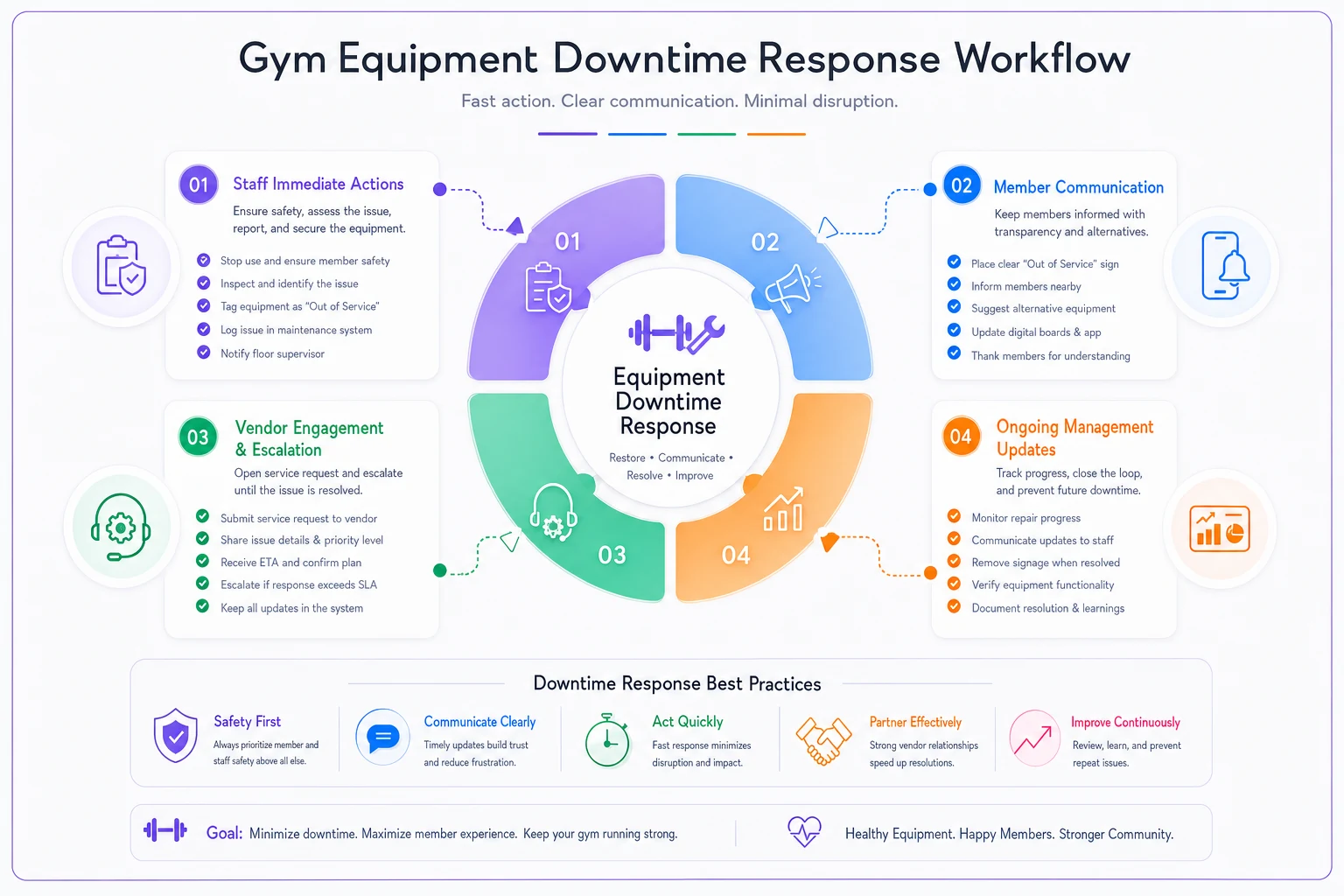
Keep this playbook visible and practiced so responses become muscle memory rather than improvisation.
Creating accountability systems that stick
The best maintenance program fails without consistent execution. Maintenance tasks compete with member service, sales, and the constant fires that need fighting. The solution isn't more policies—it's building systems where compliance is easier than non-compliance.
Match maintenance task assignment to natural workflow patterns. If your morning shift is quieter, they handle preventive checks. Evening staff focus on cleaning and basic observations. Tasks should fit when people actually have capacity to do them properly.
A functional accountability system has three parts working together:
Verification without micromanagement:
-
Photo requirements for completed tasks
-
Equipment hour meter readings
-
Simple checklist apps that timestamp completion
-
Spot audits rather than constant monitoring
Consequences tied to outcomes, not tasks:
-
Track equipment failures against maintenance completion rates
-
Link staff bonuses to uptime metrics, not just task counts
-
Celebrate prevention wins, not just completion rates
-
Share the cost impact of failures that were prevented
Visibility across all levels:
-
Maintenance dashboards visible to all staff
-
Weekly equipment status in team meetings
-
Vendor scorecards shared with management
The mistake most gyms make is building elaborate tracking systems that nobody uses past week two. Your system should take less time than the confusion it replaces. A simple shared spreadsheet beats a complex maintenance management platform that staff quietly ignore.
Attach photo proof and a timestamp to each preventive check to eliminate disputes about whether a task was done.
Integration considerations matter here too. Whatever tracking system you choose should connect with your existing operations, not create another silo. If staff already use scheduling software, add maintenance tasks there. If you track member feedback in your CRM, include equipment complaints in the same place. Fewer systems to check means better compliance in practice.
Build feedback loops that show actual impact. When preventive maintenance catches a problem early, document what failure was prevented and what it would have cost. "Today's belt adjustment prevented a $400 emergency repair" lands differently than "complete maintenance checklist daily." Make the value visible to the people doing the work.
Track vendor performance the same way. Quarterly scorecards showing SLA compliance, repair success rates, and cost trends change how vendors treat you. The ones who see you're measuring performance tend to deliver better service. The ones who push back on being held accountable are usually not worth the contract renewal.
Turning reactive repairs into predictive operations
The shift from reactive to predictive maintenance doesn't require AI sensors or complex software at the start. It begins with spotting patterns in your existing failure data and building simple prediction rules around the most common and costly breakdowns.
Pull your last 12 months of repair invoices. You'll likely find 80% of costs concentrating in 20% of equipment types—treadmill belts failing every 4–5 months, cable fraying on specific machines, electronic boards dying in older ellipticals. These patterns are predictable once you start actually looking for them.
A basic prediction framework for common gym equipment:
Treadmills (typically 70% of repair costs):
-
Belt replacement
Every 6–8 months for high-use units
-
Deck resurfacing
Annually for units with 40+ daily uses
-
Motor brushes
Every 18 months regardless of use
-
Electronic board failure
Years 4–5 for budget models
Strength equipment (roughly 20% of costs):
-
Cable replacement
Every 12 months for high-use stations
-
Pulley bearing failure
Around 24 months for machines over 100 uses/day
-
Upholstery tears
18 months for leg machines
-
Weight stack guide rod wear
About 3 years
Other cardio (remaining ~10%):
-
Elliptical stride mechanism
18–24 months
-
Bike pedal bearings
12 months for spin bikes
-
Rower chain/strap
6–8 months with regular class use
With these patterns identified, you can schedule replacements before failures happen. Your predictive system should trigger specific actions at defined thresholds—when a treadmill hits 1,400 hours, order a replacement belt. At 1,450, schedule the swap. At 1,500, replace it regardless of appearance. This removes the "looks fine to me" delays that consistently lead to failures.
Some gyms worry about replacing parts too early and wasting money. But if a belt costs $150 and might last another month, while failure would cost $400 plus member impact, early replacement makes financial sense. Track actual intervals over time and your predictions get more accurate.
Also: capture institutional knowledge before it walks out the door. Your maintenance tech who's been there five years knows that the left cable cross always needs adjustment after 90 days, or that a specific treadmill runs hot and needs extra cooling breaks. Get those observations into your maintenance notes. When that person leaves, their knowledge shouldn't leave with them.
Maintenance as competitive advantage
Your gym equipment maintenance program is either a hidden profit center or a slow leak draining cash and member satisfaction. The difference isn't about spending more—it's about aligning maintenance with how equipment actually gets used, negotiating vendor agreements that protect your operations, and building response systems for the failures that will still occur.
The gyms that get this right see it everywhere. Members stop complaining about broken equipment. Staff stop scrambling during failures. Maintenance costs become predictable line items instead of budget surprises. Emergency repairs drop from weekly occurrences to rare events.
The frameworks here—utilization-based scheduling, protective SLA templates, lifecycle CAPEX planning, and downtime response playbooks—work because they match maintenance to operational reality rather than theoretical best practices. And increasingly, AI-powered operational software can help systematize these processes by automatically triggering maintenance tasks based on usage thresholds, tracking vendor SLA compliance, and maintaining the documentation trail that protects your interests during disputes. But even starting with spreadsheets and calendar reminders moves you toward predictive rather than reactive maintenance.
Start with whichever component addresses your biggest current pain point. If you're drowning in emergency repairs, begin with utilization-based scheduling. If vendor service is the problem, implement protective SLAs first. If budget surprises are the main issue, build your CAPEX forecast model. Each piece improves operations independently while building toward a more comprehensive program. Your members don't care that the treadmill was serviced last month—they care that it works during tonight's workout.
Ready to elevate your gym operations?
Join 2,000+ gyms using Gymioly to reduce admin overhead, improve member experience, and grow revenue.