

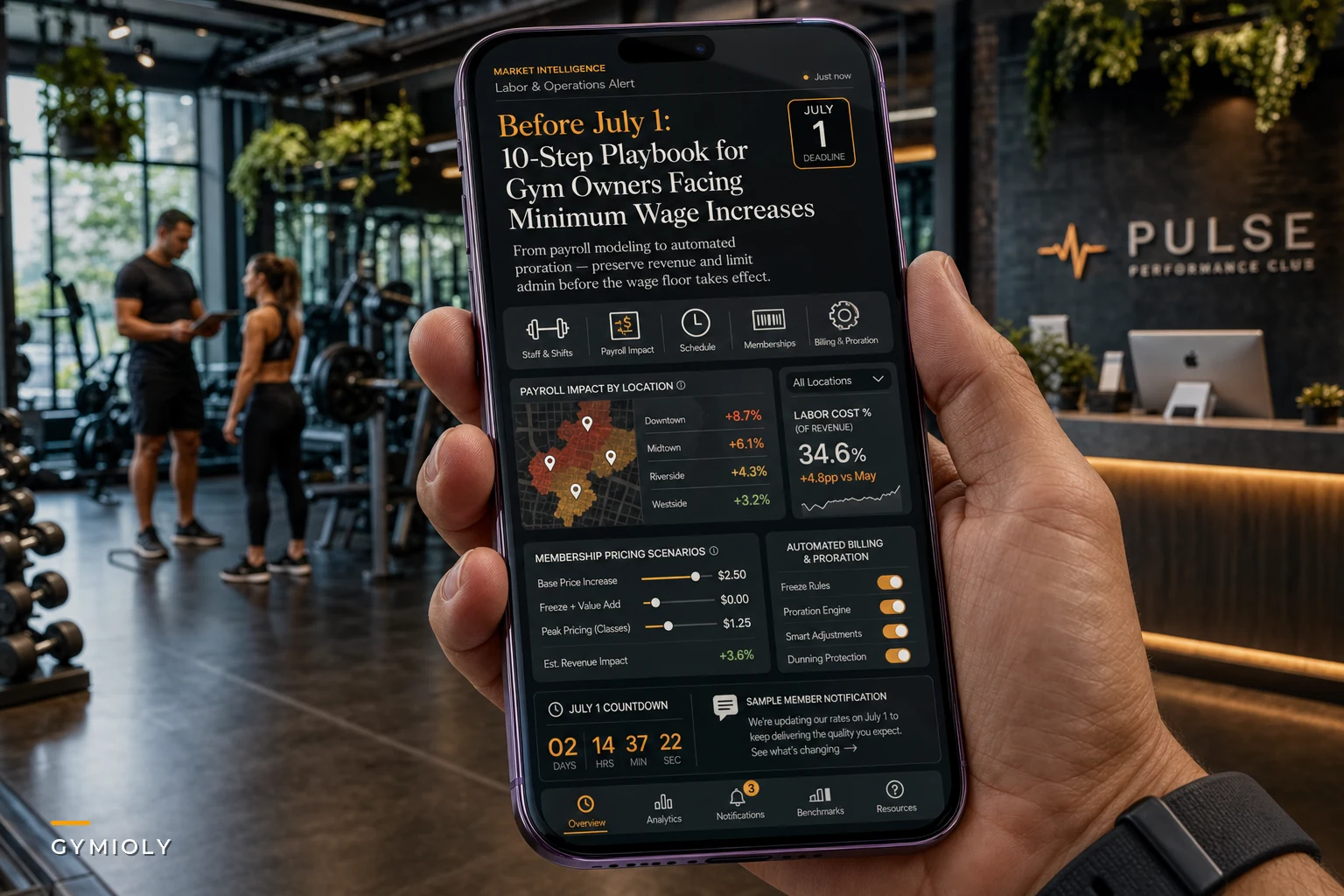

In less than a week, more than 20 states and cities will bump their minimum wages, with Alaska going to $11.91, Oregon's metro areas hitting $15.95, and DC pushing to $17.50. For gym owners, this isn't just a payroll line adjustment—it's an operational squeeze that hits every corner of your business at once.
Last month I watched a CrossFit box owner in Portland stare at his spreadsheet, running the numbers on what Oregon's wage increase would do to his July payroll. His eight part-time coaches were about to cost him an extra $4,800 a month. That's nearly $58,000 annually he hadn't budgeted for—and that was before calculating the ripple effect on experienced trainers who'd expect raises to maintain any meaningful wage gap.
The real problem isn't the wage increase itself. Gyms run on thin margins—usually 10–15% if things are going well—and most compensation structures simply weren't built to absorb sudden labor cost jumps. Front desk staff, personal trainers, class instructors, cleaning crew, childcare workers—all need adjustments. And you can't just raise membership prices overnight without triggering cancellations.
Why traditional cost-cutting won't save you this time
The first instinct is to cut hours. Makes sense on paper. But in practice: you reduce front desk coverage from two people to one during peak hours, and now member check-ins slow down, class sign-ups get missed, prospective members wait too long for a tour, and your remaining staff burns out handling twice the workload.
The second move is usually combining roles—having trainers wipe down equipment between sessions or dumping social media on front desk staff. This works for maybe three weeks before service quality drops visibly. Members start complaining, your Instagram goes quiet, and trainers get frustrated fast.
Some owners try reclassifying trainers as independent contractors. Beyond the real legal exposure (the IRS and state labor departments are actively cracking down on misclassification), you lose scheduling control, service quality gets inconsistent, and your best trainers sometimes leave to start their own thing once they get comfortable with that independence.
Then there's what economists call wage compression. When entry-level positions jump from $12 to $15, your $16/hour shift leads expect a bump too—because why take on extra responsibility for barely more than minimum wage? This cascade typically adds 40–60% on top of the direct minimum wage impact.
Your 10-step operational checklist (with realistic timelines)
Step 1: Run the real numbers by Thursday (3 days)
End appointment chaos and boost attendance.
Gymioly streamlines booking, confirms sessions, and manages memberships effortlessly.
- Unified class and membership management
- Automated member notifications
- Trainer scheduling and availability
No credit card required
Pull actual payroll from the last 90 days. Not averages—real hours worked, including overtime. Three columns: current hourly rate, new minimum rate, and likely adjusted rate for employees already above minimum.
For a 50-member boutique studio with 12 part-time employees, expect monthly payroll to increase somewhere in the $3,200–$4,100 range. For a 500-member facility with 35 employees, you're probably looking at $11,000–$14,000 more per month.
Don't forget these:
-
Employer payroll taxes (add 7.65% minimum)
-
Workers' comp premium increases (varies by state)
-
Commission structures tied to hourly guarantees
-
Overtime at the new base rate
Step 2: Identify your automation opportunities (2 days)
Map every task your hourly staff currently handles manually. You'd be surprised how much of it can shift without degrading the member experience:
Front desk tasks that can be automated:
-
Member check-ins (mobile app or kiosk)
-
Class bookings and cancellations
-
Payment processing and failed payment follow-ups
-
New member onboarding emails
-
Equipment reservation systems
-
Guest pass management
Administrative tasks to automate:
-
Payroll time tracking
-
Inventory reordering for retail/supplements
-
Birthday and milestone member messages
-
Membership renewal reminders
-
Social media post scheduling
A mid-sized gym can typically recover 15–20 labor hours per week through smart automation. That's roughly one part-time position worth of savings without cutting a single service.
Start by automating recurring member communications and failed payment follow-ups—they often save hours while improving cash flow.
Step 3: Restructure your class schedule strategically (3 days)
Instead of cutting classes, look at your actual attendance data. Most gyms run off-peak classes at 40–50% capacity. Two yoga classes at 2pm and 3pm with 8 people each? Test combining them into one 2:30pm class with 14–16 attendees.
A tiered instructor pay system also helps:
-
Base rate for classes under 10 attendees
-
Bonus tier for 10–19 attendees
-
Premium tier for 20+
This ties instructor costs more directly to revenue without gutting your schedule variety.
Step 4: Shift to performance-based compensation models (1 week)
Pure hourly pay gets painful when minimums jump. Hybrid models that reward productivity hold up better:
For personal trainers:
-
Lower base hourly + higher session commission
-
Monthly client retention bonuses
-
New client acquisition bonuses
For front desk:
-
Base pay + membership sales commission
-
Guest conversion bonuses
-
Google review generation incentives
For group instructors:
-
Base rate + per-attendee bonus over a threshold
-
Series completion bonuses (getting members through 6-week programs)
-
Referral bonuses
Done well, this reduces fixed labor costs by 20–30% while often increasing total earnings for top performers. The bottom performers self-select out over time.
Step 5: Implement dynamic pricing without losing members (2 weeks)
Straight membership price increases trigger cancellations. Strategic pricing changes are a different story.
Grandfather existing rates temporarily. Lock current members at their rate through December, but stop offering it to new signups immediately. This prevents a mass exodus while you establish higher price points.
Create value-added tiers. Instead of raising the base membership, introduce a "Premium" tier at roughly 20% higher with perks like:
-
2 guest passes per month
-
15% off retail
-
Priority class booking
-
Quarterly InBody scans
-
One free personal training session per quarter
Around 25–35% of members typically upgrade when it's framed correctly.
Adjust service pricing separately. Personal training, specialty classes, and add-ons can increase now with far less resistance. A $5 bump per training session or $10 more on massage services gets minimal pushback.
Step 6: Renegotiate vendor contracts immediately (1 week)
Labor costs are rising—everything else needs a hard look.
Payment processing:
-
Paying over 2.6% + $0.10 per transaction? Renegotiate. Threaten to switch—processors would rather cut rates than lose the account.
Equipment leases:
-
A lot of gyms are overpaying on equipment financing. Refinancing or buying out leases early can save $400–$800 monthly depending on what you're carrying.
Software subscriptions:
-
Most gyms run 5–8 different tools when 2–3 integrated platforms could cover everything. Consolidation usually saves $300–$500 monthly and reduces the administrative headache.
Utilities and services: Off-peak utility plans, renegotiated internet/phone bundles, a real audit of cleaning supply spending. Not glamorous, but it adds up.
Step 7: Maximize your space utilization (2 weeks)
Empty space is expensive when labor costs rise.
Rent to independent professionals. Massage therapists, physical therapists, or nutritionists often pay $800–$1,500 monthly for a treatment room. That covers a meaningful chunk of the payroll increase.
Sublease during off-hours. Corporate wellness programs, youth sports teams, or martial arts groups may rent your space during traditionally dead hours.
Add revenue-generating programs. Small group training (4–6 people) at premium pricing, specialty workshops, transformation challenges with entry fees.
A 5,000 square foot facility usually has over 1,000 square feet sitting underutilized during peak hours. That's revenue you're not collecting.
Step 8: Restructure your membership plans (1 week)
Unlimited models create overuse risk without generating proportional revenue.
Class packs. Offer 8 or 12 classes per month at 15% less than unlimited. Around 40% of "unlimited" members attend fewer than 10 times monthly anyway—they'll save money and you'll protect your margins.
Time-restricted memberships. Off-peak memberships (9am–4pm, after 7pm) at a 25% discount fill dead slots without cannibalizing prime-time capacity.
Commitment-based pricing. A 20% discount for 12-month commitments versus month-to-month improves cash flow and retention simultaneously.
Track which members need to freeze or modify plans carefully—automated systems prevent revenue leakage when these transitions happen at scale.
Step 9: Prepare transparent member communication (3 days)
Members understand economic realities. What they hate is surprises. Draft communications that explain:
-
Local wage increases and their impact on your business
-
Specific improvements members will actually see (better staff retention, enhanced services)
-
Grandfathering period for existing members
-
New membership options available
Send it via email, post it in-facility, and make sure staff can handle the conversation consistently. Transparency consistently reduces cancellation rates compared to sudden unexplained price changes—gym owners who've done this report roughly 40% fewer cancellations than those who just raise prices and hope for the best.
Step 10: Build your 90-day cash reserve (ongoing)
The wage increase will create cash flow pressure for 60–90 days while changes take effect. Build your buffer:
-
Offer membership prepayment discounts (pay 6 months, get 7)
-
Run a "founding member" campaign for new services at premium prepaid rates
-
Liquidate slow-moving retail inventory at cost
-
Delay non-essential equipment purchases
-
Negotiate extended payment terms with vendors
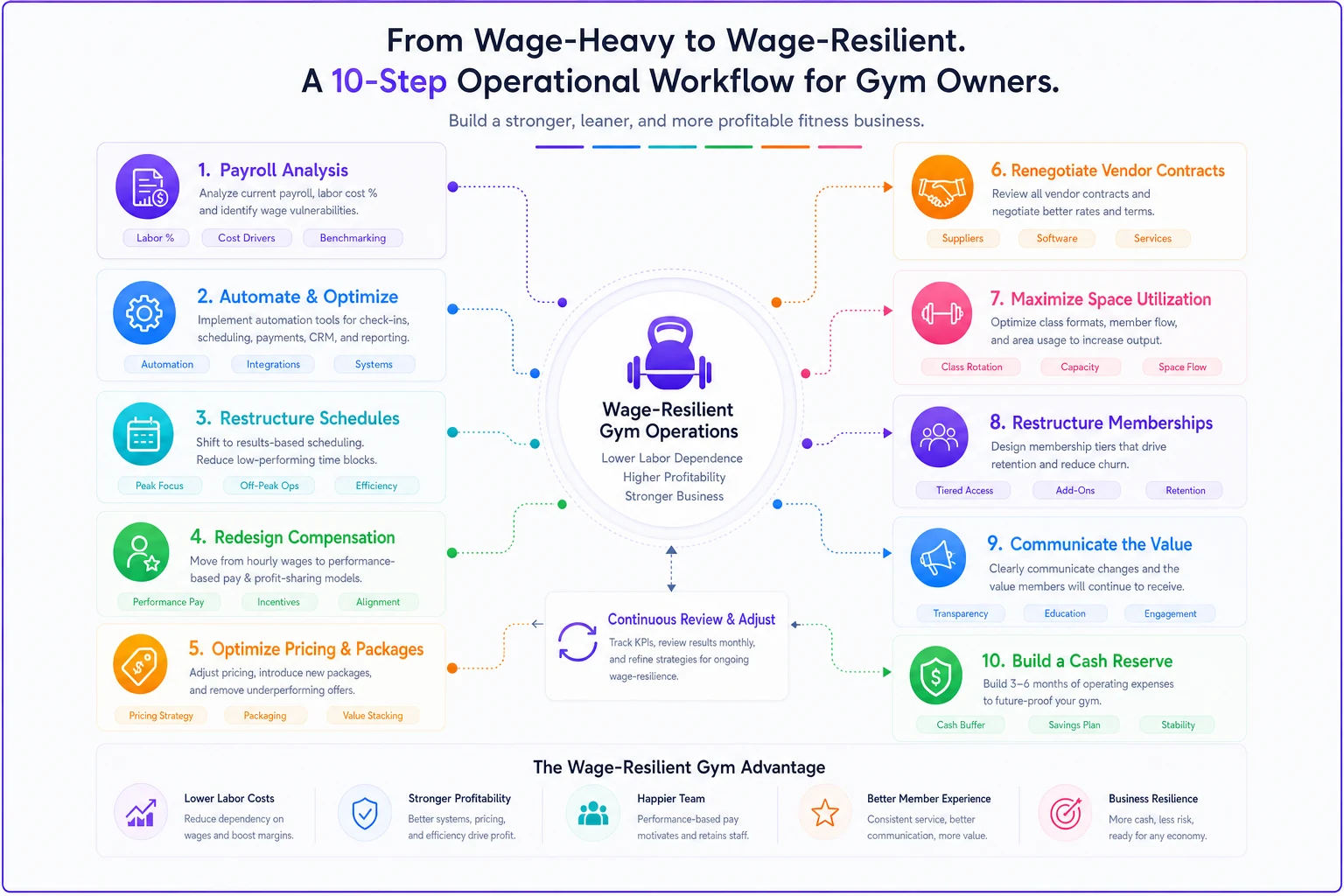
A simple visual that groups these steps by timeline (immediate, 2–4 weeks, 1–3 months) helps owners prioritize actions fast.
The operational reality check
Here's roughly what implementation looks like for a 300-member gym facing a $3/hour minimum wage increase:
| Period | Details |
|---|---|
| Month 1 | Payroll increase: $4,200 Member losses from changes: 8–12 members ($800–$1,200 revenue) New automation savings: $600 Net impact: -$4,400 to -$4,800 |
| Month 3 | Payroll increase: $4,200 Pricing adjustments kick in: +$2,100 Performance compensation reduces fixed costs: $900 Automation fully deployed: 1,200 savings Space utilization revenue: $800 Net impact: -$200 to break-even |
| Month 6 | New pricing fully adopted Operational efficiencies realized Higher service quality from better-compensated staff Net impact: +$500 to $1,200 positive |
Gyms that wait until July 1 to react typically panic-cut hours, lose good staff, frustrate members with sudden changes, and enter a slow spiral. The ones that come out ahead use this pressure to fix inefficiencies they've been tolerating for years.
Beyond July 1: Building a wage-resilient operation
This won't be the last increase. Several states have automatic annual adjustments tied to inflation, which means this scramble repeats every year unless you build your operation differently.
Technology-augmented operations. AI-powered scheduling that optimizes staffing based on real attendance patterns, automated member communication that reduces front desk load, digital check-in that eliminates manning requirements during slower hours.
Flexible staffing models. Split shifts during peak hours, on-call pools for unexpected rushes, skill-based pay differentials that reward versatility over seniority.
Revenue diversity. Membership fees at 60–70% of revenue, not 90%. The rest comes from personal training, retail, corporate contracts, and specialty programs—all with better margins than basic membership.
Obsessive metrics tracking. Revenue per square foot, revenue per labor hour, member lifetime value, class profitability by time slot. This data drives staffing and scheduling decisions instead of gut instinct.
A gym in Seattle shared their numbers after three years of operating with $15+ minimum wages. Their labor cost percentage dropped from 42% to 38% of revenue while member satisfaction scores improved. They didn't pay less—they operated smarter.
The wage increase is days away. Gyms that treat this purely as a cost problem will keep struggling every time wages move. The ones that use it as an operational forcing function will come out with leaner workflows, better-compensated staff, and margins that actually hold.
Pull those real numbers today. You still have time to get ahead of this.
Ready to elevate your gym operations?
Join 2,000+ gyms using Gymioly to reduce admin overhead, improve member experience, and grow revenue.