


Most cancellations aren't decisions. They're the paperwork on a decision that was made weeks earlier.
By the time a member calls the front desk or clicks "cancel," they've already stopped coming, stopped booking, and mentally moved on. The gym just hasn't noticed yet because nobody was watching the right numbers. And this is the part that stings: almost every gym has the data needed to catch these people a month early. It's sitting in the check-in logs, the booking system, and the billing records — just scattered, with nobody connecting it.
Churn prediction for a gym isn't some data-science fantasy. It's mostly about defining a few behavior signals, setting thresholds that actually mean something for your floor, and then having someone reach out before the member has emotionally checked out. Here's how that works in practice, without pretending you need a machine-learning team to pull it off.
The signals that actually predict a cancellation
Not every metric matters. Owners often track dozens of numbers, but the predictive ones are surprisingly few. The rest are noise or lagging indicators — useful for reporting, useless for prevention.
Attendance frequency drop. The single strongest early signal. A member who came 3x/week for two months and drops to 1x or 0x for two straight weeks is on a very different trajectory than a steady once-a-weeker. It's not the absolute number that matters — it's the change relative to their own baseline. A once-a-week member going to zero is at risk. A four-times-a-week member dropping to two might just be busy.
Booking pattern changes. For class-based gyms, watch how far in advance people book and whether they're rebooking. Someone who used to book their Tuesday spin three days ahead and now books nothing — or books and cancels — is drifting. Late cancels and no-shows are part of this signal set too. They show intent fading before attendance fully drops.
Spend behavior. This one gets ignored constantly. A member who bought protein, grabbed a smoothie twice a week, or occasionally paid for a PT session, and then goes to pure dues only for a month, is quietly disengaging. Non-dues spend tracks emotional attachment more than most people expect.
Payment friction. A failed card that took days to resolve, a freeze request, a downgrade — these aren't neutral events. They're often the first physical sign of hesitation.
Contact recency. How long since a staff member actually interacted with them by name? Members who feel anonymous churn faster, and gyms that never touch someone outside of billing have almost no early-warning coverage.
The mistake that comes up constantly: gyms weight all of these equally, or worse, they only look at attendance and miss the spend and booking signals entirely. Attendance is the loudest signal, but it's often the last behavioral signal to move. Spend and booking cadence frequently shift first.
Turning signals into a score that means something
You don't need a perfect algorithm. You need a scoring system simple enough that your staff trusts it and specific enough that it reflects real behavior.
End appointment chaos and boost attendance.
Gymioly streamlines booking, confirms sessions, and manages memberships effortlessly.
- Unified class and membership management
- Automated member notifications
- Trainer scheduling and availability
No credit card required
| Signal | Condition | Risk points |
|---|---|---|
| Attendance | No visits in 14 days (vs. their baseline) | +40 |
| Attendance | 50%+ drop from personal baseline over 3 weeks | +25 |
| Booking | Booked ahead regularly, now zero bookings for 2 weeks | +20 |
| Booking | 2+ late cancels or no-shows in 30 days | +10 |
| Spend | Dropped all non-dues spend for 30+ days (if previously active) | +15 |
| Payment | Recent failed payment, freeze request, or downgrade | +20 |
| Contact | No staff interaction in 45+ days | +10 |
Add up the points and you get a rough risk tier:
-
0–29 — Healthy. Leave them alone. Over-contacting engaged members just annoys them.
-
30–54 — Watch. Soft, non-alarming touch. This is your biggest save opportunity.
-
55+ — At risk. Needs a real human, fast.
The thresholds matter more than the exact point values. The 30-point "watch" tier is where the money is — those members are still reachable and don't yet know they're leaving. Once someone's at 70+, you're often just documenting a cancellation that's already decided.
One important nuance: baseline is personal, not global. A gym-wide "average visits" number will flag casual members as always-at-risk and let slipping regulars walk out unnoticed. Score each member against their own recent pattern.
Why gyms miss this even when the data exists
The information isn't the problem. The timing and coordination are.
In real operations, this breaks down in three places.
Check-in data lives in one system, bookings in another, and spend in the POS. Nobody's stitching them together, so no single person ever sees the full picture of a fading member. The front desk notices someone hasn't checked in, but doesn't know they also failed a payment and stopped booking — three signals that together scream "at risk" but individually look ignorable.
Second, even when a manager does notice someone's gone quiet, there's no defined next step. It becomes a "somebody should reach out" situation, which means nobody does. The member drifts for another three weeks.
Third, staff are busy. Asking a front-desk person to manually scan hundreds of members for behavior changes isn't realistic. It won't happen consistently, and inconsistency kills any retention effort. A save program that runs 40% of the time is barely better than none — because the members you miss are essentially random.
This is where an operational platform earns its keep — not by being clever, but by watching everything continuously and surfacing the small list of people who need attention today. AI automation here isn't about replacing your team's judgment; it's about making sure the right names land on someone's screen each morning instead of getting lost across three disconnected systems.
The outreach playbook: what to actually send
A risk score is worthless without an outreach sequence attached to each tier. And the outreach can't feel like a cancellation-prevention move — the moment a member smells "please don't leave," you've made leaving more salient.
Here's a tiered sequence that works:
Watch tier (30–54): soft, personal, no pressure
-
Day 1 (automated, personalized) A friendly "haven't seen you this week — everything good?" text. No offer, no guilt. Just presence.
-
Day 4 (if still no visit) Something value-based — a class recommendation based on what they used to attend, or a note about a new time slot that fits their old pattern.
-
Day 8 (if still quiet) Escalate to a real staff member for a genuine, non-scripted message.
At-risk tier (55+): human, fast, direct
-
Immediate handoff to a named staff member — not a mass text. A person calls or sends a personal note within 24 hours.
-
The conversation is diagnostic, not persuasive. "What's changed?" beats "Here's 20% off." Discounts train members to threaten leaving. Solving the actual problem — schedule mismatch, intimidation, a stalled routine — is what actually retains people.
-
If there's a fixable barrier, fix it on the call. Reschedule their usual class, book a free reassessment, connect them with a specific coach.
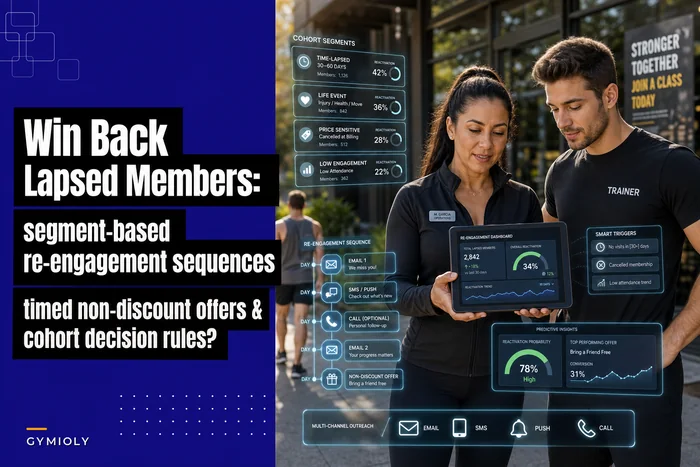
The re-engagement thinking here overlaps heavily with how you'd approach members who've already gone quiet — the segment-based logic in our lapsed-member win-back sequences applies just as well to at-risk members, except you're catching them earlier and with far higher recovery odds.
Staff SLA handoffs so nothing falls through
Automation surfaces the risk. People close it. The bridge between the two is a service-level agreement — a clear, boring rule about who does what and by when.
Without SLAs, at-risk members get flagged and then nothing happens. The flag becomes wallpaper.
-
Watch-tier flags are handled by automated sequences with a 72-hour window for a staff follow-up only if the automated touches get no response.
-
At-risk flags trigger an assignment to a specific staff member with a 24-hour contact SLA. Not "the team" — a name.
-
Every flag has an owner and an outcome. Contacted, saved, still-at-risk, or confirmed-leaving. No flag closes without a resolution logged.
-
Escalation rule if the assigned staffer doesn't act within the SLA window, it bumps to the manager automatically.
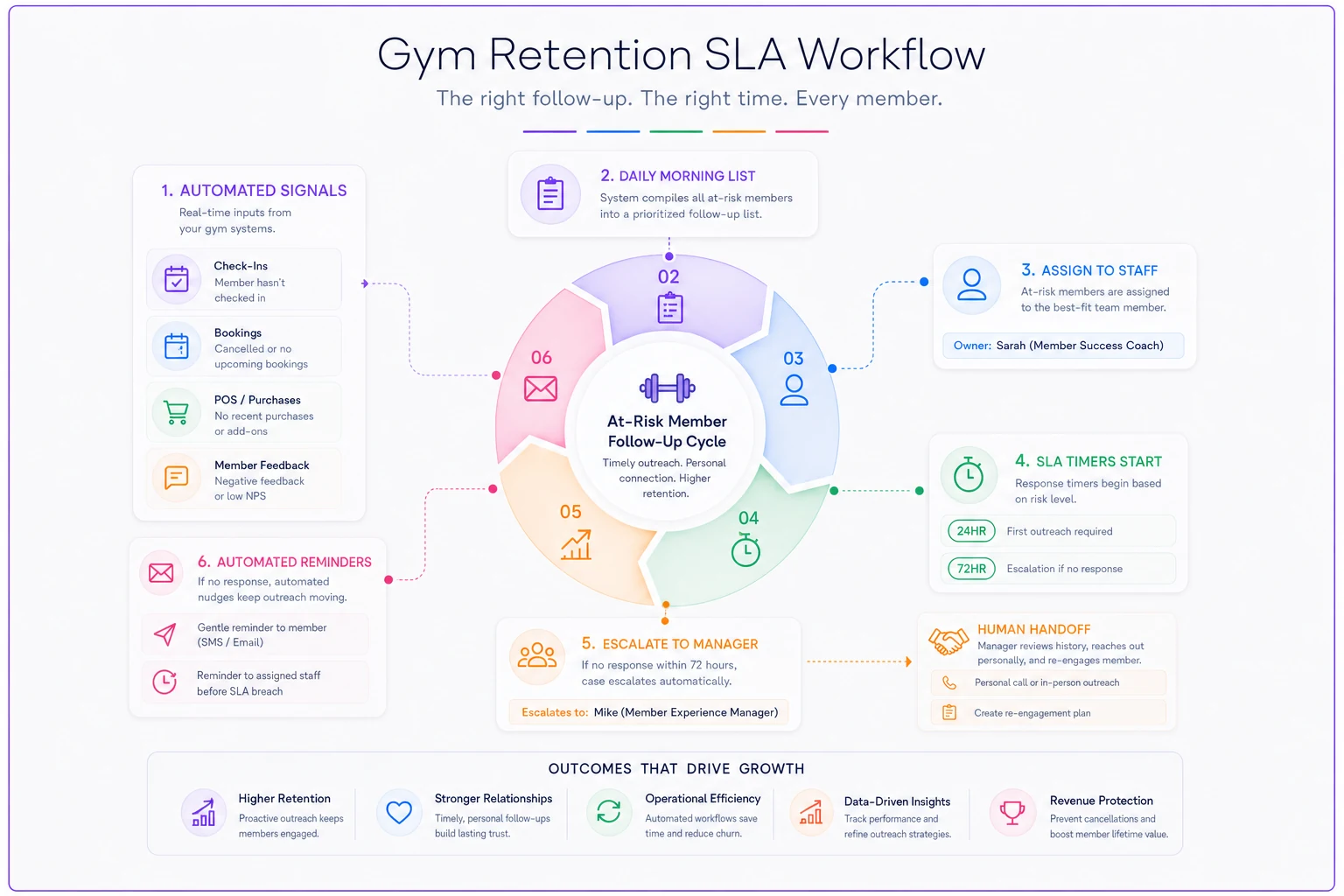
A simple diagram like this helps teams visualize who owns flags and how escalation works.
Assign a named owner every morning for the at-risk list so accountability is obvious.
The single biggest operational win here is ownership. A flag assigned to a person gets acted on. A flag sitting in a shared queue dies. This is the whole reason gyms with the same data get wildly different retention results.
A real scenario
A single-location gym, roughly 900 members, was losing somewhere around 35–40 members a month and couldn't figure out why the number stayed stubborn no matter how good the classes got.
When they mapped their at-risk members against actual behavior, the pattern was obvious in hindsight: the majority of cancellations came from people who'd dropped from regular attendance to near-zero four to six weeks before they officially quit — and nobody had reached out to a single one of them.
They set up a basic risk score covering attendance drop, booking gaps, and failed payments, a two-tier outreach flow, and a 24-hour SLA on the at-risk tier. Nothing fancy. The front desk got a short morning list — usually 8 to 15 names — instead of trying to eyeball 900 members.
Over the next quarter, monthly cancellations dropped from the high-30s to the low-to-mid 20s. Not a miracle, but at an average membership value somewhere around $55–$65/month, saving 12–15 members a month adds up to roughly $9k–$11k in retained annual revenue — from members they'd previously never even contacted before losing them.
The interesting part: they barely used discounts. Most saves came from a rescheduled class, a coach reconnecting, or just a member feeling noticed.
When this makes sense — and when it doesn't
Do this if you've got more than a couple hundred members and any meaningful class or booking activity. At that scale, manual monitoring is impossible and the churn is expensive enough to justify the setup.
Skip the complexity if you're a small studio with 80 members and know everyone by name. You already have a human early-warning system — you'll notice when someone stops showing up. Formalizing it into scores and SLAs would just be overhead you don't need.
Don't do this if your onboarding is broken, because you'll just be catching people who were never activated in the first place. Fix activation first — a strong 14-day onboarding sequence prevents far more churn than any downstream save program, because members who build a habit in the first two weeks rarely enter the at-risk pipeline at all.
One warning worth repeating: don't over-automate the at-risk tier. The watch tier can run on automated touches, but the moment someone's genuinely close to leaving, a template text often makes things worse. That tier needs a human voice, every time.
Where to start this week
You don't need to build the whole system at once. A realistic first pass looks something like this:
-
Pull the last 90 days of check-in data and find members whose attendance dropped 50%+ from their own baseline.
-
Cross-reference that list against recent failed payments and freeze requests.
-
Pick the top 10–15 names and have a staff member personally reach out this week — no script, just a real check-in.
-
Log what you learn. The reasons people give you are your future scoring model.
Do that once and you'll see the pattern yourself: most of the people about to leave gave you weeks of warning. The gyms that keep them aren't the ones with better data. They're the ones who defined the signals, set a threshold, assigned an owner, and actually reached out before the member had already made up their mind.
Do that once and you'll see the pattern yourself: most of the people about to leave gave you weeks of warning. The gyms that keep them aren't the ones with better data. They're the ones who defined the signals, set a threshold, assigned an owner, and actually reached out before the member had already made up their mind.
Ready to elevate your gym operations?
Join 2,000+ gyms using Gymioly to reduce admin overhead, improve member experience, and grow revenue.