

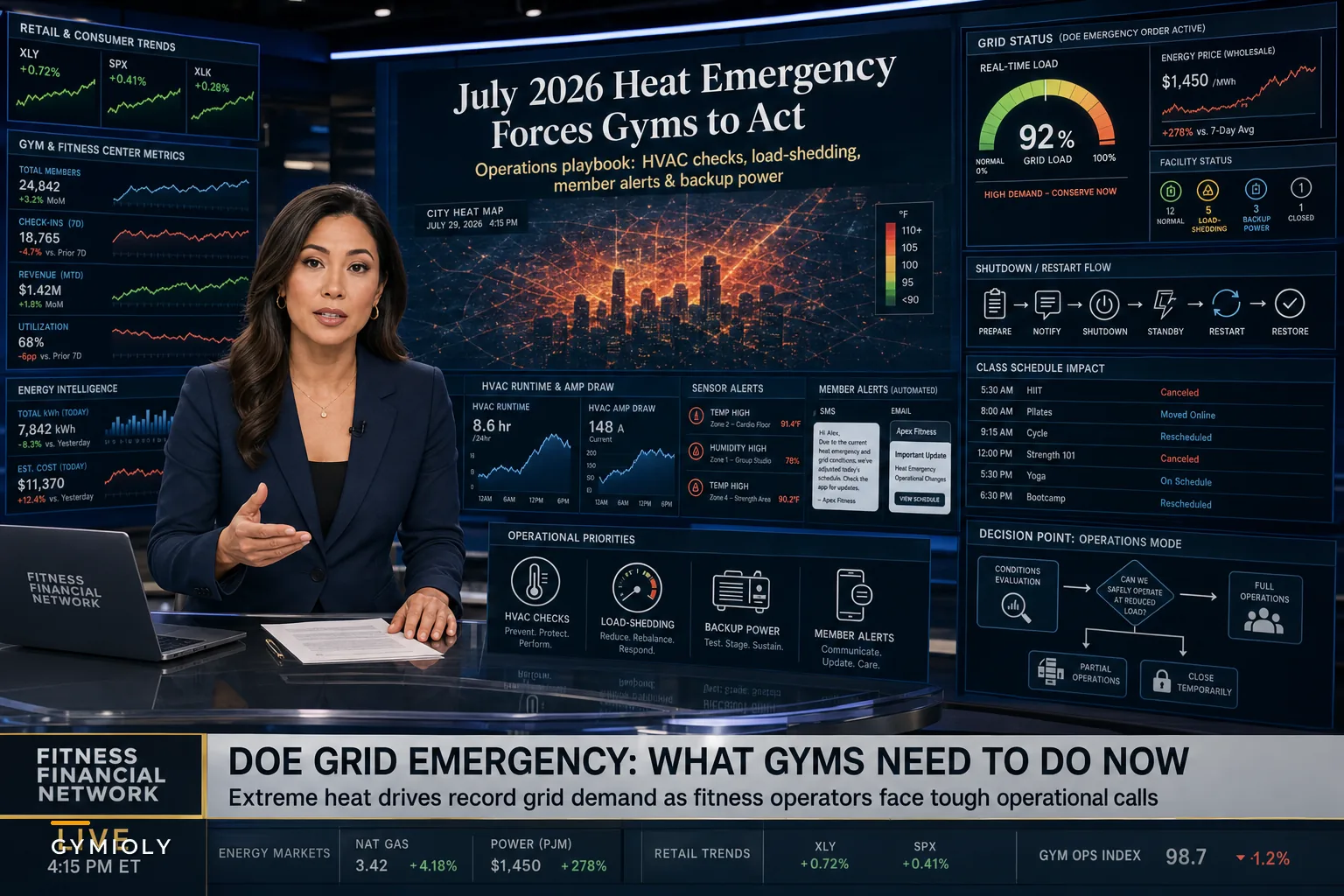

The Department of Energy doesn't issue emergency grid orders lightly. But that's exactly what happened this week when extreme heat pushed electricity demand beyond normal capacity across a massive swath of the country. From Texas to Michigan, grid operators now have federal authorization to fire up every backup generator they can find through August 3rd.
For gym owners, this isn't just another hot summer. This is the summer where your HVAC system becomes mission-critical infrastructure, where a two-degree temperature difference determines whether members show up or cancel, and where your utility bill might legitimately threaten next month's payroll.
The Grid Reality Nobody Warned You About
Most gym owners think about power in binary terms: it's either on or off. Grid stress creates a whole spectrum of problems that show up well before actual blackouts.
Your first warning sign usually comes through the HVAC system. When voltage drops even 5% below normal—which happens constantly during heat emergencies—your AC units pull harder to maintain temperature. Compressors cycle more frequently. Fans run longer. That 15-ton rooftop unit rated for 2,800 square feet suddenly struggles to cool 2,000.
Then there's demand response, which sounds voluntary until you realize your utility contract probably already opted you in. During peak hours (typically 2–7 PM), your smart thermostat might bump up two degrees without asking. Your utility calls this "grid optimization." Your members call it uncomfortably warm.
The real operational killer is intermittent brownouts. These voltage sags last seconds to minutes, just long enough to trip sensitive equipment. Treadmills error out. The sound system cuts. Digital locks reset. Your front desk staff spends the afternoon restarting equipment instead of serving members.
Why Standard Gym Energy Management Falls Apart in Extreme Heat
Traditional gym energy management assumes predictable patterns. Morning rush needs full cooling. Afternoon lull allows setback. Evening classes ramp up again. Simple enough.
End appointment chaos and boost attendance.
Gymioly streamlines booking, confirms sessions, and manages memberships effortlessly.
- Unified class and membership management
- Automated member notifications
- Trainer scheduling and availability
No credit card required
Extreme heat breaks every assumption. Members who normally work out at 5 AM show up at 9 PM to avoid the heat. Your carefully scheduled HVAC setbacks now coincide with unexpected member surges. That energy-saving occupancy sensor in Studio B keeps shutting off the AC right when people need it most.
The cascading failures get expensive fast:
Cooling System Overrun Your chiller runs continuously from 6 AM to 11 PM instead of cycling. At current peak rates (around $0.28/kWh in affected states), a single 40-ton system burns through $450–500 daily versus the usual $280.
Equipment Protection Mode Modern cardio equipment has thermal protection that reduces motor output when ambient temperature exceeds 78°F. Members notice immediately when their usual treadmill speed feels harder. They complain. They leave early. They question renewal.
Staff Schedule Chaos Opening staff arrives to an 85-degree gym because overnight setback went too deep. It takes 90 minutes to cool down. First three classes experience "sauna conditions." Refund requests pile up. The front desk manager is texting you about a member revolt before 8 AM.
The Hidden Cost Structure of Heat Emergencies
Beyond the obvious utility spike, extreme heat triggers costs that don't show up until weeks later.
Warranty claims spike when equipment runs outside design parameters. A treadmill motor rated for 5,000 hours at 72°F might last 3,000 hours at 79°F. Multiply across 30 machines and you're looking at $15–20k in accelerated replacement costs you didn't budget for.
Insurance exposure increases too. One heat exhaustion incident during a packed class becomes a liability nightmare. Even if you win, legal fees and increased premiums hurt for years.
Based on operational data from multi-location facilities during previous heat events, here's what typically happens:
| Impact Category | Normal July | Heat Emergency July | 30-Day Revenue Impact |
|---|---|---|---|
| Daily attendance | 625 members | 510 members | -18% class revenue |
| Peak hour utilization | 85% capacity | 60% capacity | Lost upsell opportunities |
| Complaint tickets | 12-15 monthly | 45-60 monthly | 3x staff time on issues |
| Membership freezes | 3-4% monthly | 8-11% monthly | $12-18k MRR reduction |
| Equipment issues | 2-3 repairs | 8-12 repairs | $3-5k unbudgeted maintenance |
Then consider what happens to membership retention. Members who experience a few uncomfortable workouts during peak heat start shopping competitors. That new franchise gym down the street promoting their "arctic blast cooling system" suddenly looks worth checking out.
Immediate Operational Adjustments That Actually Work
Forget the generic advice about "staying hydrated" and "monitoring members." Here's what operationally competent gyms actually do when heat emergencies hit:
Dynamic Schedule Flipping Stop pretending your normal schedule works. Move high-intensity classes to early morning (5–8 AM) and late evening (8–10 PM). Cancel or convert afternoon boot camps to low-intensity stretching or meditation. Yes, instructors complain about last-minute changes. Heat stroke lawsuits are worse.
Create cooling zones by concentrating AC capacity. Close off auxiliary spaces during peak heat. Run all classes in your best-cooled rooms. Three packed classes in comfortable rooms beat five half-empty classes in marginal conditions.
Tiered Temperature Response Instead of one temperature setpoint, create response tiers:
-
Below 74°F
Normal operations
-
74–76°F
Cancel high-intensity, add water stations
-
76–78°F
Reduce capacity 25%, mandatory rest periods
-
Above 78°F
Suspend classes, cardio-only on main floor
-
Above 80°F
Close until temperature recovers
Post these publicly. Members appreciate transparency over surprises.
Post these publicly. Members appreciate transparency over surprises.
Power Shedding Strategy When utilities announce demand response events, shed load strategically:
-
Auxiliary lighting (reduce 40%)
-
Non-essential equipment (displays, decorative features)
-
Hot water heaters (temporarily)
-
One of multiple AC units (rotate hourly)
-
Saunas and steam rooms (these become liability anyway in a heat emergency)
This can reduce demand by 20–25% while keeping core operations running.
Building Your Heat Emergency Playbook
A real heat emergency playbook goes beyond "check the weather forecast." You need triggered protocols that activate automatically when conditions hit specific thresholds.
Start with your communication cascade. When indoor temperature exceeds 76°F:
-
Automated SMS to all members with classes in the next 4 hours
-
Email blast with modified schedule
-
Social media updates every 2 hours
-
Staff group chat gets specific member-facing language to use
Your refund policy needs heat emergency provisions. Standard "no refunds for weather" doesn't hold up when your facility becomes genuinely uncomfortable or unsafe. Set clear triggers: automatic credit when room temperature exceeds 78°F during class time, prorated daily membership credits during closures, extended freeze options without penalty.
Equipment protection protocols should cover:
-
Shutdown sequence when brownouts are detected
-
Which equipment gets surge protection priority
-
How to properly restart after power fluctuation
-
When to cancel the rest of the day versus attempting recovery
Member safety thresholds need to be non-negotiable. Maximum occupancy drops 30% when AC operates below capacity. Mandatory water breaks every 20 minutes above 75°F. Age-based restrictions for certain conditions. These seem extreme until someone collapses in your weight room.
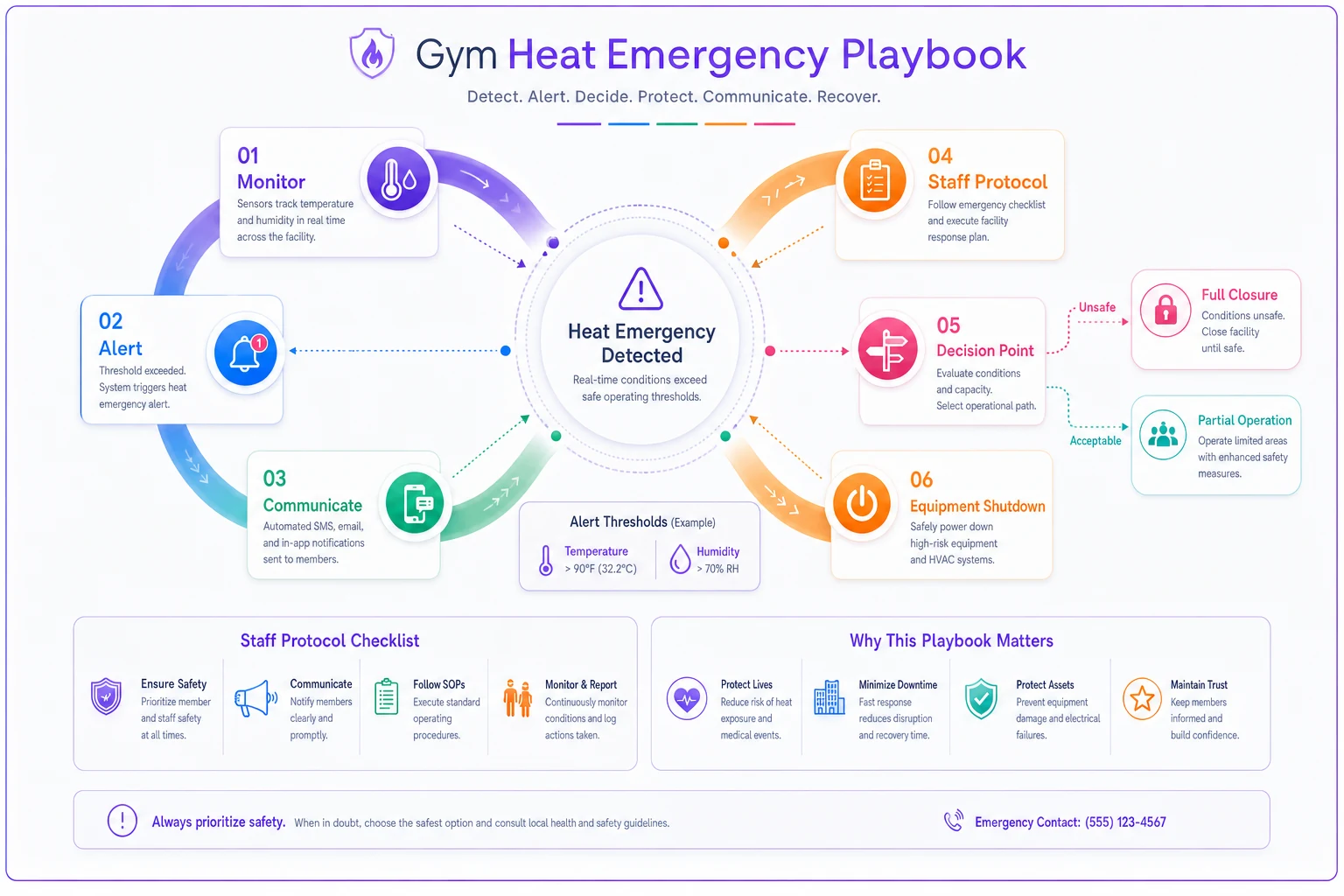
A simple diagram of the playbook workflow clarifies triggers and responsibilities for staff.
The Technology Stack That Prevents Meltdown
A smart thermostat and a few box fans won't cut it. The right technology setup lets you see problems before members feel them.
Environmental monitoring should track temperature, humidity, and air quality in real-time across zones. When your weight room hits 74°F but the front desk thermometer reads 71°F, you know exactly where to redirect cooling capacity. Set alerts for gradual temperature creep, not just hard threshold breaches.
Automated member communication triggered by environmental conditions saves your staff from making hundreds of calls manually. When sensors detect degraded conditions, your system should notify affected members, offer rescheduling, and process credits without someone having to touch it.
Demand response integration that actually protects operations means your building management system can receive utility demand signals but maintains override capability. You participate in grid savings programs without sacrificing member experience when it really counts.
The problem is that most of these systems exist in silos. Your HVAC controller doesn't talk to your member management system. Your class scheduling software doesn't know about utility demand events. Your staff is juggling multiple disconnected dashboards exactly when coordination matters most.
AI-powered operational platforms help close that gap. Instead of six separate dashboards during a heat emergency, you get unified visibility across your operation. Temperature approaching threshold in Studio A? The platform notifies members, adjusts the schedule, triggers a cooling boost, and logs the incident for insurance documentation, without your manager manually connecting those dots. Connected operational intelligence beats fragmented tools, especially when conditions are deteriorating fast.
Beyond This Summer: Building Heat Resilience
This week's DOE emergency order won't be the last. The same grid constraints driving this crisis will surface every summer, probably worse. Gym owners need permanent operational adaptations, not just temporary fixes that get forgotten in September.
Start with infrastructure investments that pay back through avoided crisis costs. Variable refrigerant flow (VRF) systems cost roughly 40% more upfront but maintain temperature through brownouts. Thermal storage systems charge during off-peak hours and provide cooling during peak demand. Solar canopies over parking areas provide shade and backup power, and members notice that kind of investment.
Rethink your membership agreement for climate reality. Add force majeure language covering extended heat events. Create summer pricing tiers that include guaranteed cooling standards. Build in automatic credits tied to internal temperature readings rather than subjective complaints.
Develop staff capabilities before the next crisis. Cross-train everyone on emergency protocols. Run monthly heat emergency drills where you simulate degraded conditions. Document every decision and outcome during actual events and use that data to refine your response the next time.
Most critically, you need operational data that tells you how your specific members respond. Which classes empty out first when temperature rises? How much does attendance lag after a heat closure? Which member segments tolerate temperature variation versus those who immediately freeze memberships? That institutional knowledge is what separates gyms that handle these situations smoothly from ones that scramble every time.
Making Heat Emergencies Operationally Manageable
The gyms that survive extreme heat events without hemorrhaging members or cash share a few common traits. They treat cooling as essential as the equipment on the floor. They communicate before members have a chance to be frustrated. They have clear, triggered protocols instead of making it up as conditions deteriorate.
But mostly, they recognize that gym energy management during heat emergencies isn't really about minimizing utility costs. It's about maintaining operational continuity when every system gets stressed at once.
The heat dome currently affecting millions is a real wake-up call. Your gym's ability to function through extreme heat depends on preparation completed before the next emergency order drops. Build your playbook now, test your protocols when conditions are mild, and invest in monitoring infrastructure while you have budget flexibility rather than when you're already in crisis mode.
When the next heat emergency arrives—and it will—you'll either be the gym that handles it smoothly or the one posting apology notices on Instagram while members explore better-prepared competitors. That outcome gets decided by the operational decisions you make today.
And these pressures don't exist in isolation. Many of the strategies here connect directly to broader financial stress gym owners are managing right now. Our recent analysis of FOMC minutes and rising operational costs offers a practical framework for handling multiple financial pressures at once, because heat emergencies almost always land on top of existing operational strain.
Ready to elevate your gym operations?
Join 2,000+ gyms using Gymioly to reduce admin overhead, improve member experience, and grow revenue.