
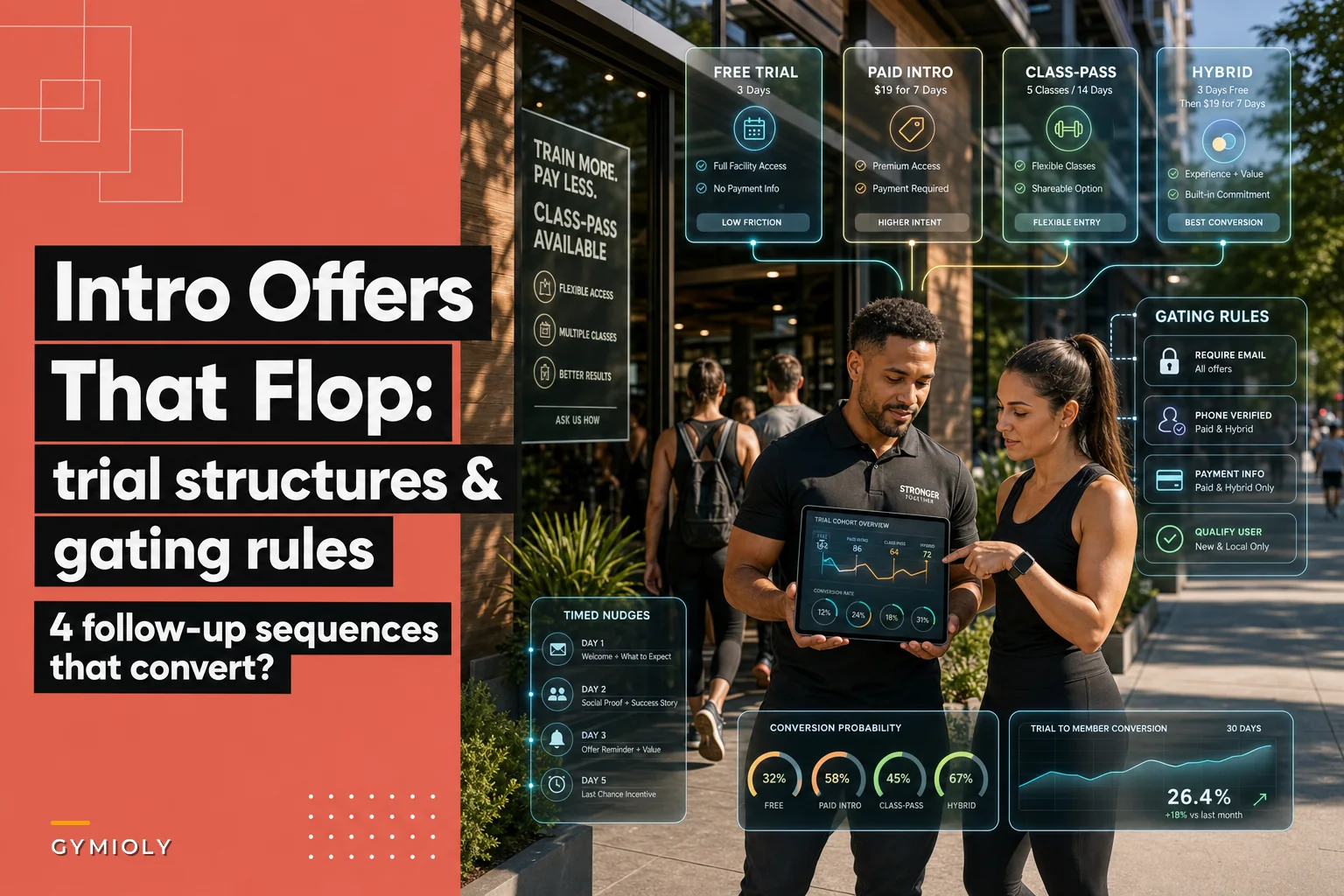

Your trial offer conversion rate sits at 18%. Maybe 22% on a good month. You've tried shorter trials, longer trials, cheaper trials, free trials. Nothing pushes past that stubborn ceiling.
The problem isn't your trial offer. You're treating every prospect like they're identical. A 24-year-old who just moved to town needs something completely different than a 45-year-old getting back into fitness after a doctor's warning. Yet most gyms run the exact same trial structure for both, then wonder why three-quarters of prospects vanish.
Looking at conversion data from roughly 400 gyms, the pattern is clear. Gyms that segment trial offers by prospect type convert at 42-48%. Those running one-size-fits-all trials stay stuck below 25%.
Trial Structures
The three trial structures that actually work (when matched correctly)
Structure 1: Short free trials (3-7 days)
This works for exactly one cohort: people who already know what group fitness is and just need to test your specific facility. Former ClassPass users, people relocating from another city, anyone who mentions their previous gym by name during the tour.
These prospects convert at 55-60% with a properly executed 5-day trial. But you need to gate this aggressively. If someone hasn't worked out in two years, a 5-day trial is worthless. They'll come twice, feel overwhelmed, and disappear.
-
Currently active elsewhere (within last 30 days)
-
Has specific fitness goals beyond "get in shape"
-
Can name the classes they want to try
-
Available to come at least 3 times during the trial period
If they don't hit all four, this trial structure fails.
Structure 2: Paid intro packages ($29-49 for 2 weeks)
This is your workhorse for semi-committed prospects. Someone who's been thinking about joining for months, researched options online, maybe tried a few YouTube workouts at home. They need more than a week to push through the initial discomfort, but they're invested enough to pay something upfront.
The paid intro works because it creates just enough commitment to get people through that awkward first week. Most gyms price these wrong though. Below $25 feels throwaway. Above $50 creates too much hesitation for someone still unsure about fitness.
-
Inactive 3-12 months (not completely sedentary, not currently active)
-
Has general goals ("lose weight," "get stronger")
-
Toured the facility or attended an event
-
Lives or works within 10 minutes
The conversion sweet spot here is 38-42%, but only if your follow-up sequence actually matches the longer trial window.
Structure 3: Class packages (5 classes for $75-100)
Most gyms ignore this option entirely, which is a mistake. It converts at around 45% for the right cohort: high-income professionals who hate commitment but love flexibility. These prospects will rarely sign up for unlimited monthly memberships right away. They need to feel in control of their schedule first.
The psychology is different here. They're not testing whether they like your gym — they're testing whether fitness can actually fit into their calendar. A class package lets them experiment without the mental weight of a recurring charge.
-
Household income above $120k
-
Mentions travel or work schedule during the tour
-
Previously used ClassPass or similar
-
Asks about freeze policies before you even get to pricing
Perfect for those who want flexibility without commitment.
Follow-up Sequences
The four follow-up sequences that triple conversion rates
End appointment chaos and boost attendance.
Gymioly streamlines booking, confirms sessions, and manages memberships effortlessly.
- Unified class and membership management
- Automated member notifications
- Trainer scheduling and availability
No credit card required
Sequence 1: The "Momentum Builder" (for short free trials)
Day 0 (signup): Booking link for first class, emphasis on tomorrow Day 1 (evening): "How was your first class?" with link to book day 3 Day 3 (morning): Instructor spotlight for the class they're booked into Day 4: Social proof from a similar member + exclusive member rate Day 5: Trial ends tomorrow + calendar showing next week's schedule Day 6: "We saved your spot in Thursday's 6pm class" + payment link
This compressed sequence creates urgency without desperation. The key is assuming success — talk like they're already coming back, not like you're trying to convince them.
KPI targets:
-
80% attend first class
-
60% attend 3+ classes during trial
-
45% convert to membership
If first-class attendance drops below 75%, your booking friction is too high. Below 50% three-class attendance usually means you've got the wrong cohort in this trial type.
Sequence 2: The "Comfort Creator" (for paid intros)
Day 0: Welcome packet with gym etiquette guide and "first week game plan" Day 3: "Most people feel awkward their first week — that's completely normal" Day 5: Beginner-friendly class recommendations for week 2 Day 8: Member story about their first month struggles and eventual breakthrough Day 10: Nutrition tip or recovery advice (shows expertise beyond just workouts) Day 12: "You've been here X times — here's what typically happens next" Day 14: Membership conversion with "keep your momentum" messaging
The real power here is acknowledging discomfort while normalizing it. Paid intro prospects need reassurance more than motivation.
KPI targets:
-
70% use the trial 5+ times
-
40% attend the same class twice
-
38% convert to membership
Watch that same-class-twice metric closely. Below 30% usually means your schedule is too complicated or staff isn't building real connections with new faces.
Sequence 3: The "Flexibility Protector" (for class packages)
After purchase: "Your 5 classes expire in 45 days — here's how members typically use them" After class 1: "4 classes remaining — most people space them every 4-5 days" After class 3: Membership math showing per-class savings After class 4: "Banking" message about rollover policies for members Before class 5: Conversion offer with unused classes as credit 7 days after class 5: "Miss having classes banked?" reengagement
High-income prospects need to feel like they're making a smart decision. Show them the efficiency of membership versus buying packages indefinitely.
KPI targets:
-
90% use all 5 classes
-
35 days average to use the package
-
45% convert before the package expires
If average package expiration creeps past 40 days, shorten the validity period. These prospects respond to gentle pressure.
Sequence 4: The "Quick Decision" (for tour no-shows who inquired)
Hour 0: "We're holding your tour slot for 15 more minutes" Day 1: "Schedule didn't work yesterday? Here are today's options" Day 3: Virtual tour video + "try us from home first" online class Day 5: Limited-time trial offer (24-hour expiration) Day 7: Final attempt with a different trial structure
This sequence looks aggressive but it works because these prospects showed real interest and then got distracted. You're competing with their inertia, not other gyms.
KPI targets:
-
25% reschedule within 48 hours
-
15% take the virtual option
-
12% total conversion from no-shows
Below 20% reschedule rate is a sign your tour booking process needs work.
Switching Cohorts
When to switch someone's cohort mid-trial
Sometimes you guess wrong about which trial structure fits a prospect. The operational complexity of switching them mid-stream stops most gyms from even trying, but the conversion lift usually justifies the effort.
Clear switch triggers:
From free to paid: They only came once and ghosted. Send a "we get it, a week isn't enough" message with a discounted 2-week paid extension. Recovery rate: roughly 22%.
From paid to package: They're using the paid trial sporadically — 2-3 times in 14 days — but genuinely engaged when they do show up. Offer to convert remaining days to a class package. Prevents the "I'm not coming enough to justify monthly" objection.
From package to membership: They've burned through 3 classes in 5 days. Don't wait for package completion. Hit them with "Looks like unlimited makes more sense for you" and apply remaining classes as account credit.
Timing Tricks
The timing tricks that everyone misses
Your conversion sequences probably fire based on trial start date. That's wrong for most prospects. The trigger should be last attendance, not calendar days.
Someone who signs up Monday but doesn't attend until Thursday needs their "midpoint check-in" on Saturday, not Wednesday. This sounds obvious but actually requires systems that track attendance in real-time and adjust communication accordingly.
The other timing mistake: sending conversion offers during their worst availability windows. If someone only comes to 6am classes, don't send membership offers at 7pm. Weekend warriors don't need Tuesday pushes.
Match your message timing to their established pattern. That one adjustment alone tends to lift conversion by 8-12 points.
Decision Cutoffs
Setting up decision cutoffs that protect your operation
Endless follow-up sequences drain staff time and start to annoy people. You need clear rules about when to stop.
The three-strike rule works:
-
No attendance after 3 days of any trial = one reactivation attempt, then stop
-
Attended once, ghosted for 7 days = different trial offer, then done
-
Completed trial without converting = one follow-up in 30 days, then move to win-back campaigns
Beyond these cutoffs, you're burning effort on prospects who simply aren't ready. Better to redirect that energy toward optimizing active trials.
Integration Headache
The integration headache you'll hit (and how to prevent it)
Running four different trial structures with dynamic follow-up sequences sounds great until you realize your current software can't handle cohort-based routing. Most gym management platforms treat all trials identically, forcing you to manually manage what should be automated.
Before implementing this system, verify your platform can:
-
Tag prospects by cohort at point of entry
-
Trigger different email sequences based on those tags
-
Pause and restart sequences based on actual attendance
-
Switch trial types mid-stream without creating duplicate records
-
Report conversion rates by cohort and sequence type
Tag prospects by both cohort and lead source at intake to make routing and reporting simpler.
If it can't do those things, you're looking at spreadsheets — which kills the ROI pretty fast. Managing complex trial structures manually tends to run 15-20 hours of staff time per week once you're running multiple cohorts simultaneously.
AI-powered operational platforms make a real difference here. They track prospect behavior, adjust communication timing based on attendance, and move people between cohorts automatically. Instead of staff manually updating records and chasing individual follow-ups, the system handles the routing while your team focuses on actually building relationships on the floor. That operational lift — especially combined with structured onboarding sequences — compounds quickly.
Implementation
How to implement this without overwhelming your team
Start with one new trial structure for your most problematic cohort. Usually that's the "thinking about it" crowd who need paid intros instead of free trials. Run it for 30 days, measure the conversion difference, then add a second structure.
-
Week 1-2
Identify your three main prospect cohorts from tour notes
-
Week 3-4
Build and test one new trial structure with basic follow-up
-
Week 5-8
Run parallel trials, measuring conversion differences
-
Week 9-10
Add cohort-specific follow-up sequences
-
Week 11-12
Implement switching triggers and cutoff rules
Visualize the implementation sequence as a 12-week rollout across cohorts.
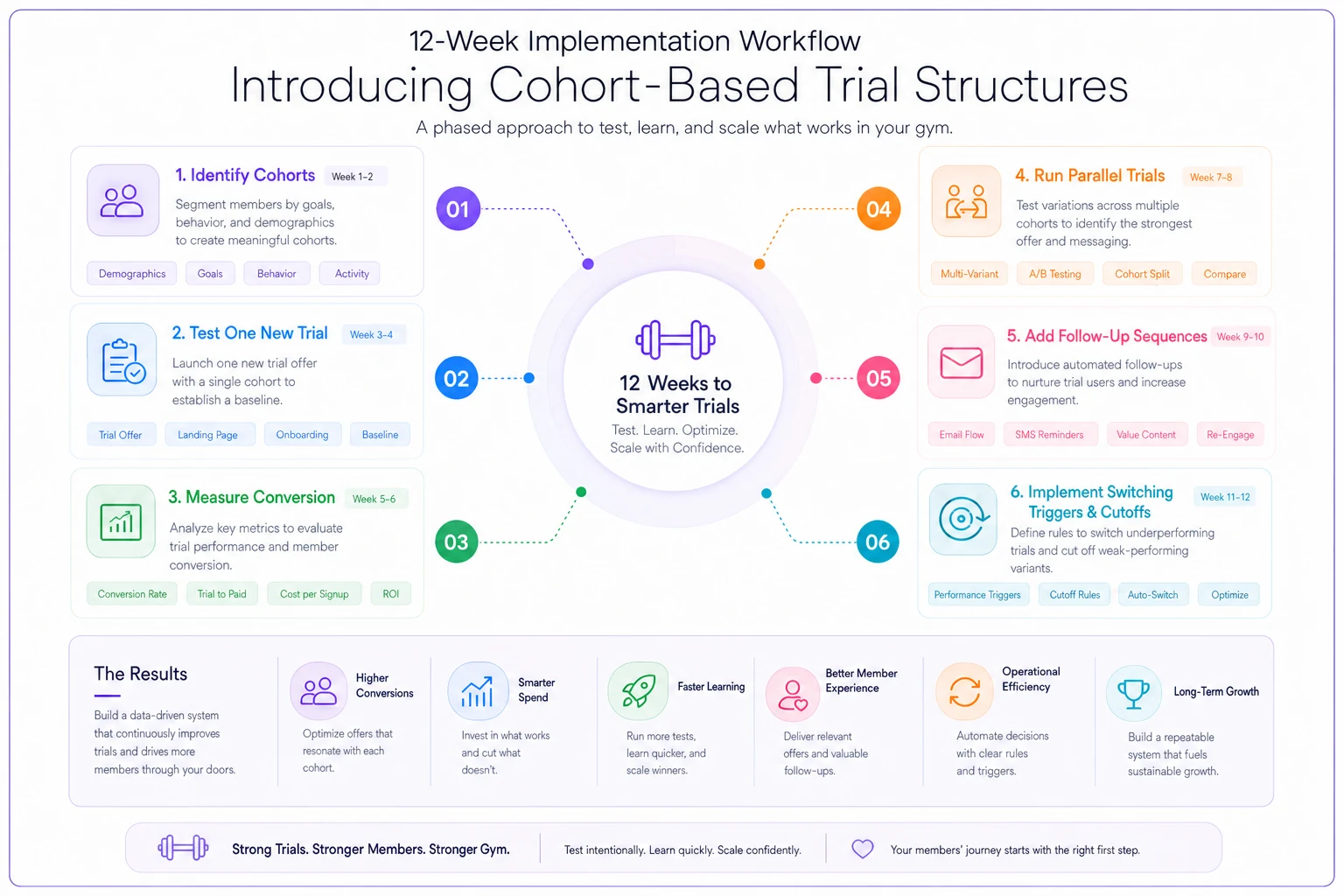
Full implementation takes about a quarter, but you'll typically see conversion improvements within the first month.
Monthly Metrics
The monthly metrics that tell you what's actually working
Track these five numbers consistently:
| Metric | What it tells you | Warning signal |
|---|---|---|
| Trial-to-tour ratio by source | Whether you have a tour problem vs. a trial problem | Walk-ins converting below 30% |
| First-class attendance rate | Booking friction level | Below 70% |
| Trial completion rate by cohort | Whether cohort selection is accurate | Free trials under 80%, paid intros under 60% |
| Conversion rate by sequence | Which sequences need real work | 10-point gap between sequences |
| Time-to-conversion from first contact | Sequence tightness | Creeping past 14-21 days |
Trial-to-tour ratio by source: If website leads convert at 60% to trials but walk-ins convert at 30%, you have a tour problem, not a trial problem.
First-class attendance rate: Below 70% means too much friction in your booking process. Usually your easiest win.
Trial completion rate by cohort: Free trials should see 80%+ completion. Paid intros 60%+. Packages 90%+. Lower than that usually means wrong cohort selection — and pairing this metric with class capacity data helps you figure out whether scheduling is part of the drop-off problem.
Conversion rate by sequence: Each of your four sequences needs its own conversion tracking. A 10-point gap between sequences means one needs real work.
Time-to-conversion from first contact: Extending beyond 21 days usually means permanent loss. If your average is creeping past two weeks, tighten your sequences.
The gym trial conversion strategies that actually work aren't about finding the perfect offer or the perfect price point. They're about matching the right structure to the right person at the right time, then following up based on their actual behavior rather than a predetermined schedule.
Most gyms will keep running one-size-fits-all trials because it feels simpler. Those willing to build segmented trial operations will capture the 40-50% of prospects everyone else loses. The operational complexity pays for itself within a couple months.
But the real advantage is what you learn about your prospects during properly structured trials. Attendance patterns, class preferences, and communication responses tell you exactly how to retain them as long-term members. That intelligence is worth more than the immediate conversion revenue.
The gyms succeeding with this approach aren't necessarily bigger or better funded. They've accepted that different people need different paths into membership, and they've built operations that can deliver those paths without burning out their staff. In a market where everyone offers the same generic trial, that operational sophistication is the actual competitive advantage.
Ready to elevate your gym operations?
Join 2,000+ gyms using Gymioly to reduce admin overhead, improve member experience, and grow revenue.