

Most gyms don't have a marketing problem. They have a deliverability problem wearing a marketing costume.
The pattern repeats constantly: a gym sends a class reminder, a billing failure notice, a "we miss you" win-back, and a Black Friday promo — all from the same domain, all mixed together, no separation. Then a member says "I never got the reminder," another says "your emails go to spam," and the front desk spends its day fielding complaints about messages that technically did send.
The message got delivered. It just didn't land anywhere visible. That gap — between "sent" and "seen" — is where gym revenue quietly leaks. This is a practical walkthrough of email deliverability for gyms: authentication, bounce handling, suppression logic, and how to keep transactional messages far away from marketing blasts.
The core mistake: sending everything from one identity
The single biggest thing that wrecks gym deliverability isn't spammy copy. It's blending flows.
A membership dues receipt and a "50% off summer challenge" email are two completely different things to an inbox provider. One is expected and rarely flagged. The other gets ignored, deleted, or reported by a chunk of your list every time it goes out. When you send both from the same domain and IP, the promo behavior drags down the receipts. So the important stuff — payment failures, class cancellations, door code changes — starts landing in spam too.
In practice, this usually happens when a gym signs up for one all-in-one tool, points everything at noreply@yourgym.com, and never bothers with a separate subdomain for marketing. Everything shares one reputation bucket. When the promos tank, the receipts go down with them.
The fix is boring but non-negotiable: split transactional and marketing into separate sending identities. Keep that mental model through everything that follows — you're protecting the messages people want from the messages you hope they'll open.
Step one: get SPF, DKIM, and DMARC actually correct
Authentication is table stakes now. Gmail and Yahoo both tightened bulk-sender requirements, and if you're sending to more than a handful of members, "we'll set it up later" just means choosing the spam folder.
End appointment chaos and boost attendance.
Gymioly streamlines booking, confirms sessions, and manages memberships effortlessly.
- Unified class and membership management
- Automated member notifications
- Trainer scheduling and availability
No credit card required
-
SPF record exists and includes every sender. If you send through your booking software, your email platform, and your payment processor, all three need to be authorized. A common failure: SPF only lists the marketing tool, so transactional receipts from the billing system fail quietly.
-
SPF stays under 10 DNS lookups. Every service you
include:counts. Gyms that keep adding tools hit the limit and the whole record silently breaks. Flatten it if you're getting close. -
DKIM is signing with your own domain, not the platform's shared signature. Shared DKIM means you inherit the reputation of every other sender on that provider — including the sketchy ones.
-
DMARC is published, starting at
p=noneso you can monitor before doing anything drastic. -
DMARC reports go somewhere a human reads. The
rua=address should land in an inbox you actually check, or a monitoring tool. Reports are how you catch a service sending "as you" without permission. -
Return-Path/bounce domain is aligned to your domain so SPF passes on the envelope, not just the visible From header.
-
A dedicated marketing subdomain (like
mail.yourgym.comorgo.yourgym.com) keeps promo reputation isolated from your root domain.
One detail that trips people up: after setting DMARC to p=none, wait and actually read a few weeks of reports before tightening the policy. Gyms that jump straight to p=reject sometimes discover their own class-reminder system was sending unaligned mail — and now those reminders are being rejected by members' email providers. You broke the exact thing you were trying to protect.
Step two: separate the two flows for real
Once authentication is solid, formalize the split. This is where most of the actual deliverability gains come from.
| Dimension | Transactional flow | Marketing flow |
|---|---|---|
| Examples | Payment receipts, failed-payment notices, class booking confirmations, cancellations, door/access codes, waiver requests | Promotions, challenges, newsletters, referral pushes, win-back campaigns |
| Sending domain | Root or mail. subdomain, tightly protected | Separate go. marketing subdomain |
| Consent needed | Implied — tied to the transaction | Explicit opt-in required |
| Unsubscribe link | Not required (and shouldn't be — you can't let someone opt out of a payment failure) | Required, one-click, honored fast |
| Frequency | As needed, event-driven | Capped and cadenced |
| Tolerance for spam complaints | Near zero — these tank fast | Some expected, manage aggressively |
A member should never be able to unsubscribe their way out of a billing notice or a class cancellation. If someone opts out of marketing, they still need to get "your 6am class is canceled" and "your card was declined." Mixing these flows means an opt-out silently kills messages people genuinely need — and then they're angry about a surprise late fee that's really just a support ticket and a churn risk born from bad architecture.
If you're building out the payment-failure side of your transactional stream, sequencing matters as much as deliverability — there's a full breakdown in the failed-payment recovery workflow that pairs well with this.
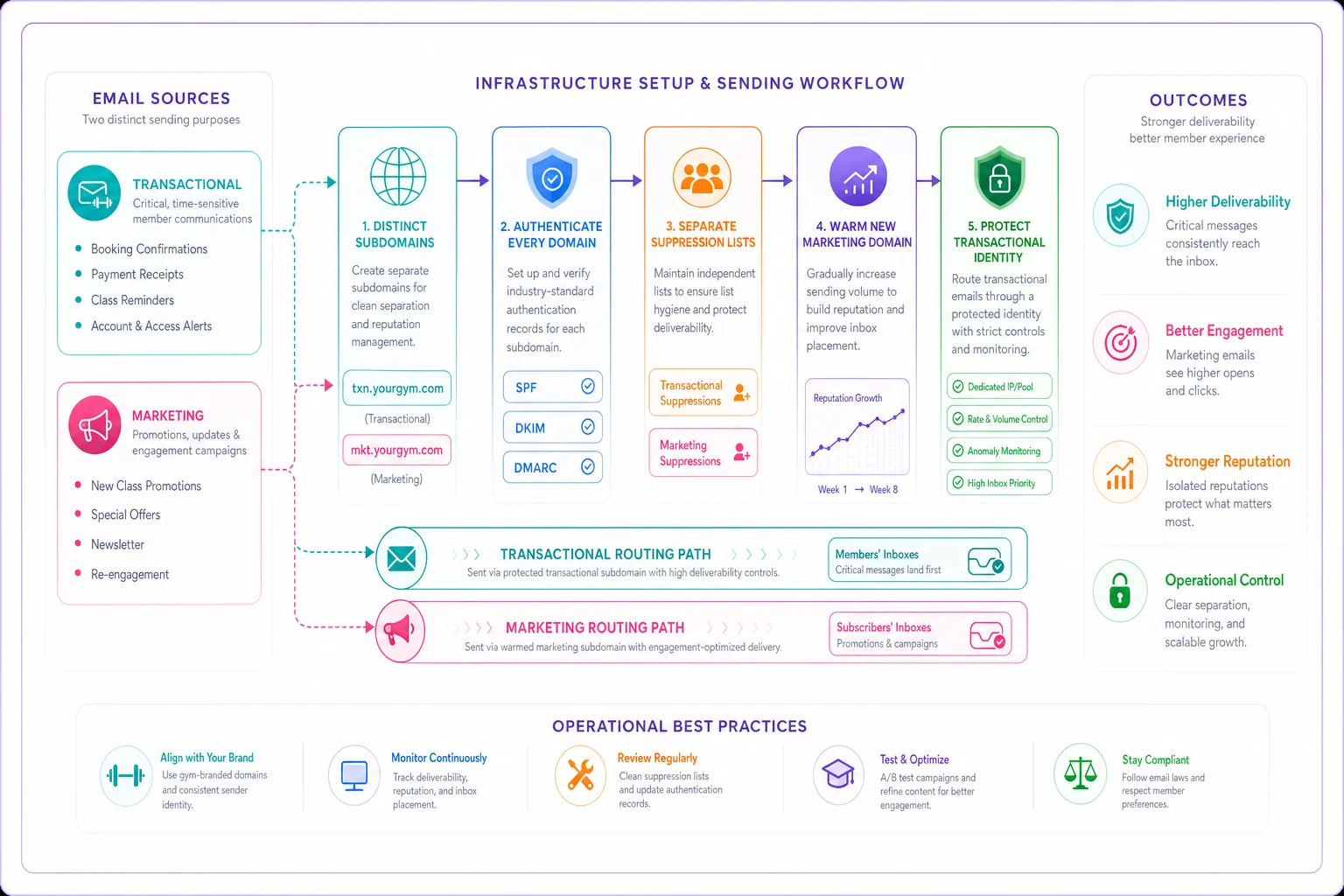
Here's a quick visual of the separation and warm-up workflow.
Bounce handling: the part everyone ignores until it's a fire
Bounces are how gyms slowly poison their own sender reputation without noticing.
-
Hard bounces (address doesn't exist, domain doesn't exist): suppress immediately and permanently. One hard bounce is enough. Don't mail that address again unless the member re-confirms it in person.
-
Soft bounces (mailbox full, server temporarily down, message too large): retry a limited number of times — three attempts over a few days is reasonable — then suppress if it keeps failing. A persistently full mailbox is functionally a dead address.
-
Block bounces (the provider actively rejected you for reputation reasons): treat this as your early warning system. If block bounces spike, stop marketing sends and investigate before you dig the hole deeper.
The operational mistake that shows up most often: a gym exports its member list to a new email tool and blasts the whole thing — including addresses that hard-bounced for two years on the old system. The bounce history didn't travel with the list. The new tool sees a 6–8% bounce rate on the first send, flags the account, and now even the clean addresses land in spam. Migrating tools without migrating your suppression list is one of the fastest ways to torch a good domain.
Suppression lists: your most underrated asset
A good suppression list isn't a punishment list. It's what protects your reputation. Treat it like an operational asset.
What belongs on it:
-
Hard bounces — permanent, as covered above.
-
Spam complainers — anyone who hit "report spam." Never mail them marketing again. Chasing a complainer costs more reputation damage than any single member is worth.
-
Explicit opt-outs — honored across every marketing send, immediately.
-
Repeated non-engagers — this is the one gyms almost always skip. If someone hasn't opened a marketing email in six to nine months, continuing to mail them signals to Gmail that you send to people who don't care. That behavior suppresses inbox placement for your whole list.
That last category deserves real re-engagement logic before you drop anyone entirely. Run one clean attempt: a short, plain-text-style "still want to hear from us?" message with an easy yes. Openers stay. Non-openers move to a suppressed segment — not deleted, just paused from marketing. They still receive every transactional message because those live on a separate flow you never suppress.
Keep a separate suppression segment for long-term non-openers so they remain paused from marketing without losing transactional messages.
The suppression list is doing two jobs at once: keeping your reputation clean with inbox providers, and making sure the people who do want your messages actually get them.
Cadence and A/B testing without wrecking your reputation
Gyms tend to overcorrect on cadence. Either they email once a quarter and every send feels cold, or they blast four times a week during a promo push and complaints spike. Both hurt placement.
-
Warm up new subdomains gradually. A brand-new marketing subdomain that suddenly sends 4,000 emails on day one looks exactly like a spammer. Ramp volume over a couple of weeks — start with your most engaged members, expand outward as reputation builds.
-
Send to engaged segments first. Your last-30-day openers are your reputation anchor. Front-loading sends to them keeps engagement metrics healthy, which holds up placement for the wider list.
-
A/B test one variable at a time. Subject line, or send time, or preview text — not all three simultaneously. Change everything at once and you learn nothing useful.
A simple A/B framework that works with deliverability instead of against it:
-
Pick one variable (subject line is a good starting point — it drives open rate, which drives reputation).
-
Split a small slice of your engaged segment — around 15–20% total — into A and B.
-
Send to that slice first.
-
Wait a few hours for open data.
-
Send the winning version to the rest of the list.
This improves the campaign and ensures your largest send goes out as the higher-engagement version, protecting sender reputation on the big volume.
One note on send timing: fitness audiences generally skew toward early morning and early evening, around workout windows. But don't over-index on industry benchmarks — your own open data will tell you more than any general chart.
Sample templates, separated by flow
Templates matter less than the flow they live in, but here's the shape of each.
Transactional — failed payment (no unsubscribe link, sent from your protected domain):
> Subject: Action needed: your [Gym Name] payment didn't go through > Hi [First Name] — we tried to run your monthly membership payment today and it didn't process. This can happen when a card expires. Update your payment info here: [link]. Your access stays active while you sort it out. Questions? Reply to this email or call the front desk.
Transactional — class cancellation:
> Subject: Canceled: [Class Name] on [Date] at [Time] > Hi [First Name] — [Class Name] on [Date] is canceled. You've been removed from the roster so you won't be charged a no-show. Want to rebook? Here are the next available sessions: [link].
Marketing — re-engagement (sent from marketing subdomain, one-click unsubscribe included):
> Subject: Still want these? [First Name], your call. > We noticed you haven't opened our updates in a while, and we don't want to clutter your inbox. Want to keep getting class updates, challenges, and member perks? Tap here to stay in: [link]. No action means we'll quietly pause these — you'll still get anything account-related.
Notice the re-engagement message tells the member what happens if they ignore it. That transparency reduces spam complaints, which is the whole point.
SMS deserves its own rules
SMS deliverability works differently from email, and gyms trip on it because they treat texts like a free channel with no consequences.
The big one: carrier compliance is real now. 10DLC registration for business texting isn't optional anymore. Unregistered numbers get filtered or blocked by carriers, and your "your 6am class moved to 6:15" text just doesn't arrive. Register your sending numbers, and keep transactional texts — reminders, confirmations, cancellations — separate from promotional texts, because promotional SMS has stricter consent and opt-out requirements.
Practical SMS suppression rules:
-
Honor STOP instantly and permanently for that number. Carriers enforce this; ignoring it gets you blocked.
-
Suppress invalid or landline numbers you keep texting — same reputation logic as email bounces.
-
Keep promo SMS rare. Text fatigue hits faster and harder than email fatigue. One or two promotional texts a month is plenty. Reminders and confirmations don't count against that — they're expected and usually welcomed.
The onboarding window is where consent gets captured cleanly or messily. Getting explicit SMS opt-in during signup — separate from the general "I agree to terms" checkbox — is what keeps your promotional texts both legal and deliverable. If you're formalizing that intake process, the 14-day onboarding sequence is a good place to bake consent capture into an existing flow rather than bolting it on later.
What this actually looks like in practice
A single-location gym with roughly 900 active members had been running everything through one email tool, one domain, no DMARC, and no real bounce management. Class reminders and payment notices were going out from the same identity as monthly promo blasts.
The visible symptom was front-desk complaints: members claiming they "never got" reminders, occasional surprise billing issues from payment failures nobody saw. Open rates on transactional emails were sitting around 40% — low for messages people should genuinely want.
The fixes weren't glamorous. They set up SPF, DKIM, and DMARC properly, moved marketing to a go. subdomain, cleaned a couple years of accumulated hard bounces off the list, and built a real suppression list that included complainers and long-term non-openers. Then they warmed the marketing subdomain slowly instead of blasting from day one.
Within about six weeks, transactional open rates climbed into the mid-60s, front-desk complaints about missed messages dropped noticeably, and marketing sends stopped landing in spam for engaged members. No new copywriting. No new offers. Just fixing the plumbing so messages actually arrived where people could see them.
Where software actually helps here
You can run all of this manually with DNS records, a solid ESP, and disciplined list hygiene. Plenty of gyms do. The place it gets hard is keeping the separation intact as your stack grows — making sure every new tool that sends mail gets added to SPF, that hard bounces are suppressed the same day across email and SMS, that opt-outs propagate everywhere, and that transactional flows never accidentally inherit an unsubscribe flag from a marketing campaign.
That's the operational layer where an AI-assisted platform earns its keep — not by writing your emails, but by watching bounce patterns, auto-suppressing dead addresses before they hurt your reputation, flagging when a block-bounce spike means you should pause sends, and keeping transactional and marketing flows structurally separated so a marketing opt-out never kills a payment notice. The value isn't cleverness. It's consistency across hundreds of small decisions that are easy to get wrong by hand.
The bottom line
Deliverability for gyms comes down to one discipline: protect the messages members need by keeping them completely separate from the messages you want to send. Authenticate properly, split your flows, suppress ruthlessly, and let your engaged members carry your reputation.
Do that, and the class reminders show up, the billing notices get seen, and your promos stop dragging down the mail that actually keeps your gym running. Skip it, and you'll keep paying for messages that send perfectly — into a folder no one opens.
Deliverability for gyms comes down to one discipline: protect the messages members need by keeping them completely separate from the messages you want to send. Authenticate properly, split your flows, suppress ruthlessly, and let your engaged members carry your reputation.
Do that, and the class reminders show up, the billing notices get seen, and your promos stop dragging down the mail that actually keeps your gym running. Skip it, and you'll keep paying for messages that send perfectly — into a folder no one opens.
Ready to elevate your gym operations?
Join 2,000+ gyms using Gymioly to reduce admin overhead, improve member experience, and grow revenue.