


You've probably already decided non-dues revenue is worth chasing. Maybe you ran a Saturday workshop, sold a few hoodies, or hosted a member competition that pulled in a couple grand. The problem isn't whether to do it — it's that most gym owners run these one-offs without a model, so they never actually know if the thing made money once you count the staff hours, the inventory sitting in the back office, or the Stripe fees nobody added up.
This toolkit fixes that. It's the practical, spreadsheet-level layer that sits under the strategy work in validating non-dues revenue with unit-economics micro-models. Here you get the actual column names, the formulas, three fully worked examples with real numbers, and runbooks you can execute without hiring an analyst.
The core non‑dues revenue micro‑model spreadsheet (copy‑paste schema)
Every event, SKU, and workshop should flow through one standardized sheet. The mistake most owners make is building a new spreadsheet each time, which means no two things are ever comparable and nobody can tell you your best-performing revenue line six months later.
| Column | Type | Notes / Formula |
|---|---|---|
offer_id | text | e.g. EVT-2026-03, MERCH-HOODIE-BLK |
offer_type | dropdown | event / merch / workshop |
gross_price | currency | price member pays |
units_sold | number | tickets, SKUs, or seats |
gross_revenue | formula | =grossprice*unitssold |
variablecostunit | currency | COGS, printing, catering per head |
totalvariablecost | formula | =variablecostunit*units_sold |
paymentfeepct | % | your processor rate, e.g. 2.9% |
paymentfeefixed | currency | per-transaction fixed, e.g. $0.30 |
total_fees | formula | =(grossrevenuepaymentfeepct)+(paymentfeefixedunitssold) |
staff_hours | number | setup + run + teardown |
staff_rate | currency | blended hourly incl. payroll tax |
staff_cost | formula | =staffhours*staffrate |
fixed_cost | currency | venue, rentals, one-time design |
total_cost | formula | =totalvariablecost+totalfees+staffcost+fixed_cost |
contribution_margin | formula | =grossrevenue-totalcost |
cmperunit | formula | =contributionmargin/unitssold |
cm_pct | formula | =contributionmargin/grossrevenue |
breakeven_units | formula | =fixedcost/(grossprice-variablecostunit-(grossprice*paymentfeepct)-paymentfee_fixed) |
The single most common error is leaving staff_cost out entirely. Owners price an event off ticket price minus catering and call the rest profit. But a Saturday event that eats 14 combined staff hours at a $26 blended rate just absorbed roughly $360 before anyone bought a drink. That line is the difference between a real micro-model and a daydream.
A note on the blended staff rate: use your actual loaded cost, not the posted wage. Add payroll tax, and if it's a weekend or overtime trigger, bump it. A $18/hr trainer frequently costs $22–$24 fully loaded.
Worked example 1: a member competition event
Real numbers through the schema. In-house throwdown, Saturday, open to members plus a few guests.
End appointment chaos and boost attendance.
Gymioly streamlines booking, confirms sessions, and manages memberships effortlessly.
- Unified class and membership management
- Automated member notifications
- Trainer scheduling and availability
No credit card required
-
-
gross_price$35
-
-
units_sold48 (42 members, 6 guests)
-
-
gross_revenue$1,680
-
-
variablecostunit$9 (t-shirt + protein bar + judging materials amortized)
-
-
totalvariablecost$432
-
-
paymentfeepct2.9%,
paymentfeefixed: $0.30 →total_fees: ~$63.10 -
-
staff_hours16 (two coaches + one front desk, ~5.3 hrs each incl. setup/teardown)
-
-
staffrate$24 →
staffcost: $384 -
-
fixed_cost$150 (banner, medals, prize)
-
-
total_cost432 + 63.10 + 384 + 150 = $1,029.10
-
-
contribution_margin~$650.90
-
-
cm_pct~39%
-
-
breakeven_units150 / (35 − 9 − 1.015 − 0.30) ≈ 6.1 units
This event cleared about $651. Not nothing, but notice the shape: breakeven was only around 6 tickets, meaning fixed costs were cheap and risk was low. The real constraint is staff cost scaling with how many hours you throw at it.
The insight most people miss: the lever here isn't price, it's attendance. Going from 48 to 70 attendees barely moves your cost — same banner, maybe one more coach hour — but adds roughly $560 in margin. Events with low breakeven and high headroom are the ones worth repeating.
Worked example 2: a single merch SKU
Black logo hoodie. This is where gyms quietly bleed money, usually because they order on vibes.
-
-
gross_price$48
-
-
units_sold40 (this ordering cycle)
-
-
gross_revenue$1,920
-
-
variablecostunit$21 (blank + embroidery)
-
-
totalvariablecost$840
-
-
paymentfeepct2.9% + $0.30 →
total_fees: ~$67.70 -
-
staff_hours3 (ordering, receiving, inventory, fulfillment)
-
-
staffrate$22 →
staffcost: $66 -
-
fixed_cost$0 (no one-time design this cycle)
-
-
total_cost840 + 67.70 + 66 = $973.70
-
-
contribution_margin~$946.30
-
-
cmperunit~$23.66
-
-
cm_pct~49%
Looks great — until you remember you didn't order 40. You ordered 60 to hit the per-unit price break, and 20 are still folded in a closet. Those 20 units are $420 in trapped cash at the blank+embroidery cost.
-
-
units_ordered(60) -
-
sellthroughpct==unitssold/unitsordered(67%)
A SKU isn't "profitable" until sell-through covers the full order cost. For this hoodie, you clear total order cost (~$1,320 landed on 60 units) once you've sold around 28 units. Everything past that is gravy; everything in the closet is a decision you'll regret at next tax time.
Worked example 3: a workshop cohort
Six-week nutrition + habit workshop, limited seats, delivered by one coach.
-
-
gross_price$220
-
-
units_sold14 seats
-
-
gross_revenue$3,080
-
-
variablecostunit$18 (printed workbook, materials)
-
-
totalvariablecost$252
-
-
paymentfeepct2.9% + $0.30 →
total_fees: ~$93.50 -
-
staff_hours24 (12 hrs delivery + 12 hrs prep/messaging over 6 weeks)
-
-
staffrate$30 (senior coach) →
staffcost: $720 -
-
fixed_cost$120 (platform/handout design, one-time)
-
-
total_cost252 + 93.50 + 720 + 120 = $1,185.50
-
-
contribution_margin~$1,894.50
-
-
cmperunit~$135
-
-
cm_pct~62%
-
-
breakeven_units120 / (220 − 18 − 6.38 − 0.30) ≈ 0.6 seats
Workshops are structurally the strongest of the three. Fixed cost is tiny, variable cost per seat is almost nothing — the whole cost base is coach time, which is fixed once you commit to running the cohort.
Every seat past breakeven is nearly pure margin, so the entire game is filling seats, not controlling cost. A cohort at 14/16 seats earns dramatically more than one at 8/16, for identical coach hours. That reframes where you spend energy: enrollment, not budgeting.
Experiment runbooks (with sample sizes and decision rules)
A model tells you what did happen. A runbook tells you what to test next. Each of these is designed to be run once, read clearly, and either repeated or killed.
Runbook A: Early-bird pricing
-
- Hypothesis An early-bird window raises total enrollment without cannibalizing full-price buyers.
-
- Setup Offer $180 early-bird (first 7 days) vs $220 standard for the same workshop.
-
- Sample size You need roughly 2 cohorts per arm to see a real signal — small gyms rarely get statistical significance on one run, so use a practical threshold instead of a p-value.
-
- Decision rule Keep early-bird if total cohort
contribution_margin≥ 110% of your standard-only baseline. Kill it if ≥60% of buyers would have paid full price anyway (ask on intake: "when did you decide to sign up?").
Runbook B: Tiered bundles
-
- Hypothesis A "workshop + hoodie + 2 guest passes" bundle lifts average order value.
-
- Setup Offer bundle at $265 alongside the $220 standalone.
-
- Decision rule Keep if bundle attach rate ≥ 25% AND blended
cmperunitrises. Watch the trap: if the hoodie in the bundle is priced below its standalone margin, you can grow revenue while shrinking margin. Model it in the base sheet first.
Runbook C: Pre-order vs inventory (merch)
-
- Hypothesis Pre-selling eliminates trapped-cash risk at the cost of some impulse sales.
-
- Setup Run one SKU as pre-order (order only what's sold) vs the previous cycle's buy-ahead.
-
- Decision rule Default to pre-order unless impulse/walk-up sales historically exceed ~30% of volume. The dead inventory from example 2 is exactly the cost pre-order removes.
Runbook D: Limited-seat pilot
-
- Hypothesis Capping seats and signaling scarcity fills faster.
-
- Setup Advertise "16 seats only" vs open enrollment.
-
- Decision rule Keep scarcity framing if time-to-fill drops by a third or more. Don't cap below your breakeven seat count.
Runbook E: Sponsor package pilot
-
- Hypothesis A local business will pay to sponsor an event, converting member attendance into offsettable cost.
-
- Setup Offer a $300–$750 sponsor package (logo on shirts, booth, email mention) for your competition event.
-
- Decision rule Pursue sponsorship only if it covers ≥50% of
fixedcost + staffcost. Below that, the admin overhead of managing a sponsor isn't worth it.
Here's a simple runbook workflow diagram:
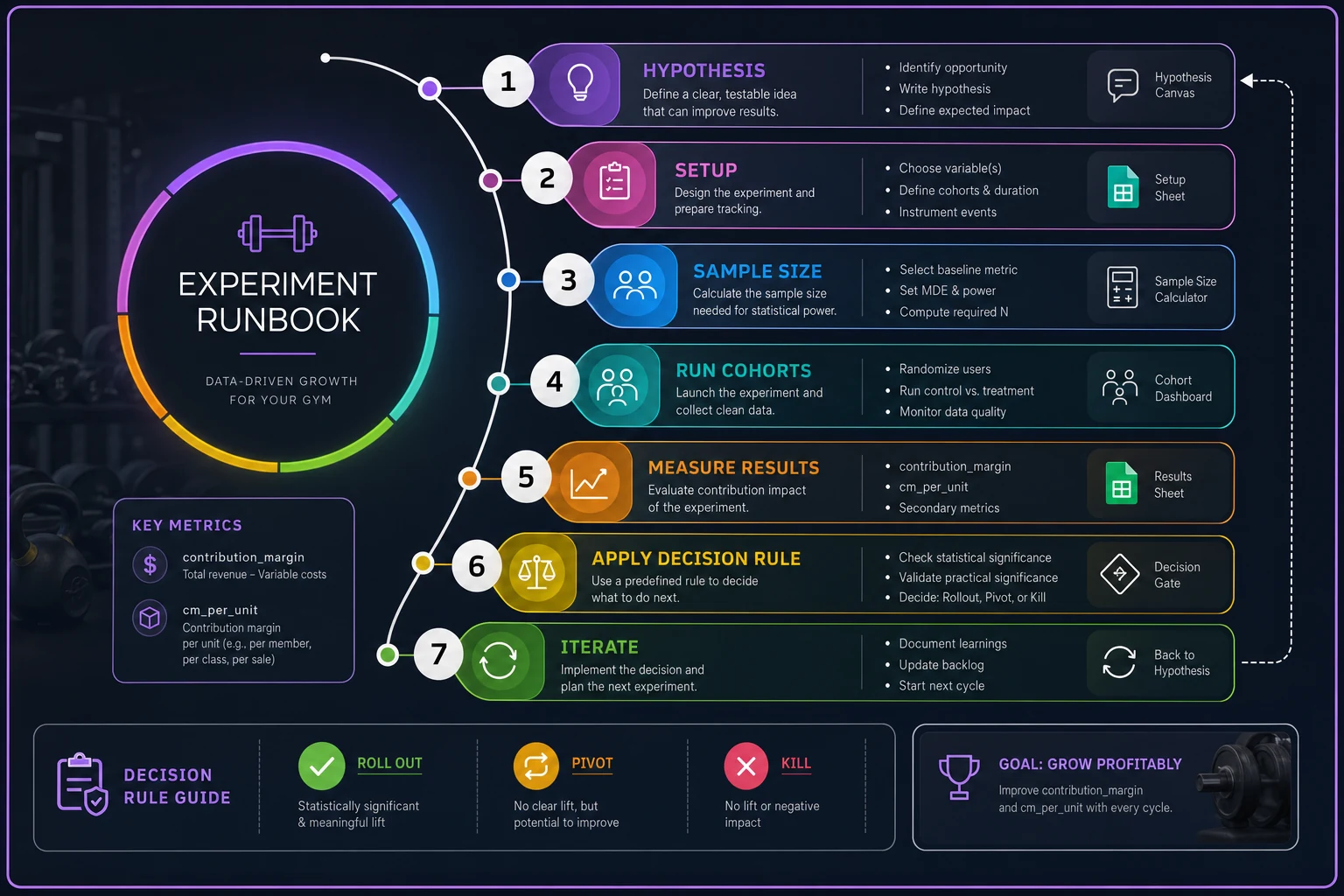
Use the diagram to walk stakeholders through a single experiment from start to finish so everyone understands the decision rule ahead of time.
Sponsor KPI & instrumentation playbook
If you sell sponsorship, the sponsor will eventually ask "what did I get?" Have the answer ready before they ask, or you won't get a second check.
-
- Reach email opens, SMS deliveries, social impressions tied to the event
-
- Attendance headcount, unique members, guest count
-
- Booth engagement scans, sign-ups, or samples handed out (give the sponsor a simple tally sheet)
-
- Attributed leads anyone who opted into the sponsor's offer
-
- Cost offset delivered the actual dollar value of what you fronted vs what they paid
Build a one-page sponsor recap. The gyms that renew sponsors are the ones who send a clean recap within 48 hours while the event is still fresh. That's not a sales tactic — it's just making it easy for them to say yes again.
Dashboard / data schema for an automated micro‑P&L
Once you've run a handful of offerings, you want a rollup, not fifteen separate tabs. The dashboard sheet pulls from your base schema.
-
-
month -
-
offer_type -
-
totalgrossrevenue==SUMIFS(...)by type and month -
-
totalcontributionmargin -
-
avgcmpct -
-
revenueperstaffhour==totalcontributionmargin / SUM(staffhours)
That last metric is the most useful and the most ignored. Contribution margin per staff hour tells you which revenue line actually deserves your team's limited weekend time. A merch SKU might clear $946 on 3 hours (~$315/hr of margin), while an event clears $651 on 16 hours (~$41/hr). Both are "profitable." Only one is efficient.
This is where lightweight operational software earns its place — not as magic, but by auto-pulling grossrevenue and unitssold from your POS and booking system so the sheet updates without manual entry. If you're hand-typing numbers off receipts each month, the dashboard quietly rots and you stop looking at it. The practical win from automation here is simply that the data stays current enough to trust.
Staffing SOP & checklist for running an offering
The margin math falls apart when staff hours drift. Standardize the run.
Pre-event checklist:
-
- [ ] Assign a single owner for the offering (one name, not "the team")
-
- [ ] Confirm staff roster and lock hours against the budget line
-
- [ ] Load inventory / materials count into the sheet
-
- [ ] Set payment link and test one transaction end-to-end
-
- [ ] Schedule the reminder messages (48 hr + 2 hr)
Day-of checklist:
-
- [ ] Timestamp actual setup start/end
-
- [ ] Log real attendance vs sold
-
- [ ] Capture sponsor booth tallies if applicable
Post-event (within 48 hrs):
-
- [ ] Enter actual staff hours — not estimated
-
- [ ] Reconcile units sold vs units on hand
-
- [ ] Update dashboard
-
- [ ] Send sponsor recap / cohort follow-up
Use a single owner and a shared timer to log setup and teardown in real time to avoid estimation bias.
The one that gets skipped every time is logging actual staff hours. Estimated hours make every event look better than it was. Real hours are how you catch the Saturday that secretly cost four extra setup hours nobody accounted for.
Tax & shipping modeling (the part that bites later)
Two areas quietly erode merch and event margin.
Sales tax: If your gym charges tax on merch and events, make sure the tax collected is a pass-through, not revenue you're mentally spending. Add a taxcollected column so it never gets mixed into grossrevenue. Owners who skip this over-report their margin all year and get surprised at filing.
Shipping (if you ship merch at all): Model it per order, not per unit. A $9 ship cost on a single $48 hoodie wrecks the margin; the same $9 on a 3-item order is fine. If you ship, set a free-shipping threshold above your average order value, not below it.
A quick worked line: hoodie at $48, ship cost $9, fee $1.69 → realized margin drops from ~$24 to ~$13.60 per single-item shipped order. That's a 43% haircut on margin from one overlooked cost. For most single-site gyms, local pickup beats shipping on every metric.
UX checkout tactics & pricing‑sensitivity recipes
A few concrete moves that reliably affect conversion on non-dues offers:
-
- Pre-fill member info. Logged-in members shouldn't retype their name and email. Every extra field drops completion.
-
- One price, visible total. Show the all-in price including tax before checkout. Surprise fees at the end are the top abandon cause for member purchases.
-
- Scarcity only when real. "3 seats left" works until members notice it's always 3 seats left.
Pricing-sensitivity recipe (simple version): run the same offer at two prices across two cohorts. Compute contribution_margin at each. If the higher price nets more total margin even with fewer units, raise it permanently. Workshops in particular are usually underpriced — a $220 → $240 bump rarely loses a full seat, and each seat is ~$135 of margin.
Vendor / integration checklist
Before you wire anything together:
-
- [ ] Does your POS export
unitssoldandgrosspriceper SKU? -
- [ ] Does your booking tool tag workshop/event seats distinctly from membership?
-
- [ ] Can your processor report fees per transaction (not just monthly lump sum)?
-
- [ ] Is tax broken out in every export?
-
- [ ] Can you pull all of the above without a manual re-type step?
If three or more of those are "no," your micro-P&L will always lag reality. Lagging data is why most non-dues experiments get abandoned — not because they failed, but because nobody could tell in time.
Risk / exit templates: when to kill an offering
Decide the kill conditions before you launch. Write them down.
-
- Kill merch SKU if sell-through < 50% at 90 days → stop reordering, discount to clear.
-
- Kill workshop if two consecutive cohorts fill below breakeven seats.
-
- Kill event if
revenueperstaff_hour< your trainer's billable rate for two runs. If the event earns less per hour than just coaching, coach. -
- Kill sponsorship if the recap can't show measurable reach and the sponsor hesitates to renew.
Pre-committing to exits is what keeps non-dues revenue from becoming a graveyard of projects nobody will admit are dead.
When this toolkit makes sense — and when it doesn't
It makes sense when you're already running at least one non-dues offering informally and want to know if it's actually worth your team's time. The modeling pays for itself the first time it stops you from reordering dead inventory or re-running a loss-making event.
It's a bad idea when your core membership operations are still shaky. If you haven't nailed retention and your month-end close is chaotic, bolting on merch and workshops just spreads a thin team thinner. Fix the base first.
Who should skip it: a brand-new gym under six months old. You don't yet have the attendance baselines or sell-through history these models depend on. Run a couple of casual events first, then come back and model them.
A quick real scenario
A single-location strength gym, around 210 members, had been running quarterly in-house competitions and selling apparel "when we remember to reorder." No model. The owner assumed merch was the money-maker because the sticker margins looked fat.
Once everything ran through one micro-model sheet, the picture flipped. The apparel line had roughly 35% of each order sitting unsold — the realized margin was closer to $11/unit than the $24 they'd assumed, and the trapped cash was somewhere in the $600–$800 range across SKUs. Meanwhile, the quarterly competitions were clearing a modest but reliable ~$600 each, and the one workshop they'd run almost by accident had the best contribution margin per staff hour of anything on the sheet.
They made three changes: moved apparel to pre-order only, doubled down on workshops with a proper enrollment push, and kept events as a quarterly community play rather than a revenue line. Within two quarters, non-dues contribution margin was meaningfully up — not from selling more stuff, but from killing the thing that was quietly losing money and feeding the thing that wasn't.
That's the whole point of a non-dues revenue micro-model spreadsheet. It doesn't make your offerings better by itself. It just stops you from mistaking busy for profitable — and tells you exactly where your next free Saturday is actually worth spending.
Ready to elevate your gym operations?
Join 2,000+ gyms using Gymioly to reduce admin overhead, improve member experience, and grow revenue.