

Most gym owners approach non-dues revenue backward. They see another gym selling protein shakes, so they buy a blender and some powder. They hear about nutrition coaching working somewhere else, so they hire a nutritionist. Six months later, they're stuck with dead inventory, a nutritionist with three clients, and no clear picture of what's actually making money.
The real problem isn't finding gym non-dues revenue opportunities — it's validating them without disrupting your core operation. The pattern is consistent: successful non-dues revenue requires micro-level tracking, controlled testing, and clear operational boundaries.
Why traditional P&L tracking fails for ancillary revenue
Your main P&L tells you membership revenue hit $47k and total expenses were $41k. Great — you made $6,000. But that same P&L completely obscures whether your smoothie bar lost $800, your massage therapy partnership broke even, or your supplement sales generated $1,400 in actual profit.
Standard gym accounting systems lump everything together. Labor gets pooled. Overhead gets spread by square footage. Marketing costs disappear into a general line item. You end up flying blind on individual revenue streams.
This matters because non-dues revenue streams have wildly different economics. A nutrition coaching program might carry 70% margins but require specialized staff. Retail products might show 30% margins but tie up cash in inventory. Recovery services might break even on paper but drive member retention worth thousands more than the direct revenue shows.
Without SKU-level or event-level tracking, expansion decisions come down to gut feeling. That's how gyms end up with three barely-profitable revenue streams instead of one that actually moves the needle.
Building micro-P&L models that actually work
Revenue Attribution Track every dollar to its source. A protein shake sold after class gets tagged differently than one sold to a walk-in. A recovery boot session bundled with membership tracks separately from standalone bookings.
End appointment chaos and boost attendance.
Gymioly streamlines booking, confirms sessions, and manages memberships effortlessly.
- Unified class and membership management
- Automated member notifications
- Trainer scheduling and availability
No credit card required
Direct Cost Allocation Only include costs that disappear if you kill the program. For smoothies: product cost, dedicated labor if applicable, equipment lease if relevant. Not your general manager's salary or rent.
Time-Based Contribution Calculate profit per hour of operational time required. A $30 massage that requires an hour of therapist time plus 15 minutes of front desk coordination has different economics than a $30 supplement sale that takes two minutes.
Inventory Velocity Metrics For physical products, track turns per month. Dead inventory kills profitability faster than low margins. Those premium yoga mats with 40% margins mean nothing if they sit for six months.
Here's a simple visual workflow to map the micro-P&L steps for a single SKU before you run an experiment.
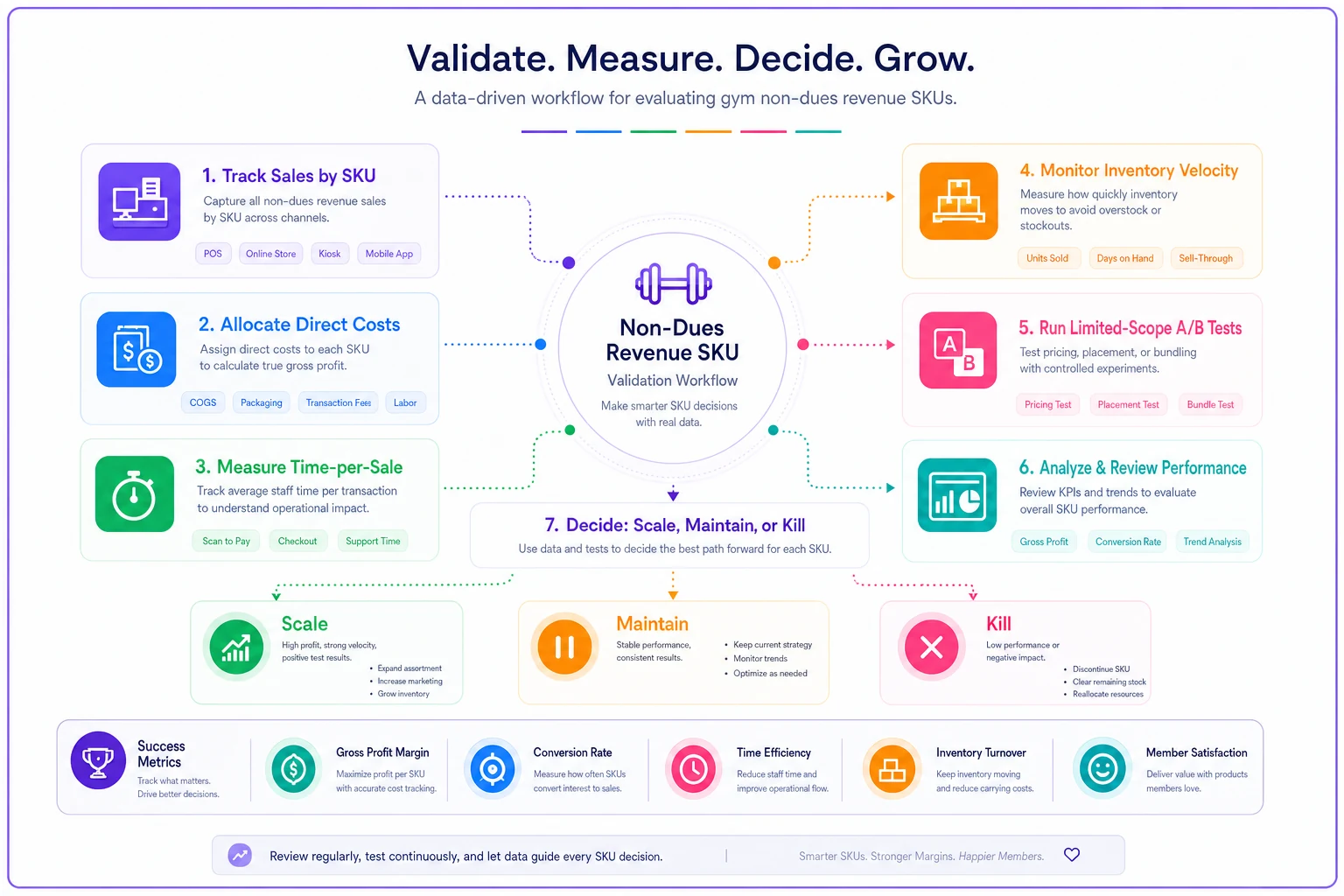
One gym discovered their profitable-looking supplement sales were actually losing money once they factored in the 20 minutes of staff education time per sale. The numbers looked fine until someone actually accounted for that time. Another found their "unprofitable" recovery lounge was driving around $3,200 monthly in membership upgrades that never showed up in the service's direct P&L. Both of these things are easy to miss when you're only looking at top-line revenue.
The A/B testing framework for new services
Testing new revenue streams in a live gym environment creates chaos if you don't have boundaries. Staff get confused about priorities. Members get mixed messages. Operations spiral.
The approach that actually works is structured around four constraints.
Limited Scope Launch Pick one segment, one location, or one time window. Test nutrition coaching with just your 6am crew. Offer recovery services only on weekends. Keep the blast radius small.
Fixed Experiment Timeline Run for exactly 30, 60, or 90 days. No extensions because "it's almost working." You need clean start and stop points to measure impact accurately.
Pre-Set Decision Criteria Before launching, document what success looks like. Not "if it goes well" — specific numbers: 20+ sales per week, 40%+ margin, under 10 hours of weekly staff time.
Control Group Tracking Monitor members who didn't participate. Did class attendance drop because staff got distracted? Sometimes the indirect effects matter more than the direct revenue.
A franchise location tested premium small-group training by offering it only to members who joined in January. They tracked everything: session attendance, membership retention, retail purchases, referrals. After 60 days, the data showed small-group participants had roughly 3x the lifetime value — but only if they started within their first month of membership. That single insight reshaped their entire onboarding strategy.
Staffing mechanics that protect your core business
The fastest way to kill a promising revenue stream is letting it cannibalize your core operation. Front desk staff start pushing supplements instead of memberships. Trainers focus on nutrition coaching instead of filling their training slots. Everyone chases the new thing.
Dedicated vs Shared Resources Decide upfront: does this revenue stream get dedicated staff or share existing resources? Shared resources only work if you have genuine idle time. A front desk person can handle smoothie sales during slow periods. They can't run a nutrition consulting program while checking in members.
Commission Structure Alignment If you pay commission on supplement sales but not on membership renewals, guess what your staff will prioritize? Any non-dues revenue commission has to complement core revenue incentives, not compete with them.
Capacity Thresholds Set hard limits on how much time existing staff can dedicate to ancillary revenue. Maximum 20% of trainer time on nutrition coaching. Maximum 10% of front desk time on retail. When you hit the threshold, either hire dedicated resources or cap the program.
Skills-Based Assignment Not every trainer should sell supplements. Not every front desk person should explain recovery services. Match staff to revenue streams based on actual skills and interest, not just availability.
Getting this wrong is one of the more common mistakes. The staff alignment piece tends to get skipped because it feels like a soft issue — but it determines whether a revenue stream survives past the first 90 days.
Inventory and equipment investment rules
Consignment First Start with consignment agreements when possible. Yes, margins will be lower. But you're buying information, not just inventory. One gym tested CBD products on consignment for 90 days, learned which SKUs actually moved, then negotiated direct purchasing for just the top sellers.
Graduated Equipment Investment Don't buy a $15,000 recovery system before proving demand. Rent or lease first. One location rented massage guns for around $200/month, confirmed demand over 90 days, then purchased equipment only after hitting 40+ sessions weekly consistently.
Turnover Requirements Set minimum velocity standards for any SKU. If a product doesn't turn in 45 days, mark it down. If it doesn't move in 90 days, it's gone. Dead inventory doesn't just tie up cash — it signals that your retail section is stale.
Category Depth Limits Start with one brand, three SKUs per category. Prove the category before expanding. Too many options paralyze customers and complicate operations. Variety can come later after core demand is validated.
Setting decision cutoffs before emotions kick in
Every new revenue stream feels promising in month one. By month three, you're emotionally invested. By month six, you're justifying poor performance because of everything you've already put into it.
Minimum Viable Metrics Document specific thresholds before launching. A recovery lounge needs 15 sessions daily at $20 each to justify the space. Nutrition coaching needs 10 active clients at $150/month to cover the contractor. No exceptions.
Time-Based Gates
| Timeframe | What You're Evaluating |
|---|---|
| 30 days | Proof of concept — any sales at all? |
| 60 days | Trend validation — growing or flat? |
| 90 days | Profitability check — hitting margin targets? |
| 180 days | Scale decision — expand, maintain, or kill? |
Opportunity Cost Calculation Every square foot used for retail could be used for training. Every hour spent on nutrition coaching could go toward membership sales. Calculate what you're giving up, not just what you're gaining.
Exit Criteria Document exactly how you'll wind things down if needed. How will you clear inventory? How will you transition clients? What will you tell members? Having an exit plan makes it easier to actually use it when you need to.
When non-dues revenue actually makes sense (and when it's a distraction)
Not every gym needs non-dues revenue. If you're struggling to fill classes or retain members, fix that first. Ancillary revenue is expansion, not salvation.
Non-dues revenue makes sense when your membership base is stable and growing, you have actual idle resources — space, time, or staff — members are actively requesting additional services, you can maintain focus on core operations, and the revenue stream reinforces your gym's positioning.
It's a distraction when you're under 70% membership capacity, retention is below 80% annually, you're understaffed for current operations, you're chasing revenue to cover operational losses, or it conflicts with your core value proposition.
One boutique studio killed their profitable retail section because it conflicted with their minimalist brand. Revenue dropped around $2,000 monthly, but membership grew 12% once the messaging became consistent again. Sometimes the right call is the one that costs you in the short term.
Connecting revenue streams to member lifecycle stages
First 30 Days New members are in buying mode. They'll invest in gear, supplements, or foundational programs. One gym pulls in around $120 average ancillary revenue in the first month through a "starter pack" that feels helpful rather than pushy.
Months 2-6 Plateau frustration kicks in. Nutrition coaching, specialty workshops, or technique sessions address the "why isn't this working faster" anxiety. Education-based revenue thrives here.
Months 6-12 Commitment deepens or wavers. Recovery services, premium programming, or accountability coaching either lock in loyalty or reveal who's drifting. One location found that members who purchased any ancillary service between months 7-9 had about 40% better annual retention.
Year 2+ Veterans want variety and status. Exclusive workshops, partner services, or VIP perks work well. These members already trust you — they're looking for what's next.
The lifecycle lens also explains why some revenue streams fail quietly. Offering recovery services to people in their first month, or basic workshops to members who've been around for two years — timing the offering wrong is often just as damaging as offering the wrong thing entirely.
Real-world validation: boutique studio supplement program
Phase 1 — Weeks 1 through 4 Tested three products on consignment, tracked every sale by member type and time of day. Found that roughly 80% of sales happened post-workout to members who'd been active at least three months.
Phase 2 — Weeks 5 through 8 Expanded to 10 SKUs based on initial data, added QR codes for reordering, tested commission structures. Discovered flat-rate commission ($2 per sale) worked better than percentage-based for their team.
Phase 3 — Weeks 9 through 12 Refined inventory to the 7 top movers, implemented auto-reorder systems, added a member subscription option. Subscriptions hit 40 members at roughly $79/month average.
| Metric | Result |
|---|---|
| Monthly revenue | $3,400 |
| Margin (after all costs) | 31% |
| Weekly staff time | 6 hours |
| Supplement buyers who upgraded memberships | 12% |
They almost killed the program at day 60 when margins looked weak. The pre-set evaluation criteria forced them to wait until day 90, when subscription revenue kicked in and changed the whole picture. Without that structure in place, they would have walked away from something that eventually worked.
Building operational boundaries that stick
The biggest challenge with non-dues revenue isn't finding opportunities — it's maintaining boundaries once things start working. Success in one area creates pressure to expand everywhere.
Revenue Stream Limits Cap yourself at 3-5 ancillary revenue streams. Every additional stream adds complexity. One well-executed program beats five mediocre ones.
Space Allocation Rules Define maximum square footage for non-membership services. One club limits ancillary services to 15% of total space. When they want to add something new, something else has to go.
Staff Time Boundaries Track time spent on ancillary versus core revenue weekly. If non-dues revenue starts consuming more than 20-30% of operational focus, you're drifting from your actual business.
Member Communication Limits Restrict how often you promote ancillary services to your base. One email monthly. One lobby poster. Two social posts. Over-promotion turns your gym into a shopping mall.
Financial Thresholds Set minimum contribution requirements. If a revenue stream can't contribute at least 10% of membership revenue, it's a hobby, not a business line.
The data infrastructure you actually need
You don't need enterprise software to track non-dues revenue properly. But you need more than a spreadsheet you update occasionally.
Minimum viable tracking involves daily sales by SKU or service, time invested across setup, sales, and service delivery, customer type broken down by member versus non-member, tenure, and membership tier, direct costs covering product, labor, and commissions, and weekly inventory counts for physical goods.
This data feeds into weekly dashboards showing revenue per operational hour, margin by product or service, velocity trends, customer penetration rates, and inventory turns.
Automate daily SKU sales imports where possible to reduce manual errors and stale data.
One gym built this entire system in Google Sheets with basic formulas. Another integrated their POS with their membership management system to automate tracking. The tool matters less than the discipline of consistent measurement.
AI-powered operational software can cut down a lot of the manual work here. Instead of updating spreadsheets daily, modern platforms can pull data from your various systems, calculate micro-P&Ls automatically, and flag when metrics drift outside acceptable ranges — so you're making decisions instead of chasing data.
Making the final decision
After all the testing, tracking, and analysis, the decision itself is simple: scale, maintain, or kill.
Scale Triggers
-
Hitting profitability targets consistently for 90+ days
-
Clear operational systems that don't require constant attention
-
Growing demand without heavy promotion
-
Positive impact on core metrics like retention, referrals, and lifetime value
Maintain Triggers
-
Breaking even or generating small profit
-
Members value it even if economics are marginal
-
Low operational burden
-
Strategic value beyond direct revenue
Kill Triggers
-
Missing profitability targets after optimization attempts
-
Declining demand despite promotion
-
Operational burden exceeding revenue contribution
-
Negative impact on core business metrics
The hardest decision is cutting something that almost works. But almost profitable is still unprofitable. Almost sustainable still requires constant intervention. Operational energy is finite — spend it where it counts.
Moving from testing to systems
Once you validate a non-dues revenue stream, the focus shifts from testing to optimization. Most gyms stumble here — they keep running things in startup mode instead of building repeatable systems.
The transition requires the following steps:
-
Documented SOPs for every touchpoint
-
Automated ordering and scheduling where possible
-
Clear staff training materials
-
Performance dashboards that update without your input
One location spent six months validating recovery services, then another six months tightening operations. They cut service delivery time by 40% and improved margins by 12 points just by systematizing what they'd learned during testing. The validation phase gets all the attention, but the systems phase is where the money actually compounds.
The framework here isn't about finding magical new revenue streams. It's about testing intelligently, measuring honestly, and scaling deliberately. Most gyms have two or three solid ancillary revenue opportunities sitting right in front of them. The difference between success and frustration is approaching them with the right operational structure from the start. Your members are already telling you what they want — through their questions, their complaints, and how they use your space. Check out how historical attendance data can improve your capacity planning as you build out the broader operational picture.
Ready to elevate your gym operations?
Join 2,000+ gyms using Gymioly to reduce admin overhead, improve member experience, and grow revenue.