
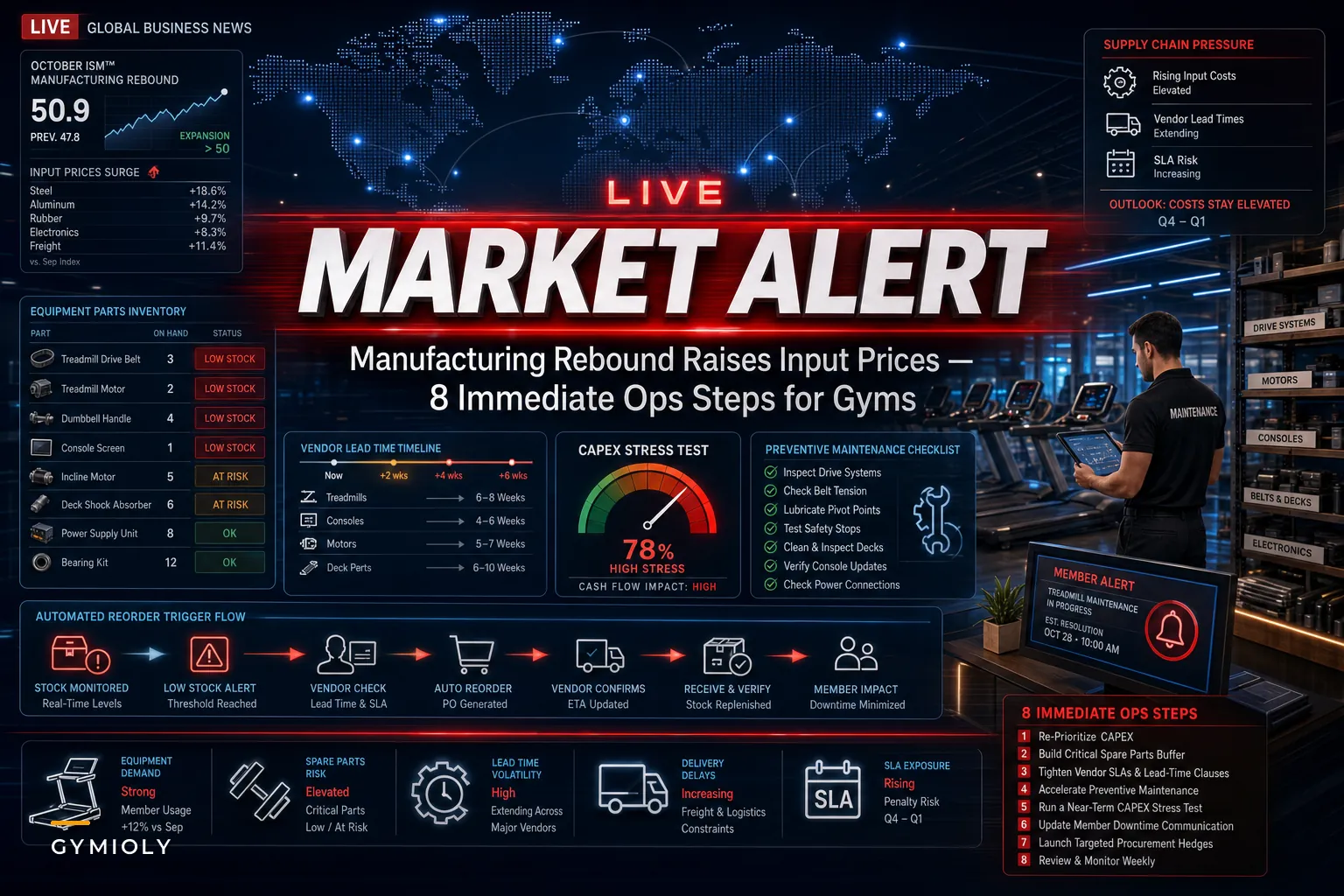

The October ISM data put something awkward on the table for anyone who buys equipment: factories picked up pace, but the stuff they make didn't get cheaper or faster to ship. The ISM PMI climbed to 55.5, signaling real demand — and at the same time, input prices stayed elevated and supplier deliveries slowed. A recent Reuters report on October manufacturing laid it out plainly: activity is up, but cost and availability pressure hasn't eased.
For a gym owner, that combination is genuinely uncomfortable. Demand strength usually means suppliers get busier and less flexible on price. Slower deliveries mean the treadmill motor or cable assembly you need next month might actually land two months later. If you were planning a Q1 equipment refresh or counting on quick parts turnaround to keep machines running, the ground just shifted.
This isn't a reason to panic-buy or freeze all spending. It's a reason to get tactical. Below are eight moves worth making in the next few weeks — ordered roughly by how fast they protect you.
First, understand what "input prices stay high" actually does to your P&L
Rising manufacturing input costs don't hit gyms as one clean line item. They leak in through three doors, and most owners only watch one of them.
The obvious door is new equipment — a rack of plate-loaded machines or a cardio refresh costs more than it did a year ago. The less obvious doors are repair parts and service labor tied to parts availability. When a belt, motor controller, or console board gets back-ordered, you're not just paying more for the part. You're paying for a machine sitting dead on the floor, a member complaint cycle, and sometimes an emergency rush-shipping fee that quietly eats the savings you thought you'd locked in with your vendor.
In practice, this usually looks like: a mid-size gym budgets $8k–$12k a year for parts and repairs, treats it as a predictable line, and then one bad quarter with two back-ordered components blows that number by 30–40% because of expedite fees and loaner rentals. The budget wasn't wrong. The lead-time assumption behind it was.
So before touching any of the eight steps, reframe the problem: you're not managing a price increase. You're managing price + lead time + downtime risk at the same time.
The 8 steps, in priority order
1. Re-score your CAPEX list into "must," "can wait," and "kill"
End appointment chaos and boost attendance.
Gymioly streamlines booking, confirms sessions, and manages memberships effortlessly.
- Unified class and membership management
- Automated member notifications
- Trainer scheduling and availability
No credit card required
Pull every planned purchase for the next two or three quarters and sort it coldly. Not by what you're excited about — by what actually protects revenue or prevents a failure.
-
Must
replaces equipment that's failing or already driving member complaints.
-
Can wait
nice upgrades, aesthetic refreshes, "new category" machines you haven't validated.
-
Kill or defer indefinitely
anything bought on vibes or because a competitor got one.
The machines owners are most emotionally attached to buying are rarely the ones driving retention. When input prices are elevated, the "can wait" pile should get bigger than it feels comfortable making it. You can always buy in Q2 if lead times loosen.
2. Lock pricing now where you can, even if delivery is later
A move a lot of owners miss: with deliveries slowing, you can sometimes separate the price lock from the delivery date. Ask vendors to honor today's quote with a flexible or staged delivery window. In a rising-input environment, a 60–90 day price hold is worth real money, and suppliers chasing volume are often willing to trade a firm order now for a delayed ship date.
Get the price-hold terms in writing. A verbal "yeah, that price should still be good" means nothing when the invoice shows up 11% higher.
3. Stock the critical spare parts — but only the critical ones
Blanket stockpiling is a cash trap. Targeted stockpiling is smart. The question isn't "what might break" — it's "what breaks, is hard to get, and kills a revenue machine when it's down."
| Part category | Lead-time risk | Downtime impact | Stock it? |
|---|---|---|---|
| Treadmill belts & motors | High | High (prime cardio) | Yes — 1–2 spares |
| Cable/pulley assemblies | Medium | Medium | Yes — common sizes |
| Console/display boards | High | Medium | Case by case |
| Upholstery/pads | Low | Low (cosmetic) | No — order as needed |
| Bearings & hardware | Low | Varies | Keep a small kit |
The point isn't the exact list — yours depends on your equipment mix. The logic is: stock the intersection of slow-to-get and expensive-to-have-down. Everything else, order reactively.
4. Renegotiate lead times before you renegotiate price
When suppliers are busy, owners instinctively push on price and usually lose. The smarter ask right now is lead-time certainty. A guaranteed 3-week turnaround on a common part is often worth more than a 5% discount with an unpredictable ship date, because the discount doesn't cover a dead machine sitting on the floor.
-
What's your current realistic lead time on my top five parts — not the website number, the actual one?
-
Can you commit to a backorder notification within 24 hours instead of me finding out at delivery?
-
What do I need to order ahead to get priority allocation?
Vendors who can't answer the first question clearly are telling you something important. Write it down for when you re-tier them.
5. Tighten preventive maintenance so you stop needing parts urgently
Probably the highest-leverage step here, and the one most owners under-invest in. When parts are cheap and fast, sloppy PM is survivable — you fix things reactively. When parts are expensive and slow, reactive maintenance turns small issues into back-ordered emergencies.
The fix is boring and effective: move from calendar-based maintenance to utilization-tied maintenance, so the machines getting hammered get serviced before they fail. A treadmill doing 40+ hours a week of use shouldn't be on the same service schedule as one doing 8. If you want the full framework for tying PM cadence to actual usage and forecasting CAPEX around it, we broke that down here: avoid sudden downtime with utilization-tied preventive maintenance and CAPEX forecasting.
Tie maintenance checks for high-use machines to logged hours rather than calendar dates to reduce surprise failures.
Fewer surprise failures means fewer urgent parts orders at exactly the moment urgent orders are most expensive and slowest to fill.
6. Stress-test your 13-week cash against two "delay" scenarios
Don't model the average case. Model two uncomfortable ones:
-
A planned purchase lands 6 weeks late, pushing a revenue-tied upgrade into the next quarter.
-
A key cardio machine goes down and the replacement part is back-ordered 4+ weeks, forcing a rental or rush fee somewhere in the range of a few hundred to a couple thousand dollars.
If either scenario cracks your cash position, you've found a risk worth fixing now — by front-loading a spare, adjusting CAPEX timing, or holding a small contingency buffer specifically earmarked for parts delays.
7. Re-tier vendors based on reliability, not just price
A busy supply environment exposes which vendors actually perform. The one with the best catalog price but the worst communication becomes a liability when deliveries slow. Build a simple scorecard — on-time delivery, backorder honesty, parts availability, response time — and shift priority orders toward whoever scores highest.
You don't need a complicated system for this. A spreadsheet with four columns and a monthly review beats what most gyms do, which is nothing. Owners who track vendor reliability spend the next slow-delivery cycle calm; the ones who don't spend it on hold with customer service.
8. Centralize the whole thing so it doesn't live in your head
This is where most of it quietly falls apart. The spare-parts list is in someone's memory, vendor quotes are buried in an email thread, the PM schedule is on a whiteboard that gets erased, and the CAPEX plan is in a spreadsheet nobody updates. When lead times stretch, that scattered setup is exactly what turns a $200 part into a $1,500 problem — because nobody realized the spare was already used and never reordered.
A simple centralized workflow ties machine logs, parts inventory, vendor lead times, and reorder triggers into one system.
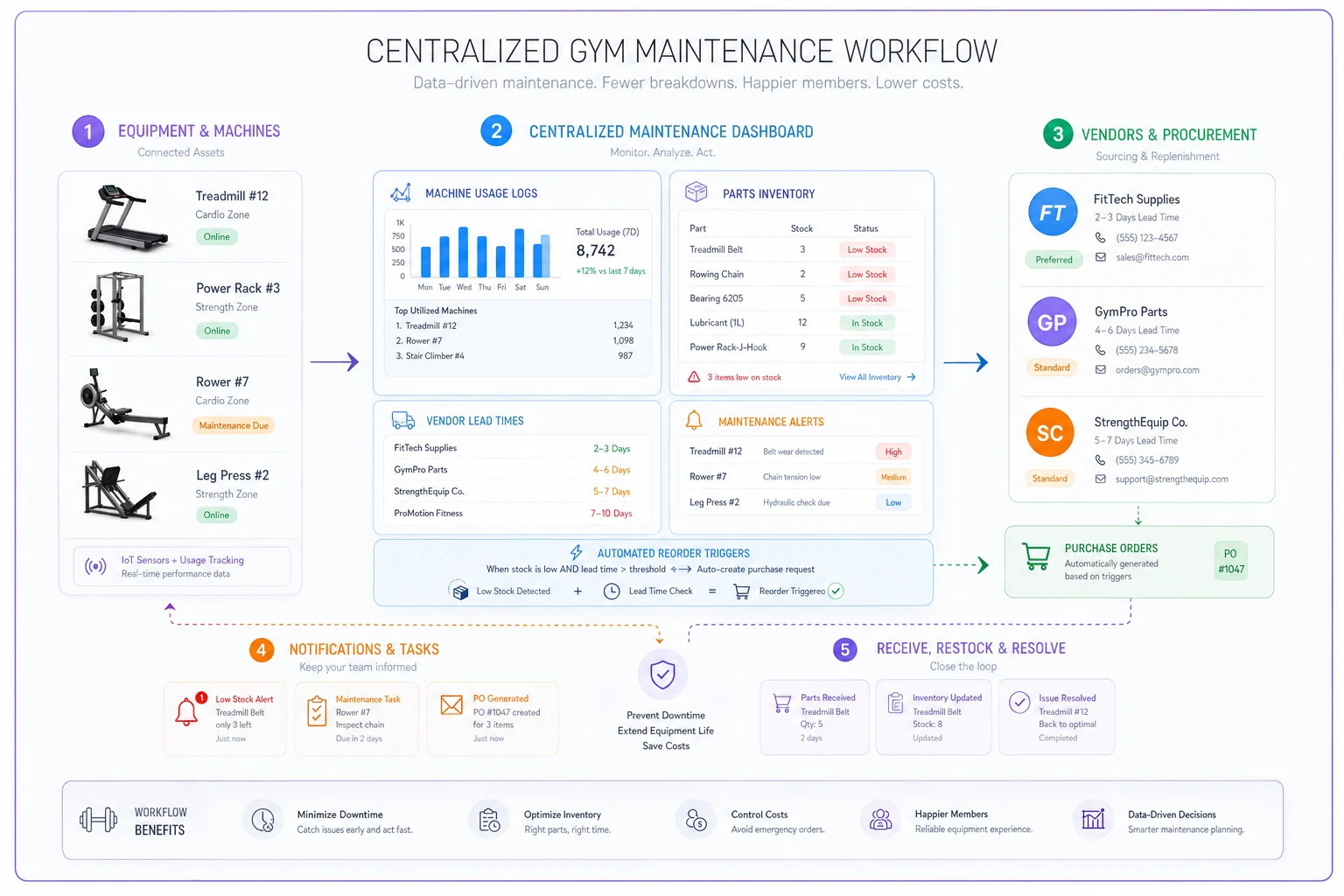
It's a coordination problem more than a knowledge problem. Logging maintenance by machine, tracking parts inventory with low-stock reminders, and keeping vendor lead-time notes in one place is where operational software earns its keep — not as a futuristic add-on, but as the thing that makes sure a reorder trigger fires automatically when your last treadmill belt comes off the shelf. AI-assisted alerts that flag a machine trending toward failure based on usage, or that remind you a spare dropped below threshold, turn a reactive scramble into a scheduled, cheaper fix. That's the quiet value: fewer emergencies during exactly the stretch when emergencies cost the most.
When aggressive buying actually makes sense right now
Not every situation calls for caution. Front-loading a purchase is the right call when:
-
The equipment is already failing and a breakdown would knock out a high-traffic zone.
-
You can lock a firm price with a staged delivery, protecting against further increases.
-
You have a validated revenue use for it — a new program with real demand, not a hunch.
In those cases, waiting costs more than buying. The ISM signal of rising demand suggests prices aren't falling soon, so deferring a necessary purchase can backfire.
When it's a bad idea
Hold off when the purchase is discretionary, unvalidated, or driven by competitive anxiety. If you can't point to the specific revenue or retention outcome a machine drives, elevated input prices are a perfectly good excuse to wait.
The ISM October manufacturing roundup points to continued cost pressure, not a cliff — which means you have time to be selective.
A quick real scenario
A two-location gym had a Q4 plan to replace eight cardio units across both sites — roughly a $40k–$48k outlay. When lead times started stretching and quotes came in higher than budgeted, the owner re-scored the list instead of pushing the whole order through.
Four units were genuinely near failure and got ordered with a locked price and staged delivery. The other four were "looking a bit tired" but functional, so they got deferred to Q2 and paired with tighter PM on the existing machines. The owner also pulled two treadmill belts and a motor controller into on-site spares after mapping which parts were both slow to get and tied to the busiest zone.
Nothing dramatic happened — which was the point. Over the following couple of months, one of the deferred machines threw a belt, but the spare was on the shelf and it was back running the same day instead of sitting dead for three weeks on a back-ordered part. The re-scoped order kept roughly $20k in cash available through a tight stretch, and the gym avoided the rush fees that would have come from ordering reactively into a slow-delivery market.
The underlying problem this moment exposes
The manufacturing data is the hook, but the real issue is structural: most gyms run their equipment and parts operation on assumptions that only hold when supply is fast and cheap.
Loose PM schedules, memory-based spare tracking, price-first vendor selection, and CAPEX plans that assume on-time delivery all work fine in easy conditions. The October numbers just stress-tested those assumptions, and a lot of operations are quietly fragile underneath.
Fixing it isn't about reacting to one data release. It's about building a parts-and-maintenance operation that doesn't flinch when lead times stretch — because they will again. Get the critical spares in place, tie maintenance to actual usage, track which vendors actually deliver, and keep the whole thing in one system instead of scattered across five people's heads. Do that, and the next supply-chain squeeze becomes a scheduling exercise instead of a fire drill.
Ready to elevate your gym operations?
Join 2,000+ gyms using Gymioly to reduce admin overhead, improve member experience, and grow revenue.