


Most gym owners treat pricing like a one-time decision. Pick some round numbers that feel right, maybe copy what the gym down the street charges, and hope it works. Then three years later you're still running the same pricing structure while costs have climbed 30% and half your members are on grandfathered rates from 2019.
Pricing is an operational system that needs constant testing and adjustment. Gyms that actively experiment with their membership pricing architecture generate 15–25% more revenue per member than those who set-and-forget. Not by raising prices blindly, but by understanding how different member segments respond to different pricing structures.
The three-tier trap most gyms fall into
Walk into almost any gym and you'll see the same pricing board: Basic, Premium, Elite. Maybe they call them Bronze, Silver, Gold. Round numbers like $29, $49, $79. The middle option has a little star next to it that says "Most Popular!"
This setup fails for a specific reason. The gaps between tiers are too uniform. When the jump from Basic to Premium is $20, and Premium to Elite is another $30, you create what pricing researchers call "cognitive friction." Members can't quickly assess value differences, so they default to the cheapest option that technically meets their needs.
A gym in Austin spotted this after running usage analytics on their three tiers. Their $39 Basic and $59 Premium plans had nearly identical usage patterns — members were paying an extra $20 for features they weren't touching. Meanwhile, the $89 Elite tier sat mostly empty because the jump felt too steep.
The fix wasn't adding more features. It was restructuring the price gaps using a geometric progression instead of linear jumps. They moved to $35, $55, and $95. Same features, different architecture. Premium tier adoption went from 22% to 41% of new signups within two months.
Running elasticity experiments without losing members
Price elasticity sounds complicated but the concept is pretty simple. How much can you adjust pricing before members start canceling or prospects stop converting? Most gyms never test this systematically — they either keep prices flat for years or make massive jumps that shock their member base.
End appointment chaos and boost attendance.
Gymioly streamlines booking, confirms sessions, and manages memberships effortlessly.
- Unified class and membership management
- Automated member notifications
- Trainer scheduling and availability
No credit card required
The smarter approach uses cohort testing. Instead of changing prices for everyone at once, you test with specific segments. New member pricing is the easiest starting point because there's no existing expectation to manage. Current members never see the test prices, so you avoid the backlash that comes from someone noticing a new member is paying less.
A testing framework that works:
-
Week 1–2
Baseline measurement
Track your normal conversion rate from tour to signup. Include average membership value — not just the tier they choose, but expected lifetime value based on historical retention data. -
Week 3–6
Price variant A
Raise your middle tier by 10–15%. Keep everything else identical. Track the same metrics. -
Week 7–10
Price variant B
Return the middle tier to its original price. Drop your entry tier by 10–15%. Track everything again. -
Week 11–14
Price variant C
Test a compression strategy. If you're at $30, $50, $80, try $35, $50, $75.
A boutique fitness studio in Denver ran this exact sequence. Their baseline conversion rate was 31% with an average membership value of $67. Variant A (raising the middle tier) dropped conversion to 27% but pushed average value to $74. Variant B (lowering the entry tier) boosted conversion to 38% but dropped value to $61. Variant C was the surprise — 34% conversion with $71 average value.
The compression strategy won because it reduced decision paralysis. When the gaps between tiers are smaller, prospects spend less mental energy on the financial decision and more time imagining themselves as members.
The anchor pricing mistake that kills premium memberships
Every gym needs an anchor price — the option that makes everything else look reasonable by comparison. Most gyms accidentally anchor against their cheapest option instead of building a true premium tier.
Look at your current top-tier membership. Does anyone actually buy it? If less than 5% of your members are on your highest tier, it's not working as an anchor. It's decoration.
The principle behind this is context-dependent valuation. People don't evaluate prices in isolation — they compare options. When your top tier is $79/month for unlimited classes plus some perks, and your middle tier is $49/month for unlimited classes, the mental math becomes "$30 extra for... perks?" The value proposition falls apart.
A CrossFit box in Phoenix restructured their anchor after realizing only 3 members out of 400 were on their Elite plan. Rather than unlimited classes plus perks, they created a genuine premium tier at $179/month that included:
-
Unlimited classes
-
Monthly personal training session
-
Quarterly nutrition consultation
-
Two guest passes per month
-
Priority booking for specialty workshops
-
Exclusive Saturday morning "Elite Athletes" sessions
They weren't expecting a rush of signups. That wasn't the point. The anchor made their $89 "Professional" tier — previously their top option — suddenly look like solid value. Professional tier adoption jumped from 11% to 28% over four months.
Usage thresholds and the hidden profit in class limits
Unlimited memberships look great on marketing materials but can quietly wreck unit economics. The operational cost of someone coming 20 times a month is meaningfully different from someone coming 8 times, yet they pay the same price.
The fix isn't eliminating unlimited options — those still drive signups. It's building smart usage thresholds that connect price to actual facility load. That requires understanding your real capacity costs.
Step 1: Calculate real per-visit cost Factor in instructor pay, facility overhead during class time, equipment wear, and cleaning. For most gyms, this lands somewhere between $7–12 per visit when fully loaded.
Step 2: Map current usage patterns Pull attendance data from the last 90 days. Segment by visit frequency:
-
Light users
1–4 visits/month
-
Regular users
5–12 visits/month
-
Heavy users
13–20 visits/month
-
Super users
21+ visits/month
Step 3: Design tiers around natural usage Instead of feature-based tiers, build usage-based options that match actual behavior patterns rather than aspirational ones.
A yoga studio in Portland found 67% of their "unlimited" members came fewer than 8 times a month. They introduced a "Flex 8" membership at $79 (versus $99 for unlimited). Members who consistently stayed under 8 visits self-selected into it, improving margin per visit. Heavy users stayed on unlimited. The studio also gained clean data on who was actually using their capacity — which turned out to be useful on its own.
Track per-visit cost by class type (instructor-led vs open gym) so usage thresholds reflect real marginal costs, not rough averages.
The studio's change improved margins and gave them clearer signals for when to add capacity or create waitlists.
Building pricing tiers that naturally guide upgrade paths
Static pricing tiers create static members. If someone joins your Basic plan, they'll probably stay on Basic forever unless something forces a change. The goal is designing a structure with natural progression points built in.
Behavioral economists call this "commitment escalation" — starting small and building over time. Instead of hoping members jump from $39 to $79 on their own, you create logical steps between them.
A cycling studio in Seattle restructured their membership ladder this way:
Old structure:
-
Basic
$49 (4 classes/month)
-
Plus
$89 (8 classes/month)
-
Unlimited
$139
New structure:
-
Starter
$39 (3 classes/month)
-
Active
$69 (6 classes/month)
-
Committed
$99 (10 classes/month)
-
Unlimited
$139
The upgrade momentum came at renewal time. They added an automated check at months 3 and 6. Members who'd exceeded their class allowance at least twice received an offer to upgrade at a promotional rate for the first month. The email basically said: "We noticed you bought extra classes last month. Upgrade to Active and save $12 compared to what you're spending now."
Upgrade rate from Starter to Active hit 34% by month 6. The old structure saw less than 10% ever move up from Basic.
This kind of process requires operational software that tracks usage patterns and triggers upgrade recommendations automatically. Manual tracking turns into a spreadsheet mess pretty quickly.
A/B testing payment terms without confusing your staff
Payment frequency seems like a minor detail until you look at what it does to both cash flow and retention. Monthly, quarterly, annual — each creates a different member psychology and different operational requirements.
The challenge with testing payment terms is complexity. Your front desk staff can't juggle multiple payment options for different test groups without things slipping. Systematic testing with clear protocols matters here.
Protocol for payment term testing:
Segment by acquisition channel, not randomly. New members from social ads get Option A, website signups get Option B, walk-ins get Option C. This prevents staff confusion because the offer is determined by how the prospect arrived — not by some decision tree they have to remember mid-conversation.
Test structure:
-
Control
Month-to-month at standard rate
-
Test A
3-month commitment with 10% discount
-
Test B
6-month commitment with 15% discount
-
Test C
Annual payment with 20% discount
Track three metrics:
-
Conversion rate from tour to sale
-
Average contract value (total commitment, not just monthly rate)
-
Actual retention at 6 months
A martial arts gym in Dallas ran this exact setup. Results were counterintuitive. The 3-month commitment had the highest conversion rate but the worst 6-month retention. Annual payment had lower initial conversion but 95% of those members were still active at month 6, compared to 61% for month-to-month.
The sweet spot ended up being 6-month commitments with automated renewal to month-to-month. Better initial commitment than monthly, better retention than forcing annual renewals.
Measuring actual financial impact beyond the monthly fee
Most gyms measure pricing success by whether average membership price went up or down. This misses most of the picture.
Real pricing impact means analyzing several things at once. Revenue per square foot per hour — your 6am and 7pm classes carry the same instructor cost but very different attendance. Pricing should reflect peak demand. Some gyms successfully charge $5–10 more for peak-hour memberships while offering discounts for off-peak access.
Lifetime value relative to acquisition cost also matters more than most owners realize. A member paying $39/month who stays 18 months is worth more than one paying $79/month who leaves after 4. Retention rates need to factor into pricing decisions, not just headline monthly rates.
Then there's ancillary revenue. Members on certain tiers often spend differently on personal training, retail, or workshops. A gym in Austin found their middle-tier members spent roughly 3x more on personal training than premium members. The explanation was straightforward: premium members felt they were already paying enough, while middle-tier members saw PT as an affordable add-on.
Here's a framework for tracking all of it:
| Metric | Calculation | Target Impact |
|---|---|---|
| Revenue per member month | Total revenue / Active members | Increase 10–15% |
| Utilization rate | Visits / (Capacity × Hours open) | Maintain 65–75% |
| Tier migration rate | Upgrades / Total eligible | Achieve 20%+ annually |
| Price realization | Actual collected / List price | Keep above 92% |
| Cohort LTV variance | 6-month LTV by join month | Reduce variation under 15% |
Getting consistent data across all five metrics is harder than it sounds when you're managing multiple pricing tiers simultaneously. That's where AI-assisted operational software starts earning its keep — not replacing decisions, but making sure the numbers you're looking at are actually accurate.
Grandfather rates and the compound revenue problem
Every gym has them. Members paying 2018 prices in 2024. Somehow they're on $29/month for unlimited access while new members pay $79. The gap compounds every month.
Say you have 200 members on legacy rates averaging $35/month when your current rate is $65. That's $6,000 a month in foregone revenue — $72,000 a year. Enough to hire another instructor or upgrade equipment.
But raising prices on longtime members feels bad. The solution is strategic migration, not abrupt increases.
Instead of forcing price hikes, create incentive structures for voluntary migration. Offer something that makes the higher price feel earned.
A gym in Miami had 300+ members on rates from $29–45 when current unlimited was $89. They built a campaign around it: "Legacy Member Appreciation Program"
-
Keep current rate
No changes, same access as today
-
Upgrade to current membership
Unlimited guest passes, priority booking, quarterly InBody scans, monthly nutrition consultation
47% of legacy members upgraded within 90 days. Not necessarily for the features — but because the gym framed it as joining the current community rather than being stuck with an old deal.
For the holdouts, gradual increases work better than big jumps. $5 every 6 months with 60-day notice, framed as a "sustainability adjustment" to maintain quality. Most members accept small, predictable increases far better than a single shocking one.
The psychology of trial offers and intro pricing
Free trials sound generous but often pull in the wrong prospects. Paid trials create commitment. People value what they pay for, even when the amount is small.
The optimal trial structure based on conversion patterns:
-
Length
14–21 days (long enough to build habit, short enough to maintain urgency)
-
Price
$19–39 (serious enough to filter out tourists, not so much it becomes a real decision)
-
Access
Full (restrictions reduce conversion)
What most gyms miss — trial pricing should shift by season and capacity. January trials can be priced higher with shorter windows. July trials might need aggressive pricing just to fill empty slots.
A testing framework by demand period:
-
High-demand periods (January, September) - 7-day trial at $29 - Scarcity framing ("only 20 spots available") - Immediate upgrade incentive
-
Moderate periods (March, October) - 14-day trial at $19 - Standard conversion process - Follow a structured onboarding sequence
-
Low-demand periods (July, December) - 21-day trial at $9.99 - Include free personal training session - Extended conversion window
Gyms using variable trial pricing see roughly 22% better annual revenue compared to fixed trial offers. The catch is you need systems that can handle multiple trial types running simultaneously without manual tracking errors.
Real scenario: Complete pricing overhaul at a mid-size gym
TotalFit Gym in Columbus had 450 members and was barely breaking even despite decent overall numbers. Pricing hadn't changed in four years:
-
Basic
$30 (gym access only)
-
Standard
$45 (gym + classes)
-
Premium
$60 (everything + guest passes)
The tier distribution was a problem:
-
60% on Basic
-
35% on Standard
-
5% on Premium
Usage data revealed members gaming the structure. Basic members occasionally bought day passes for classes. Standard members shared guest passes to sidestep Premium. The system was leaking revenue in multiple directions.
The restructure: Phase 1: Add anchor tier
Created "Elite Performance" at $129 including personal training sessions, nutrition planning, and exclusive workshop access. Expected minimal adoption — the goal was reframing everything else.
Phase 2: Compress and redistribute
-
Essential
$39 (gym access, 2 classes/month)
-
Active
$59 (unlimited classes, no guests)
-
Complete
$79 (unlimited everything)
-
Elite
$129 (premium services)
Phase 3: Migration campaign
-
Give existing members 60 days to choose new plans
Stay at current price but lose certain features
-
Move to new structure with 3-month discount
-
Upgrade a tier with 6-month rate lock
Results after 6 months:
-
Revenue per member
$51 to $64
-
New member conversion
28% to 34%
-
Tier distribution
25% Essential, 45% Active, 27% Complete, 3% Elite
-
Monthly revenue up roughly $8,000 with the same member count
The operational challenge was managing the transition. Multiple pricing structures running simultaneously, grandfathered rates tracked individually, and migration communications on a timeline. Without the right software, that would've been an unmanageable spreadsheet situation.
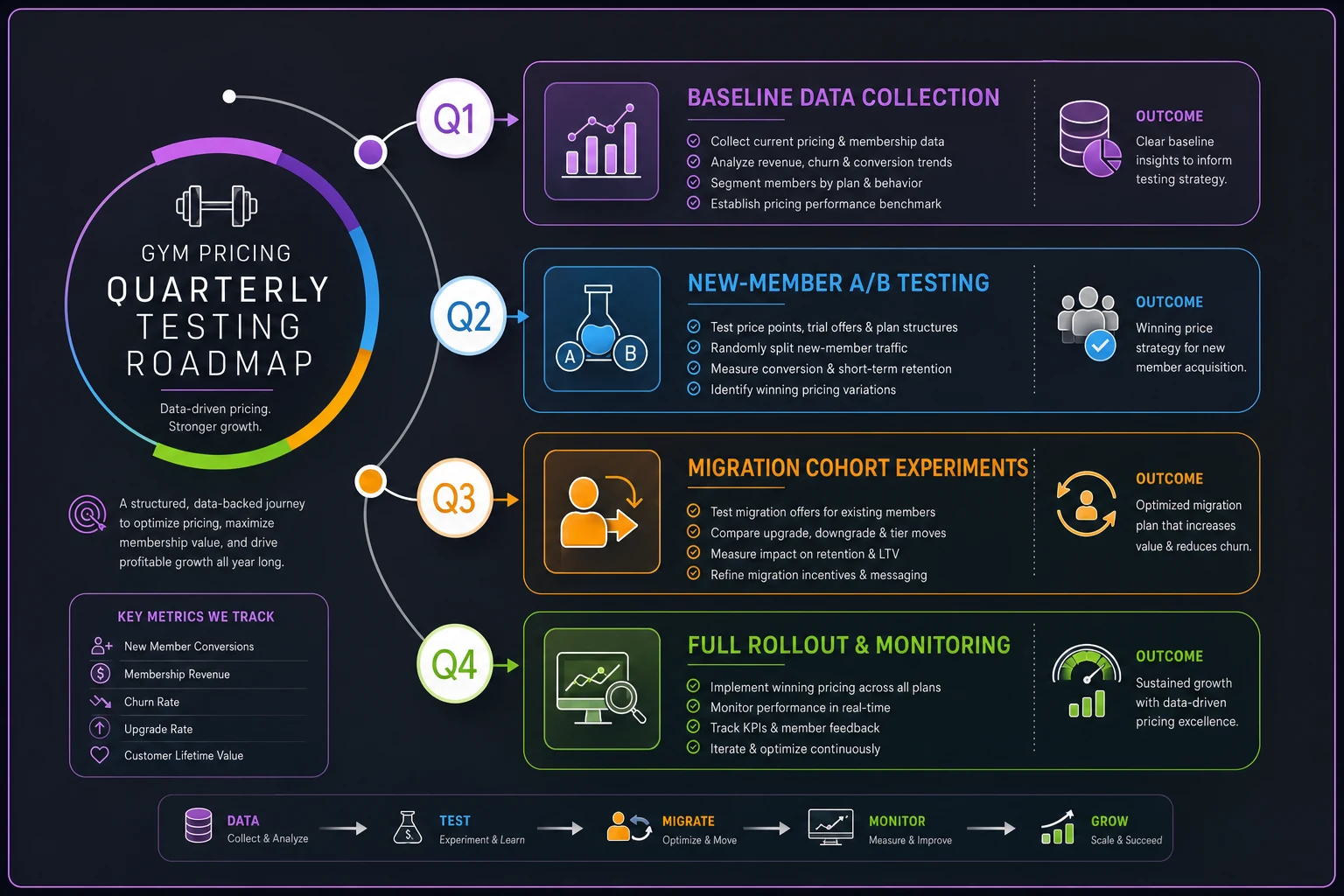
Building your testing roadmap
A new pricing architecture isn't a weekend project. It takes systematic testing, honest measurement, and willingness to adjust.
Q1: Foundation and baseline
-
Analyze current usage patterns
-
Calculate true per-visit costs
-
Survey members on price sensitivity
-
Draft initial test structures
Q2: New member testing
-
Run A/B tests on trial pricing
-
Test tier structures with new signups only
-
Measure conversion and early retention
-
Refine based on what you learn
Q3: Migration planning
-
Design migration offers for existing members
-
Build communication campaigns
-
Get operational systems in place for multiple price structures
-
Test with a small cohort first
Q4: Full implementation
-
Roll out to all new members
-
Execute migration campaign
-
Monitor financial impact closely
-
Adjust based on member feedback
Here's a visual workflow to help plan and sequence tests across quarters.
The gyms that actually improve their pricing treat it as an ongoing process. They build systems that can test, measure, and adjust continuously — using AI-assisted operational software to track usage patterns, automate testing protocols, and manage multiple pricing structures without burying their staff in complexity.
The biggest mistake is holding out for a "perfect" pricing strategy. There isn't one. Member preferences shift, competition changes, costs move. Gyms that thrive build experimentation into how they operate — test small, measure everything, adjust quickly. That's when pricing becomes a genuine competitive advantage instead of a set-and-forget line item.
Your current pricing probably has 15–25% improvement potential sitting untapped. Start with one test. Measure the real impact. Build from there. The revenue is already in your member base — you just need the right structure to capture it.
Ready to elevate your gym operations?
Join 2,000+ gyms using Gymioly to reduce admin overhead, improve member experience, and grow revenue.