



Most gym referral programs fail within six months. Not because members don't want to refer friends — they do. The programs collapse because the mechanics underneath can't handle basic fraud scenarios, reward tracking turns into spreadsheet chaos, and nobody can actually reconcile what's owed to whom.
A CrossFit box in Austin learned this the hard way when their "bring a friend, get a month free" program resulted in $14,000 of uncollected revenue after members figured out they could refer the same person multiple times under slightly different email addresses. Another boutique studio in Denver shut down their program entirely after spending 12 hours trying to untangle whether 47 pending rewards were legitimate.
The difference between referral programs that scale profitably and those that hemorrhage cash comes down to operational mechanics — validation windows, tracking fields, antifraud rules, and reconciliation processes that hold up when you're managing 200+ active members.
Why standard referral tracking breaks at scale
Referral programs typically start simple. Member refers friend, friend joins, member gets reward. Clean logic — until operational reality kicks in.
What happens when Sarah refers Tom, but Tom doesn't sign up for three weeks? Do you still honor it? What if Tom attended a free trial class two months ago — does Sarah still get credit? When Mike refers his roommate Jennifer, but Jennifer's boyfriend already referred her last month, who gets the reward?
These edge cases multiply fast. A 400-member gym running an active referral program deals with roughly 30-40 referral attempts monthly. About half fail validation for timing issues, duplicate attempts, or eligibility problems. Without clear rules, staff end up buried in email chains trying to figure out who deserves what.
The tracking problem compounds when rewards vary. Free month for referring a yearly member. $50 credit for monthly signups. Class passes for trial conversions. Each reward type needs different accounting treatment, proration rules, and application timing. Most gyms track this across disconnected spreadsheets that fall apart the moment someone forgets to update a cell.
Building antifraud rules that protect revenue without killing legitimate referrals
Referral fraud in gyms follows predictable patterns. The same-household loop where family members refer each other repeatedly. The email variation trick using Gmail aliases. The signup-and-cancel scheme where referred members join for the minimum period then immediately cancel.
End appointment chaos and boost attendance.
Gymioly streamlines booking, confirms sessions, and manages memberships effortlessly.
- Unified class and membership management
- Automated member notifications
- Trainer scheduling and availability
No credit card required
Effective antifraud rules need to catch obvious gaming without blocking legitimate referrals. Here's the framework that works:
Validation Windows Set a 90-day lookback period for existing contact records. If someone's email, phone, or payment method appeared in your system within 90 days, they don't qualify as a new referral. This catches trial-class-to-member conversion attempts while still allowing genuine re-engagement.
Household Restrictions Block referrals between members sharing addresses or payment methods. Roommates exist, yes, but the fraud risk outweighs the occasional legitimate case. Create a manual override process for genuine situations — human review beats automated fraud rules any day.
Minimum Commitment Rules Referred members must complete at least 60 days of active membership before rewards activate. This shuts down instant-cancel schemes. For annual prepays, hold the reward until month three.
Referral Velocity Limits Cap members at 3 successful referrals per quarter. Higher volumes trigger manual review. Someone who suddenly "knows" dozens of potential new members usually has another agenda.
Payment Method Validation Flag referrals sharing payment methods with existing members. Same credit card across multiple "new" members almost always points to fraud or family account manipulation.
The tracking field architecture that prevents reconciliation nightmares
Clean referral tracking requires specific data fields captured at the right moments. Miss one or capture it incorrectly, and reconciliation becomes impossible three months down the line.
Here's the minimum viable field structure:
| Field Name | Capture Point | Validation Rule | Storage Location |
|---|---|---|---|
| referrermemberid | Referral submission | Must be active member | Member record |
| referred_email | Referral submission | Format validation + duplicate check | Prospect record |
| referral_date | Referral submission | Timestamp | Referral log |
| referral_source | Submission form | Predefined list (web, app, desk) | Referral log |
| conversion_date | Membership activation | Within 90 days of referral | Member record |
| reward_type | Upon conversion | Based on membership type purchased | Reward queue |
| rewardapplieddate | Reward processing | After validation period | Member account |
| reward_value | Reward processing | Calculated based on rules | Financial records |
These fields need to flow between your CRM, billing system, and accounting records. Manual entry guarantees errors. A member management platform with referral tracking built in eliminates the spreadsheet juggling that causes most reconciliation failures.
Reward accounting that actually balances
Referral rewards create real accounting complexity. Free months generate deferred revenue adjustments. Credit rewards affect cash flow differently than service rewards. Tax implications vary by reward type and local regulations.
Structure rewards to minimize that complexity:
Account Credits (Simplest) Apply a dollar credit to the member's account for future purchases. Books as a liability until used. Clean tracking, no revenue recognition issues. Members can apply credits toward anything — membership, personal training, retail.
Service Add-ons (Moderate Complexity) Free guest passes or class packs. Track as promotional inventory with an assigned value. No cash impact but requires usage monitoring.
Membership Discounts (Most Complex) Free or discounted months create deferred revenue situations. Revenue recognition spreads across the discount period and requires monthly reconciliation adjustments.
Most gyms find account credits work best operationally. Set credit values at 50-75% of your average monthly membership fee — meaningful enough to motivate referrals, small enough to protect margins. Credits also nudge members toward additional spending when they redeem them for premium services.
The referred member onboarding flow that maximizes conversion
Referred prospects convert differently than cold leads. They arrive with social proof but often without real commitment. The wrong onboarding flow kills conversion rates.
When someone gets referred, trigger this sequence:
-
Hour 0-24
Immediate Welcome
— Send a personalized message that mentions their friend by name. "Hey Alex, Sarah mentioned you might be interested in checking us out..." Include a booking link for a free consultation or trial class within the next 7 days. -
Day 2
Social Proof
— If they haven't booked yet, send success stories from other referred members. Include a photo of their referring friend if you have permission. Make it feel like joining a community, not buying a service. -
Day 5
Urgency Without Pressure
— Mention the referral validation window. "Quick heads up — Sarah's referral bonus activates when you join within 30 days. Just wanted you to know about the timeline." -
Day 7-14
Value Demonstration
— Shift from selling to educating. Send workout tips, nutrition guides, or class schedules. Let them see what actual members experience. -
Day 21
Final Opportunity
— One last message with a specific offer. "Sarah really hoped you'd join our community. Here's a 7-day trial pass to see if we're the right fit."
This sequence respects the referral relationship while keeping conversion front of mind. Track each touchpoint's response rate to identify where people drop off.
The onboarding flow for converted referred members needs separate attention too. They joined because of a relationship, so reinforce that. Pair them with their referring friend for their first workout. Introduce them to other referred members. Build a WhatsApp group or Facebook community around that group. Social bonds reduce churn meaningfully — referred members who stay connected with their referrer's social circle show noticeably lower 90-day churn compared to members who drift in cold.
For a detailed framework on member onboarding that drives activation through daily milestones and staff handoffs, the systematic approach ensures no referred member falls through the cracks during their critical first two weeks.
Visual workflow of the onboarding sequence:
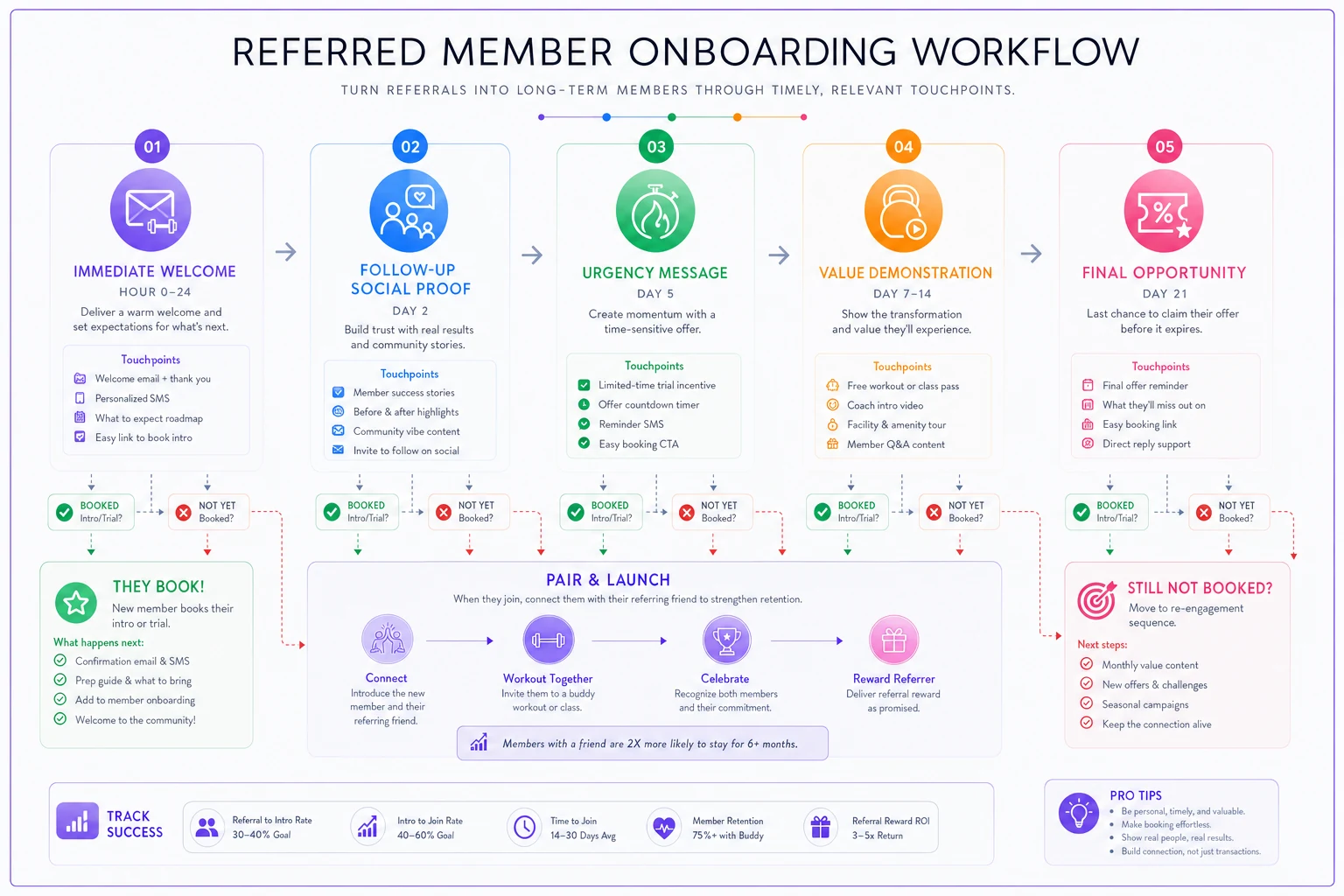
Use this to map your automation and handoffs.
Reconciliation worksheets that catch discrepancies before they compound
Monthly reconciliation prevents small errors from becoming expensive problems. Without structure, you'll discover three months later that 15 members never received promised rewards — or that 8 rewards got double-applied.
Build a reconciliation worksheet with four checkpoints:
-
Submission Verification — List all referral submissions from the month. Match each against member records to confirm referrer eligibility at submission time. Flag any submissions from inactive members or those carrying outstanding balances.
-
Conversion Tracking — Track referred prospects through the full journey. How many scheduled trials? Attended? Converted? Calculate conversion rates by referrer to figure out who your real advocates actually are.
-
Reward Queue Validation — List all pending rewards from conversions. Verify each one meets antifraud rules and minimum commitment periods. Calculate total reward liability for the month.
-
Applied Reward Audit — Confirm all eligible rewards were applied correctly. Check that billing system adjustments match approved rewards. Verify account credits equal the calculated amounts.
Here's a practical reconciliation template structure:
Monthly Referral Reconciliation Sheet
Section A: New Referrals
-
Referrer ID | Referred Name | Submission Date | Validation Status | Notes
Section B: Conversions
-
Referred Name | Join Date | Membership Type | Referrer ID | Reward Earned
Section C: Pending Rewards
-
Referrer ID | Reward Type | Estimated Value | Eligible Date | Approval Status
Section D: Applied Rewards
-
Referrer ID | Reward Type | Applied Date | Actual Value | Billing Adjustment Ref
Section E: Discrepancy Log
-
Issue Type | Member Affected | Resolution Required | Status
Use the template sections to assign clear owners for each checkpoint so nothing falls through during monthly reviews.
Run this reconciliation by the 5th of each month for the previous month's activity. Catching errors early prevents member frustration and accounting headaches before they spiral.
Common failure points that kill referral programs
Beyond the operational mechanics, a few strategic mistakes consistently destroy referral programs.
Retroactive Rule Changes Changing program terms after members already earned rewards destroys trust fast. If you must modify the rules, grandfather existing participants. One gym lost around 30 members after retroactively requiring 90-day minimum commitments for rewards members had already earned under different terms.
Inconsistent Application Staff making exceptions "just this once" creates precedent. Members talk. When Tom gets his reward after 45 days but Sarah has to wait 60, your credibility is gone. Document override authority clearly — only managers approve exceptions, and every exception needs written justification.
Reward Devaluation Starting with generous rewards then quietly cutting them frustrates your most active referrers. If economics force a reduction, add non-monetary benefits to maintain perceived value. Two weeks instead of a full month, but with priority booking privileges or exclusive member events, can land better than a straight cut.
Poor Communication Members need to know where their referral stands. Send confirmation when referrals are submitted. Update them when prospects book trials. Make some noise when conversions happen. Silence breeds suspicion that the program isn't real.
Technology integration and automation opportunities
Manual referral tracking wastes time and guarantees errors. Modern gym management platforms handle the complex operational mechanics automatically, but setup requires careful planning.
The technology stack should connect referral tracking to your CRM, billing system, and communication tools. When someone submits a referral through your app or website, the system should automatically check eligibility, create prospect records, trigger communication sequences, and queue rewards when conversions happen.
AI-powered operational software can go further by surfacing referral patterns and fraud risks you wouldn't catch manually. Instead of relying on rigid rules alone, the platform adapts to recognize suspicious behavior while leaving room for legitimate edge cases. Routine tasks like sending referral confirmations, tracking conversion timelines, and applying standard rewards can run on autopilot — which alone saves hours every month.
Keep human oversight in the loop for exceptions and high-value decisions though. A $500 annual membership referral deserves manual verification even if the system flags it as clean.
The reconciliation process particularly benefits from automation. Rather than manually matching spreadsheets, operational platforms can compare referral records across systems, flag discrepancies, and generate exception reports automatically. What used to take 8 hours becomes a 30-minute review.
ROI reality check: when referral programs actually make financial sense
Not every gym should run a referral program. The operational overhead might exceed the revenue benefit, particularly for smaller locations.
Run these numbers first:
Calculate your current member lifetime value. Include average membership length, monthly revenue, and ancillary purchases. Then subtract your customer acquisition cost through traditional channels — marketing spend, sales commissions, trial costs.
A referral program makes sense when:
-
Your referral reward cost is less than 50% of traditional CAC
-
You have operational capacity to manage the program properly
-
Member satisfaction scores consistently sit above 7 out of 10
-
At least 20% of new members already come through word-of-mouth
If your gym has 150 members and gains 5-8 new members monthly, a referral program probably doesn't justify the operational complexity. Focus on retention and organic growth first.
For gyms with 300+ members gaining 15 or more monthly, referral programs can meaningfully reduce acquisition costs while strengthening member community. The operational investment pays off through lower marketing spend and better-quality new members.
The operational backbone determines success
Referral programs succeed or fail based on operational execution, not marketing creativity. Fancy reward structures mean nothing if you can't track them accurately. Generous incentives backfire if fraud runs unchecked.
Start with simple rewards and airtight tracking. Add complexity only after the basic mechanics have run cleanly for at least three months. Test antifraud rules with small batches before full deployment. Build reconciliation discipline from day one, not as an afterthought.
Treat referral programs as operational systems that need constant monitoring and adjustment. The same attention you give to class capacity and no-show management should apply to referral mechanics — both directly affect member experience and revenue.
Strong referral mechanics create a sustainable acquisition channel that gets more effective as you scale. Weak mechanics create operational nightmares that damage member relationships and drain profitability. The difference lives in the unglamorous details — validation windows, tracking fields, and reconciliation processes that hold up when Monday morning arrives and members expect their rewards.
Strong referral mechanics create a sustainable acquisition channel that gets more effective as you scale. Weak mechanics create operational nightmares that damage member relationships and drain profitability. The difference lives in the unglamorous details — validation windows, tracking fields, and reconciliation processes that hold up when Monday morning arrives and members expect their rewards.
Ready to elevate your gym operations?
Join 2,000+ gyms using Gymioly to reduce admin overhead, improve member experience, and grow revenue.