

Gym staff scheduling optimization feels straightforward until you're staring at a Tuesday 2pm yoga class with three members and a $45/hour instructor, while your Saturday morning spin class is turning people away because you only scheduled one instructor instead of opening a second room.
The problem runs deeper than just matching staff to busy times. Your front desk person at $18/hour spends half their shift doing admin work that your $28/hour fitness manager is also doing during the overlap. Your personal trainers sit idle during floor hours because you scheduled them around their availability rather than when members actually book. The cleaning crew shows up at 5am when the place is empty, then disappears right when the morning rush creates the biggest mess.
These inefficiencies compound quietly. A typical 8,000 square foot gym with around 1,400 members wastes somewhere between $2,800 and $4,200 monthly on poorly allocated labor — profit disappearing into scheduling gaps, skill mismatches, and demand blindness.
Why traditional scheduling breaks down in fitness operations
Most gym scheduling is built around staff preference, historical habit, and whoever complains loudest about their hours. You build the schedule around instructor availability first, then try to make member demand fit around it.
This backwards approach creates predictable problems. Your highest-paid instructors gravitate toward prime evening slots whether those classes fill or not. Part-timers get scattered across shifts that don't match their actual skills. Managers pile up during morning overlaps while afternoons run skeleton crews.
The standard Monday-through-Sunday template also assumes every week is identical — but gym attendance doesn't work that way. The first week of January looks nothing like the third week of August. Monday holidays throw off entire weeks. A local event can double or cut your typical Tuesday evening crowd in half.
Without demand data driving decisions, you end up with expensive instructors teaching near-empty classes, minimum-wage desk staff handling complex membership issues alone, and cleaning happening on a fixed schedule regardless of what the facility actually looks like.
Building attendance bands from actual member behavior
The foundation of demand-driven scheduling is understanding your real attendance patterns — not the ones you've assumed. Pull your check-in data for the past 90 days and map it by hour and day. You'll likely find things that contradict what you thought you knew.
End appointment chaos and boost attendance.
Gymioly streamlines booking, confirms sessions, and manages memberships effortlessly.
- Unified class and membership management
- Automated member notifications
- Trainer scheduling and availability
No credit card required
Export weekly check-in snapshots into a single sheet so trends are easier to spot across multiple months.
Peak Bands (>80% of hourly capacity)
-
Monday–Thursday
5:30am–7:30am, 5:00pm–7:30pm
-
Saturday
8:00am–11:00am
-
Sunday
9:00am–12:00pm
Moderate Bands (40–80% capacity)
-
Monday–Friday
11:30am–1:00pm
-
Monday–Thursday
7:30am–9:00am, 7:30pm–9:00pm
-
Saturday
11:00am–2:00pm
Low Bands (<40% capacity)
-
Monday–Friday
9:00am–11:30am, 1:00pm–5:00pm
-
Friday
7:00pm–close
-
Saturday
2:00pm–close
-
Sunday
12:00pm–close
Your bands will look different depending on location, member demographics, and facility type. Downtown gyms see lunch rushes that suburban locations never experience. College-area gyms stay busy until 11pm while family-focused facilities empty out after 7:30.
Track these patterns for at least twelve weeks to account for seasonal variation. Include holidays, events, and weather disruptions. The goal isn't perfect precision — it's separating reliable demand patterns from random noise.
Creating shift templates that match real demand patterns
Once you understand your attendance bands, you can build shift templates that actually align with member flow. Stop thinking in traditional 8-hour blocks and start thinking in coverage segments that match when people show up.
For peak morning bands (5:30am–7:30am), you might run:
-
2 front desk staff (5
15am–8:00am)
-
3 group fitness instructors staggered across studios
-
2 personal trainers on floor coverage
-
1 maintenance person focused on machine prep
For low afternoon bands (1:00pm–5:00pm), you'd scale back:
-
1 front desk person who can also handle admin
-
1 group instructor if afternoon classes run
-
Personal trainers on appointment-only basis
-
Maintenance on project work, not general cleaning
The core principle: build your base coverage for moderate demand, scale up for peaks, and run lean during guaranteed slow periods. That means some staff work split shifts, others work four 10-hour days, and some work standard blocks depending on their role.
A quick visual of the workflow helps crystallize the steps from data to schedules.
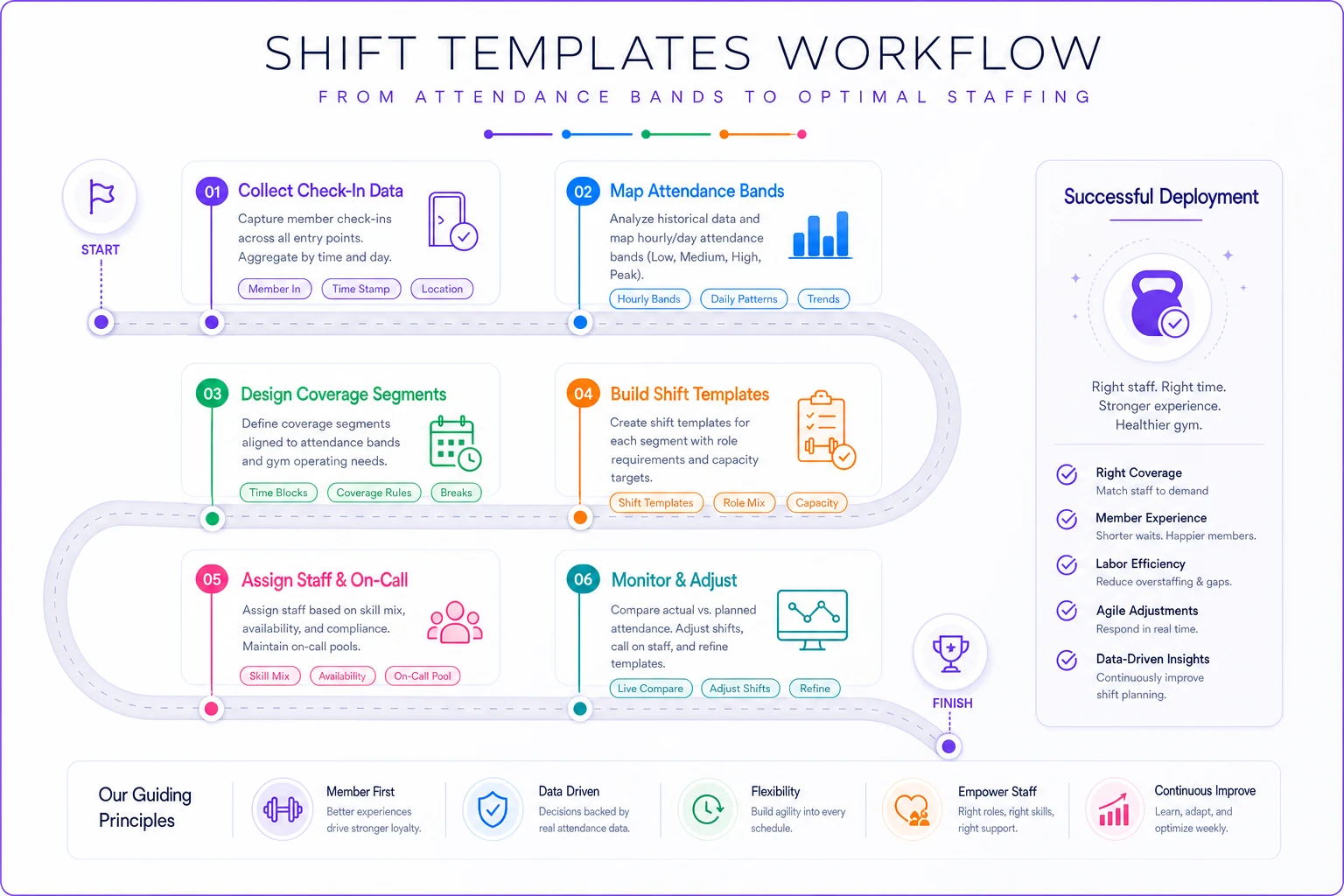
A practical example — instead of scheduling your fitness manager 9am to 5pm, split their hours into 6am–10am (handling morning issues) and 4pm–8pm (covering evening peak and close). Those mid-day hours where they'd normally be doing computer work? Batch that into designated admin days or let them handle it remotely. It sounds like a small change. It adds up fast.
Skill-mix matrices that prevent expensive redundancy
The most expensive scheduling mistake gyms make is role redundancy — multiple people at different pay rates doing identical tasks. Your fitness manager shouldn't be checking in members while your front desk person sits idle. Your personal training director probably shouldn't be teaching group classes unless that's genuinely the highest-value use of their time.
A skill-mix matrix clears this up fast:
| Role | Primary Tasks | Overflow Tasks | Never Does |
|---|---|---|---|
| Front Desk ($15–18/hr) | Check-ins, basic questions, towel service | Light cleaning, inventory counts | Sales conversations, program design |
| Fitness Instructor ($25–35/hr) | Teach classes, prep/breakdown | Floor supervision during peaks | Administrative work, deep cleaning |
| Personal Trainer ($30–45/hr) | 1-on-1 sessions, assessments | Small group training, floor coverage | Front desk, general cleaning |
| Manager ($50k–65k/year) | Staff supervision, member escalations | Sales, high-level programming | Regular front desk, routine maintenance |
During peak bands, everyone stays in their primary role. During moderate bands, overflow tasks kick in. During low bands, you run fewer staff who can flex across responsibilities.
This matrix also shapes hiring. Instead of filling every function with a specialist, you hire versatile people who can flex when needed. That part-time front desk person should have enough fitness knowledge to handle floor supervision. Group instructors should be able to cover simple member service tasks between classes.
On-call pools and coverage rules that actually work
Every gym hits the same crisis at some point: your Tuesday evening instructor calls in sick three hours before a packed cycling class. Without a system in place, you either cancel (damaging member trust) or scramble to beg another instructor to cover — usually paying overtime or building a favor economy that causes problems down the road.
Instructor On-Call Pool:
-
Voluntary sign-up for weekly on-call blocks
-
Guaranteed minimum 2-hour pay if called
-
1.5x rate for same-day coverage
-
Priority scheduling preferences next month for anyone who covers
Front Desk Floater Pool:
-
Part-timers who want extra hours
-
Must be reachable within 45 minutes notice
-
Guaranteed 4-hour minimum shift
-
Automatic approval on their next schedule request
Coverage Hierarchy:
-
Try the on-call pool first (yes, at premium rates)
-
Offer extended shifts to staff already on-site
-
Combine or modify services (merge two smaller classes)
-
Last resort
cancel with member credits or makeups
Track who declines coverage offers. Someone who never accepts on-call shifts loses priority for preferred schedule slots. This creates natural accountability without punitive management — people self-select into the level of flexibility they're willing to offer.
Overtime reduction through strategic scheduling architecture
Overtime kills gym profitability fast. One employee hitting 45 hours weekly costs you an extra $300–400 that month. Five employees doing it regularly and you're burning $1,500–2,000 in unnecessary labor costs every single month.
Hard caps by role:
-
Full-time staff
max 38 scheduled hours (2-hour buffer)
-
Part-time staff
max 28 scheduled hours (keeps them below benefit thresholds)
-
Managers
salaried, but still track hours to prevent burnout
Early warning checkpoints:
Flag anyone approaching 35 hours by Thursday. That gives you time to adjust Friday through Sunday coverage before you're scrambling.
Shift architecture options:
-
Four 9.5-hour days (38 hours, 3-day weekends)
-
Three 12-hour days plus one 4-hour admin day
-
Split shifts that mirror demand peaks (6am–10am, 5pm–9pm)
Cross-training as an investment:
Most overtime happens because "only Sarah knows how to close" or "only Mike does the morning routine." Spend eight hours training a second person on those processes and you save hundreds in overtime every month. Document every critical task so coverage isn't dependent on one person.
Real-world example: How Metro Fitness cut labor costs 22% while improving coverage
Metro Fitness ran a 24,000 square foot facility with around 2,100 members. Monthly labor costs averaged $47,000, with constant overtime, coverage gaps, and member complaints about understaffing during peaks.
They pulled three months of check-in data and discovered their assumptions were badly off. They thought Tuesday and Thursday evenings were equally busy — Tuesday averaged 280 check-ins between 5pm and 8pm, Thursday only 180. They were staffing Sunday mornings heavily despite just 60–80 members showing up before noon.
Before:
-
Fixed 8-hour shifts regardless of demand
-
Instructors chose their own schedules
-
Managers worked standard 9–5 Monday–Friday
-
Overtime averaged $3,400 monthly
After:
-
Varied shift lengths (4, 6, 8, and 10-hour blocks)
-
Scheduling driven by attendance bands, not preference
-
Managers on split schedules covering actual peaks
-
Structured on-call pools with clear compensation rules
Results after four months:
-
Labor costs dropped to $36,500 monthly (22% reduction)
-
Member complaints about understaffing down 60%
-
Overtime nearly eliminated (under $400 monthly)
-
Employee satisfaction improved — predictable schedules matter to people
The key wasn't cutting staff. They actually added coverage during true peak times. They just stopped wasting money during slow periods and fixed expensive role overlaps.
Decision rules you can implement without fancy software
You don't need an expensive workforce management platform to start improving gym staff scheduling optimization. These simple rules work on their own.
-
The 70% Rule If a shift consistently runs below 70% of capacity, reduce staffing or cut the shift.
-
The Two-Deep Principle Every critical role needs two trained people. No shift should depend on one irreplaceable person.
-
The 3-Hour Minimum Don't schedule anyone for less than 3 hours. The setup and transition time isn't worth the fragmented coverage.
-
Peak Premium Principle Your best — and most expensive — staff should work your busiest shifts where their skills generate the most value.
-
The Thursday Checkpoint By Thursday noon, review next week's schedule for overtime risks. Adjust Friday through Sunday before thresholds get crossed.
Start with one rule. Measure it for a full month. Then add another. These guidelines alone can cut labor costs 10–15% without any technology investment.
When AI-powered scheduling platforms make sense
Manual scheduling works fine for smaller gyms with under 15 staff and predictable patterns. But as you scale, complexity multiplies fast — multiple locations, dozens of instructors with varying certifications, overlapping member programs, and constantly shifting demand.
This is where AI-powered operational software becomes genuinely useful. Instead of spending eight hours a week building and adjusting schedules, platforms with AI automation built in can analyze your historical attendance patterns, match staff skills to actual demand, and surface optimization gaps you'd never catch manually.
The better platforms don't just automate — they learn. They notice that your Tuesday spin instructor consistently draws 20% more attendance than Thursday's. They spot that members who attend morning classes are more likely to buy personal training. They start predicting demand shifts based on weather, local events, and seasonal patterns.
When connected to your member management system, this kind of software tracks actual versus projected attendance and adjusts future schedules based on what really happened. And when integrated with your member onboarding sequences, some platforms can even anticipate new member behavior and adjust staffing before demand spikes show up in your data.
The real cost of ignoring demand-driven scheduling
Most gym owners feel like they can't afford workforce management tools or advanced scheduling systems. But you're already paying for bad scheduling — through overtime, overstaffing, member churn from inconsistent service, and instructor turnover from unpredictable hours.
A gym doing $600,000 in annual revenue typically spends $180,000–210,000 on labor (30–35% of revenue). Poor scheduling inflates that by 15–20%, meaning you could be wasting $27,000–42,000 yearly on inefficient labor allocation. That's money that should be hitting your bottom line.
Beyond direct costs, bad scheduling creates knock-on problems. Your best instructors leave for gyms that give them better hours. Members cancel when their favorite classes disappear — often because attendance looked low at the wrong time of day, not because the class wasn't viable. Staff morale erodes when some people consistently land good schedules while others scramble for hours.
The gyms that hold up well in competitive markets aren't always the ones with the best equipment or nicest facilities. They're the ones that run efficiently, deliver consistent member experiences, and protect their margins through operational discipline. Demand-driven scheduling sits at the center of that.
Start simple. Track your actual attendance for the next month. Build basic attendance bands. Create one on-call pool. Apply one decision rule. Then layer in more complexity as you see results. Your members won't see the backend changes, but they'll notice better service during peak hours.
Your staff won't see the scheduling matrix, but they'll appreciate predictable shifts and fair coverage rules. And your P&L will reflect it when monthly labor costs drop while service quality holds.
Ready to elevate your gym operations?
Join 2,000+ gyms using Gymioly to reduce admin overhead, improve member experience, and grow revenue.