



The September numbers landed harder than most people expected. Employers added only about 29,000 jobs and unemployment ticked up to 4.2%, according to the Labor Department's Employment Situation release. Markets reacted fast, and as Reuters reported, the slowdown was broad enough to shift the conversation from "soft patch" to "watch your cash."
For gyms, a jobs report isn't abstract macro news. It's a leading indicator of what your next 90 days of billing might look like. When hiring stalls in a local market, discretionary spending gets cautious — and a $49–$129 monthly membership is exactly the kind of line item people start eyeing when they feel less secure about their paycheck.
This isn't a reason to panic or slash prices. It's a reason to tighten a handful of operational screws before the pressure shows up in your numbers. Below is the checklist I'd run through this week.
First, understand what actually hits your gym — and in what order
Weaker jobs data doesn't cause members to quit overnight. It moves through your business in a predictable sequence, and knowing that sequence lets you get ahead of it instead of reacting after the damage is done.
| Timeline | What happens | Where it shows up |
|---|---|---|
| Weeks 1–3 | New sign-up pace softens first | Front-desk conversions, trial-to-paid rate |
| Weeks 2–6 | Failed payments climb | Declined cards, expired cards not updated |
| Weeks 4–10 | Freeze and downgrade requests rise | Plan-change volume, "pause my membership" emails |
| Weeks 6–12 | Voluntary cancellations increase | Churn rate, especially among low-attendance members |
The pattern matters because most owners fixate on the last column — cancellations — which is the slowest and most visible signal. By the time churn moves, you've already lost a month or two of early warnings sitting in your failed-payment report and your sign-up funnel.
New sign-ups going quiet is the first domino, and it's easy to miss because nothing visibly breaks. Your members are still there. Revenue looks fine on the 1st. But the top of the funnel has thinned out, and that gap compounds every month it goes unnoticed.
1. Re-run your short-term cash picture before anything else
Before you touch pricing, staffing, or marketing, you need to know how much room you actually have. Most single-site gyms operate with far less cushion than the owner assumes, because membership revenue feels stable until two or three stressors hit at once.
End appointment chaos and boost attendance.
Gymioly streamlines booking, confirms sessions, and manages memberships effortlessly.
- Unified class and membership management
- Automated member notifications
- Trainer scheduling and availability
No credit card required
The practical move is a rolling, forward-looking cash view — not a backward-looking P&L. You want to see, week by week, what's coming in versus what's going out, with payroll modeled explicitly because it's your largest and most adjustable cost. If you don't already run one, this is the week to build it. We walked through the full mechanics in our guide to building a rolling 13-week cash model with payroll-linked staffing levers, and a demand-risk environment is exactly what that model was built for.
A simple workflow for building and updating a rolling cash view each week:
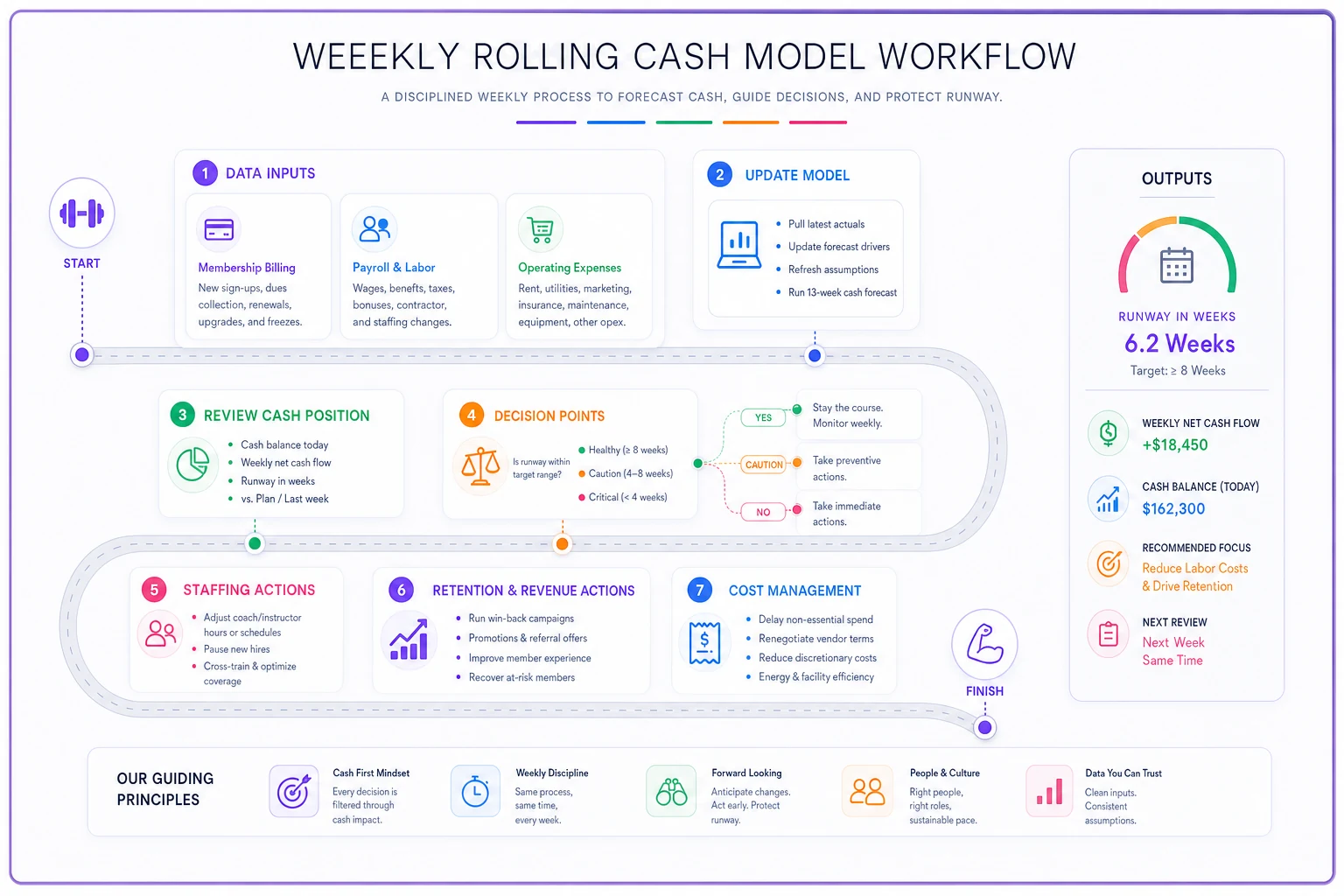
This goes first for a reason: every other decision on this list depends on knowing your actual runway. Whether you can afford to keep a slow Tuesday-morning shift, whether you should invest in a retention campaign — none of it makes sense without that foundation. Guessing here is how gyms end up making panicked, expensive cuts in month two.
2. Tighten failed-payment recovery now, not after it spikes
This is the single highest-leverage thing you can do in a soft economy, and it's consistently the most neglected.
In a normal month, a mid-sized gym with roughly 600–900 members might see a few percent of charges fail — expired cards, insufficient funds, old billing info. When money gets tight, that failure rate creeps up, and the recovery rate drops because members are slower to update payment details they'd rather not deal with.
A typical example: a gym running around $55k in monthly recurring billing sees failed charges go from roughly 3% to 5%. That's about $1,100 in extra at-risk revenue per month. If half of it never recovers because follow-up is manual and inconsistent, you're quietly leaking $500–$600 monthly — more than a part-time weekend shift.
A structured recovery sequence fixes most of this:
-
Day 0 Automatic retry on soft declines
-
Day 1 Friendly SMS + email with a one-tap update link
-
Day 3 Second retry
-
Day 5 Follow-up message with a clear deadline before access pauses
-
Day 7–10 Staff-assisted outreach for higher-value plans
Automate the first two touches (Day 0 and Day 1) and you'll capture the easiest recoveries without adding headcount.
The thing most owners miss: recovery is a timing problem more than a messaging problem. A card that fails on the 2nd and gets a nudge on the 3rd recovers far more often than one that sits untouched until someone notices it at month-end. Automating those first few touches removes the human lag that kills recovery rates.
3. Protect sign-up velocity before you protect price
When demand softens, the instinct is to discount. Resist it as a first move. Discounting trains your market to wait for deals and compresses margin exactly when you can least afford it.
What actually holds up sign-up velocity in a cautious environment is reducing friction and risk for the prospect, not the price:
-
Shorten the gap between "interested" and "started" — same-day or next-day first visits
-
Offer lower-commitment entry points (shorter initial terms, not cheaper ones)
-
Make the trial-to-paid handoff feel effortless and low-pressure
A soft market punishes gyms with slow, clunky onboarding far more than it punishes gyms with slightly higher prices. The prospect who has to wait three days for a callback simply drifts. Speed is free, and it's more defensible than a discount.
4. Match staffing to real demand — carefully
The jobs data cuts both ways here. Softer local hiring can ease wage pressure and make it easier to fill shifts, but demand risk means you can't afford to carry hours you don't need.
The mistake to avoid is a blunt across-the-board cut. When owners panic-cut, they usually trim total hours evenly — which kills service quality during actually-busy windows and barely saves money during the dead ones.
-
Pull the last 8–12 weeks of hourly check-in data
-
Identify your genuine low-traffic blocks (often mid-morning weekdays, late evenings)
-
Consolidate coverage in those windows rather than cutting your peak support
-
Protect the shifts that touch new members and retention directly
A gym that trims two thin weekday-morning shifts might save close to $1,500–$2,000 a month without any member ever noticing. That's a surgical adjustment that protects margin without degrading the experience that keeps people paying.
When this makes sense — and when it doesn't
Cutting hours makes sense when the data clearly shows under-utilized coverage. It's a bad idea when you'd be cutting the exact staff who drive first-visit conversions or who are the reason members feel personally known. In a retention-sensitive period, those people are an investment, not a cost.
5. Prioritize your most at-risk members for outreach
Not every member carries the same churn risk, and in a soft stretch you want to spend your retention energy where it actually matters. Members who've quietly stopped showing up are the ones who cancel first when money gets tight — they've already mentally disengaged, and a weaker paycheck just gives them the push.
Attendance is the earliest honest signal you have. Someone who hasn't checked in for 14–21 days is in a different risk tier than someone training four times a week, and they deserve different outreach: a genuine check-in, a nudge toward a class they used to enjoy, maybe a conversation about what changed.
The operational point is that this outreach can't be random or dependent on whoever happens to notice. It needs a defined trigger and a defined response so no at-risk member slips through unseen during the exact weeks that matter most.
6. Pressure-test your non-dues revenue
When core membership faces headwinds, the gyms that hold revenue steady usually have a second or third stream that doesn't move in lockstep with sign-ups. Small-group training, specialty programs, retail, short paid challenges — these can absorb some of the softness in base membership.
This isn't about launching something new during a stressful month. It's about leaning into what's already working and testing small, reversible additions. A paid 6-week challenge priced around $120–$180 can bring in a few thousand dollars from existing members without acquiring a single new one — and it deepens engagement, which quietly protects retention as a side effect.
Non-dues revenue tends to perform better with your existing base during uncertain times, because those members already trust you. Selling a challenge to current members is a warm, low-friction motion compared to chasing cold prospects in a cautious market.
7. Watch the right numbers weekly — not monthly
Monthly reporting is too slow for a demand-risk environment. By the time your month-end close tells you sign-ups dropped, you've lost a full month of reaction time.
Shift to a short weekly check on the metrics that actually move first:
-
New sign-ups and trial-to-paid rate
-
Failed-payment count and recovery rate
-
Freeze and downgrade requests
-
14-day no-show count (your churn early warning)
-
Net member change (gross adds minus cancels)
This takes ten minutes if your data lives in one place. It takes an afternoon if it's scattered across your billing system, a spreadsheet, and someone's memory — which is exactly why so many owners skip it, and exactly why they get surprised.
Operationally, the gap between "we review this monthly" and "we check this every Friday" is the difference between catching a problem in week two versus month three. That time gap is where recoverable situations turn into expensive ones.
A real scenario
A single-location gym with around 720 members noticed their sign-up pace had softened for three straight weeks heading into fall — nothing dramatic, just a noticeable dip from their usual 25–30 new joins a month down to the high teens.
Rather than discount, the owner ran the checklist. They tightened failed-payment recovery and pulled back roughly $700 a month that had been quietly leaking. They consolidated two under-used weekday-morning shifts, saving close to $1,600 monthly without touching peak coverage. They also ran a short paid challenge to existing members that brought in just over $2,800.
None of those were heroic moves. But stacked together, they offset most of the revenue softness from the slower sign-up months — and because they protected service quality, churn stayed flat instead of climbing. Three months later, sign-ups recovered on their own as the local market stabilized, and the gym came out the other side without having trained its members to expect discounts.
The takeaway isn't any single tactic. Small, early, surgical adjustments beat big, late, blunt ones every time.
Where this leaves you
A weak jobs report is a signal, not a sentence. Gyms rarely get hurt by the macro environment itself — they get hurt by reacting too late, cutting too bluntly, or discounting out of fear. The owners who come through soft stretches in good shape are the ones who tightened their cash visibility, plugged the quiet leaks, and made precise staffing calls while they still had room to choose.
Run the seven steps this week. Start with the cash picture, because everything else depends on knowing your runway. Then work down the list in whatever order fits your situation. The goal isn't to brace for the worst — it's to make sure that if demand softens, you see it in week two instead of month three, with enough time and margin to actually do something about it.
A weak jobs report is a signal, not a sentence. Gyms rarely get hurt by the macro environment itself — they get hurt by reacting too late, cutting too bluntly, or discounting out of fear. The owners who come through soft stretches in good shape are the ones who tightened their cash visibility, plugged the quiet leaks, and made precise staffing calls while they still had room to choose.
Ready to elevate your gym operations?
Join 2,000+ gyms using Gymioly to reduce admin overhead, improve member experience, and grow revenue.