


Your trainers are showing up. Your clients aren't. And that personal training no-show policy gym owners copied from a Facebook group three years ago? It's bleeding money in ways you haven't even calculated yet.
The real damage happens in the accounting gap between what trainers get paid and what actually gets collected. A trainer making $35/hour costs you around $42 after payroll taxes and benefits. When their 9am client ghosts them, you're not just losing the session revenue—you're eating that $42 while the trainer scrolls Instagram in an empty studio.
Most gyms treat every no-show the same way. That's the core mistake. The client who books eight sessions monthly and occasionally misses one requires completely different handling than the person who books sporadically and cancels half their appointments. Yet gyms run identical policies for both, wondering why retention tanks and trainers keep quitting.
Why uniform PT policies create operational chaos
The standard 24-hour cancellation policy looks clean on paper. Simple to explain, easy to enforce. Except it completely ignores how different client segments actually behave.
High-value PT clients—the ones booking 12+ sessions monthly—typically give advance notice when life gets complicated. They'll text about the sick kid or the work emergency. These aren't the people creating your no-show problem. Yet when you hit them with rigid cancellation fees, you damage relationships worth $800-1,200 monthly.
Meanwhile, casual clients booking 2-4 sessions treat appointments like suggestions. They'll skip for mild rain, a late night, or just because they don't feel like it. These are the ones creating actual operational friction, but they're also the most likely to quit entirely if you enforce strict penalties.
The accounting gets uglier when you factor in package structures. A client on a 10-session package who no-shows creates immediate cash flow confusion. Do you deduct the session? Issue a makeup credit? How do you track it in your books when they've prepaid but haven't received the service? Most gyms handle this with spreadsheets and Post-it notes, creating reconciliation nightmares at month-end.
Trainers feel this chaos directly. They see certain clients repeatedly waste their time while management does nothing. Or they watch good clients get penalized for legitimate emergencies while problem clients game the system. Eventually, your best trainers protect themselves by going independent and taking their client base with them.
Building segmented rules that actually protect revenue
Segmentation starts with purchase behavior, not demographics. Track how clients buy and consume sessions over 90 days, then build distinct policies for each group.
End appointment chaos and boost attendance.
Gymioly streamlines booking, confirms sessions, and manages memberships effortlessly.
- Unified class and membership management
- Automated member notifications
- Trainer scheduling and availability
No credit card required
-
High-commitment clients (8+ sessions monthly)
- First no-show per quarter: automatic reschedule within 7 days - Second no-show: 50% session charge - Third no-show: full charge plus required deposit on future bookings
-
Regular clients (4-7 sessions monthly)
- 12-hour cancellation window - No-show triggers immediate session deduction - Two no-shows in 30 days requires prepayment for next month
-
Casual clients (1-3 sessions monthly)
- Full prepayment required - 48-hour cancellation window - No-show forfeits session entirely - Must book next session immediately or lose trainer access
Notice what's missing? Exceptions. Refunds. Manager discretion. Every deviation from these rules creates operational drag and trains clients to negotiate.
The deposit structure changes based on history, not hope. New clients pay a rolling deposit equal to two sessions. After 90 days of consistent attendance, that drops to one session. After six months with zero no-shows, the deposit becomes optional—but one no-show resets the clock.
For package buyers, implement capacity holds. When someone buys 10 sessions, they must schedule at least 6 immediately. The remaining 4 can float but expire after 60 days. This prevents the hoarding behavior that destroys trainer schedules.
Automated flows that handle 80% of reschedule scenarios
Manual reschedule coordination burns roughly 3 hours weekly per trainer. That's around 150 hours annually of non-billable administrative work across a five-trainer gym.
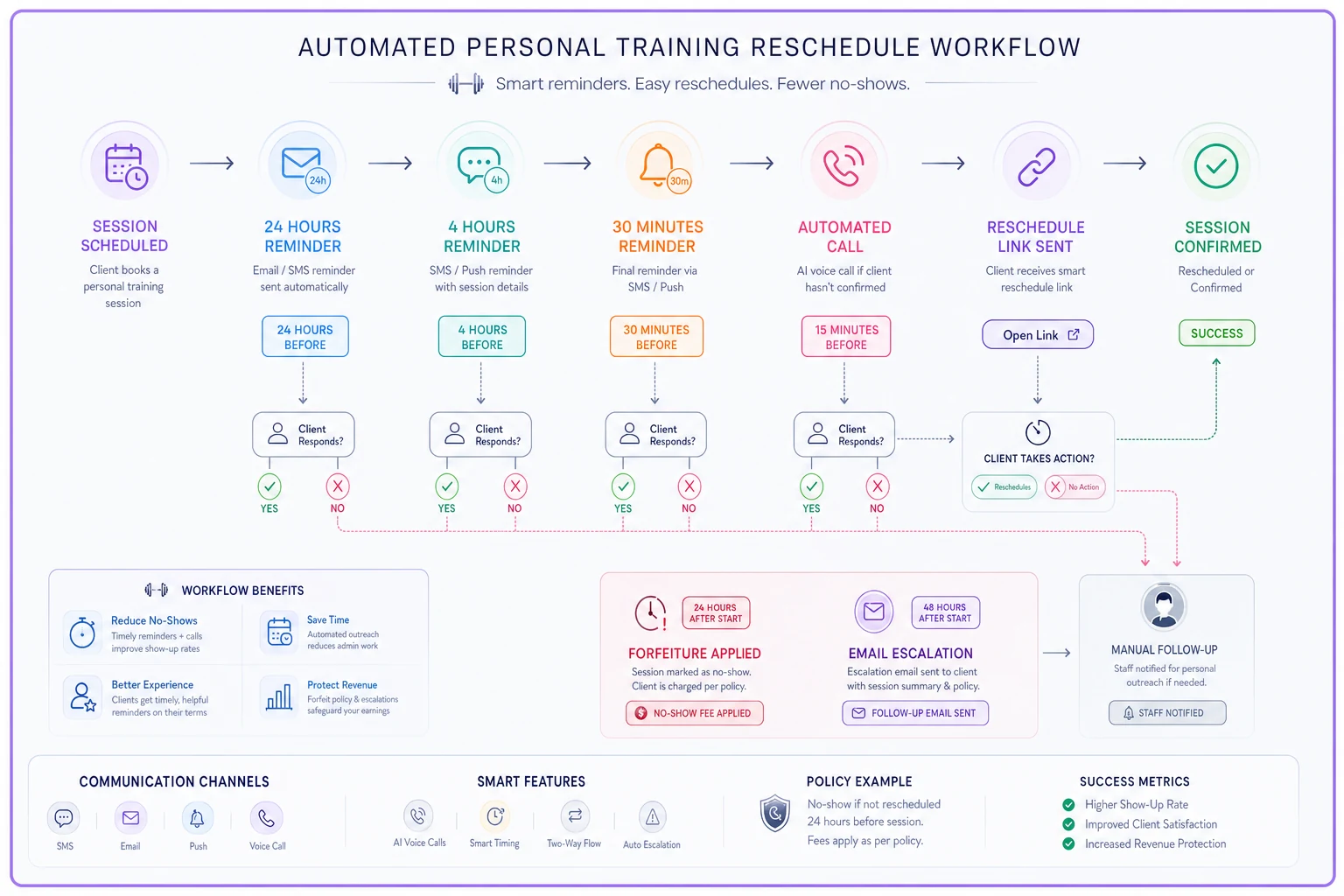
The automation sequence needs to trigger based on timing, not just the no-show event:
-
24 hours before session Text reminder with one-tap confirm or reschedule option. If no response within 2 hours, second text. If still nothing, automated call.
-
4 hours before (if unconfirmed) Final text warning that the session will be marked as a no-show if not confirmed. Include the specific financial impact: "This session will be charged at $75 if not confirmed."
-
30 minutes after no-show Immediate text with rescheduling link. Available slots shown for the next 72 hours only. If not rescheduled within 24 hours, session is forfeited and charged.
-
48 hours after unresolved no-show Automated email documenting the missed session, charge applied, and updated deposit requirement for future bookings.
The point is removing human intervention from standard scenarios. Your front desk shouldn't be mediating between annoyed trainers and defensive clients every week. The system handles it, documents it, and moves forward.
Include one-tap reschedule links in reminder texts to maximize reconfirmation rates.
Here's a simple visual of how the automated confirmation and reschedule flow should operate across the 72-hour window.
Build in smart capacity protection too. If a trainer has three no-shows in a week, the system automatically blocks their most popular slots from new bookings for 14 days. This ensures reliable clients get priority access while protecting trainer income.
Trainer protection clauses that prevent turnover
Trainers need guaranteed income protection or they'll build their own client base outside your gym. The standard independent contractor agreement doesn't cover no-show scenarios, leaving trainers exposed to income volatility they can't control.
Start with baseline guarantees. If a trainer experiences more than 15% no-shows in a month—anything above 3 no-shows for someone working 20 sessions weekly—they receive a stability payment equal to 50% of the missed session value. This comes from the no-show fees you're already collecting, not additional overhead.
Create fill-rate incentives. Trainers who maintain 95% confirmation rates across their clients get a 10% bonus on all completed sessions. This motivates them to build relationships with reliable clients and professionally move on from chronic problem ones.
Same-day fill policies matter too. When a client no-shows, that slot immediately opens for discounted drop-in training at 70% of normal rate. The trainer gets their full rate, you keep the 30% margin, and members get opportunistic access to premium services. Everyone benefits except the client who didn't show.
-
Exact no-show compensation structure
-
How deposits protect their schedule
-
Their right to refuse chronic no-show clients
-
Automatic rebooking priorities after cancellations
-
Monthly income protection thresholds
Without these protections, trainers start taking private clients on the side. They'll use your facility but handle booking and payment directly, cutting you out entirely. The clauses above keep them invested in your system.
The accounting reality of missed sessions
A typical small gym with 5 trainers doing 20 sessions weekly faces roughly 15-20 no-shows per week. At $75 per session average, that's $1,125-1,500 in theoretical lost revenue. But the actual accounting breaks down differently:
Direct costs per no-show:
-
- Trainer cost (if employed)
$42
-
- Facility allocation
$8
-
- Administrative handling
$5
-
- Total hard cost
$55
Recovery scenarios:
-
Full charge (rare)
Collect $75, net $20 profit
-
Half charge
Collect $37.50, lose $17.50
-
Makeup session
Collect $0 now, incur double facility cost when made up
-
Complete loss
Lose $55 plus client lifetime value impact
Package accounting gets even messier. When clients prepay for 10 sessions, you've got deferred revenue sitting on your books. Each no-show creates a decision point: deduct the session (recognizing revenue without delivering service), extend the package (deferring revenue longer), or credit forward (creating accounting complications across multiple months).
| Decision | Implication |
|---|---|
| deduct the session | recognizing revenue without delivering service |
| extend the package | deferring revenue longer |
| credit forward | creating accounting complications across multiple months |
The clean approach: treat no-shows as completed sessions for accounting purposes. Revenue gets recognized, trainer gets paid, and any fee collected is additional recovery. This prevents the spreadsheet gymnastics of tracking makeups, credits, and partial charges across multiple months.
The conversation scripts that prevent relationship damage
How you communicate policy violations determines whether clients comply or quit. Most gyms either go too soft—enabling bad behavior—or too harsh and damage otherwise good relationships.
-
First violation message "Hey Sarah, missed you at training this morning. I've automatically rescheduled you for Thursday at 9am (your usual backup slot). Confirm by tonight to lock it in, otherwise we'll need to charge for today's session per our agreement."
-
Chronic violator reset "Tom, looking at the last 30 days, we've had 4 cancelled sessions with less than 12 hours notice. Starting next week, we'll need to collect a two-session deposit to hold your regular slots. This protects both Jake's schedule and your priority booking status."
-
High-value client exception "Lisa, sorry to hear about your mom's surgery. We've credited this week's sessions forward and Jake will reach out next week to rebuild your schedule when you're ready. No charges, just let us know when you're back."
Casual clients get automatic consequences. Chronic problems trigger systematic changes, not lectures. Valuable clients experiencing real emergencies get human understanding.
The language avoids judgment while establishing clear boundaries. You're not calling anyone irresponsible or uncommitted—you're running operational processes that protect everyone's interests.
Train your staff to never negotiate in the moment. When clients push back, the response is always: "I understand your frustration. The policy applies uniformly to ensure trainer availability and schedule integrity. Would you like to discuss modifying your training package to better fit your schedule flexibility needs?"
This redirects the conversation from policy exceptions to service fit. Maybe they need to move from fixed sessions to a flexible punch-card model. Maybe they're not ready for the commitment level of personal training. Better to identify that mismatch now than fight about policies every week.
Fixing the problem before it starts
The most effective personal training no-show policy gym owners can implement actually begins during the sales conversation, not after problems emerge.
When selling training packages, explicitly discuss attendance expectations. Show prospects actual no-show rates: "Our committed clients maintain around 94% attendance. Casual drop-in clients average closer to 68%. Which group sounds like you?" This self-selection prevents mismatched expectations later.
Set up the initial package structure to encourage compliance. Instead of selling 20-session packages, sell monthly memberships with included sessions. The psychological difference matters—people protect recurring commitments more than depleting balances.
Your onboarding sequence should include PT schedule establishment as a critical milestone. Don't let new training clients float without fixed appointments. The moment someone buys training, they should leave with their next 4 sessions booked.
Build deposit collection into your point-of-sale flow. This isn't a conversation or negotiation—it's just part of the transaction. "That's $600 for your 8-session package plus $150 deposit that credits toward your final sessions. Total today is $750."
The operational software managing all this can't be your scheduling system alone. You need something tracking purchase patterns, violation history, deposit status, and automated communication flows. Most gyms try to duct-tape three different systems together, creating gaps where problems hide. AI-powered operational platforms handle exactly this kind of segmentation and automation—tracking client behavior across multiple variables and triggering the right communication at the right time, without someone manually monitoring it. Gyms that implement this kind of connected workflow typically see no-show rates drop from 15-20% down to around 5-7% within 90 days.
Making the math work for everyone
A properly structured personal training no-show policy gym system should improve three metrics at once: trainer retention, client lifetime value, and actual collected revenue per scheduled session.
Trainers stay because they're protected from income volatility. They know chronic no-show clients will either reform or get filtered out. They trust the system to handle conflicts without them becoming the bad guy.
Clients paradoxically become more committed when clear boundaries exist. High-value clients appreciate the professionalism. Casual ones either step up their commitment or self-select out, which honestly improves overall studio culture anyway.
Revenue per scheduled session should hit 92-95% of theoretical maximum. For every 100 sessions on the calendar, you're collecting payment for 92-95 of them—whether through completion, no-show fees, or deposit forfeitures.
The transition takes roughly 60 days. Month one is rough as people test boundaries. Month two sees real improvement as consequences become consistent. By month three, it's just how things work.
Start with segmentation, not a universal policy. Your best clients deserve flexibility. Problem clients need structure. Trainers need protection. Build the system to acknowledge these different needs instead of pretending everyone's the same, and the operational friction that's been quietly killing your PT program finally starts to clear. Stop treating no-shows like isolated incidents. They're systematic patterns that need systematic solutions. Get the structure right, automate the standard scenarios, protect your trainers, and your PT revenue becomes predictable instead of perpetually frustrating.
Ready to elevate your gym operations?
Join 2,000+ gyms using Gymioly to reduce admin overhead, improve member experience, and grow revenue.