


Most gym owners think about emergencies as one dramatic event — a fire, a burst pipe, a break-in. That's the wrong mental model. The real damage almost never comes from the event itself. It comes from the twelve small decisions that get made badly in the first 48 hours because nobody knew who was supposed to make them.
What falls apart when your gym goes offline for a few days
A power outage isn't the problem. The problem is that your front desk manager froze 40 memberships manually with no policy, three members got double-billed during the outage window, your PT clients showed up to locked doors, and your insurer received a claim 11 days late with photos that didn't match the incident report. Now you've got a billing dispute pile, chargeback risk, and a coverage gap — all from one Tuesday afternoon.
That's a systems failure, not a bad event. The gyms that handle disruption well aren't the ones with the best luck. They're the ones who decided, in advance, what "severity" means, who owns each action, and what the member sees at each level.
Below is the framework that holds up under real pressure — heat closures, equipment floods, staff walkouts, payment processor outages, and the occasional building evacuation.
The core mistake: treating every disruption the same
The pattern that shows up across almost every gym without a plan is pretty consistent. A disruption hits, and the response is either wild overreaction — full refunds, panic emails to the entire list — or total paralysis where nobody touches billing and members find out from a locked door.
End appointment chaos and boost attendance.
Gymioly streamlines booking, confirms sessions, and manages memberships effortlessly.
- Unified class and membership management
- Automated member notifications
- Trainer scheduling and availability
No credit card required
Both come from the same root cause: there's no severity language.
A treadmill bank going down is not the same as losing HVAC in July. A two-hour processor hiccup is not the same as a data breach. But when there's no triage system, staff default to whatever the last owner reaction was, which is usually emotional and inconsistent.
The fix isn't more rules. It's a severity triage matrix that turns fuzzy judgment into a lookup. Once a staff member can classify an event in 30 seconds, everything downstream — member comms, billing decisions, insurer contact — becomes mechanical instead of stressful.
The severity triage matrix
Build three or four tiers. Any more than that and staff won't remember them. The point is that the classification drives the actions, not the other way around.
| Severity | Trigger examples | Member impact | Billing action | Staff action | Insurer/legal |
|---|---|---|---|---|---|
| S1 – Minor | Partial equipment down, one class canceled, short processor delay | Barely noticeable, alternatives available | No change | Floor staff logs it, GM notified end of day | None |
| S2 – Moderate | Section closed 1–3 days, no HVAC in mild weather, plumbing in one restroom | Real inconvenience, some services unavailable | Hold new charges only if closure >48h; case-by-case credits | GM owns comms, posts signage, notifies affected PT clients | Log internally, notify broker if repair >$2.5k |
| S3 – Major | Full closure 1–7 days, HVAC out in extreme heat, flood, break-in | Cannot use facility | Auto-pause billing for closure window, prorate on reopen | Owner + GM activate closure playbook | Notify insurer within 24h, start claim file |
| S4 – Critical | Extended closure, injury on premises, data breach, structural damage | Facility offline indefinitely | Freeze all billing, publish member options | Owner leads, legal counsel looped in | Insurer + attorney within 12h, preserve evidence |
The single most useful column in that matrix is billing. That's where owners lose the most money and the most trust — because indecision there creates refund leakage and angry chargebacks at the same time.
One thing worth noting: the person who classifies the event should almost never be the owner. Owners are usually not on-site, and by the time they hear about it, three hours are already gone. Give your GM and senior front-desk staff the authority to declare S1 and S2 on their own. Reserve S3/S4 for the owner, but make the first-hour actions automatic regardless of who's around.
Here's a quick workflow to visualize how classification triggers the billing, comms, and insurer notification actions.
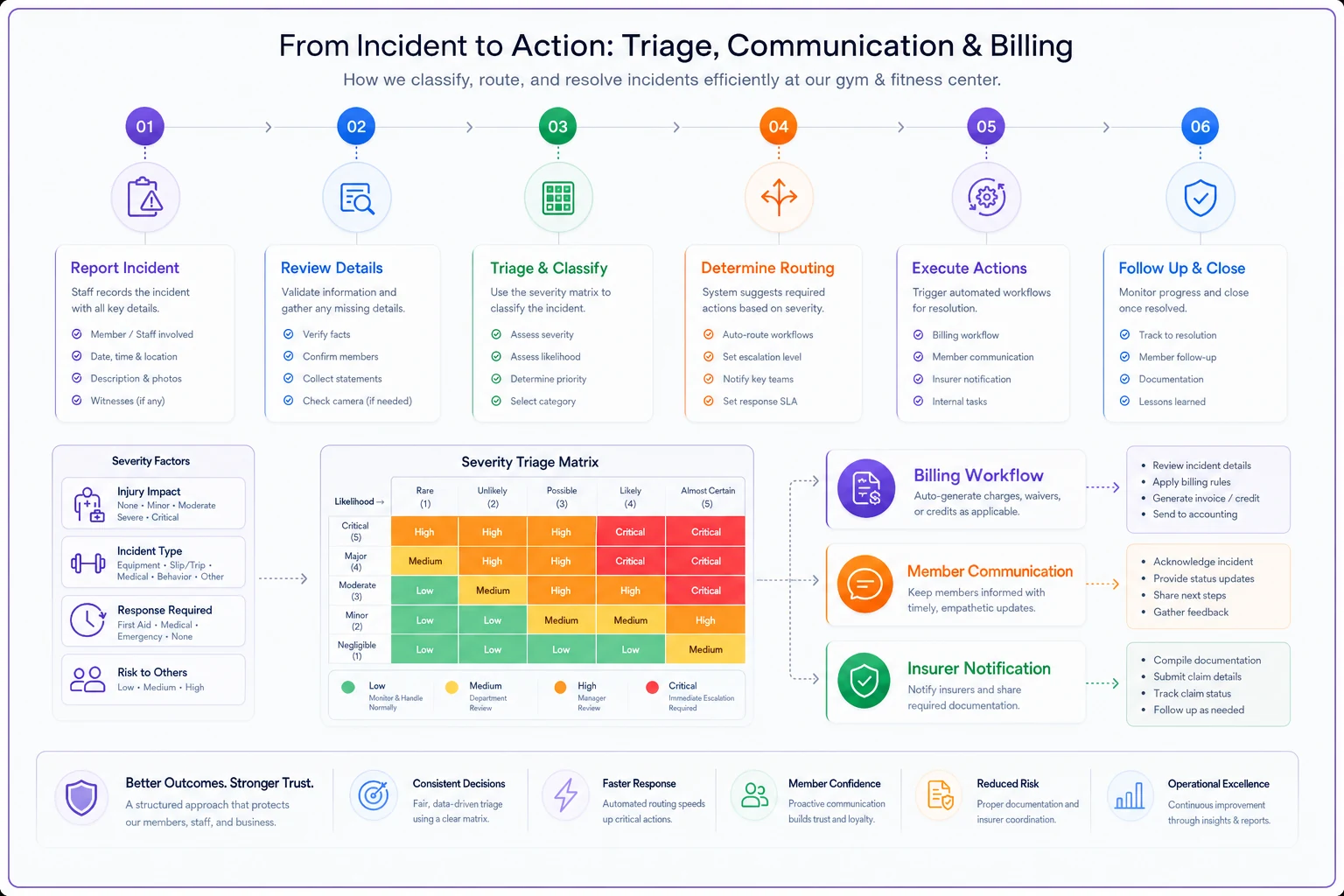
The graph shows the steps: classify severity, run billing logic, queue comms, notify insurer as required.
Closure billing: where good gyms quietly lose thousands
Billing during a closure is the part everyone gets wrong, and the mistakes tend to compound.
When you close for five days, you have three broad options — and mixing them randomly across your member base is exactly how disputes start:
-
Do nothing — keep billing, offer nothing. Cheapest short term, most expensive long term. Members remember it, and a chunk will cite it when they cancel three months later.
-
Credit on reopen — keep the charge, apply a prorated credit to the next cycle. Cleanest for cash flow, but only works if your system can actually track and apply the credit reliably.
-
Pause and prorate — stop billing for the closure window, resume on reopen with a prorated first charge. Fairest from the member's perspective, most operationally demanding.
A practical example: a gym charging around $52/month closes for five days in a 30-day cycle. The fair credit is roughly $8.60 per member. On a 900-member base, that's about $7,700 in credits. The instinct is to skip it to protect the number. But gyms that quietly credit it — and tell members they did — tend to see fewer downstream cancellations. The $7,700 isn't really a cost. It's retention spend with a receipt.
The operational trap is trying to do this manually. Five hundred proration edits during a stressful week is how you end up with double-billing and missed accounts. This is the same discipline covered for automating membership freezes and plan changes without losing revenue — a closure-triggered pause should run through the exact same proration logic as a member-requested freeze.
Membership options to publish at S3/S4
For longer closures, give members choices instead of one take-it-or-leave-it outcome. Publishing the menu upfront kills most of the inbound support volume:
-
Auto-pause — billing stops, membership resumes automatically on reopen (default, no action needed)
-
Convert to home/virtual access — if you offer digital content, keep them engaged
-
Extend membership term — add the closed days to the end of their commitment instead of crediting cash
-
Cancel with no penalty — for extended or indefinite closures only
Don't offer the "cancel with no penalty" option too early. At S3 with a known reopen date, putting cancellation on the table plants an idea that didn't need to be there. Save it for S4 where the timeline is genuinely uncertain.
Giving members a menu of options rather than a single decision protects retention in ways that a blanket policy never will. People who feel in control of the situation are far less likely to churn when you reopen.
Scripted comms by severity
Comms go sideways in a crisis because someone writes them live, under pressure, and either overpromises or leaks anxiety. Pre-write them. Fill in the brackets. Send.
S2 template (section closure):
> "Quick heads up — our [free weights area] is closed through [Thursday] for [repairs]. Everything else is open as usual. No changes to your membership. Thanks for your patience — [Gym Name]."
S3 template (full closure, known reopen):
> "[Gym Name] is temporarily closed through [date] due to [reason]. We've automatically paused billing for the closure period, so you won't be charged for time you can't train. Your membership resumes when we reopen. Questions? Reply here. We'll update you [day] with reopening details."
S4 template (extended/uncertain):
> "An important update on [Gym Name]. Due to [event], we're closed for an extended period. All billing is frozen effective immediately. You have options — [pause / extend / cancel with no penalty] — details here: [link]. We're sorry for the disruption and will keep you updated every [X days]."
Two things separate scripts that work from ones that don't. First, the billing action goes in the first two sentences — not buried at the bottom. Members' first question is always "am I still being charged," and answering it upfront collapses your inbound volume. Second, commit to an update cadence and actually hit it. "We'll update you Thursday" is a promise. Missing it does more damage than the closure itself.
Insurer notification: the templates that protect your claim
This is what gym owners under-invest in until they actually need it — and by then the mistakes are already baked in. Late notice, vague descriptions, and missing evidence are the three main reasons claims get reduced or denied.
The single biggest error is waiting until you "know more" before notifying. Most policies require prompt notice, and "prompt" gets interpreted against you when you're slow. Notify early even if the claim details are incomplete. You can supplement later.
Keep a notification template ready to go:
> To: [Broker/Insurer claims line] > Policy #: [xxxx] > Date/time of incident: [exact] > Location: [specific area] > Description: [factual, no speculation — "water observed entering from ceiling in Studio B at approx. 2:15pm"] > Immediate actions taken: [shut off water, evacuated area, closed studio] > Estimated impact: [preliminary only] > Evidence attached: [timestamped photos, incident log] > Contact: [owner name, direct line]
Notice the "no speculation" note. Write only what you observed. The moment you write "the pipe probably failed because it was old," you've handed the adjuster a maintenance-negligence angle. Facts, timestamps, photos — nothing else.
The evidence discipline that wins claims
The first hour of an S3/S4 event should include, before cleanup starts:
-
Timestamped photos and video of the damage from multiple angles
-
The incident log with exact times and staff on shift
-
Any relevant maintenance records showing the equipment or system was serviced
-
Names and contacts of any witnesses
-
Screenshots of the outage or alert if it's a systems or power event
The mistake people make is cleaning up first and documenting later. Adjusters can tell. Document, then mitigate.
What breaks as you scale locations
At one location, this whole thing can live mostly in the owner's head because the owner is usually there. The plan breaks the moment you're not the one classifying the event.
With two or three sites, the failure mode shifts. GMs start making inconsistent calls — one credits members generously, another does nothing, and members talk. Billing becomes chaotic because each site handles proration differently. Insurer notifications go out on wildly different timelines depending on which manager happened to be on shift.
Scale turns this from a judgment problem into a standardization problem. The triage matrix has to be identical across sites, billing actions need to be system-enforced rather than manually applied, and the insurer templates have to live somewhere every GM can grab them at 6am on a Sunday.
Integration discipline matters here too. If your billing system, your comms tool, and your incident log don't talk to each other, every closure becomes a manual reconciliation job. The provider-neutral approach to avoiding integration traps applies directly: a closure event should trigger billing pauses and member comms without someone hand-copying a member list between three systems. AI-powered operational platforms handle exactly this kind of multi-step coordination — classifying an event type, triggering the appropriate billing logic, and queuing the pre-written comms — so the response doesn't depend on who happens to be working that shift.
The test and drill calendar
A plan that's never rehearsed is a document, not a capability. The gyms that actually execute well run small drills on a schedule so the muscle memory exists before the real thing.
You don't need to simulate a flood to test the plan. A realistic annual cadence looks something like this:
| Frequency | Drill | What you're testing |
|---|---|---|
| Monthly | Incident classification quiz for GMs | Can staff assign the right severity in under a minute? |
| Quarterly | Comms dry-run — send S3 template to a test segment | Deliverability, template accuracy, cadence discipline |
| Quarterly | Billing pause simulation on a test account cohort | Does proration actually calculate and apply correctly? |
| Twice a year | Full closure tabletop with owner + GMs | Decision flow, who declares what, handoffs |
| Annually | Insurer notification walk-through with your broker | Are your templates and coverage assumptions still accurate? |
The most valuable one on that list is the quarterly billing simulation. Owners assume their system will pause and prorate correctly under pressure — and then discover during a real closure that it double-charged 30 members or applied the wrong window. Test it on a small cohort when it doesn't matter.
Run the billing pause simulation on a small, low-risk cohort quarterly so proration bugs surface safely.
When a formal plan is overkill
If you're a single studio with 150 members and you're on-site every day, you don't need a four-tier matrix and a broker tabletop. A one-page version — three severity levels, pre-written comms, and your insurer's number taped to the office wall — is enough. Building bureaucracy you'll never use is its own kind of operational drag.
The formal version earns its keep once you cross roughly 500 members or open a second location. That's the point where you personally stop being the fail-safe.
A quick real-world scenario
A mid-size gym — around 750 members, one location, dues near $49/month — lost HVAC during a July heat stretch and had to close for four days. Before building any kind of plan, the previous summer's outage had been a mess: billing untouched, a flood of angry messages, a batch of chargebacks, and a claim filed late with weak photos that got partially reduced.
The second time around, the GM classified it S3 within the hour, auto-paused billing for the closure window, and sent the pre-written S3 message with the billing line up top. The proration credit ran automatically — roughly $6–7 per member, around $4,800 total across the base. The insurer got notified the same afternoon with timestamped photos and the incident log.
Inbound support dropped to a fraction of the prior event, chargebacks were essentially zero, and the claim went through clean. The owner described reopening week as "boring" — which, in this line of work, is the highest compliment an operational plan can earn.
Where to start
Don't try to build the whole thing at once. Write your severity matrix first — even a rough three-tier version — because every other piece hangs off it. Then pre-write the comms templates and store them somewhere staff can actually find them. Then, the step most people skip, run one billing pause simulation before you ever need it for real.
A gym business continuity plan isn't a binder you file and forget. It's a set of decisions you make now, calmly, so that when the building's hot or the water's rising or the processor's down, nobody has to improvise the expensive parts. The gyms that survive disruption well aren't lucky. They just decided the hard stuff in advance — and made sure the system, not a stressed-out person, executed it.
Don't try to build the whole thing at once. Write your severity matrix first — even a rough three-tier version — because every other piece hangs off it. Then pre-write the comms templates and store them somewhere staff can actually find them. Then, the step most people skip, run one billing pause simulation before you ever need it for real.
A gym business continuity plan isn't a binder you file and forget. It's a set of decisions you make now, calmly, so that when the building's hot or the water's rising or the processor's down, nobody has to improvise the expensive parts. The gyms that survive disruption well aren't lucky. They just decided the hard stuff in advance — and made sure the system, not a stressed-out person, executed it.
Ready to elevate your gym operations?
Join 2,000+ gyms using Gymioly to reduce admin overhead, improve member experience, and grow revenue.