

Most gym owners treat the energy bill like weather. It shows up, it's annoying, you pay it. But in fitness facilities, energy is usually the second or third largest operating expense after rent and payroll — and unlike payroll, nobody's watching it closely. A 6,000 sq ft gym running HVAC hard, pumping showers, and lighting a floor 16 hours a day can easily burn through $1,800–$3,500 a month depending on climate and local rates. The frustrating part is that a meaningful chunk of that is avoidable without buying a single thing.
This post is narrow on purpose. We're going to walk through a fast audit you can run yourself, give you the actual language to use with your utility and HVAC vendors, set realistic savings benchmarks so you know when to stop chasing a number, and lay out a 90‑day plan that keeps CAPEX and OPEX decisions separate so you don't over-invest early.
The quick audit: where gym energy actually hides
Skip the full engineering audit for now. A professional audit costs money and takes weeks. You can find the majority of the waste in an afternoon with a notepad and your last 12 months of bills.
The pattern that shows up most often in gyms: the waste isn't spread evenly. It clusters in four places, and HVAC plus water heating usually accounts for most of it.
The four high-consumption zones to inspect:
-
HVAC runtime and setpoints. Walk the floor at 6am before anyone's in. Is the AC already blasting? Many gyms run 24/7 schedules because somebody set it once and never touched the thermostat again. A gym that's empty from 11pm to 5am and still conditioning the full space to 68°F is lighting money on fire.
-
Water heating. Showers and towel laundry. If you've got old tank heaters cycling to keep 80 gallons hot overnight when nobody's showering, that's standby loss you're paying for every hour.
-
Lighting. Less of an issue now that LEDs are common, but older metal halide fixtures over a turf area or in high-ceiling spaces still chew through power. Also check: are exterior and parking lights on a timer or photocell, or does someone flip them manually and sometimes forget?
-
Phantom and equipment load. Treadmills, screens, vending machines, and that back-office setup running all night. Individually small, collectively a steady drain.
The afternoon audit, step by step
-
Pull 12 months of utility bills and chart kWh usage month over month. You're looking for the summer and winter spikes — those point straight to HVAC as your biggest lever.
-
Find your rate structure. Are you on a flat rate, time-of-use, or do you have demand charges? Demand charges — a fee based on your single highest 15-minute usage peak — are the sneaky one. If you have them, your bill is partly driven by when you use power, not just how much.
-
Do a 6am and a 10pm walkthrough. Note what's running when the building is empty or close to it. Lights, HVAC, screens, music. Write down every system that's on and ask yourself whether it actually needs to be.
-
Check your water heater settings and age. Temperature setting, tank vs. tankless, whether it's insulated. Anything set above 125°F for a shower setup is usually overkill.
-
Read your HVAC thermostat schedules. Most "programmable" thermostats in gyms are running in permanent hold. That's the single most common finding.
Here's a simple workflow for the afternoon audit.
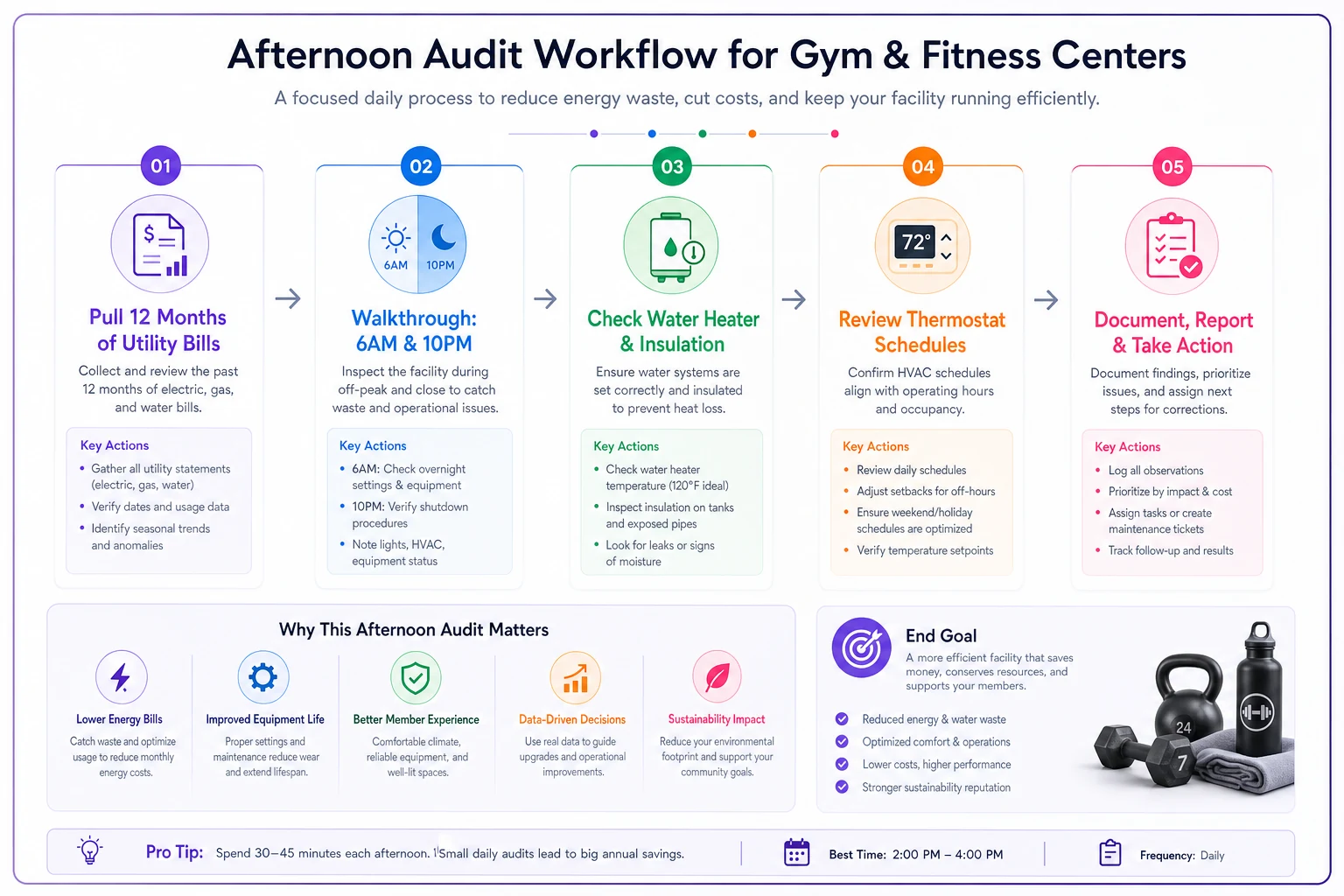
By the end you'll have a short list of 5–8 specific issues that roughly sort into "free to fix today" and "costs money, needs a plan."
Reading your bill like you mean it
The line item that catches gym owners off guard is the demand charge. Say you open at 5am, and your HVAC, water heaters, lighting, and the first wave of cardio equipment all kick on within the same 15-minute window. That simultaneous spike sets your peak demand for the entire billing period — and you pay for it even if it only happened once.
End appointment chaos and boost attendance.
Gymioly streamlines booking, confirms sessions, and manages memberships effortlessly.
- Unified class and membership management
- Automated member notifications
- Trainer scheduling and availability
No credit card required
A gym pulling a 40 kW peak on a $15/kW demand charge is paying $600/month just for that spike, regardless of total usage. Staggering startup — bringing HVAC up at 4:30am and equipment at 5am — can shave that peak meaningfully with zero equipment cost.
Before you spend a dollar, understand which bill you're actually fighting: a usage problem (too many kWh) or a demand problem (badly timed peaks). The fixes are completely different.
The vendor negotiation scripts
Two conversations matter: your utility provider and your HVAC vendor. Most gym owners never have either one.
Script 1: Calling your utility about rate plans
> "Hi, I run a fitness facility and I'm reviewing our energy usage. I'd like to understand which rate schedules we qualify for. Specifically: Do you have a time-of-use plan, and based on my usage history, would it save me money versus my current plan? Also, do I currently have demand charges on my account, and is there a plan structure that reduces or caps those? Can you run a bill comparison across the plans I qualify for using my last 12 months of data?"
That last request is the important one. Utilities can almost always run a "what would you have paid on Plan X" analysis. Make them do it. There are gyms sitting on the wrong rate schedule for years, losing a few hundred dollars a month, simply because nobody asked for the comparison.
Script 2: Talking to your HVAC vendor
> "Before we talk about any replacements, I want to optimize what I already have. I need you to verify my thermostat schedules match my actual hours, check my refrigerant charge and airflow, and tell me the three cheapest things I can do to cut runtime. If you're going to recommend a replacement, I want a payback calculation — equipment cost divided by projected monthly savings — not just a quote."
The phrase "payback calculation" changes the conversation. A vendor who can't or won't give you the payback period on a $12,000 rooftop unit is selling you a unit, not a solution. It's also worth aligning any replacement timing with your broader CAPEX forecasting and preventive maintenance planning so you're not replacing working equipment just because a vendor suggested it.
Expected savings benchmarks — so you know when to stop
Use these as rough targets. If you're already hitting them, the next dollar of effort probably isn't worth it.
| Fix | Typical cost | Realistic savings | Payback |
|---|---|---|---|
| HVAC schedule/setpoint correction | $0 | 8–15% of HVAC load | Immediate |
| Staggered equipment startup (demand) | $0 | $200–$600/mo if on demand charges | Immediate |
| Water heater setpoint + insulation wrap | $30–$150 | 5–10% of water heating | Weeks |
| LED retrofit (older fixtures) | $2k–$8k | 50–70% of lighting cost | 1–3 years |
| Smart thermostat / BMS controls | $500–$4k | 10–20% of HVAC load | 1–2 years |
| Tankless or heat-pump water heater | $4k–$12k | 20–40% of water heating | 3–6 years |
Notice the pattern: the top of this table costs nothing and pays off immediately. The bottom costs real money and takes years. A lot of owners get sold the bottom of the table before they've done the top.
A reasonable whole-facility target for a gym that's never optimized anything is 12–20% off the total energy bill in the first 90 days, with most of that coming from behavior and scheduling changes, not purchases.
A real scenario
A single-location strength-and-conditioning gym, around 5,500 sq ft, was running roughly $2,400/month in electricity and gas combined. The owner assumed it was just the cost of running a big space with high ceilings.
The audit turned up three things: HVAC was in permanent hold conditioning the full space 24/7, the water heater was set to 140°F and uninsulated, and all the cardio equipment plus HVAC spiked together at open, triggering demand charges the owner didn't know he had.
Fixes, in order: corrected the thermostat schedule to match actual hours and set back overnight (free), dropped the water heater to 122°F and wrapped it ($40), and staggered HVAC and equipment startup by 30 minutes (free). Over the next two billing cycles the combined bill settled around $2,000–$2,100. That's $300–$400 a month, roughly $4k a year, for an afternoon of work and a $40 insulation blanket. The LED retrofit and a smart thermostat got pushed to a later phase where the payback math made sense.
The 90‑day plan: keep CAPEX and OPEX separate
The reason to phase this is simple — CAPEX decisions and OPEX decisions have totally different risk profiles. Behavior changes are reversible and free. Equipment purchases aren't. So you front-load the free stuff and only commit capital once you've seen the data.
Days 1–30 — OPEX only, zero spend:
-
Run the afternoon audit and the two vendor calls.
-
Correct all HVAC schedules and setpoints.
-
Fix water heater temperature, add insulation wrap.
-
Stagger startup to flatten demand peaks.
-
Request the utility rate-plan comparison and switch if it saves money.
Days 31–60 — measure and target:
-
Compare the new bill against baseline. Did you hit 12–20%?
-
Identify which remaining issues actually justify spend. Pull payback numbers from your HVAC vendor on anything they recommended.
-
Rank CAPEX candidates by payback period, shortest first.
Days 61–90 — selective CAPEX:
-
Approve only purchases with a payback under roughly 2–3 years, unless a rebate changes the math.
-
LED retrofits and smart controls usually clear this bar; full HVAC or water heater replacement often doesn't unless the unit is already failing.
-
Check for utility and state rebates before you buy — they can cut a 3-year payback down to 18 months.
Ask your utility for a 12-month bill comparison across plans before authorizing any CAPEX.
It's also worth tying replacement timing to the rest of your equipment lifecycle rather than treating energy in isolation. Your HVAC is part of your business-resilience and downtime planning too — a failed unit on a July weekend is both an energy problem and a members-walking-out problem.
When this makes sense — and when it doesn't
Do this now if: you've never looked at your rate plan, your thermostats run in permanent hold, or your bill spikes hard in summer and winter. That describes most gyms.
Skip the CAPEX phase if: you're on a short lease — under three years or so — and the landlord owns the HVAC. You'll pay for upgrades you don't keep. Do the free OPEX fixes, negotiate the rate plan, and stop there.
Don't let a vendor talk you into replacement if: your current equipment is under 8–10 years old and working. The free optimizations capture most of the gain. A new rooftop unit with a 6-year payback is a worse use of capital than almost anything else you could do with that money.
The owners who handle this well aren't the ones who spend the most. They're the ones who do the free work first, measure honestly, and only write a check when the payback math is boring and obvious. Energy isn't weather. It's a controllable line item that most gyms have simply never bothered to control.
Ready to elevate your gym operations?
Join 2,000+ gyms using Gymioly to reduce admin overhead, improve member experience, and grow revenue.