
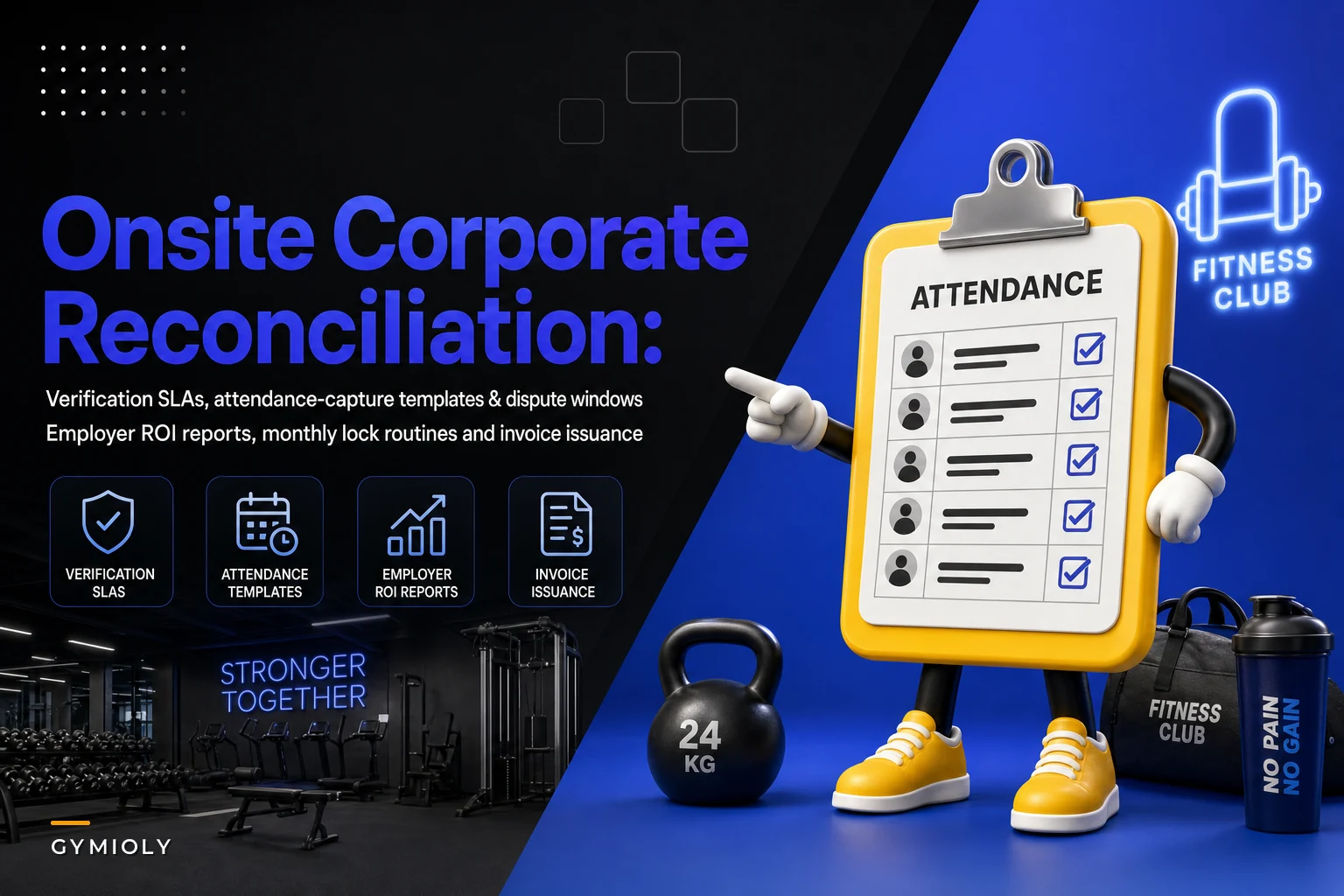

Onsite corporate class reconciliation breaks in a specific, predictable way: your trainer runs a 7am bootcamp at a company's office park, 14 people show up, and six weeks later the employer's HR contact disputes the invoice because "they only counted nine on the badge scanner." Now you're digging through a coach's phone for a blurry sign-in sheet photo, your bookkeeper is guessing at headcounts, and you've quietly written off revenue you actually earned.
The messy part isn't the training. It's everything that happens between the class ending and the money landing. Operators who get burned worst are the ones treating onsite delivery and in-gym corporate access as the same billing flow. They're not. They fail differently, they get disputed differently, and they need completely separate reconciliation routines.
This playbook covers only that gap: verification SLAs, attendance capture at the point of delivery, the monthly reconciliation routine, and the contract language that protects you when an employer's internal numbers don't match yours.
Why onsite and in-gym corporate billing have to be separate flows
The instinct is to lump all corporate revenue into one bucket. One employer contract, one invoice, done. That's where the leakage starts.
In-gym corporate access is passive. The employee badges in at your facility, your access control logs the swipe, and the record is clean because it lives inside your own system. You control the sensor. Onsite delivery is the opposite — you're on their turf, often with no turnstile, no reliable scanner, and a coach who is there to teach, not run compliance paperwork.
| Dimension | In-gym corporate access | Onsite delivery |
|---|---|---|
| Who captures attendance | Your access control / check-in | Your coach, manually, offsite |
| Source of truth | Your system logs | Contested (yours vs. their badge data) |
| Dispute window risk | Low — logs are authoritative | High — HR may run parallel counts |
| Billing basis | Per-active-employee or flat | Per-session, per-head, or per-block |
| Reconciliation frequency needed | Monthly is fine | Weekly capture, monthly settle |
| Common failure | Entitlement drift | Headcount disputes, no-show billing |
Keep them on separate invoices, separate line-item logic, and separate reconciliation cadences. If you've built out broader employer pricing and per-employee access rules, the onsite flow sits beside that structure, not inside it — the piece on selling and running corporate wellness programs covers the in-gym access side in depth, and this one deliberately handles only what happens at the employer's location.
The verification SLA is the thing that actually prevents disputes
Most onsite corporate deals have no verification SLA at all. The contract says "provider will deliver weekly group classes" and never defines when attendance gets reported, to whom, in what format, or by when a dispute must be raised. That silence is what turns a $400 headcount disagreement into a three-week email war.
End appointment chaos and boost attendance.
Gymioly streamlines booking, confirms sessions, and manages memberships effortlessly.
- Unified class and membership management
- Automated member notifications
- Trainer scheduling and availability
No credit card required
A verification SLA is just a set of mutually agreed deadlines and formats around attendance proof. It protects both sides. The employer knows exactly when they'll see numbers. You know exactly when the dispute window closes — which means after that window, your invoice is final.
-
Capture Provider will record attendance at the point of each session using the agreed method (sign-in + headcount confirmation). Attendance is timestamped at session end.
-
Reporting Provider will deliver an attendance summary to the client's named contact within 2 business days of each session.
-
Dispute window Client must raise any attendance discrepancy within 5 business days of receiving the summary. After this window, recorded attendance is considered final and billable.
-
Resolution method Disputes are resolved by comparing the provider's timestamped sign-in record against the client's badge/access data. Where both exist, the sign-in sheet governs for class participation (badge data proves building entry, not class attendance — an important distinction).
-
Billing trigger Verified attendance feeds the monthly invoice. Sessions delivered but unverified due to late client reporting are billed at recorded headcount.
That point 4 distinction is the one that saves deals. Employers love to point at badge scanners and say "only nine entered the building." But badge data proves someone walked in a door — not that they walked into your class. Your sign-in sheet, timestamped and tied to the session, is the stronger participation record. Writing that into the SLA upfront ends the argument before it starts.
The quiet failure: no named contact
A verification SLA with no named recipient is useless. "Report to the client" means the email goes to a general HR inbox, sits unread for three weeks, and the dispute window never effectively starts because nobody acknowledges receipt. Require a named contact and a backup in the contract. When that person leaves the company — and they will — your coach is suddenly reporting into a void.
Attendance capture at the point of delivery
This is where onsite falls apart operationally, because the person capturing attendance is the same person coaching. A trainer cueing a 20-person bootcamp is not going to run a careful check-in process. So you build capture to survive a distracted coach.
-
QR self-check-in — You post a session-specific QR code; employees scan on arrival. Best audit trail, timestamped automatically, no coach effort. Fails when the office has bad signal or employees forget.
-
Coach-confirmed roster — Coach opens a pre-loaded roster of enrolled employees and taps present/absent. Fast, works offline, but only captures expected attendees, not drop-ins.
-
Paper sign-in + end-of-session photo — The fallback everyone actually uses. Works anywhere, but it's the weakest for disputes unless you timestamp the photo and store it immediately.
Programs that reconcile cleanly tend not to rely on one method. They run a primary (roster tap) with a backup (sign-in sheet) and treat the sheet as the dispute-resolution artifact. Belt and suspenders — because the one session that gets disputed is always the one where the QR code didn't work.
A capture template that works for a distracted coach — keep it to five fields:
-
Client/employer name + session type
-
Date and session start/end time
-
Enrolled headcount vs. actual headcount
-
Drop-ins / unregistered attendees (name + walk-up flag)
-
Coach signature or confirmation tap
Keep the capture template to five fields so coaches actually complete it at the session.
The drop-in problem nobody plans for
Onsite classes get walk-ups. An employee sees a bootcamp happening, wanders over, joins. If your billing is per-head, that person is revenue — but they're not on the enrolled roster, so they vanish in reconciliation. The capture template needs an explicit drop-in field, and your contract needs to state whether drop-ins are billable. A good chunk of onsite revenue leakage traces back to unregistered attendees who were delivered to but never billed.
The monthly reconciliation routine
Weekly capture, monthly settlement. The reconciliation routine is where you turn a month of scattered session records into one defensible invoice. Done loosely, this is where a coach's missing sheet costs you two sessions of revenue.
-
Pull all session records for the billing period — every captured attendance entry, by employer, by session.
-
Flag gaps — any scheduled session with no capture record. These are your investigation items. Chase them now, not at invoice time.
-
Match captured attendance against the enrolled roster — identify drop-ins and no-shows separately. Both affect billing depending on your contract model.
-
Cross-check against any client-provided data — if the employer sends badge counts, compare. Note discrepancies but default to your sign-in record per the SLA.
-
Build the line-item invoice — one line per session or block, with headcount and billing basis visible so the employer can audit it themselves.
-
Lock the period — once the dispute window on all sessions has closed, the period is final. No retroactive edits.
That "lock the period" step is underrated. Without it, every invoice stays mentally open-ended and employers will keep relitigating sessions from two months ago. A hard lock tied to the SLA dispute window gives you a clean cutoff.
> Session delivered → Coach capture (roster + sign-in backup) → Two-day attendance summary to employer → Five-day dispute window → Discrepancies resolved → Period locked → Invoice issued
Running it in that sequence every month keeps each step accountable. If something breaks, you know exactly where in the chain it broke.
Here's a simple visual of that monthly flow.
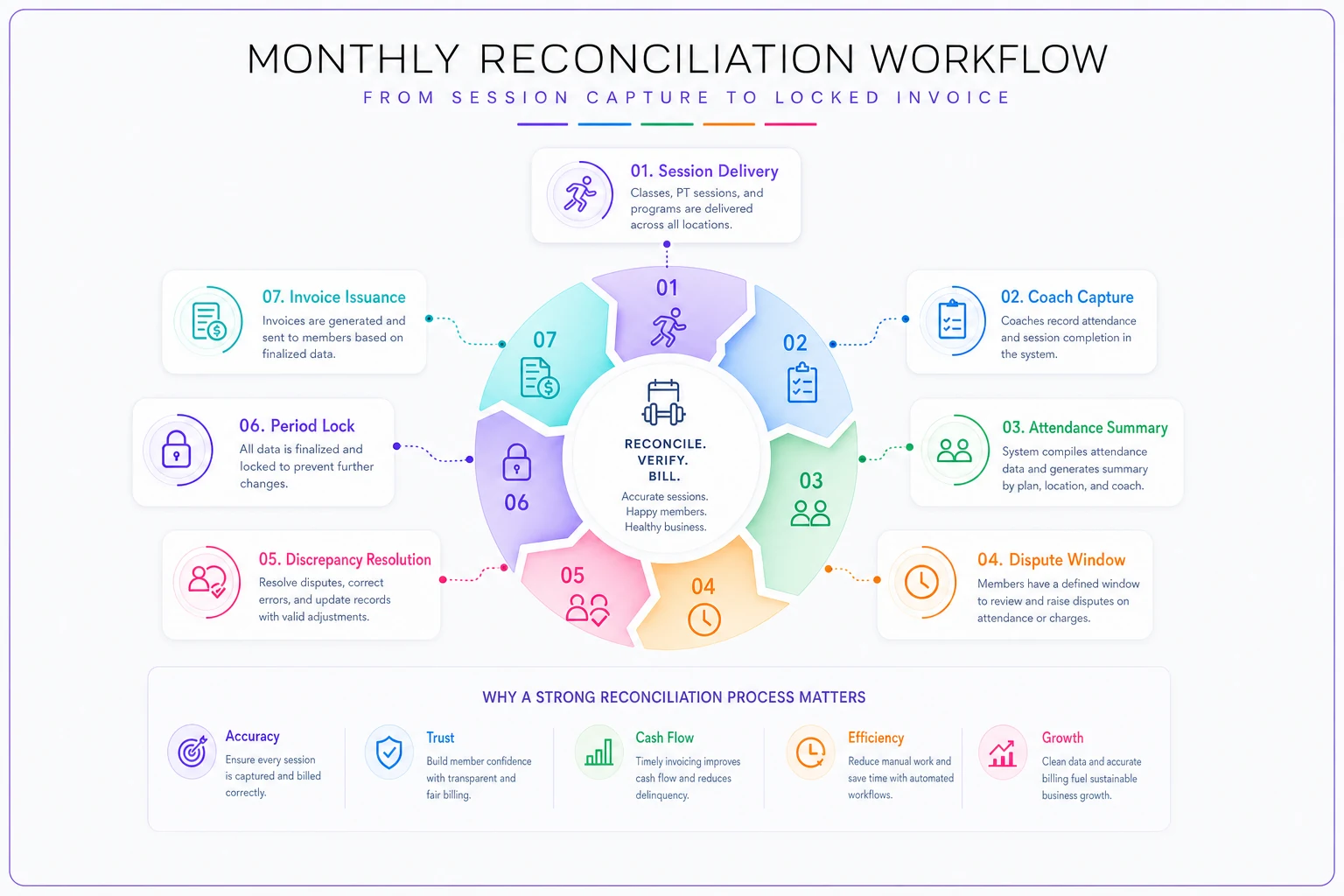
When attendance capture feeds directly into your operational platform, the monthly routine stops being a manual stitch-together.
Where this gets easier with the right system
A lot of onsite reconciliation pain is really a data-scatter problem — sign-in sheets in a coach's phone, enrollment in your booking software, badge counts buried in an employer email thread. When attendance capture feeds directly into your operational platform, the monthly routine stops being a manual stitch-together. The sessions, rosters, and timestamps already live in one place, so building the reconciliation report is pulling a view instead of rebuilding history from screenshots. The tooling doesn't replace the SLA or the capture discipline — it just removes the part where your bookkeeper spends a day hunting for proof that a class happened.
Employer ROI reporting that actually gets contracts renewed
Attendance proves you delivered. ROI reporting proves it was worth it — and that's what gets the contract renewed. These are different documents and should not be confused. The attendance summary is operational and goes out within two days. The ROI report is quarterly or at renewal and goes to the decision-maker, not the HR coordinator.
-
Participation rate — unique employees who attended at least once vs. eligible headcount. A company paying for 50 slots wants to know how many humans actually showed up, not just raw session counts.
-
Repeat engagement — the share of participants who came back three or more times. This is the number that signals the program is sticky, not a one-time novelty.
-
Session fill vs. capacity — are you consistently filling the classes they're paying for?
-
Trend over the contract term — is participation growing, flat, or decaying? A decaying trend caught early lets you adjust before renewal, instead of getting blindsided by a non-renewal.
Keep it to one page. The decision-maker renewing a wellness contract is not reading a 12-page deck. Participation rate, repeat engagement, and a trend line — that's the internal justification they need to re-up.
A real scenario
A mid-size gym running three onsite corporate contracts — two office parks and a logistics warehouse — was billing roughly $6k–$7k a month across the three. Their reconciliation was a coach texting headcounts to the owner on Sunday nights.
The warehouse client disputed two consecutive invoices, claiming the Tuesday class averaged 8 attendees, not the 12–14 being billed. The gym had no timestamped records, only text messages. They ended up crediting back close to $900 just to keep the relationship, and the owner realized she couldn't prove any of her onsite headcounts if pushed.
The fix wasn't complicated. She put a verification SLA into all three contracts with a five-business-day dispute window, switched to a roster-tap capture with a photographed sign-in backup, and moved to a locked monthly reconciliation. Within two billing cycles the disputes stopped — not because the employers got nicer, but because the two-day attendance summary meant discrepancies got raised and resolved while the session was still fresh, instead of two months later.
The warehouse client, seeing clean weekly numbers, actually expanded to a second weekly session. The real win wasn't the recovered $900; it was that onsite revenue became something she could forecast instead of guess at.
When tightening this up actually makes sense
If you run one small onsite class for a friendly client who never disputes anything, a full SLA-and-reconciliation routine is overkill. Don't build bureaucracy for a handshake deal that works.
It becomes worth the effort the moment you have more than one onsite contract, per-head billing, an employer with an internal HR or finance team running their own numbers, or any contract large enough that a disputed month genuinely hurts. Multi-contract onsite delivery without reconciliation discipline is the setup that quietly leaks the most.
Who should not bother yet: single-class, flat-fee, low-dollar arrangements where the admin overhead would exceed the revenue at risk. Keep those simple and spend your structure where disputes can actually cost you.
The contract clauses that hold the whole thing together
Your SLA and reconciliation routine only work if the contract backs them. The clauses that matter most for onsite delivery specifically:
-
Billing basis definition — per-session, per-head, or per-block, stated explicitly, including how drop-ins are treated.
-
Verification SLA — the capture, reporting, dispute-window, and resolution terms from earlier, written in full.
-
Data-of-record clause — states that the provider's timestamped sign-in record governs class participation disputes.
-
Named contact + backup — who receives reports and who acknowledges receipt.
-
No-show / minimum-headcount terms — whether you bill a floor regardless of attendance, which protects you when the employer under-promotes the program.
-
Cancellation notice — how much warning you need to not bill for a canceled onsite session (coaches still get paid for showing up).
That no-show clause deserves attention. Onsite participation is heavily dependent on the employer promoting the program internally. If HR forgets to send the reminder email, your 14-person class becomes a 4-person class through no fault of yours. A minimum-headcount floor means you're billed for the slot you held, not the attendance the employer failed to drive. This is the same reconciliation-and-revenue-share thinking that applies to any outside partnership, and the breakdown on running local partnerships with proper reconciliation cadence covers the broader revenue-split mechanics if your onsite deals involve shared economics.
Bringing it together
Onsite corporate class reconciliation fails because operators treat it like in-gym billing, capture attendance loosely, and leave dispute rules undefined until something goes wrong. The repair is three connected pieces: separate the onsite flow from in-gym access entirely, put a real verification SLA with a hard dispute window into every contract, and run a locked monthly reconciliation fed by point-of-delivery capture that a distracted coach can actually complete.
None of this is glamorous. But operators who build it stop crediting back revenue they earned, stop guessing at headcounts, and walk into renewal conversations with clean participation data instead of a defensive posture. That's the difference between onsite corporate being a headache you tolerate and a revenue line you can actually grow.
Ready to elevate your gym operations?
Join 2,000+ gyms using Gymioly to reduce admin overhead, improve member experience, and grow revenue.