


Most gym partnerships die quietly. Not with a blowup — with a spreadsheet that stops getting updated, a payout that's three weeks late, and a partner who slowly stops answering texts. The physical therapist who was supposed to send post-rehab clients drifts off. The juice bar in your lobby stops paying rent on time. The corporate account you signed with a local logistics company never gets used because nobody figured out who checks the employee list.
Almost none of that is a relationship problem. It's an operations problem. The partnership was built on a handshake and enthusiasm, and enthusiasm doesn't survive month three when neither side can agree on what got sold, who owes what, or how it gets paid.
This piece is narrow on purpose. It's about the mechanics of running local partnerships — how you pick partners, what the contract actually needs to say, how you track the money with a micro‑P&L, and the reconciliation rhythm that keeps everyone honest. Not the sales side. The operational side, which is where these deals actually fall apart.
Start with the failure pattern, because it's always the same
When a gym partnership collapses, walk it backward and you land on one of four points:
-
The partner was wrong from the start. Great vibes, no operational fit. They couldn't deliver volume, or their customer wasn't your customer.
-
The contract was vague on money. "We'll split it" — but split what? Gross? Net of processing fees? Before or after the trainer gets paid?
-
Nobody owned the numbers. No micro‑P&L, so the deal's actual profitability was a mystery for six months.
-
Reconciliation never happened on a schedule. Payouts drifted, disputes piled up, trust eroded.
Fix those four and most partnerships survive long enough to matter. Ignore any one of them and you're back to a dead spreadsheet by summer.
Partner selection: score them before you fall in love with the idea
The mistake here is emotional. You meet a chiropractor who seems sharp, you both get excited about cross-referrals, and you skip the boring question: can this person actually move the needle for us, and can we operationally support what we're promising them?
End appointment chaos and boost attendance.
Gymioly streamlines booking, confirms sessions, and manages memberships effortlessly.
- Unified class and membership management
- Automated member notifications
- Trainer scheduling and availability
No credit card required
Partners who look most exciting in a first meeting are frequently the worst operational fits. The physical therapist with a packed practice has no time to actually refer anyone. The trendy smoothie brand wants prime lobby space but sells maybe eight drinks a day to your members.
Score partners on things that predict operational reality, not chemistry. Here's a scoring frame that keeps you honest:
| Criterion | What you're really checking | Weight |
|---|---|---|
| Audience overlap | Do their customers match your member profile? | High |
| Delivery capacity | Can they actually fulfill their side at volume? | High |
| Financial hygiene | Do they pay vendors on time? Clean books? | Medium |
| Effort asymmetry | Who does more work to keep this alive? | Medium |
| Brand risk | Would their reputation ever bite you? | Medium |
| Exit friction | How painful is it to unwind if it flops? | Low‑Medium |
The one people underweight is effort asymmetry. A partnership where you do 80% of the operational lifting and split revenue 50/50 isn't a partnership — it's you subsidizing someone else's growth. Run that math before you sign, not after.
When a partnership actually makes sense
-
The partner reaches people you can't reach cheaply on your own
-
Their fulfillment doesn't depend on you babysitting it
-
The revenue math still works after you account for your operational cost to support it
-
You can measure whether it's working within 60–90 days
When it's a bad idea
-
You're partnering mainly because you're bored or anxious about revenue
-
The partner needs constant hand-holding to deliver their half
-
The money only works if you assume best-case volume
-
There's no clean way to shut it down without a mess
Who should not do this at all
If your core operations are still shaky — billing failing, scheduling a mess, onboarding inconsistent — don't add partnerships. A partnership multiplies operational complexity. Adding it to a fragile base just gives you more surfaces to break. Get the house in order first.
The contract: the boring clauses that actually save you
You don't need a 40-page legal document for a lobby smoothie deal. You need a short agreement that removes ambiguity on the exact things that cause fights. Fancy contracts fail on the same simple gaps that handshake deals do.
Here's what the contract has to nail, in plain language:
-
Revenue definition. Spell out gross vs. net explicitly. "Revenue share is calculated on net revenue, defined as gross sales minus payment processing fees, minus refunds." No assumptions.
-
Split mechanics. Who collects the money first, who pays whom, and on what schedule. If you collect and pay them, say so. If they collect and pay you, say that.
-
Attribution rules. How do you decide a sale "belongs" to the partnership? Promo code? Sign-up form? Staff tag at point of sale? Pick one method and write it down.
-
Payout timing. "Within 10 business days of month-end reconciliation." A concrete date kills most of the payment friction.
-
Reconciliation right. Both sides can request the underlying numbers. Nobody's flying blind.
-
Term and exit. A defined trial period (say 90 days), then month-to-month with 30 days' notice. Cheap to enter, cheap to leave.
-
Staff responsibilities. Who at each business owns the day-to-day. Names, not departments.
That last one gets skipped constantly, and it's the one that quietly kills deals.
Staff handoffs: the invisible failure point
A partnership isn't run by the two owners who signed it. It's run by whoever's at the front desk at 6pm, or the trainer who's supposed to hand a rehab client a referral card. If those people don't know the partnership exists — or don't know their exact role in it — the whole thing is theater.
A typical example: a gym signs a deal with a nearby PT clinic. Owners are thrilled. But the front desk staff were never told what to do when a PT-referred client walks in. So the client shows up, mentions the clinic, gets checked in like anyone else, and the referral never gets tagged. Two months later the owners can't figure out why the "partnership isn't producing" — when it's actually producing fine, it's just invisible because the handoff never happened at the desk.
Fix it with a dead-simple handoff protocol per partnership:
-
One named owner on your side, one on theirs
-
A written trigger
"When X happens, staff member does Y"
-
The exact tag/code/form used to attribute the transaction
-
A fallback
what to do if the normal flow gets missed
-
A weekly 5-minute check that the handoff is actually happening
Keep this on one page. If your handoff instructions need more than a page, the partnership is too complicated to run reliably.
The revenue-share micro‑P&L: know if the deal is actually good
This is where most gym owners fly blind. They know the partnership generates some revenue. They have no idea if it's profitable after the cost of running it.
A micro‑P&L is just a tiny profit-and-loss statement scoped to one partnership. Not your whole gym — just this deal. It answers one question: after everything, are we making money on this or not?
Here's a realistic one for a lobby smoothie bar paying you a revenue share plus a small rent:
Monthly micro‑P&L — Lobby Smoothie Partnership
-
Revenue share received (12% of net sales)
~$640
-
Fixed rent from partner
$300
-
Gross partnership revenue
~$940
-
Costs
-
Square footage opportunity cost (space could hold retail)
~$250
-
Staff time on reconciliation + coordination (~2 hrs/mo)
~$60
-
Utilities allocated to their equipment
~$45
-
Total cost to support
~$355
-
Net contribution
~$585/month, roughly $7k/year
Now the deal is real. It's not "we have a smoothie bar." It's "this partnership nets us about $585 a month, and here's exactly why." If that number were negative — which happens more than owners expect once you count the space and staff time — you'd renegotiate the split or kill it.
The same discipline applies to any non-dues stream running through a partner. If you're building out these revenue lines, it's worth pressure-testing each one with the same unit-economics thinking laid out in validating non-dues revenue for your gym — because a partnership that looks like found money on the surface can quietly lose you money once you allocate the real operational cost.
Corporate partnerships need this even more, since the fulfillment cost is easy to underestimate. If you're running or considering employer deals, the pricing and access mechanics in selling and running corporate wellness programs pair directly with a micro‑P&L — you want the per-employee math and the profitability math sitting side by side, not in separate heads.
Reconciliation cadence: the rhythm that keeps trust intact
Partnerships don't fail from bad math — they fail from late and irregular math. When reconciliation happens at random — sometimes the 5th, sometimes the 22nd, sometimes not at all — both sides start to assume the worst. The partner thinks you're stalling on their payout. You think they're inflating their numbers. Resentment compounds.
A fixed cadence removes all of that. The dates don't even have to be aggressive. They just have to be predictable.
A workable month-end cadence looks like this:
-
Day 1–2 after month-end Pull the raw numbers. Sales, refunds, processing fees, attribution tags. Whoever collected the money produces the source data.
-
Day 3 Both sides review the same figures. Flag any transaction that's ambiguous — a sale that might or might not belong to the partnership.
-
Day 4–5 Resolve disputes. Usually it's an attribution question. Settle it against the rule you wrote in the contract, not against whoever argues louder.
-
Day 6 Lock the number. Once it's locked, it's locked — no reopening last month during next month's review.
-
By Day 10 Payout clears. Same window every single month.
The discipline that matters most is step 4. Lock the number. Partnerships get poisoned when last month keeps getting reopened. Once both sides agree, it's done — even if someone finds a $30 discrepancy later, you fold it into next month rather than relitigating a closed period.
Automate the transaction pull and attribution checks so humans only review exceptions.
Visualizing the reconciliation workflow helps teams follow the cadence.
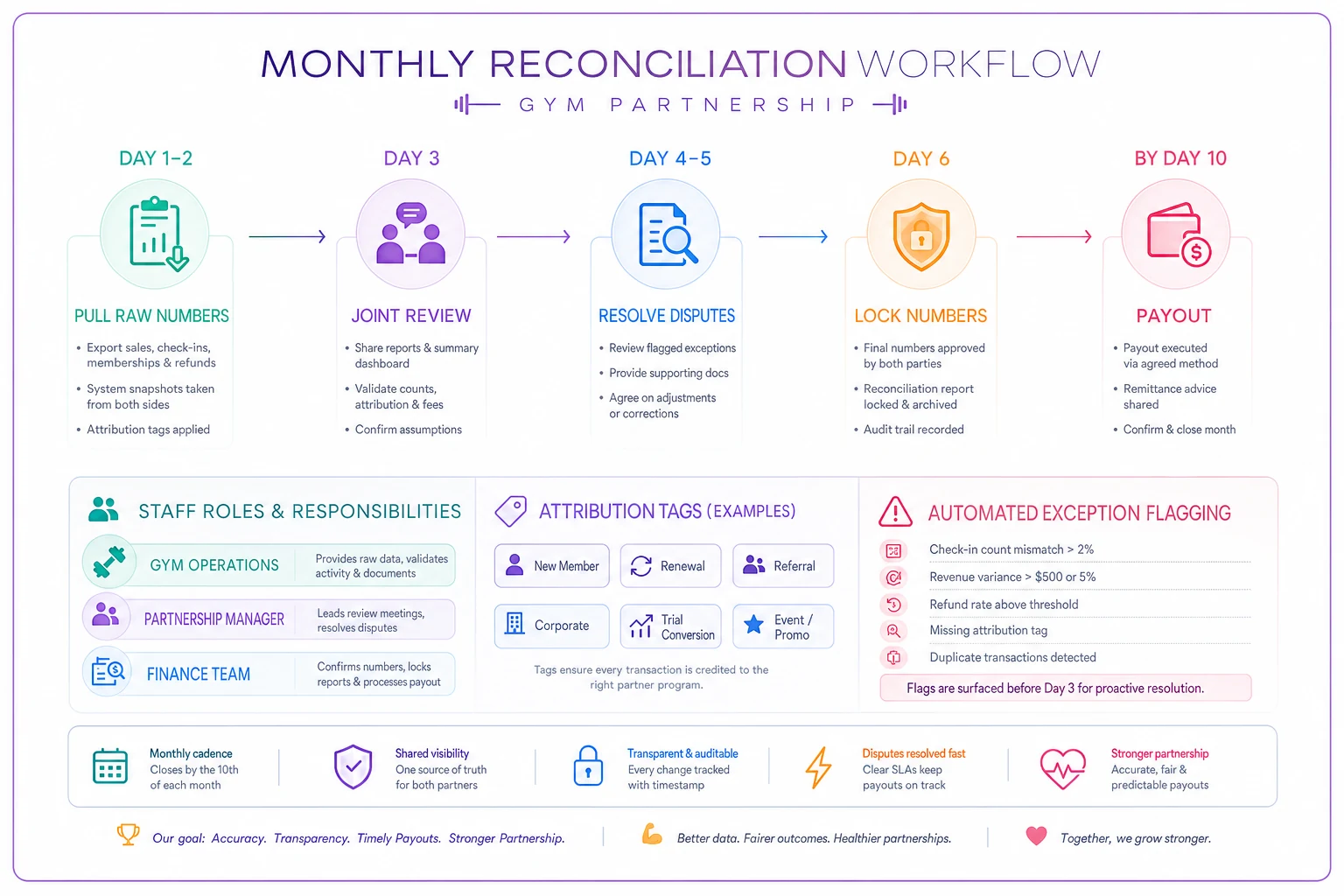
Use this as a quick checklist during month-end.
Where AI-assisted operational software quietly helps is in the reconciliation pull itself. It's not doing anything magical — it's matching source transactions against attribution tags automatically and flagging the handful that don't reconcile cleanly. So instead of someone eyeballing hundreds of rows, they're only reviewing the ten that actually need a human decision. That's the difference between reconciliation taking two hours and taking fifteen minutes, and it's usually the difference between a cadence that gets followed and one that quietly gets skipped.
A real scenario: the referral deal that was "losing money" but wasn't
A single-location gym had a referral arrangement with a nearby physical therapy clinic. Cross-referrals both ways, with the gym paying the clinic a flat $40 per converted member the clinic sent over.
Six months in, the owner was convinced it was a dud. "We paid them a bunch and got, what, a handful of members." He was ready to cancel it.
The problem was he'd never built a micro‑P&L or run a real reconciliation. When he finally sat down and pulled the numbers by attribution, it turned out the clinic had sent around 14 members over six months, not the "handful" he remembered. He'd paid roughly $560 in referral fees. Those 14 members were paying about $85/month, and most were still active — close to $1,190/month in recurring dues traceable directly to the partnership, against a one-time-ish cost that averaged under $100 a month.
The deal wasn't losing money. It was one of his best acquisition channels. He just couldn't see it because there was no cadence and no micro‑P&L. Once he set up a monthly reconciliation and tagged referrals properly at signup, he did the opposite of canceling — he asked the clinic how to send more.
That's the whole point. Without the operational scaffolding, a good partnership and a bad one look identical from the owner's chair. The scaffolding is what lets you tell them apart.
Putting it together without overbuilding it
You don't need to run every local deal like a corporate joint venture. A lobby vending partnership doesn't need the same rigor as a five-figure corporate wellness contract. Match the operational overhead to the size of the deal.
-
Select with a scorecard, not a gut feeling
-
Contract with clear revenue definitions and named staff owners
-
Track each deal with its own tiny micro‑P&L
-
Reconcile on a fixed, predictable cadence and lock the numbers
The gyms that run partnerships well aren't better at picking partners or negotiating. They're just better at the unglamorous operational rhythm — the monthly close, the attribution tag at the desk, the payout that shows up on the same day every month. That consistency is what turns a nice-idea handshake into a revenue line you can actually count on. Everything else is just enthusiasm, and enthusiasm has never once reconciled a payout.
The gyms that run partnerships well aren't better at picking partners or negotiating. They're just better at the unglamorous operational rhythm — the monthly close, the attribution tag at the desk, the payout that shows up on the same day every month. That consistency is what turns a nice-idea handshake into a revenue line you can actually count on. Everything else is just enthusiasm, and enthusiasm has never once reconciled a payout.
Ready to elevate your gym operations?
Join 2,000+ gyms using Gymioly to reduce admin overhead, improve member experience, and grow revenue.