
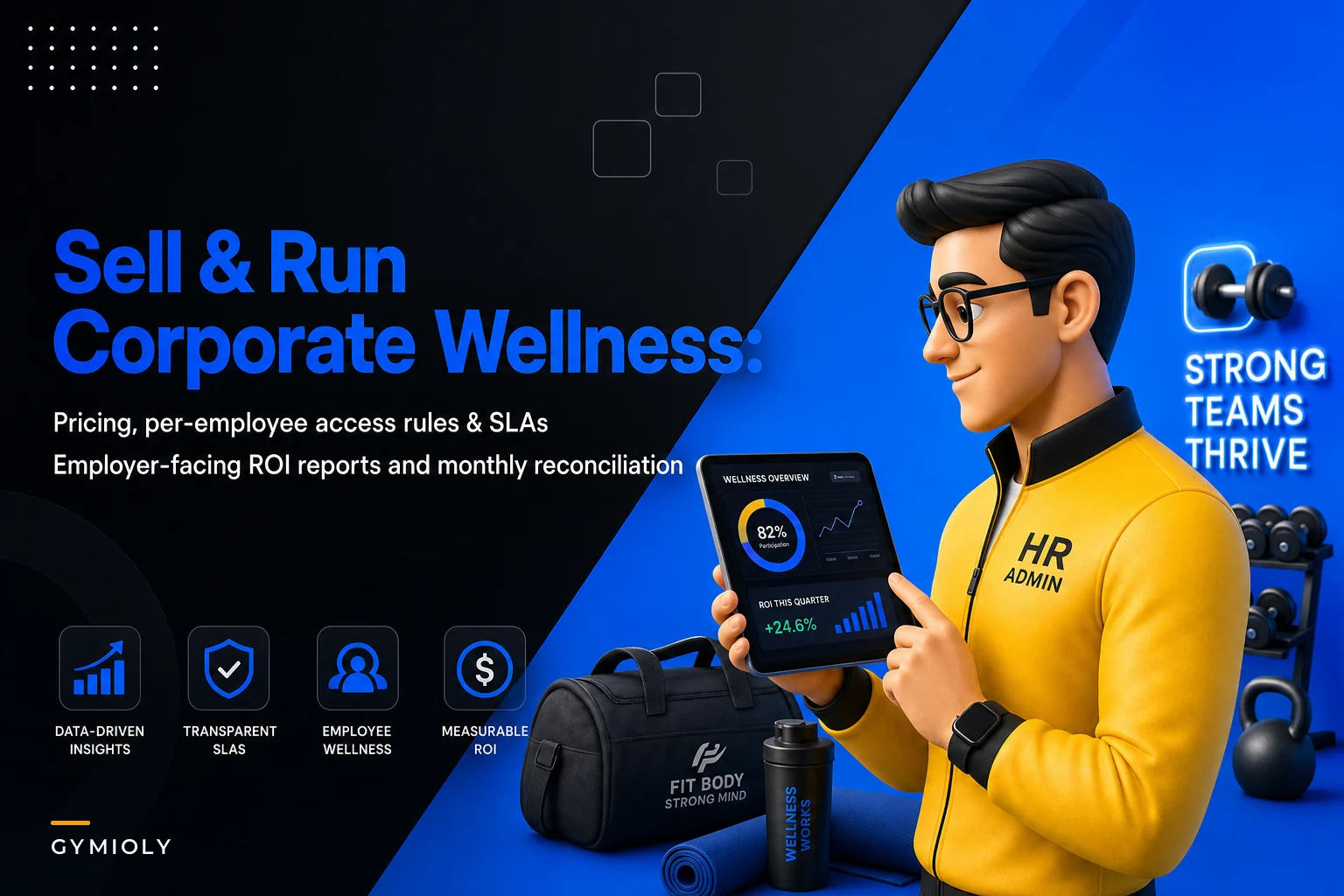

Corporate wellness programs feel like easy money until you're three months in, drowning in spreadsheets, trying to figure out why Accounting at TechCorp says you billed them for 247 employees when HR approved 195, and somehow 312 people actually showed up last month.
The gap between selling a corporate contract and actually running it profitably kills most gym wellness programs in the first year. Not because demand isn't there — companies genuinely want these programs. They fail because gyms treat corporate accounts like bulk membership sales instead of what they actually are: complex operational partnerships that need completely different systems than regular memberships.
The billing reconciliation nightmare nobody warns you about
Every corporate wellness program starts the same way. You close the deal, everyone's excited, HR sends over an employee list, and you think you're set. Then month one ends and reality hits.
A gym owner in Austin learned this with a 500-employee tech company contract. The deal looked simple: $25 per employee per month for unlimited access. HR provided a roster of 385 approved employees. Straightforward math — $9,625 in monthly revenue.
-
427 unique check-ins attributed to that company
-
42 employees who'd already left still accessing the facility
-
84 new hires nobody had reported
-
Ongoing disputes about contractor vs. employee status
-
Zero documentation on who authorized what
The tech company's finance team refused to pay for "unauthorized" users. The gym couldn't prove who was actually eligible. Three months of back-and-forth emails later, they settled for about 60% of what they were owed and lost the contract entirely.
This happens constantly because gyms try to manage corporate programs through their regular membership system. Corporate contracts need completely different verification and tracking from the start.
Building per-employee access rules that actually work
The most expensive mistake in corporate wellness isn't pricing — it's access control. Most gyms go either too restrictive (killing utilization) or too loose (creating billing chaos).
End appointment chaos and boost attendance.
Gymioly streamlines booking, confirms sessions, and manages memberships effortlessly.
- Unified class and membership management
- Automated member notifications
- Trainer scheduling and availability
No credit card required
Tiered Access Model
Instead of all-or-nothing access, structure three tiers:
-
Full Access Employees ($30-40/month) - Unlimited facility use - All group classes - Guest privileges once monthly
-
Basic Access Employees ($15-20/month) - Facility use during off-peak hours - Limited class selection - No guest privileges
-
Supplemental Access ($8-12/month) - Employees who already have memberships elsewhere - 4 visits per month - Good fit for remote workers or frequent travelers
The key insight here: companies will pay more for a system that gives them cost control. Offering tiers lets HR manage their budget while you keep billing predictable.
Verification Requirements
-
Initial enrollment (employee provides company email and employee ID)
-
Monthly audit against HR roster
-
Quarterly deep reconciliation with company stakeholders
Skip any of these and you'll accumulate phantom users that quietly destroy your margins.
Monthly reconciliation templates that prevent disputes
The difference between profitable and painful corporate programs almost always comes down to documentation — not the original contract, but the ongoing operational records that prove what you're actually billing for.
The Master Reconciliation Template Build a standardized monthly report tracking:
| Data Point | Why It Matters | Dispute Prevention |
|---|---|---|
| Unique users by tier | Shows actual utilization | Prevents "we don't use it" arguments |
| New additions with authorization | Documents HR approvals | Eliminates unauthorized access claims |
| Removed users with dates | Shows you're actively managing | Reduces overcharge disputes |
| Peak usage times/days | Demonstrates value | Supports renewal conversations |
| Department breakdown | Reveals adoption patterns | Helps HR promote internally |
Every month, this report goes to three people:
-
HR contact (for roster verification)
-
Finance contact (for billing approval)
-
Executive sponsor (for program validation)
Send the monthly reconciliation report to Finance and HR at once to speed approvals.
Most gyms only communicate with HR. That's exactly why they get blindsided when Finance questions an invoice or leadership cancels during budget reviews.
The employer-facing ROI dashboard that seals renewals
Companies don't renew wellness programs because employees like them. They renew because someone can show ROI to leadership. If you're not providing that proof, you're hoping HR fights that battle for you — and they usually lose.
Build a quarterly dashboard that speaks executive language:
Health Impact Metrics
-
Average visits per active user (aim for 8+ monthly)
-
Participation rate by department
-
Member tenure trends (longer = healthier habits forming)
Productivity Indicators
-
Usage patterns (consistent lunch workouts signal engaged employees)
-
Friday participation rates
-
New user activation rate over time
Cost Efficiency Comparison
-
Your per-employee cost vs. competitor programs
-
Utilization rate vs. traditional wellness benefits
-
Cost per visit vs. standard public membership rates
One boutique fitness studio in Denver changed how their corporate renewals went by adding anonymous employee testimonials to their quarterly reports. Not vague quotes about "feeling better" — specific, grounded ones. Something like "Started working out at lunch, afternoon energy improved, stopped needing the 3pm coffee run" carries more weight with a CFO than a utilization chart. Small change, noticeable impact on renewal conversations.
Contract templates and SLAs that protect your operations
A standard gym membership agreement falls apart for corporate programs. You need contracts built around the operational realities of business accounts.
Critical Contract Components
Your corporate agreement needs to explicitly address:
-
Enrollment Windows - New employees join on the 1st or 15th only - Terminations processed within 48 hours of notification - Quarterly true-ups for billing adjustments
-
Minimum Commitments - Base fee regardless of utilization (covers your overhead) - Minimum 6-month terms with 60-day renewal notices - Penalty clauses for late roster updates
-
Usage Parameters - Peak hour definitions and access limits - Class booking priorities (members vs. corporate users) - Equipment reservation policies
Service Level Agreements That Matter
-
Onboarding SLA
New approved employees get access within 2 business days
-
Support SLA
Dedicated corporate contact responds within 4 hours during business hours
-
Reporting SLA
Monthly utilization reports delivered by the 5th
-
Billing SLA
Disputes resolved within 5 business days
Without SLAs, every problem becomes a negotiation. With them, you're just following an agreed process.
Pricing structures that scale without complexity
The biggest pricing mistake is assuming corporate automatically means discount. Corporate programs carry more operational overhead than regular memberships. Price accordingly.
Base + Variable Model
Structure pricing with two components:
-
Administrative Base Fee ($200-500/month) - Covers reporting and reconciliation work - Pays for dedicated account support - Non-negotiable regardless of utilization
-
Per-Employee Variable ($20-40/employee) - Scaled by tier selection - Volume discounts at 100+ employees - Quarterly adjustments based on roster changes
This structure ensures you're compensated for the operational work even when utilization dips.
Hidden Costs to Account For
-
Extra staff time for access management
-
Increased peak-hour congestion
-
Higher facilities wear from concentrated usage patterns
-
Administrative overhead for billing and reporting
-
Opportunity cost of displaced full-price members
If you don't build these into your pricing, margins will quietly disappear.
When corporate wellness programs actually make sense
Not every gym should pursue corporate contracts.
They make sense when:
-
You have real excess capacity during work-adjacent hours (7–9am, 11am–1pm, 4–6pm)
-
Your location is walkable from office buildings
-
You can dedicate at least one staff member to corporate account management
-
Your systems can handle more complex billing scenarios
They're a bad idea when:
-
You're already at capacity during peak hours
-
You don't have bandwidth for monthly reporting
-
Your facility can't absorb sudden usage spikes without degrading the member experience
Your facility can't absorb sudden usage spikes without degrading the member experience
The technology stack that makes this manageable
Running corporate wellness programs manually is a slow operational drain. The complexity compounds with every corporate client you add until you're spending more time on reconciliation than on running your gym.
Modern operational software handles most of this through automation. AI-powered platforms can match employee rosters against access logs, catch discrepancies before they turn into disputes, and generate ROI dashboards automatically. Instead of three days of Excel work each month, you're reviewing a prepared report in 30 minutes.
The workflow shift is significant. When a company's HR team uploads their monthly roster, the system compares it against the previous month, flags changes, cross-checks check-in patterns against authorized users, and drafts the reconciliation report. What used to take a day and a half of manual cross-referencing gets done in minutes.
A typical automated workflow looks like this.
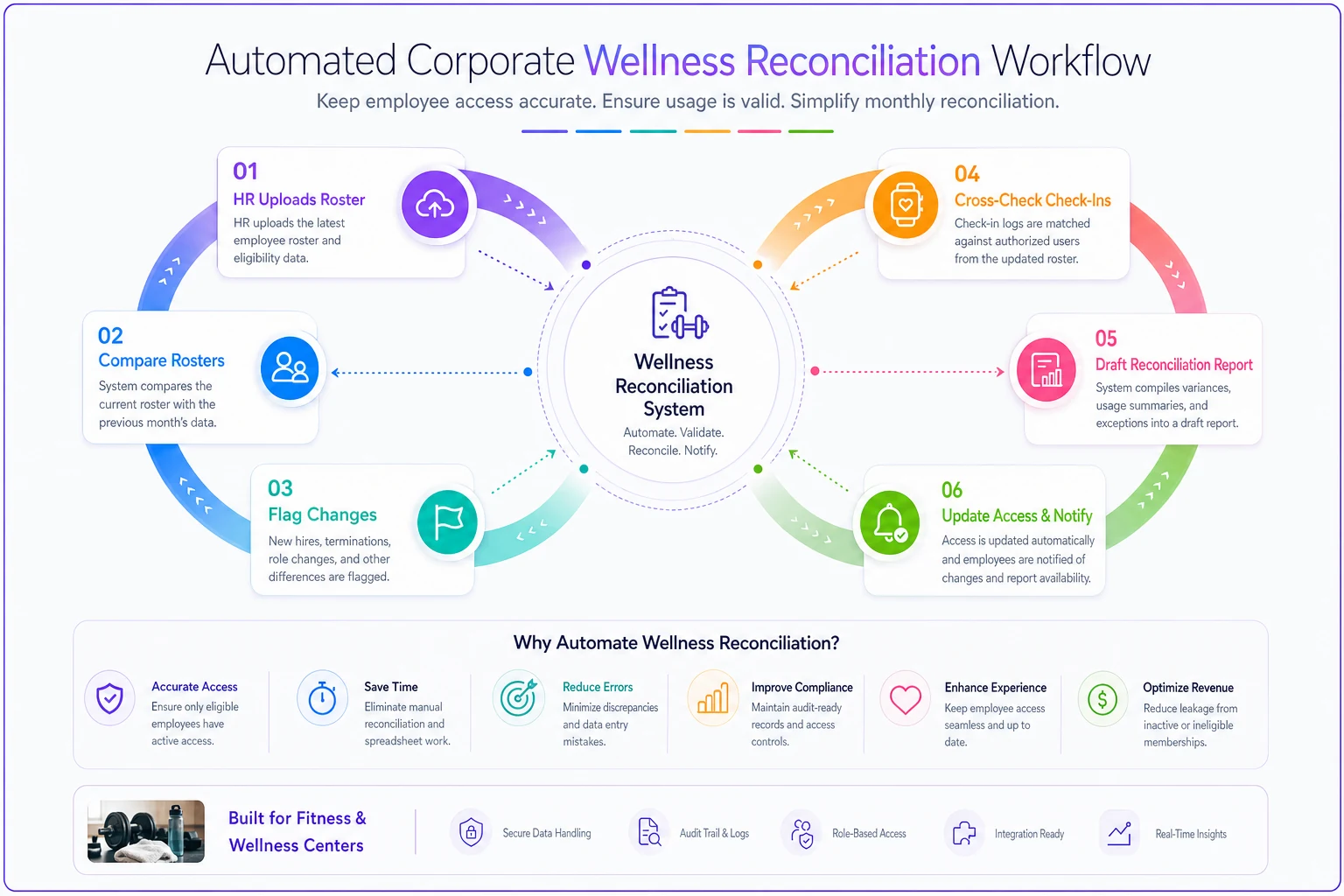
This visual maps the steps from roster upload to access updates.
Access control works the same way. Rather than manually updating each employee's permissions when they join or leave, the platform processes HR updates as they come in — adjusting access, queuing welcome emails for new users, and removing terminated employees without anyone having to remember to do it.
The capacity management insights that prevent overcrowding also become more critical when you're balancing corporate groups alongside regular members during the same peak windows.
Making corporate wellness profitable, not just possible
Corporate wellness programs represent real revenue opportunity wrapped in real operational complexity. The gyms that make them work treat them as a distinct business line with their own processes — not a bulk membership category.
The framework here — tiered access, reconciliation templates, ROI dashboards, SLA-backed contracts — turns that complexity into a competitive advantage. While other gyms are stuck in billing disputes, you're delivering clean monthly reports that make renewal conversations straightforward.
One thing worth keeping in mind: companies buy wellness programs to solve business problems, not just to offer employee perks. Reduced healthcare costs, productivity improvements, retention benefits — that's what gets a program renewed when budgets tighten. Make yourself part of their HR strategy, not just another vendor line item.
The operational overhead is real. The billing complexity is genuinely annoying. The verification requirements are tedious. But with the right systems in place, corporate wellness programs become some of the most predictable, scalable revenue a gym can build — just don't try to run them like regular memberships. That path leads nowhere good.
Ready to elevate your gym operations?
Join 2,000+ gyms using Gymioly to reduce admin overhead, improve member experience, and grow revenue.