
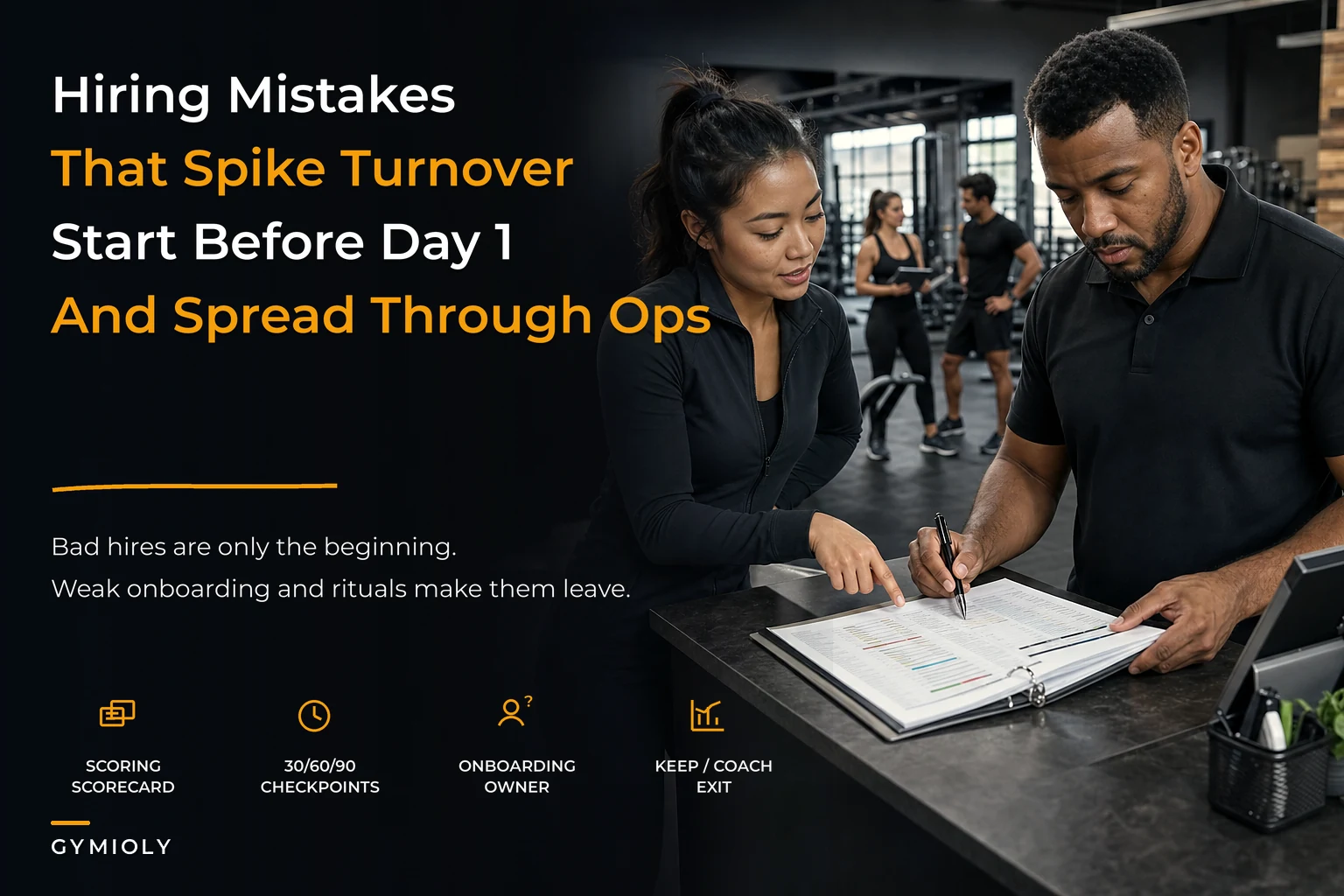

Most gym owners think they have a hiring problem. They don't. They have a systems problem that only shows up at the hiring stage because that's where the pain is loudest.
When a trainer quits after four months, or a front-desk hire ghosts you three weeks in, the instinct is to blame the person, tighten the job ad, and run the same loose process again. But turnover in a single-site gym almost never traces back to one bad decision. It traces back to a chain of missing structure — a fuzzy interview, no scorecard, an onboarding that's really just "shadow Marcus for a week," and zero feedback rhythm once someone's on the floor. Each weak link feels survivable on its own. Stacked together, they produce exactly what quietly kills gyms: high turnover and wildly inconsistent service.
That service inconsistency is the part people underrate. A member doesn't churn because one employee left. They churn because the experience feels different depending on who's working. Same gym, wildly different vibe. That's a people-ops failure showing up as a retention number.
So let's map the whole chain — where gym hiring and onboarding breaks, what changes as you add staff, and how to build a system that produces consistent people instead of consistent surprises.
Why the whole thing breaks in the first place
Gym hiring gets treated as an event instead of a pipeline. You have an opening, you feel the pressure, you interview a few people, you pick the one who "gets it," and you move on. No shared definition of what good looks like, so every hiring decision is basically a gut call made under time pressure.
The pattern that shows up across a lot of small operators: the owner does the hiring while already understaffed, which means every interview is happening at the exact moment they have the least bandwidth and the most desperation. Worst possible headspace for a decision that costs thousands when it goes wrong.
And it does cost thousands. A mis-hire at the front desk that falls apart after six weeks isn't just wasted wages. It's the manager's time recruiting, the awkward member interactions during that confused first month, lost mornings covering shifts, and then running the whole recruiting loop again. For a single-site gym, one bad front-desk hire realistically burns somewhere in the $3k–$6k range in soft and hard costs before you're back to square one. Trainers cost more because members form actual relationships with them.
The second reason it breaks: onboarding isn't designed, it's improvised. New hires get handed a login, a t-shirt, and a vague instruction to "jump in." Two weeks later nobody can say whether they're doing well, because nobody defined what week-two competence even means. So the new person guesses, develops their own version of the job, and your service variance just went up by one more flavor.
Start with the scorecard, not the job ad
The single highest-leverage fix is building an interview scorecard before you post anything. Not a personality vibe check — an actual document listing the competencies the role requires, with a way to rate each candidate against them.
End appointment chaos and boost attendance.
Gymioly streamlines booking, confirms sessions, and manages memberships effortlessly.
- Unified class and membership management
- Automated member notifications
- Trainer scheduling and availability
No credit card required
The trick is separating two things most owners blur together: skills you can teach versus traits you can't. You can teach someone your check-in flow, your POS, your class booking rules. You cannot easily teach warmth, follow-through, or the instinct to notice a member struggling and walk over. Your scorecard should weight the un-teachable traits heavily and treat teachable skills as nice-to-haves.
A workable front-desk scorecard might rate each candidate 1–5 across something like:
-
Member-facing warmth — do they naturally engage, or wait to be approached?
-
Reliability signals — job tenure history, how they talk about past shifts, punctuality to the interview itself
-
Composure under mess — how they'd handle two members complaining while the phone rings
-
Coachability — do they get defensive when you give correction in the interview, or lean in?
-
Systems comfort — basic ease with software and process, not expertise
Score each one, weight the traits you can't train, and now you're comparing candidates on the same axes instead of whoever you happened to like more that afternoon. This alone kills a huge chunk of mis-hires, because it forces you to notice when your favorite candidate is actually a 2 on reliability and you were about to hire them anyway.
For trainers, the competency matrix runs deeper because the role has more surface area:
| Competency | What "good" looks like | Why it matters for retention |
|---|---|---|
| Program design | Can build safe, progressive plans, not random workouts | Members see results, stay longer |
| Session presence | Full attention, no phone, remembers member history | Members feel known, not processed |
| Sales without sleaze | Comfortable renewing packages honestly | Protects your PT revenue |
| Schedule discipline | Shows up prepped, manages own calendar | Reduces reschedule chaos |
| Team fit | Covers for others, doesn't build a private client cult | Prevents the "trainer takes members when they leave" problem |
That last row matters more than people expect. A trainer who builds a personal brand inside your gym instead of buying into the gym's brand is a retention time-bomb — when they leave, a chunk of members goes with them.
The 30/60/90 onboarding that actually reduces variance
Onboarding is where turnover is either prevented or guaranteed. The first 90 days decide whether someone becomes a reliable, on-brand team member or a confused improviser who eventually quits or gets quietly managed out.
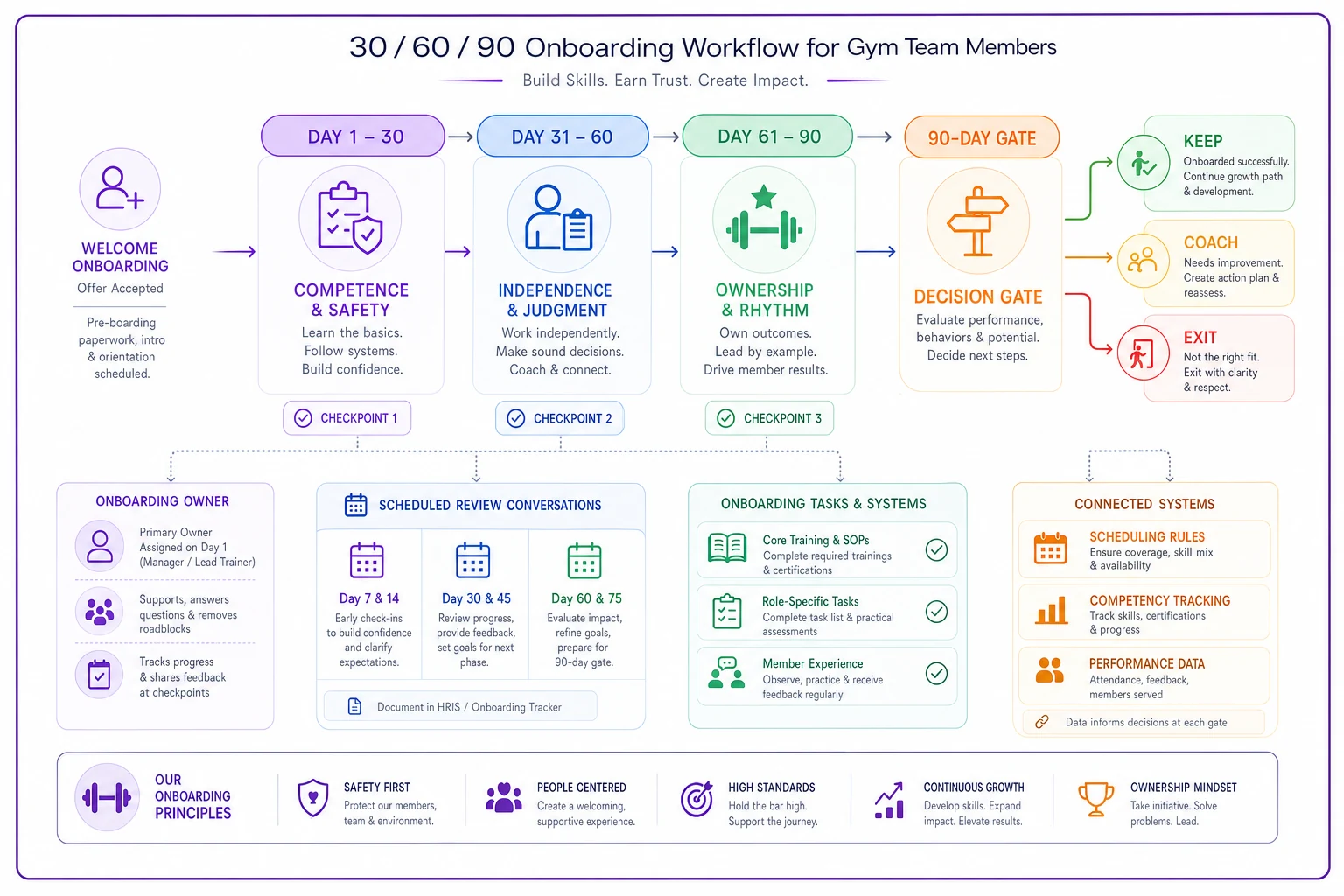
The structure that works is a milestone-based 30/60/90, where each phase has a clear focus and a defined checkpoint. Not a binder they read once — a sequence with actual outcomes attached.
Days 1–30: Competence and safety. The goal isn't productivity yet, it's getting them to reliable baseline execution. Front desk should own the full check-in, booking, and basic problem-resolution flow. Trainers should be running sessions to your standard, not their own. The checkpoint at day 30 is simple: can they do the core job without supervision on a normal day?
Days 31–60: Independence and judgment. This is where they handle the non-standard stuff — the upset member, the billing question, the overbooked class. You're watching decisions now, not just execution. The day-60 checkpoint is whether they make good calls when the script runs out.
Days 61–90: Ownership and rhythm. By now they should be contributing to the team, not just surviving in it. Covering shifts smoothly, spotting things that need fixing, hitting their role's early KPIs. Day 90 is your genuine keep/coach/exit decision — and if you've run the first two phases honestly, that call should be obvious rather than agonizing.
Here's how to actually run it so it doesn't dissolve into good intentions:
-
Assign one onboarding owner per hire. Not "the team." One named person accountable for that hire's ramp.
-
Write the day-30, day-60, and day-90 checkpoints before day one. The new hire should see these on their first shift.
-
Schedule the three review conversations in advance — on the calendar, before you get busy and skip them.
-
Track completion of core competencies, not hours logged. "Watched Marcus for 20 hours" tells you nothing.
-
Make the day-30 checkpoint a real gate. If someone's clearly not going to make it, a struggling day-30 is your cheapest exit point — far cheaper than a day-120 one.
-
Document what they still can't do and turn it into the next 30 days' plan.
Make the day-30 checkpoint a real gate. If someone's clearly not going to make it, a struggling day-30 is your cheapest exit point — far cheaper than a day-120 one.
Most gyms skip this because it feels like overhead when you have three staff. But this is exactly what kills service variance. When every hire runs through the same milestones, members stop getting three different versions of your gym.
Onboarding also connects tightly to scheduling — a half-trained person on a solo shift is where mistakes cluster. It's worth being deliberate about not putting new hires alone on high-traffic slots until they've cleared their day-30 gate, which ties directly into how you build demand-driven shift templates and skill-mix rules so you're not accidentally staffing your busiest morning with your greenest hire.
Visualize this flow to make checkpoints unskippable.
Most gyms skip this because it feels like overhead when you have three staff. But this is exactly what kills service variance. When every hire runs through the same milestones, members stop getting three different versions of your gym.
The weekly rituals that keep people from drifting
Hiring and onboarding get someone in well. Rituals keep them good. Almost every single-site gym neglects this part, because once someone clears 90 days, the assumption is they're set. They're not. Without rhythm, even good hires slowly drift back toward their own version of the job, and service variance creeps right back in.
The ritual layer is simple and cheap. Consistency matters more than sophistication.
A weekly team huddle — 15 minutes, same time, standing up if possible — covering what's happening with members that week, any process changes, and shout-outs. Sounds trivial. It's the single biggest thing that keeps everyone running the same playbook. The gyms with the tightest service consistency almost always have some version of this, even informal.
Monthly one-on-ones with each staff member are worth protecting. Not a performance review with paperwork — a fifteen-to-twenty-minute conversation about how they're doing, what's frustrating them, and what they want to get better at. This is your early-warning system for turnover. People rarely quit out of nowhere; they quit after weeks of small frustrations nobody bothered to ask about. A monthly check-in surfaces that while you can still fix it.
A lightweight performance scorecard reviewed on a set cadence also helps keep things honest. For front desk, that might be member feedback, punctuality, and how cleanly they handle their opening and closing duties. For trainers, session retention, package renewals, and no-show rates. The point isn't to police anyone — it's that people perform to what gets measured, and if you measure nothing, you get drift.
Trainer performance especially benefits from tight rhythm around their calendar, because so much of their revenue and reliability lives in how they manage sessions. If reschedules and no-shows are eating your trainers' hours, the fix is partly structural — the kind of deposit models and automated reschedule flows that protect their time — and partly ritual, keeping calendar discipline in your weekly rhythm instead of hoping each trainer self-manages.
A real scenario: a single-site gym drowning in service complaints
Picture a gym running around 700 members with a team of maybe eight — a couple full-timers at the desk, a handful of trainers, some part-time class instructors. The owner's problem wasn't obvious turnover. It was that member reviews kept mentioning inconsistency: great one visit, cold the next. Two front-desk people had left in six months, and each departure meant a scramble.
Digging in, the issues were textbook. Hiring was a gut-feel conversation with no scorecard. Onboarding was shadowing whoever happened to be free. There were no regular check-ins, so nobody knew a strong front-desk hire was miserable until she gave notice.
They rebuilt the system over a quarter. Interview scorecards for both roles. A real 30/60/90 with named onboarding owners and pre-scheduled checkpoints. A 15-minute weekly huddle and monthly one-on-ones.
The change wasn't a fireworks moment — it was a settling. Over the next two quarters, front-desk turnover essentially stopped, the "inconsistent service" complaints thinned out noticeably, and the day-30 gate caught two hires who weren't going to work out before they'd cost a full onboarding cycle. The owner estimated they avoided two full mis-hire cycles in the first six months — somewhere north of $5k saved — plus the harder-to-price benefit of members finally getting the same gym every time.
The real unlock wasn't any single tool. It was that hiring, onboarding, and ongoing rhythm finally connected into one loop instead of three disconnected scrambles.
When this level of structure makes sense — and when it doesn't
When it makes sense: the moment you have more than two or three staff and you're no longer personally standing next to every hire during every shift. Once you can't be the quality control by physical presence, the system has to be. It also makes sense the instant service inconsistency shows up in member feedback, because that's the symptom scorecards and onboarding milestones directly treat.
When it's overkill: if you're a two-person operation and you are the front desk, a full 30/60/90 with named owners is more process than you need. Keep the scorecard concept, keep a lightweight onboarding checklist, and skip the ceremony until headcount justifies it.
Who should not do this: owners who won't actually hold the checkpoints. A 30/60/90 you don't enforce is worse than no system, because it creates the illusion of structure while you keep making the same gut calls. If you know you'll skip the day-30 gate, be honest that you're running informally — and fix that first.
Where software quietly does the heavy lifting
None of this requires fancy tooling. But the ongoing rhythm is exactly where things fall apart manually, and that's where a proper operations platform earns its keep. Onboarding checkpoints get skipped because nobody's reminding you they're due. One-on-ones slip because they're not on a schedule. Performance signals stay invisible because the data lives in five different places.
An AI-assisted operations platform helps mostly by removing the "remembering" burden. Onboarding milestones can trigger automatically — day-30, day-60, and day-90 checkpoints surface as tasks instead of relying on you to track dates in your head. Staff performance signals like session retention, no-show rates, or shift punctuality can be centralized so your monthly one-on-ones are grounded in actual patterns rather than vague impressions. The human part — the conversations, the coaching, the judgment calls — stays yours. The point is to make sure the structure runs even during your busiest weeks, which is precisely when informal systems collapse.
That's the difference between a people-ops system that exists on paper and one that actually runs: the reminders fire, the data's in one place, and the human judgment happens on schedule instead of whenever you finally get around to it.
Pulling it together
Turnover and service variance in a single-site gym are the same problem wearing two costumes. Both trace back to the absence of a connected people system — a scorecard that defines good, an onboarding sequence that produces consistency, and weekly rituals that keep people from drifting.
Fix them as separate fires and you'll be fighting the same fires next quarter. Build them as one loop — hire against a standard, ramp against milestones, maintain with rhythm — and the whole operation gets quieter. Fewer surprise departures, fewer "it depends who's working" complaints from members, and a lot more of your time freed up to actually run the gym instead of constantly re-hiring for it.
Ready to elevate your gym operations?
Join 2,000+ gyms using Gymioly to reduce admin overhead, improve member experience, and grow revenue.