

Most gyms already have the raw material for member-led events. There's always that one member who organizes a weekend hike, or the coach who wants to run a nutrition workshop, or a small crew that shows up for a Saturday partner WOD they basically programmed themselves. The energy is there. What's usually missing is the boring stuff underneath — who's liable, who gets paid, who covers the front desk, and what happens when 40 people RSVP and 12 show up.
That gap is exactly where gym community monetization either becomes a real revenue line or stays a chaotic side hobby that occasionally makes $80 and creates a scheduling headache. This post is about the governance and money rules that turn ad-hoc member events into something you can repeat, staff, and count on.
Staying narrow here: event staffing rules, liability waivers, ticketing flows, and the role definitions that make member-led events safe to hand off. Not community building in general. Not marketing. Just the operational spine.
Why member-led events fall apart operationally
The failure pattern is almost always the same, and it has nothing to do with enthusiasm.
A member proposes an event. You say yes because it feels good and costs nothing. There's no written agreement about who staffs it, so either nobody does — and it runs sloppy — or you quietly assign a coach off the clock, which is an unpaid labor problem waiting to surface. Nobody collects money cleanly, so payment happens over Venmo to the member's personal account, which means the gym never sees the revenue and can't reconcile it. And the waiver question never comes up until someone rolls an ankle during a "fun" partner competition that wasn't on your insurance radar.
The enthusiasm masks the risk. Because the event "worked" the first time — meaning nobody got hurt and a few people had fun — the gym assumes it can scale. Then event number four is a 60-person outdoor bootcamp with kettlebells in a public park, a member "instructor" with no certification on file, and a waiver that covers your indoor facility only.
The core issue: member-led doesn't mean gym-exempt. If it happens under your brand, you inherit most of the liability and none of the structure.
Governance first: who owns what
Before ticketing or money, you need role definitions. This is the part gyms skip, and it's the part that actually makes events repeatable.
End appointment chaos and boost attendance.
Gymioly streamlines booking, confirms sessions, and manages memberships effortlessly.
- Unified class and membership management
- Automated member notifications
- Trainer scheduling and availability
No credit card required
Here's a clean way to split responsibilities so a member can lead without the gym losing control:
| Role | Who fills it | Owns | Does NOT own |
|---|---|---|---|
| Event Lead | Member or coach | Programming, energy, day-of vibe, participant communication | Money handling, liability sign-off, staffing decisions |
| Staff Sponsor | Gym employee | Facility access, safety oversight, waiver enforcement | Event content or promotion |
| Revenue Owner | Owner/manager | Pricing, payout terms, reconciliation | Running the session |
| Safety Checker | Certified staff | Confirming waivers signed, verifying instructor creds | Ticketing |
The thing most owners miss: the person with the idea should almost never be the person handling the money or signing off on safety. Splitting those two out is what protects you. When the Event Lead and the Revenue Owner are the same person — and that person is a member — you've basically outsourced your P&L and your liability to someone with no accountability to your business.
For recurring member-led events, put this in a one-page agreement. Not a legal document — just something that says: this event, this lead, this staff sponsor, this revenue split, waiver required yes/no, cert required yes/no. Sign it before the event goes on the calendar.
Liability waivers: the part that quietly sinks gyms
Your standard membership waiver almost certainly does not cover member-led events, and definitely doesn't cover off-site ones. This is the single most expensive assumption in this whole topic.
-
Off-site events. Your waiver names your facility address. A park, a trail, a rented studio — different location, arguably out of scope.
-
Non-members attending. Member-led events are a natural way to bring in guests. But that guest never signed anything. If they get hurt, you have a walk-in participant with zero waiver on file.
-
Peer-led instruction. When a member "coaches" other members and someone gets injured following their cues, "they're not our employee" is a weak defense if the event ran under your name and on your schedule.
-
Equipment moved off premises. Kettlebells, bands, med balls hauled to a park change your risk profile and sometimes your coverage.
The fix is operational, not just legal. Build an event-specific waiver flow:
-
Every event gets its own waiver variant that names the actual location and activity type.
-
No waiver signed, no participation — enforced at check-in, not "we'll get it later."
-
Guests sign a guest-specific version that also captures contact info and marketing consent.
-
Store waivers tied to the specific event, not just the member profile, so you can pull "everyone who signed for the Nov 9 partner comp" in one query.
Call your insurance broker before you run anything off-site or anything involving non-member participants. That's a 20-minute phone call that has saved gyms from five-figure surprises. Ask specifically: does my policy cover off-premises events, guest participants, and peer-led instruction? Get the answer in writing.
Ticketing flows that actually reconcile
This is where money leaks the hardest. If revenue moves through a member's personal payment app, you don't have a business — you have a favor economy.
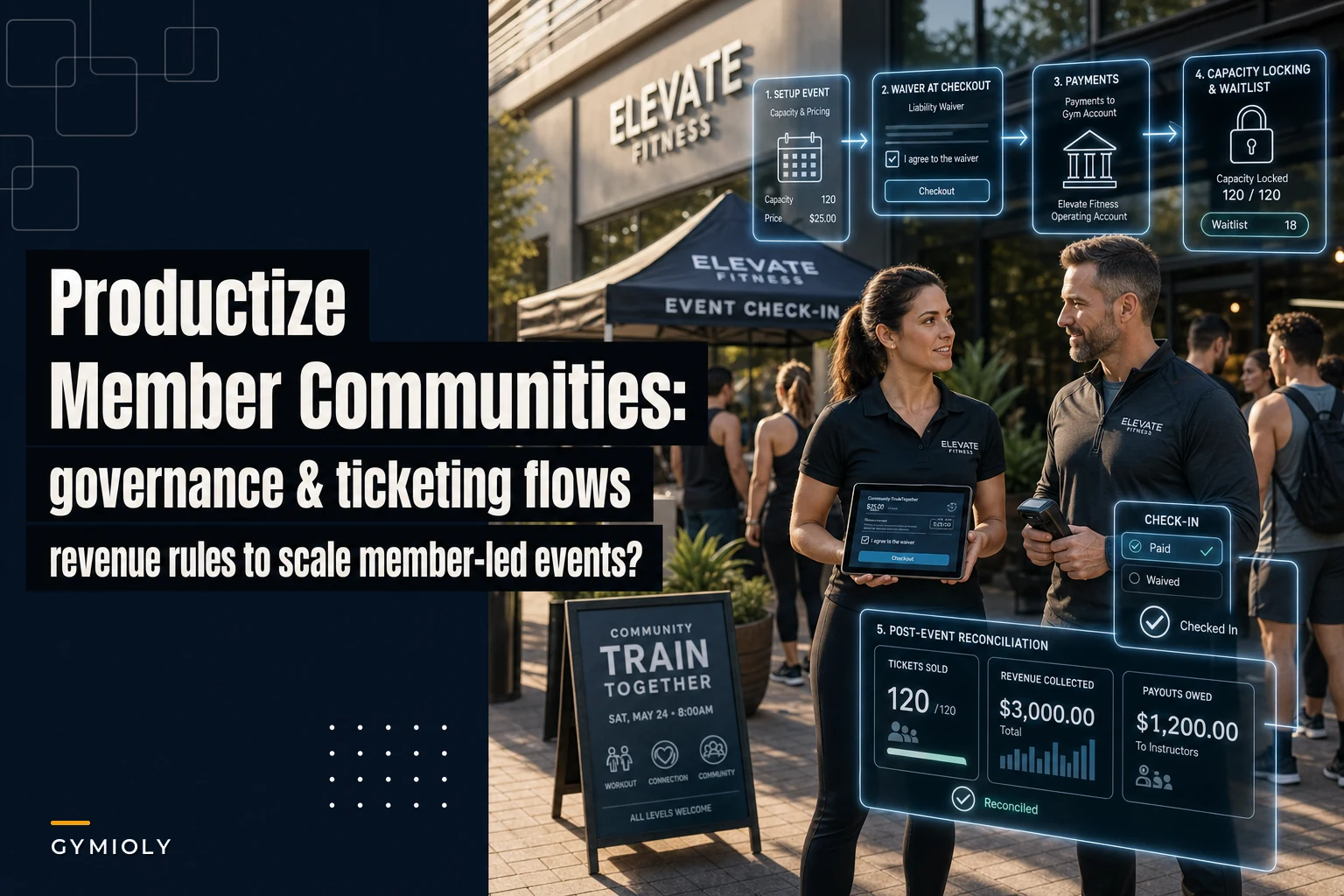
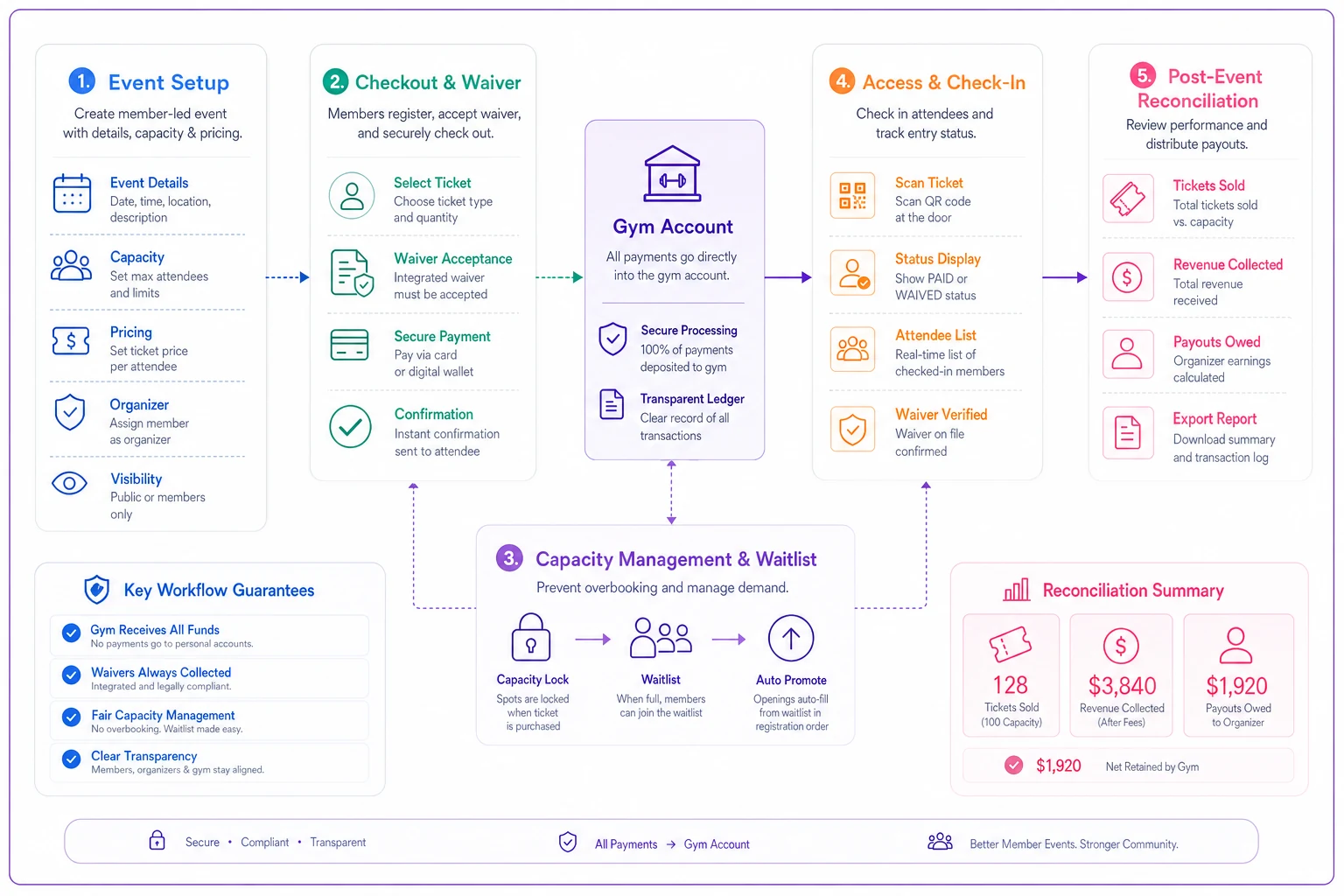
The ticketing flow needs to do four things: collect payment into a gym-controlled account, enforce the waiver as part of purchase, cap capacity, and give you a clean record you can reconcile against your books.
-
Event created with a fixed capacity and price (or tiered — member vs. guest).
-
Ticket purchase requires waiver acceptance in the same checkout. No waiver, no ticket.
-
Payment lands in your gym account, never a personal one.
-
Capacity auto-locks when sold out; a waitlist opens.
-
At check-in, staff sees a live list of paid and waived attendees.
-
Post-event, the system outputs
tickets sold, revenue collected, member payout owed, no-shows.
That last line matters more than people expect. If you're paying an Event Lead a cut, you need a clean number for what they earned — and a policy on whether no-shows count toward their payout. Strong recommendation: pay on tickets sold, not attendance, so the Lead has a real reason to promote hard and isn't punished for weather or a slow week.
Strong recommendation: pay on tickets sold, not attendance, so the Lead has a real reason to promote hard and isn't punished for weather or a slow week.
The no-show problem rhymes with regular class no-shows, and the same deposit and cancellation logic applies — worth reviewing your existing approach to reducing no-shows and late cancellations if that's not already tight, because paid events make empty spots hurt more.
This is also where an AI-assisted operational platform earns its place quietly — not as the star of the show, but as the thing linking ticket purchase, waiver signature, capacity cap, and payout math into one record so nobody's reconciling Venmo screenshots at month-end. The value isn't automation for its own sake; it's that the money and the liability paperwork live in the same verifiable place.
Revenue rules: splits, pricing, and where gyms give away margin
Pricing member-led events is where owners either underprice into worthlessness or overprice into empty rooms.
Set a floor that covers real costs. If the event uses a staff sponsor for two hours plus facility time, that's a real cost. Price above it. A "free-except-supplies" event that eats four hours of paid staff time isn't free — it's a subsidized loss.
Pay the Event Lead a percentage, not a flat fee, once you trust the model. A flat fee rewards mediocre turnout. A percentage — commonly 20–40% of net ticket revenue for member leads, less for salaried coaches doing it on the clock — ties their reward to the outcome.
Keep guest pricing higher than member pricing, but make member conversion easy. A guest paying $35 for a Saturday event who then sees a "first month membership credited with your ticket" offer is a warm lead you already have waiver info and payment details for. That's a cleaner acquisition path than most ads.
-
Ticket price
$25 member / $40 guest
-
Capacity
24
-
Typical sell-through
~18–20 tickets
-
Gross
roughly $500–$650 per event
-
Event Lead payout
~30% of net
-
Staff sponsor cost
your normal hourly
That's not life-changing money on one event. But run two a month with three rotating member leads and it becomes a steady non-dues line that also feeds referrals and guest conversions. The referral overlap is real — the same anti-fraud and reward-accounting discipline from your referral program mechanics applies when member leads start bringing guests who become members and expect credit.
KPIs that tell you if this is working
Track a small set — don't overcomplicate it:
-
Sell-through rate — tickets sold ÷ capacity. Below ~60% consistently means pricing or promotion is off.
-
Guest ratio — % of attendees who aren't members. This is your acquisition value signal.
-
Guest-to-member conversion — of guests attending, how many join within 30 days.
-
Net revenue per event — after payouts and staff cost.
-
Waiver compliance — % of attendees with a signed, event-specific waiver. Should be 100%. Anything less is a live liability.
-
Repeat-lead rate — how many member leads run a second event. Low repeat means your process is too painful.
Repeat-lead rate is the one people forget. If members run one event and never come back, the operational friction is too high — you've made leading an event feel like a part-time job with no upside. Fix the process before you recruit more leads.
A real scenario
A single-location strength gym had one member — a former collegiate lifter — running informal technique nights for free, roughly once a month. Popular, unstructured, and completely ungoverned. No payment, no event-specific waiver, and a coach usually stayed late off the clock to unlock and supervise.
They restructured it: technique night became a ticketed event at $20 for members and $32 for guests, capped at 20 people. The member became a formal Event Lead on a 30% payout. A closing coach was scheduled and paid as the staff sponsor. Every attendee signed an event-specific waiver at checkout, guests included.
Over the first quarter, they ran it twice a month. Sell-through landed around 16–18 tickets, roughly a third of the room were guests, and several converted to memberships. Net per event came in around $250–$350 after payout and staff cost — not huge, but real, repeatable, and fully reconciled. The quieter win: no more off-the-clock supervision, no more waiver gap, and a member lead who felt compensated instead of quietly exploited.
When this makes sense — and when it doesn't
When it works: You have engaged members who want to lead, at least one certified staff member who can sponsor safely, and the willingness to enforce waivers and clean payment. Recurring formats — technique nights, workshops, partner events — scale far better than one-off spectacles.
When it's a bad idea: If your baseline operations are shaky — POS isn't reconciled, class attendance is a mystery, staffing is already stretched — adding ticketed events just adds surface area for mistakes. Fix the core first.
Who should not do this: Gyms that can't or won't confirm insurance coverage for off-site and guest participation. Running these events without that answer isn't entrepreneurial — it's gambling with a claim you can't afford.
Member-led events don't fail because members lack energy. They fail because the gym never built the boring infrastructure: who's liable, who's paid, who's covered, and who signed. Get the governance split right, make waivers event-specific and non-negotiable, run every dollar through a controlled ticketing flow, and track a small set of KPIs. Do that, and a scattered set of favors turns into a genuine, defensible revenue line — one that also happens to bring you warm leads you already have signed and paid.
Ready to elevate your gym operations?
Join 2,000+ gyms using Gymioly to reduce admin overhead, improve member experience, and grow revenue.