


Most gym retail shelves are a graveyard of good intentions. You tried the branded shaker bottles because a rep swore they'd move. You stocked three flavors of a pre-workout because a member asked once. Eighteen months later half those SKUs are collecting dust behind the front desk, and nobody can tell you which items are actually paying rent on your limited shelf space.
The core problem isn't that you bought bad products. It's that you have no structured way to kill products. Buying is easy. Delisting is where gyms freeze up — because it feels like admitting a mistake, and because nobody set a rule in advance for what "failing" actually looks like.
This piece lays out a tight gym retail assortment testing system: four-week test cycles, POS tagging rules so you can actually measure what you're testing, profit thresholds that decide pass or fail, automatic delist triggers, and how the whole thing ties into your month-end close so retail stops being a mystery line item.
If you've already read why gym retail leaks margin, this is the operational layer underneath that — the actual mechanics of running and ending tests.
Why dead SKUs survive so long in gyms
The pattern is almost always the same. A product gets added without a defined test window, so it never has an expiration date on its evaluation. It just... exists. Front desk staff reorder it on autopilot when the box looks low, because reordering is a reflex and nobody told them to stop.
Then there's the emotional attachment. The owner picked it. Or a top member likes it. Or it "looks good on the shelf." None of those are revenue reasons, but they're the reasons items stay.
The measurement gap makes it worse. Most gym POS setups tag a sale as "retail" or "merchandise" and stop there. You can see that retail did roughly $1,400 last month, but you can't easily see that $900 of that came from three items and the other nineteen SKUs split the remaining $500 while tying up $2,000 in inventory. Without SKU-level visibility, there's no separating winners from passengers.
A pretty typical scenario: a single-location gym carries 22 retail SKUs. When you actually break it down, five of them drive around 70% of retail gross profit. The rest average under one unit sold per week and collectively hold more cash in inventory than the winners do. That's not a product problem. That's a no exit rule problem.
The four-week test cycle
Four weeks is the right window for gym retail. Shorter and you're catching novelty noise — members buy the new thing once out of curiosity. Longer and you've already sunk reorder cash into something that was never going to work. Four weeks gives you enough foot traffic to see whether a real repeat-purchase pattern is forming.
End appointment chaos and boost attendance.
Gymioly streamlines booking, confirms sessions, and manages memberships effortlessly.
- Unified class and membership management
- Automated member notifications
- Trainer scheduling and availability
No credit card required
-
Week 0 — Setup. Assign the SKU a test tag in your POS, set a defined par level (small — don't overbuy a test), and record a start date. Define the pass threshold before the test starts. This is the step everyone skips, and skipping it is why tests drag on forever.
-
Weeks 1–2 — Observe, don't touch. No price changes, no moving it behind the counter, no pushing it hard. You want clean baseline demand. If staff hand-sell it aggressively, you've contaminated the test.
-
Week 3 — Mid-cycle check. Pull units sold and gross profit so far. If it's tracking at less than 25% of the pass threshold, flag it early — it's almost certainly a fail.
-
Week 4 — Decision. Compare actual performance to the threshold you set at Week 0. Pass, extend one cycle (only if borderline), or delist. No "let's give it more time" without a specific reason written down.
The discipline is that the decision is mechanical. You're not re-debating the product every month. You set the rule once, and the number tells you what to do.
Here's a simple visual of the cycle and where tagging, thresholds, and delist triggers sit in the process.
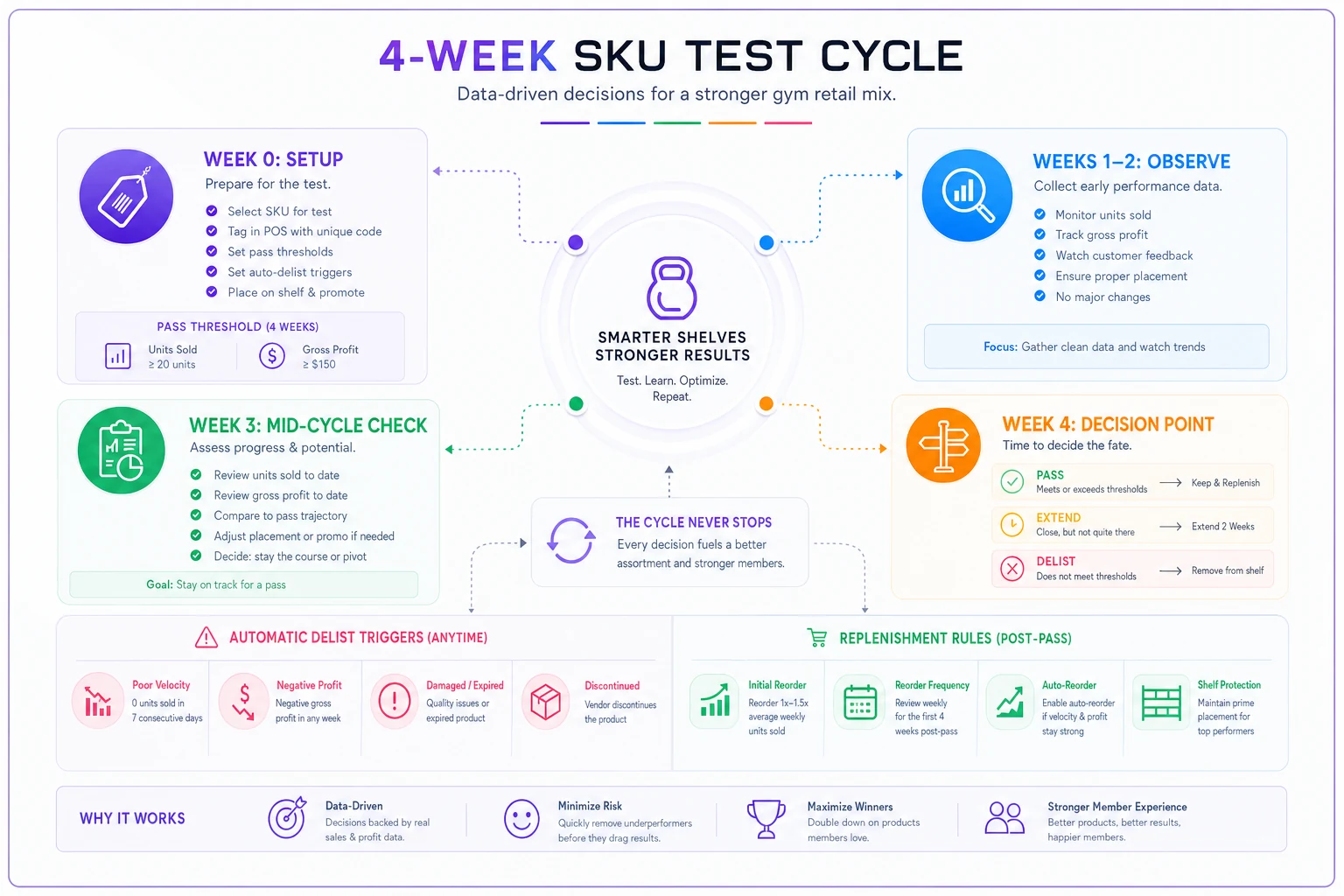
The visual ties the mechanical steps to the POS tags and decision points so it's clear who's responsible for what.
POS tagging: the part everyone gets wrong
You can't test what you can't isolate. The tagging scheme is the foundation, and it needs to be consistent enough that any front desk person rings it the same way every time.
| Tag | Purpose | Example |
|---|---|---|
TEST-[date] | Marks a SKU currently in a four-week cycle | TEST-0311 |
CORE | Proven winners, not under evaluation | Branded tee, top pre-workout |
SEASONAL | Time-boxed items, excluded from standard delist rules | Holiday hoodie |
WATCH | Passed once but trending down, under re-evaluation | Second-tier protein bar |
DELIST-PENDING | Failed a test, selling through remaining stock | Discontinued shaker |
A few rules that keep tagging clean:
-
Every SKU carries exactly one status tag at all times. No untagged items. An untagged SKU is an unmeasured SKU.
-
Only the owner or manager can move a SKU to
CORE. That promotion should be earned by data, not vibes. -
TESTtags include the start date so cycle timing is unambiguous. -
Anything sitting in
DELIST-PENDINGgets a sell-through discount and is not reordered — ever.
What breaks tagging in practice is turnover. New front desk staff ring everything under a generic "retail" button because nobody showed them the tags. One untrained weekend hire can muddy a whole month of test data. Tagging has to be baked into register training, not treated as an advanced feature nobody gets around to explaining.
Include tagging steps in your register training checklist so new hires can't ring items under a generic "retail" button.
Tagging has to be baked into register training, not treated as an advanced feature nobody gets around to explaining.
Setting profit thresholds that actually mean something
A pass/fail threshold needs to account for what the shelf space is worth, not just whether the item sold. A SKU can sell and still lose you money if it ties up cash and margin that a better product could've used.
A practical threshold formula for a four-week test:
Pass if: four-week gross profit ≥ the cost of carrying that shelf slot AND units sold ≥ your minimum velocity floor.
In plain terms, set two gates:
-
Gross profit floor. For a small gym, somewhere around $40–$60 of gross profit per SKU over four weeks is a reasonable starting line. Below that, the item isn't earning its place.
-
Velocity floor. Roughly 6–10 units over four weeks (about 1.5–2.5 units/week). Items that sell in tiny dribs — one unit every ten days — create reorder hassle and stockouts without ever contributing real money.
An item has to clear both gates. High margin but two units sold? Fail — it's a novelty. Decent velocity but razor-thin margin? Fail — you're doing free labor for the manufacturer.
Set these numbers to your own cost base. A gym with a tiny retail footprint and high rent per square foot should have a higher gross profit floor because each slot costs more. The point isn't the exact figure — it's that the figure exists and gets written down before the test, so the decision can't be argued away later.
Automatic delist rules
This is where gyms tend to recover the most hidden cash: the moment you make delisting automatic instead of discretionary.
An automatic delist rule means the SKU gets pulled when it hits a defined trigger, no meeting required. Build these triggers in advance:
-
Failed test cycle Didn't clear both gates at Week 4 → move to
DELIST-PENDING, stop reorders, discount to clear. -
Zero sales for 21 straight days on a non-seasonal item → flag for delist review.
-
Three consecutive weeks below velocity floor for a
WATCHitem → delist. -
Gross margin drops below your floor after a cost increase and can't be fixed with a price adjustment → delist.
The behavioral win here is that nobody has to be the bad guy. The rule delisted the item, not a person. That removes the emotional friction that keeps dead SKUs alive. Staff aren't defending a product they personally stocked — they're following a trigger everyone agreed to ahead of time.
One caveat: protect seasonal and genuinely strategic items from these rules. A gym-branded hoodie that only moves in winter would fail a July test cycle. That's what the SEASONAL tag is for — it's exempt from standard velocity triggers and evaluated on its own calendar.
Replenishment cadence tied to the test outcome
Reordering is where most of the money quietly leaks. Gyms reorder on sight — box looks empty, order more — which guarantees you keep buying losers.
Tie replenishment to tag status instead:
-
COREitemsReorder to par on a fixed weekly or biweekly cadence. These are proven; keep them in stock.
-
TESTitemsDo not reorder during the test window. You bought a small test quantity on purpose. If it sells out mid-test, that's a strong signal — note it, finish the cycle, then decide.
-
WATCHitemsReorder minimum quantities only, enough to keep the test honest.
-
DELIST-PENDINGZero reorders. Sell through and done.
This one rule — no reordering during a test — stops the most common leak, where a gym tests something, sells a few units, reflexively reorders, and ends up with a failed SKU plus a fresh case of it sitting in the back room.
Integrating with month-end reconciliation
A test program that lives in someone's head falls apart the first busy month. It has to connect to your month-end close so retail decisions get reviewed on the same cadence as everything else.
-
List every SKU currently tagged
TEST, with days elapsed and current performance vs. threshold. -
Flag any test crossing its Week 4 decision point in the coming month.
-
Confirm every
DELIST-PENDINGitem is selling through and not being reordered. -
Reconcile retail gross profit by SKU against the POS tags — this is where tagging pays off, because you can finally see profit by item instead of one lumped "retail" number.
-
Promote any test that cleared both gates to
CORE.
This folds neatly into the kind of month-end discipline covered when you validate non-dues revenue with real unit economics — retail is just another non-dues line that deserves the same measured treatment as PT packages or corporate programs.
Modern gym operations platforms with POS tagging and automation can handle a lot of this in the background — flagging SKUs that hit their delist trigger, surfacing tests nearing their decision date, rolling SKU-level profit into the month-end view so you're reviewing a report instead of rebuilding a spreadsheet. But the system matters less than the rules. The rules are what actually change the outcome.
A real scenario
A single-location strength gym carried about 20 retail SKUs and reported roughly $1,500/month in retail sales, which the owner assumed was fine. Nobody tracked anything at the SKU level.
After tagging everything and running three rounds of four-week cycles, the picture cleared up fast. Six SKUs drove the vast majority of gross profit. Nine were below both the velocity and margin floors — slow sellers that collectively tied up around $1,800 in inventory while generating maybe $150 in monthly gross profit combined.
They delisted the nine losers, discounted remaining stock to clear it, and redirected that freed-up cash into deeper inventory of the six proven winners plus two new test SKUs. Monthly retail revenue didn't explode — it landed somewhere around $1,650–$1,750 — but retail gross profit improved meaningfully because the mix was finally working. The back-room clutter was gone. The bigger win was that retail stopped being guesswork.
When this makes sense — and when it doesn't
Worth doing if:
-
You carry more than about 8–10 retail SKUs and can't rank them by profit off the top of your head.
-
You've got inventory you "keep meaning to deal with."
-
Your POS supports SKU-level tagging and reporting.
Overkill if:
-
You only sell 2–3 items (water, a branded tee, one supplement). Just watch those directly.
-
Retail is a rounding error you offer purely as a member convenience with no real profit expectation.
Who should skip it: gyms where retail genuinely isn't a business line — where you stock a couple of things because members asked and you don't care whether they turn a profit. If that's an honest description, don't build a test system. Just keep it small and don't let it sprawl.
The point of all this
Stocking losers isn't a buying mistake. It's a missing exit process. Gyms are good at adding products and terrible at removing them, because removal feels like judgment and nobody set the rule ahead of time.
Four-week cycles, clean POS tags, thresholds you define before the test, automatic delist triggers, and a month-end review turn retail from a slow leak into a tight, measured line. The products that earn their shelf space stay. The ones that don't get pulled without a debate. And your limited counter space finally goes to work for you instead of serving as storage for decisions you never got around to reversing.
Ready to elevate your gym operations?
Join 2,000+ gyms using Gymioly to reduce admin overhead, improve member experience, and grow revenue.