


Your gym retail probably looks fine on the surface. Members grab protein bars after workouts, pick up a branded shirt occasionally, maybe snag resistance bands when theirs snap. The POS tracks everything, staff restocks when shelves look thin, and at month-end someone exports a sales report for the accountant.
But underneath that apparent simplicity, most gym retail operations leak margin through dozens of small inefficiencies that quietly compound into thousands of dollars in lost profit every year. The problem usually isn't the wrong products or unwilling members — it's that the operational mechanics around pricing, bundling, and reconciliation create systematic margin erosion that's nearly invisible until you actually dig into the numbers.
The hidden math behind SKU-level margin targets
Most gym owners think about retail margin at the category level. Supplements should hit 40%, apparel maybe 50%, accessories somewhere in between. But that broad-brush approach misses how products actually move through your inventory.
Take a standard protein powder SKU. You buy it for $28, mark it up to $45 — a theoretical 37.8% margin. Seems reasonable. But that calculation ignores a few things:
The 2.9% credit card processing fee on that $45 sale drops your actual revenue to $43.70.
Shelf space opportunity cost. That protein tub sits an average of 18 days before it sells, while the $12 shaker bottles next to it turn every 4 days. The shaker generates roughly $3 margin every 4 days versus the protein's $15.70 every 18 days. Per day, the shaker actually outperforms.
Handling labor. Staff spend about 3 minutes receiving, stocking, and ringing up a protein tub versus maybe 30 seconds for a pre-packaged bar. At $15/hour, that's $0.75 in labor on the protein versus $0.13 on the bar.
Factor all that in and that 37.8% margin shrinks to something closer to 28%. Still profitable, but not what you thought.
This is why SKU-level margin targeting matters. You need different thresholds for different product types based on their operational characteristics — not just their category. High-touch items need higher margins. Fast movers can survive on thinner ones. Bulky items that eat shelf space need to justify that footprint.
A framework that works reasonably well across different gym setups:
-
Fast movers (turn in <7 days) Target 25-35% margin - Pre-workout shots - Single-serve proteins - Basic accessories like straps
-
Standard movers (7-21 days) Target 35-45% margin - Multi-serve supplements - Mid-range apparel - Equipment accessories
-
Slow movers (>21 days) Target 45-60% margin - Premium apparel - Specialty equipment - High-end supplements
-
Bundled items Target 30-40% margin on package - Class packages with gear - Starter kits - Member upgrade bundles
Margin isn't just about markup. It's velocity, handling cost, and opportunity cost rolled into a number that actually reflects profitability.
Why bundling class packages with merchandise multiplies problems
Bundling seems like an obvious win. New member signs up for unlimited yoga, you throw in a mat and water bottle for $30 extra. They get convenience, you move inventory, everyone's happy.
End appointment chaos and boost attendance.
Gymioly streamlines booking, confirms sessions, and manages memberships effortlessly.
- Unified class and membership management
- Automated member notifications
- Trainer scheduling and availability
No credit card required
Except bundling creates tracking nightmares that most POS systems handle poorly — leading to inventory discrepancies, margin confusion, and reconciliation headaches.
The core problem: bundles exist at the intersection of service revenue and product revenue, but most gym systems treat them as one or the other. When someone buys that yoga package with gear, your POS either:
Records it all as service revenue, so your retail inventory mysteriously shrinks without corresponding sales records. Month-end counts show missing mats but no sales to explain it.
Or it records everything as retail, inflating product revenue while understating class package sales — which screws up instructor commissions tied to package volume.
Or worst case, it tries to split the revenue but uses some arbitrary percentage instead of actual product cost, destroying your ability to track true margins on either side.
A mid-size gym I analyzed thought they were making decent margin on "transformation packages" — 12 weeks of training plus supplements and gear for $899. The owner figured with around $150 in product cost and trainer pay at $35/session for 24 sessions, they were netting a small profit.
When we dug into the actual mechanics, the whole picture fell apart. The POS was recording the entire $899 as training revenue. Retail products were being pulled from inventory with no cost of goods sold recorded. Training revenue looked inflated, and the retail inventory kept showing unexplained shrinkage every quarter. The accountant was writing it off as losses, not realizing it was being sold through bundles.
After fixing the recording mechanics and properly allocating revenue, those transformation packages turned out to be losing about $47 each — once you factored in actual product cost, trainer commissions calculated on the inflated revenue number, and the staff time spent assembling everything.
The operational mechanics of bundle pricing that actually works
Setting up bundles that don't destroy your margin tracking requires specific operational rules that most gyms never bother establishing. You need clear pricing formulas, explicit allocation rules, and systematic tracking of what actually gets bundled.
A simple pricing formula:
Bundle price = (Service value × 0.95) + (Product cost × 1.3)
This gives members a 5% discount on the service while maintaining at least 30% margin on products. More importantly, it gives staff a consistent framework instead of pricing by feel.
For revenue allocation, use actual cost basis rather than percentage splits:
-
Pull the actual product cost from your inventory system
-
Apply your standard retail margin to get the allocated retail revenue
-
Everything else goes to service revenue
-
Track both components separately in your POS
A yoga package example:
-
- Bundle price
$180
-
- Mat cost
$12, retail value at standard margin: $20
-
- Water bottle cost
$3, retail value at standard margin: $5
-
- Retail revenue to record
$25
-
- Service revenue to record
$155
This keeps margin tracking clean across both revenue streams and eliminates the inventory shrinkage problem.
For tracking, a simple bundle SKU system helps:
-
- BND-[Service Code]-[Product Summary]-[Price Point]
-
- Example
BND-YOG-MATBOT-180
This lets you see which bundles actually sell versus which ones were good ideas that never moved. Most gyms create a dozen bundle options but only two or three ever get purchased with any regularity.
Here’s a visual workflow for how bundle pricing and revenue allocation should flow in your POS and accounting systems.
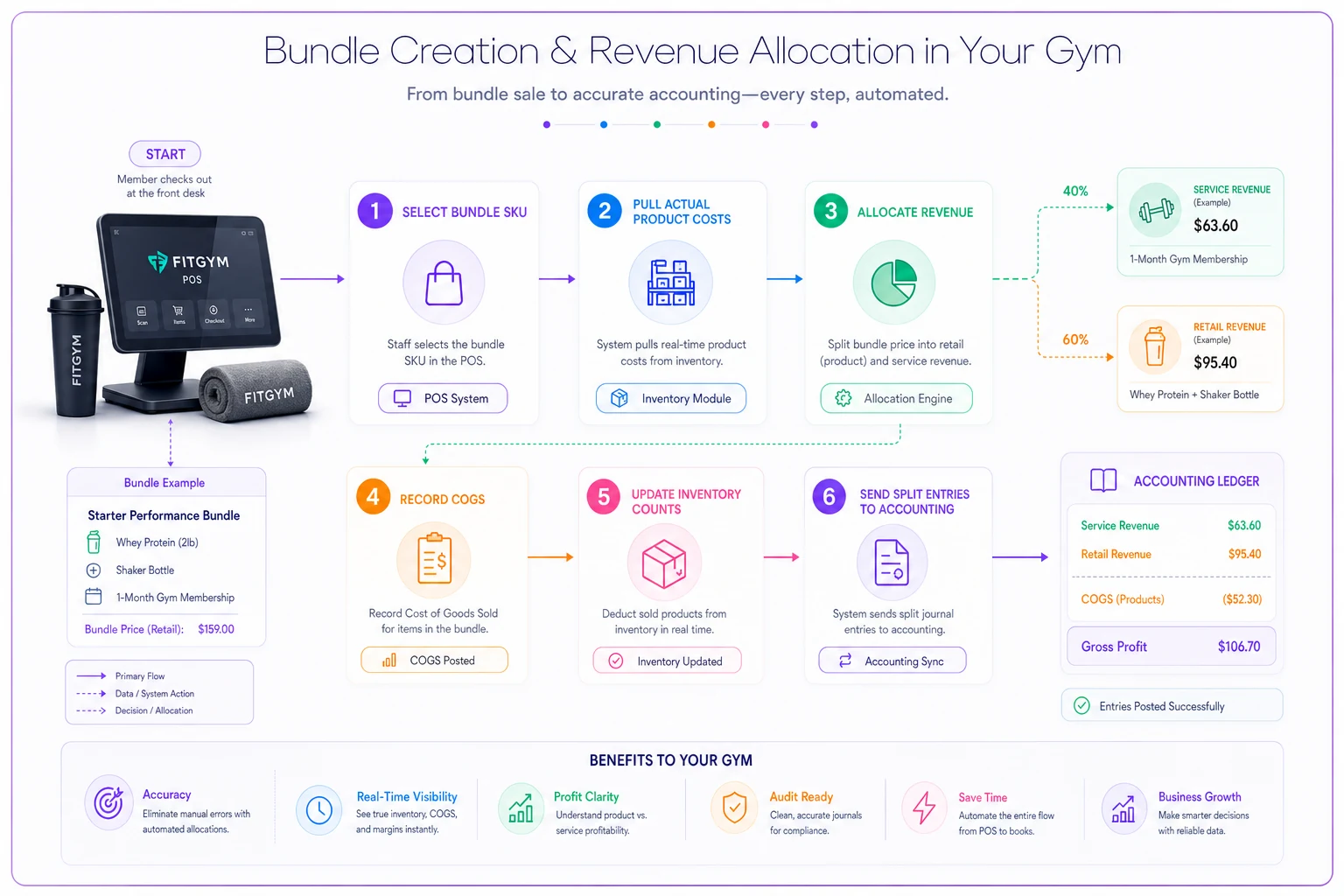
A simple diagram like this helps staff understand why allocation matters and where mistakes typically happen.
Replenishment rules that prevent both stockouts and dead inventory
The typical gym retail replenishment process: someone notices the protein shelf looking sparse and orders more. Maybe there's a par level scribbled on a sticky note. Maybe the manager does a walkthrough once a month and makes a list.
This reactive approach guarantees you'll cycle between stockouts that lose sales and overstock that ties up cash. The protein runs out Thursday but the order doesn't arrive until Tuesday — four days of weekend sales gone. Or you panic-order too much and end up with $2,000 in slow-moving inventory eating up your limited retail space.
Effective replenishment requires rules based on actual velocity data, not visual inspection. But they also need to be simple enough that part-time front desk staff can execute without much training.
Calculate reorder points using this formula:
Reorder point = (Daily velocity × Lead time) + Safety stock
For a protein that sells 2 units daily with a 5-day supplier lead time: Reorder point = (2 × 5) + 3 = 13 units When inventory hits 13, reorder.
Automate reorder alerts in your POS to trigger when the reorder point is hit so part-time staff don't have to remember manual checks.
Set order quantities based on shelf life and space:
Order quantity = Maximum stock - Current stock
Maximum stock = Minimum of:
-
- 30 days of inventory (2 units × 30 = 60)
-
- Physical shelf capacity (maybe 40 units)
-
- Product shelf life remaining (if applicable)
At the 13-unit reorder point with 40-unit shelf capacity: Order quantity = 40 - 13 = 27 units
Create dead stock rules to prevent inventory zombies:
-
If velocity drops below 0.5 units/week for 4 weeks → Stop reordering
-
If no sales in 6 weeks → Discount 25%
-
If no sales in 10 weeks → Discount 50%
-
If no sales in 14 weeks → Bundle with fast movers or donate
The critical point: these rules need to be systematic, not discretionary. When replenishment decisions get left to whoever's working that shift, you end up with inconsistent ordering and feast-or-famine inventory cycles.
The month-end reconciliation mess that hides your true numbers
Month-end hits and your bookkeeper asks for the retail revenue number. Someone exports a report from the POS, emails it over, and it lands in QuickBooks. Done, right?
-
The POS shows $8,400 in retail revenue. But it doesn't tell you
-
- Which $1,200 came from bundled packages that should be partially allocated to services
-
- Why inventory value dropped $3,800 but cost of goods sold only shows $2,900
-
- How $400 in refunds got processed as negative service revenue instead of retail returns
-
- Where the $300 in wholesale orders to personal trainers ended up categorized
Without proper reconciliation, you genuinely don't know what your retail operation is doing.
Building reconciliation worksheets that actually work
Most gym owners think reconciliation means matching POS totals to bank deposits. That's cash reconciliation, which matters, but it tells you almost nothing about operational performance. You need operational reconciliation — mapping POS transactions to accounting codes in a way that reveals true margins and catches problems before they compound.
A functional reconciliation worksheet for gym retail needs four components:
Transaction categorization matrix:
| POS Transaction Type | Primary Account | Secondary Account | Split Rule |
|---|---|---|---|
| Retail sale - standalone | Retail Revenue | COGS - Retail | Full amount |
| Bundle - yoga package | Service Revenue | Retail Revenue | Cost + 30% to retail |
| Trainer wholesale | Retail Revenue - Wholesale | COGS - Wholesale | Full amount |
| Retail refund | Retail Revenue (negative) | COGS - Retail (negative) | Full amount |
| Damaged inventory | Inventory Adjustment | Shrinkage Expense | Cost basis |
Daily variance tracker:
-
POS retail total versus items actually sold (quantity check)
-
Inventory movement versus recorded COGS
-
Refund count versus return merchandise received
When variances exceed 5%, investigate right away. A pattern of small daily variances almost always points to a systematic problem — incorrect bundle allocation, missing wholesale tracking, something like that.
Margin validation check:
Your worksheet should automatically calculate implied margin: Implied margin = (Revenue - COGS) / Revenue
-
If this differs from expected margin by more than 3%, something's off
-
- Products being sold below intended price
-
- Incorrect COGS recording
-
- Missing revenue categorization
-
- Theft or unreported damage
Roll-forward inventory proof:
Starting inventory + Purchases - COGS - Adjustments = Ending inventory
If this doesn't match your physical count within 2%, you have an operational problem, not an accounting one. Either products are leaving without being recorded, your receiving process is broken, or the POS isn't capturing all transactions.
The worksheet itself doesn't need to be complex. A spreadsheet with these four components will catch most common retail revenue problems before they become material.
How proper categorization reveals hidden margin leaks
One gym I worked with noticed their retail margin had been declining steadily for about six months — from 42% down to 31%. The owner blamed rising wholesale costs. The real culprit was more interesting.
Their POS had a "quick sale" button that staff used for simple transactions to speed up checkout. This button was categorized as "miscellaneous revenue" with no COGS association. Staff had started using it for all small retail sales under $20 just to save time.
The result: around $2,100 monthly in retail sales were being recorded without any corresponding COGS, artificially inflating reported margins on everything else. When wholesale prices ticked up slightly, the reported margin cratered because that hidden buffer disappeared.
Once they fixed the categorization and retrained staff, margins stabilized around 38% — lower than the inflated number they'd been seeing, but higher than the 31% that had everyone panicking.
The compounding effect of small operational fixes
Retail might only represent 5-10% of your total revenue, making it easy to deprioritize compared to membership billing or personal training. But the operational disciplines required to run it profitably — SKU-level margin tracking, systematic replenishment, proper reconciliation — build capabilities that improve your entire business.
The same inventory velocity thinking that optimizes retail shelves applies to equipment utilization in your main gym. The reconciliation discipline that catches retail categorization errors will also catch membership billing discrepancies. The bundling mechanics that properly split retail and service revenue work just as well for personal training packages with nutrition consultations.
Small fixes compound. A 2% improvement in retail margin, a 3% reduction in inventory carrying cost, and a 1% decrease in shrinkage might add up to a few hundred dollars monthly. The operational habits you build to get there — systematic thinking, measurement discipline, staff training — those change how your whole gym runs.
Making retail operations systematic instead of reactive
The shift from reactive to systematic retail management doesn't require big investment or complex software. It requires clear rules, simple tools, and consistent execution. Mostly it requires recognizing that retail isn't just a sideline convenience — it's an operational function that either strengthens or weakens your overall business based on how you run it.
Start with SKU-level margin targets that reflect operational reality. Build bundling rules that keep revenue allocation clean. Set replenishment triggers based on data instead of eyeballing shelves. Create reconciliation worksheets that surface problems rather than hide them.
None of this is revolutionary. These are basic operational disciplines that every successful retail business runs on. The difference is applying them systematically in a gym environment where retail usually gets treated as an afterthought.
When you stop treating retail as a side business and start treating it like any other operational function — the same way you'd approach membership management or class scheduling — the margin leaks slow down and the numbers start making sense.
And in an industry where the difference between thriving and just surviving often comes down to a few percentage points, that matters more than most owners realize.
Ready to elevate your gym operations?
Join 2,000+ gyms using Gymioly to reduce admin overhead, improve member experience, and grow revenue.