

Most gym owners treat semi-private training like an awkward middle child. It's not one-on-one PT, and it's not a class you can pack 20 people into. So it gets priced on a hunch, scheduled around whatever slots are left over, and staffed by whoever's available. Then six months later someone looks at the numbers and realizes the format is barely breaking even — or worse, quietly losing money because a trainer is running a "group" of two people at a per-head rate that doesn't cover their hourly.
The whole thing lives or dies on three numbers: what you charge per head, how many heads you actually get in the room, and how much of your trainer's paid hour you're actually selling. Get those wrong and no amount of marketing saves you. Get them right and semi-private becomes the highest-margin coaching product most single-site gyms carry.
This is a math post. We're going to build the micro-P&L per format, run break-even by class size, lay out scheduling grids that protect trainer utilization, and map the specific touchpoints that move a free class attendee into a paid 4- or 8-week group program. No fluff.
Why semi-private pricing goes sideways in the first place
The core mistake is pricing semi-private as "discounted PT." Owner logic goes: PT is $75/session, semi-private has 4 people, so charge each person $35 and everyone wins. On paper the trainer is now making $140/hour instead of $75. Great.
Except that math assumes 4 people show up every single session. In real operations, a "4-person" semi-private group averages closer to 2.7 attendees once you account for cancellations, vacations, illness, and the person who bought the pack and ghosts by week three. So your $140 hour is actually a $95 hour on average — and on the bad days it's a $35 hour when only one person walks in and you still have to run it.
The second mistake is not separating format economics from individual pricing. A gym will sell semi-private at one flat rate regardless of whether the pod holds 2, 3, or 4 people. That means your 2-person pods and your 4-person pods have wildly different margins, but you're managing them like they're the same product. You can't fix what you're not measuring separately.
Building the micro-P&L per format
Before you touch pricing, you need a clean per-session P&L for each format you run. Not per month, not per member — per session. That's the unit where semi-private actually makes or loses money.
End appointment chaos and boost attendance.
Gymioly streamlines booking, confirms sessions, and manages memberships effortlessly.
- Unified class and membership management
- Automated member notifications
- Trainer scheduling and availability
No credit card required
| Format | Cap | Avg attendees | Per-head rate | Session revenue | Trainer cost | Room/overhead allocation | Session margin |
|---|---|---|---|---|---|---|---|
| 1:1 PT | 1 | 1.0 | $70 | $70 | $32 | $6 | $32 |
| Duo (2:1) | 2 | 1.8 | $45 | $81 | $32 | $6 | $43 |
| Small pod (3–4) | 4 | 2.9 | $32 | $93 | $32 | $6 | $55 |
| Large pod (5–6) | 6 | 4.3 | $26 | $112 | $34 | $8 | $70 |
A few things jump out once you build this.
The duo format looks nice per-head but it's fragile. With an average of 1.8 attendees, one no-show drops you to a single person paying $45 against a $32 trainer cost — you're netting about $7 for a fully committed coaching hour. The small pod, even averaging under 3 people, throws off a stronger and more stable margin because the pricing was built around realistic attendance, not the theoretical cap.
The overhead allocation line matters more than people think. If you're running semi-private in the same floor space during peak hours when members want open gym access, you're paying an opportunity cost that doesn't show up in payroll. Allocate something real there — even a rough number forces the honest conversation.
Break-even by class size
Break-even for a semi-private session is the point where session revenue covers trainer cost plus overhead. Everything above that is contribution margin toward rent, admin, and profit.
Using $32 trainer cost plus $6 overhead = $38 to break even per session, here's how many paying heads you need at different price points:
-
At $26/head
you need 1.5 attendees to break even — effectively 2 people. Below that you lose money every session.
-
At $32/head
break-even is 1.2 attendees. One committed person nearly covers it; two makes it profitable.
-
At $45/head
break-even is 0.85 attendees. Even a solo show technically covers cost, which is why duo pricing feels safe but caps your upside.
The takeaway: your per-head price sets your fragility. Cheaper per-head rates require larger, more reliable pods to work. If your attendance is inconsistent — and for most gyms starting out, it is — price closer to the $32–$45 band and grow pod size after you've proven attendance holds, not before.
A common failure pattern: a gym prices at $22/head to look competitive, sells six-packs, then averages 2.4 attendees. At $22, break-even needs 1.7 heads, so technically they're above water — but only by a few dollars a session. A trainer running that all week generates almost no contribution margin while the owner assumes the "packed" schedule means things are working.
The scheduling grid that protects utilization
Trainer utilization quietly determines whether semi-private is worth running at all. Utilization here means: of the hours you're paying a trainer, how many are actually generating semi-private revenue at target margin?
A trainer on a 30-hour week running only 14 billable semi-private sessions sits at roughly 47% utilization. The other 16 hours — floor coverage, admin, empty slots you scheduled optimistically — are pure cost. The goal isn't 100% (that's unrealistic and burns people out), but the difference between 50% and 70% utilization is often the difference between a losing format and a decent one.
You fix utilization by clustering demand, not by adding more slots. Here's what that looks like in practice:
Bad grid (scattered, low utilization):
-
6
00 AM — 1 person
-
9
00 AM — 2 people
-
12
00 PM — empty
-
4
00 PM — 3 people
-
7
00 PM — 2 people
Better grid (clustered blocks):
-
5
30 AM / 6:30 AM — back-to-back morning pods
-
Off-clock midday
-
4
30 PM / 5:30 PM / 6:30 PM — evening block
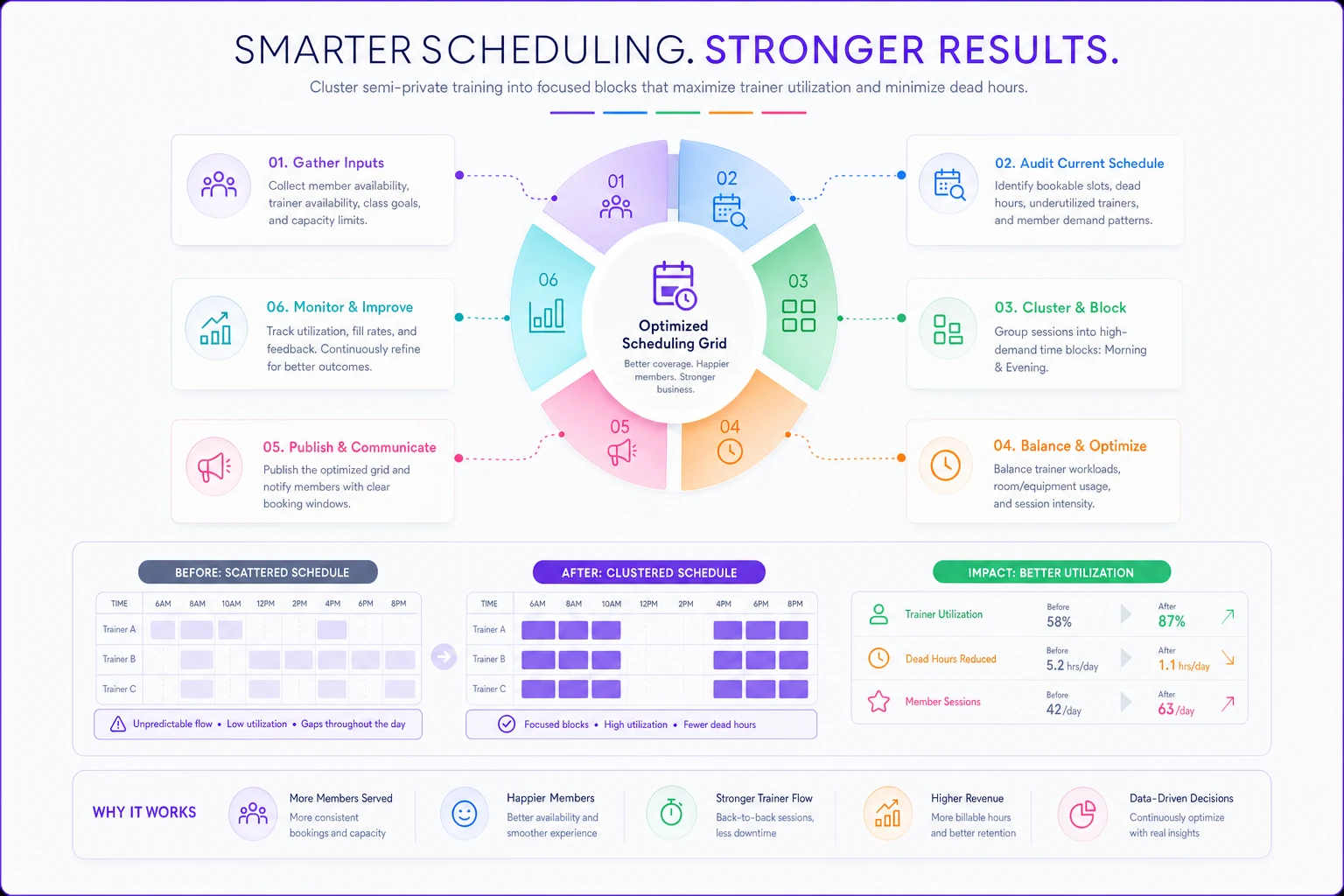
Same revenue, dramatically better cost structure, and a schedule the trainer doesn't resent.
The rule that matters most: never open a semi-private slot outside your two or three proven demand windows. Empty aspirational slots don't just fail to earn — they train members to think your schedule is flexible, which encourages last-minute booking and undermines the consistency the format depends on.
Converting free attendees into paid group programs
This is where most of the money leaks. A gym runs a free community class, 12 people show up, everyone has a great time — and then nothing happens. No structured path from that free session into a paid 4- or 8-week semi-private program.
The conversion problem is almost never about workout quality. It's the absence of a defined next step offered at the right moment. People who just finished a class are at peak intent for about 48 hours. After that, life takes over.
Here's the touchpoint sequence that actually converts, mapped to timing:
-
End of the free session (in person) the coach names the next program specifically — "We're starting an 8-week strength pod on Tuesdays and Thursdays, 4 spots left." Not a flyer. A verbal, specific, scarcity-anchored ask.
-
Within 2 hours a short message that references the exact session they attended and the exact program start date. Personalization beats polish here.
-
Day 2 a single follow-up with pricing and the pod cap. If the math says a 4-person pod needs to fill, the message should reinforce that spots are limited — because they genuinely are.
-
Day 4 the last-call message, then stop. Chasing past this point annoys people and hurts your reputation.
The structural insight: your conversion offer should be a program, not a membership. A committed 8-week pod with a start date, a cap, and a small deposit converts far better than an open-ended "come whenever" package, because it creates the same commitment device that makes any cohort work. If you want the deeper mechanics of why cohort structure drives retention, we broke that down in the piece on designing 4/8/12-week class series and cohort onboarding.
Where automation genuinely earns its keep is timing and consistency. The 2-hour and Day-2 messages are the ones humans forget when they're busy coaching back-to-back sessions — and those are the highest-intent moments in the whole sequence. Setting up an automated follow-up triggered by attendance at a free class means the message actually goes out every time, referencing the right program and start date, without a staff member needing to remember. The coach makes the verbal ask; the system handles the follow-through.
A real scenario with the numbers
A single-location gym running semi-private in a mid-size town had four pods listed at $28/head, capped at 5. On paper that's a $140 session. In reality their attendance averaged 2.6 per pod, so sessions were pulling about $73 against a fully-loaded trainer cost near $33 — thin margin, and two of their weekly slots were regularly sitting at one attendee.
They made three changes without any new marketing spend:
-
Repriced by pod tier. Raised the small-pod rate to $34/head and kept larger, fuller pods at $27. The higher price on thin pods immediately improved per-session margin, and a few price-sensitive members consolidated into the fuller evening pods — which is exactly what you want.
-
Killed the two dead slots and moved that trainer time into a second evening block where demand actually existed. Utilization on that trainer went from roughly 50% to around 68%.
-
Added a post-class conversion sequence to their free monthly community class — the verbal ask at the end, plus automated 2-hour and Day-2 follow-ups.
Over the following quarter, average attendees per pod rose to about 3.4, and free-class-to-paid-pod conversion went from a guess (they weren't tracking it) to a measurable rate in the low-20s percent. Session margin roughly doubled on the reworked slots. Nothing dramatic — they just stopped running the format on hope and started running it on the actual numbers.
When semi-private makes sense — and when it doesn't
When it makes sense:
-
You have at least two genuine demand windows (usually early morning and evening) where you can cluster pods.
-
You have a coach who's good at running a room of 3–5 people, which is a different skill than 1:1.
-
You already run classes or free events that produce a steady flow of warm attendees to convert.
When it's a bad idea:
-
Your attendance is too thin to reliably fill 3+ seats and you're tempted to price low to compensate. Low price plus thin pods is the exact combination that loses money quietly.
-
You'd have to open slots in slow midday hours just to have a schedule. Aspirational slots drag utilization down and rarely recover.
-
Your trainers are already maxed on 1
1 that pays well — pulling them into lower per-head work can cannibalize higher-margin PT.
Who should probably not run it yet: gyms without any reliable free-attendee funnel. Semi-private lives on conversion. If you don't have a top-of-funnel producing warm people, you're building the middle of a machine with no front end. Sort out the intro and community-event side first — and if you're still deciding whether this format is worth the operational lift, the non-dues revenue unit-economics models walk through how to pressure-test a new revenue line before you commit staff hours to it.
Pulling it together
Semi-private training isn't complicated, but it's unforgiving of vague numbers. The three levers — per-head price, average attendees, and trainer utilization — interact with each other, and moving one without watching the others is how gyms end up with a full-looking schedule that generates almost no margin.
Build the per-session P&L for each pod size separately. Set your price against realistic attendance, not the cap. Cluster your schedule into proven demand windows and stop opening hopeful empty slots. Then give every warm attendee a specific, time-bound program to step into within 48 hours of their first session. Do those four things and the format stops being the confusing middle child and starts being one of the better products in your building.
Semi-private training isn't complicated, but it's unforgiving of vague numbers. The three levers — per-head price, average attendees, and trainer utilization — interact with each other, and moving one without watching the others is how gyms end up with a full-looking schedule that generates almost no margin.
Build the per-session P&L for each pod size separately. Set your price against realistic attendance, not the cap. Cluster your schedule into proven demand windows and stop opening hopeful empty slots. Then give every warm attendee a specific, time-bound program to step into within 48 hours of their first session. Do those four things and the format stops being the confusing middle child and starts being one of the better products in your building.
Ready to elevate your gym operations?
Join 2,000+ gyms using Gymioly to reduce admin overhead, improve member experience, and grow revenue.