

Most gyms run classes like a bus timetable. There's a 6am HIIT, a noon spin, a 7pm yoga. People drop in, sweat, leave. Nobody tracks where a member is in their journey, because there is no journey — just a rolling calendar of disconnected sessions.
That's the whole problem. A schedule doesn't create commitment. A series does.
When you look at gyms that keep members past the 90-day cliff, the pattern is almost always the same: they've stopped selling access to a room full of equipment and started selling structured programs with a beginning, a middle, and a finish line. Progressive class programming isn't a marketing gimmick — it's the mechanism that turns "I went to a few classes" into "I completed something and I want the next thing."
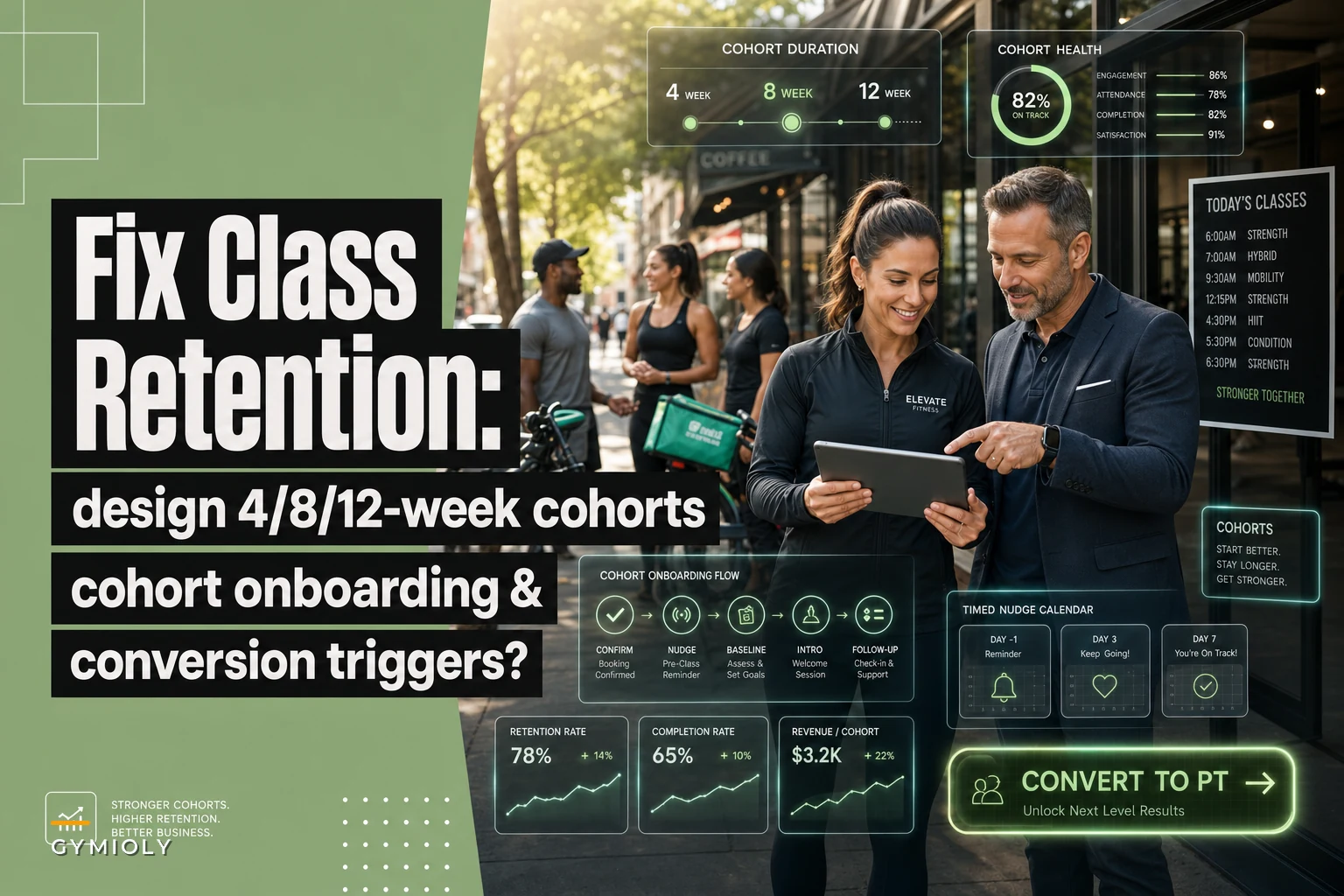
This post is about how to build those 4, 8, and 12-week series properly. Not the coaching content — you already know how to program a squat progression. The operational layer: how you onboard a cohort, how you measure whether people are actually progressing, and where you place the triggers that move someone from a $19 class pack into PT or a full membership.
Why drop-in classes quietly kill retention
A drop-in class has no memory. Week three feels exactly like week one. There's no sense of accumulation, no "I'm three sessions from finishing," no real reason to show up on the day you don't feel like it.
-
They feel behind if they skip, because the group moves forward without them
-
They build relationships with the same faces every session
-
They have an actual endpoint to work toward
This usually shows up in the numbers pretty clearly. A pure drop-in model tends to see attendance decay fast — someone buys a 10-pack, uses four, and the punch card sits in a gym bag for six months before they quietly stop coming. A cohort model front-loads commitment and gives people a reason to see the block through.
The insight most owners miss: retention isn't about individual class quality, it's about the arc. You can have brilliant coaches running phenomenal sessions and still bleed members, because there's nothing connecting Tuesday's class to next Tuesday's class in the member's head.
Choosing between 4, 8, and 12 weeks
The length isn't arbitrary. Each block does a different operational job, and picking the wrong one for your context is a common mistake.
End appointment chaos and boost attendance.
Gymioly streamlines booking, confirms sessions, and manages memberships effortlessly.
- Unified class and membership management
- Automated member notifications
- Trainer scheduling and availability
No credit card required
| Series length | Best used for | Commitment ask | Primary goal |
|---|---|---|---|
| 4 weeks | New members, intro offers, seasonal challenges | Low — easy yes | Get a first "win" and build the habit |
| 8 weeks | Skill development, body-composition goals | Medium | Show measurable progress, create identity |
| 12 weeks | Transformation programs, committed members | High | Deep results, natural bridge to membership/PT |
A 4-week block is your acquisition tool. Short enough that a nervous beginner will say yes, long enough to build a habit loop. You're not trying to transform anyone in four weeks — you're trying to get them to finish something so they trust you enough to buy the next block.
The 8-week block is the workhorse. Long enough to show real change, short enough that it doesn't feel like a life sentence. This is where most of your recurring cohort revenue should live.
The 12-week block is where you put your best members and your highest price point. It's also the most fragile — a lot of people fall off around week 5 or 6 when motivation dips and results feel slow. Run 12-week programs without mid-block check-ins and expect completion rates to crater.
When shorter is actually smarter
If your gym attracts a lot of first-timers or has a high walk-in rate, lean on 4-week blocks and stack them. Someone who finishes three consecutive 4-week blocks has effectively done a 12-week program — but they said "yes" three times to a low-risk ask instead of once to a scary one. Psychologically, that's a completely different sale.
Cohort onboarding: the first 72 hours decide everything
Most program dropouts are decided before the program even starts. The gap between "signed up" and "showed up to session one" is where you lose people, and it's almost entirely an onboarding failure.
-
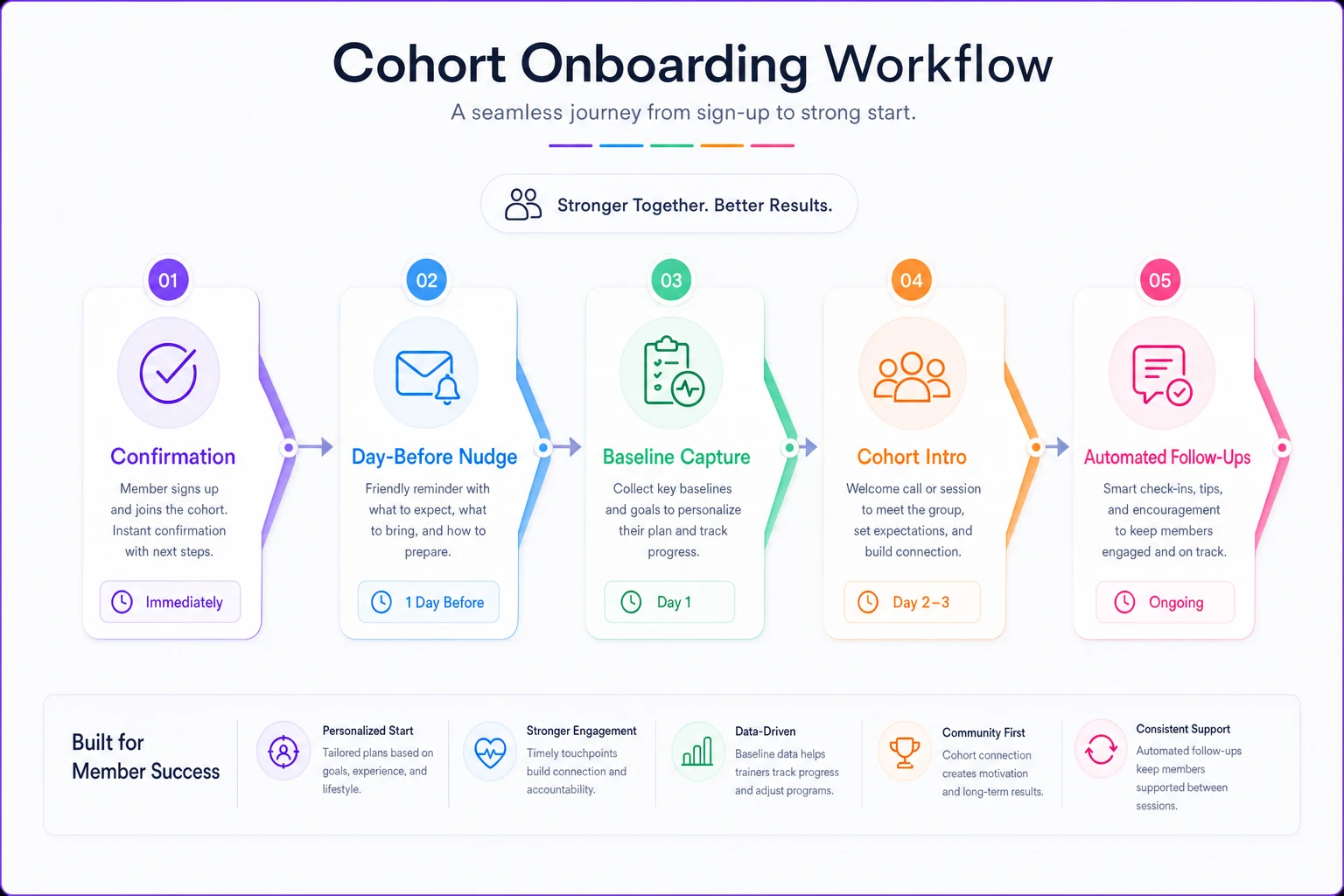
Immediate confirmation (within minutes) Not just a receipt. A short message that tells them exactly when their cohort starts, what to bring, where to park, and what to expect in session one.
-
Day-before nudge A reminder plus one piece of "reduce the anxiety" content — a 60-second video of the coach explaining that everyone in the cohort is starting from the same place.
-
A baseline capture Before session one, get their starting numbers — a photo, a few measurements, a benchmark workout, whatever fits the program. It makes them feel like the program is serious, and it gives you the "before" you'll use for the conversion pitch later.
-
Cohort intro Put the group in a shared thread or channel so they meet a couple of names before they walk in. People who know one person in the room are dramatically more likely to show up.
Gyms that get this right treat onboarding as a fixed workflow, not something a front-desk person pieces together from memory when they remember to do it. When the confirmation, reminder, baseline request, and cohort intro all fire on a set schedule, session-one show-up rates climb noticeably — and the whole block starts from a stronger base.
A simple workflow for the cohort onboarding flow:
If no-shows are a recurring headache more broadly, it's worth pairing this with the tactics in reducing class no-shows and late cancellations — cohort onboarding and no-show policy reinforce each other more than most owners expect.
Measuring progression (or you're just guessing)
A mistake that comes up constantly: gyms sell an "8-week transformation" and then have no idea, at week 8, whether anyone transformed. No measurement means no story to tell at the end, and the conversion pitch falls flat because it's built on vibes.
-
Attendance-based progression — sessions completed out of scheduled. This is your leading indicator. Someone who's attended 6 of 8 is finishing; someone at 3 of 8 by week 5 is already gone.
-
Performance markers — a benchmark you retest. Reps, weight, time, distance. Something they can actually see improve.
-
Completion milestones — did they hit the halfway checkpoint, the week-6 check-in, the final assessment.
The real value of tracking attendance mid-block is that it lets you intervene before someone ghosts. If your cohort data shows a member dropped from weekly attendance to once every two weeks around week 4, that's your cue to reach out — not with a guilt trip, but a "we saved your spot, you're closer than you think" nudge.
Keep cohort sizes small so individual attendance changes are obvious and you can intervene early.
One thing worth noting on capacity: measurement only works if your cohorts are sized right. Oversized cohorts dilute the group feeling and make it nearly impossible to notice when one person drifts. If you're unsure how to size them, the logic in class capacity planning using historical attendance applies directly to cohort caps.
-
Week 1–2 Track attendance, confirm every member has their baseline on file
-
Week 3–4 Flag anyone below 50% attendance for a personal check-in
-
Week 5–6 Retest a performance marker, surface results to each member individually
-
Week 7–8 Final assessment, before/after comparison, present the next step
Simple, but most gyms aren't doing even half of it consistently.
The conversion triggers: turning finishers into members and PT clients
This is where the money is, and where almost everyone leaves it on the table. Someone finishes your 8-week block, feels great, and then... nothing. No offer. They drift back into drop-in mode or vanish entirely.
Trigger 1 — The mid-block win. Around week 4 of an 8-week program, when someone hits a visible improvement, that's the moment to plant the seed: "You know, the people who really lock this in usually add a session of 1-on-1 work — want me to explain how that works?" You're not closing, you're opening.
Trigger 2 — The completion moment. When someone finishes, they're at peak motivation and peak proof. Show them their before/after (the baseline you captured in onboarding pays off here) and present the natural next step: enroll in the next block at a members-only rate that only makes sense with a full membership.
Trigger 3 — The plateau conversation. Some finishers won't want another group block — they've outgrown it. That person is your PT conversion. The trigger is honesty: "You've maxed out what the group format gives you. To keep progressing you'd need individualized programming."
A simple way to structure the economics: price the standalone series slightly high, and make the membership the obviously smart choice for anyone wanting a second block. A member doing back-to-back 8-week series at a bundled membership rate is worth far more over a year than someone paying per-block, and the transition feels like a favor rather than an upsell.
A realistic example
Take a boutique strength gym running roughly 30–40 people through cohorts each month. Before restructuring, they sold drop-in packs and had maybe 15% of pack-buyers ever convert to a recurring membership. Classes were reasonably full, but revenue was flat and unpredictable.
They switched to a 4-week intro block feeding into 8-week core blocks, with baseline capture and completion check-ins built in. Within a couple of months, block completion rates were sitting around 70–75% (up from people never finishing punch cards), and roughly a third of finishers were rolling into a membership or adding PT at the conversion moment. Nothing overnight — but monthly recurring revenue stopped being a mystery and started compounding. The front desk finally had a clear "what's next" for every member instead of hoping people rebooked on their own.
Who should NOT do this
Progressive class programming isn't free to run. It adds operational overhead — tracking cohorts, capturing baselines, timing triggers, chasing at-risk attendees.
If you're a low-touch, high-volume gym whose whole model is cheap access and 24/7 open floor, forcing everyone into cohorts will feel heavy and off-brand. If you only have one coach and can barely staff your current schedule, don't layer on 12-week transformation programs you can't measure or support properly — you'll create a worse experience than the drop-in model you started with.
This works best when you have coaches who can own cohorts, a member base that wants structure and results, and a price point above pure commodity gym pricing. If that describes you, the series model isn't just retention insurance — it's the cleanest path from a first class to a long-term member.
Where the operational load actually lands
The reason most gyms know they should do cohorts but don't is that the manual tracking is brutal. Onboarding sequences, baseline data, mid-block attendance alerts, timed conversion offers — that's a lot to run by hand across multiple concurrent cohorts. It falls apart the moment your front desk gets busy, which is always.
This is the part worth systemizing. Not because you need fancy software for its own sake, but because the whole model depends on things firing on schedule. AI-powered operational platforms built for gym management can handle the parts that are easy to forget — sending the day-before nudge, flagging a member who's dropped attendance mid-block, queuing the conversion message when someone hits their final session. When that scaffolding runs automatically based on each member's position in their block, coaches can focus on coaching and the front desk isn't drowning in admin.
Start with one program. Pick your 8-week core block, build the onboarding flow, capture baselines, place your three conversion triggers, and actually measure completion. Get that one working end to end before you touch the rest of your schedule. A single well-run series that people finish will teach you more about retention than a full calendar of classes nobody remembers attending.
Ready to elevate your gym operations?
Join 2,000+ gyms using Gymioly to reduce admin overhead, improve member experience, and grow revenue.