


Last month, a gym owner in Portland told me something that stuck: "We hired three different 'people persons' for member success in eighteen months. All three failed." The problem wasn't the people. He kept trying to solve a systems problem with personality.
Member success for gyms isn't about finding someone who's naturally good with people. It's about building an operational framework that turns member interactions into predictable outcomes. The gyms that treat member success as a defined operational function consistently outperform those that rely on intuition and charm.
The difference shows up in concrete ways. Retention rates climb from the typical 60-65% annual range to 75-80%. Member lifetime value extends by several months. Personal training penetration increases from around 12% to 18-22%. These aren't magic numbers—they're what happens when you build systematic member engagement on top of clear role definitions, measured touchpoints, and clean handoffs.
Why member success breaks down at single-location gyms
Single-location gyms face a specific problem here. You don't have the scale for a dedicated customer success team, but you also can't rely on the owner handling every member interaction once you pass 300-400 members.
The breakdown usually happens around month 8-10 after opening, or when membership crosses that 350-member mark. Suddenly the owner can't remember everyone's name. The front desk is too busy checking people in to notice who hasn't shown up in two weeks. Trainers are focused on their paying clients, not the general membership base.
What fills that gap? Nothing. Members drift into inactivity, then cancellation, while staff assumes someone else is handling outreach. A typical single-location gym quietly loses somewhere between 8-12 members per month to this void—not members who are dissatisfied, just disconnected.
Gym owners usually don't see this as an operational failure. They blame competition, pricing, equipment. But when you actually track member journeys, the pattern is pretty obvious: members who receive structured touchpoints in their first 90 days stay significantly longer than those who don't.
That's why building a formal member success function matters. It takes personality-dependent retention and turns it into something you can actually manage.
The member success role most gyms actually need
Most gym owners think member success means hiring a salesperson who also handles retention. That's the wrong frame entirely. The role needs three distinct operational zones:
End appointment chaos and boost attendance.
Gymioly streamlines booking, confirms sessions, and manages memberships effortlessly.
- Unified class and membership management
- Automated member notifications
- Trainer scheduling and availability
No credit card required
Engagement Operations (40% of role)
-
Daily usage monitoring through your management system
-
Proactive outreach based on attendance patterns
-
Coordination with trainers and class instructors
-
Goal-setting sessions and progress reviews
Lifecycle Management (35% of role)
-
Transition management from sales to active member
-
Risk identification and intervention workflows
-
Upgrade pathway conversations (classes to PT, basic to premium)
-
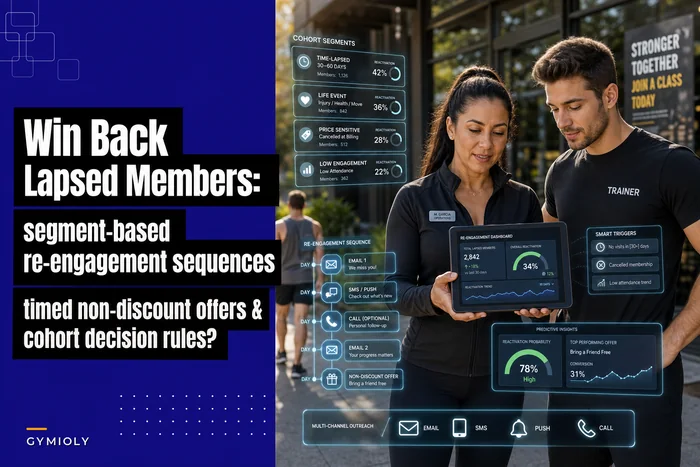
Re-engagement sequences for declining usage
Operational Intelligence (25% of role)
-
Weekly cohort analysis and reporting
-
Feedback collection and pattern identification
-
Program effectiveness measurement
-
Coordination with other departments on member needs
Notice what's not on that list? Sales. New member tours. Billing issues. These contaminate the member success function. When your member success person is also selling memberships, guess which activity wins when both need attention at the same time?
The role needs someone who thinks in systems and patterns, not just relationships. They should be asking questions like "Why do members who join in January have different retention patterns than July joiners?"—not just "How do I make members like me?"
Building your 90-day implementation roadmap
Standing up a member success function isn't about hiring someone and hoping it works. You need a phased rollout that builds capability without breaking what's already running.
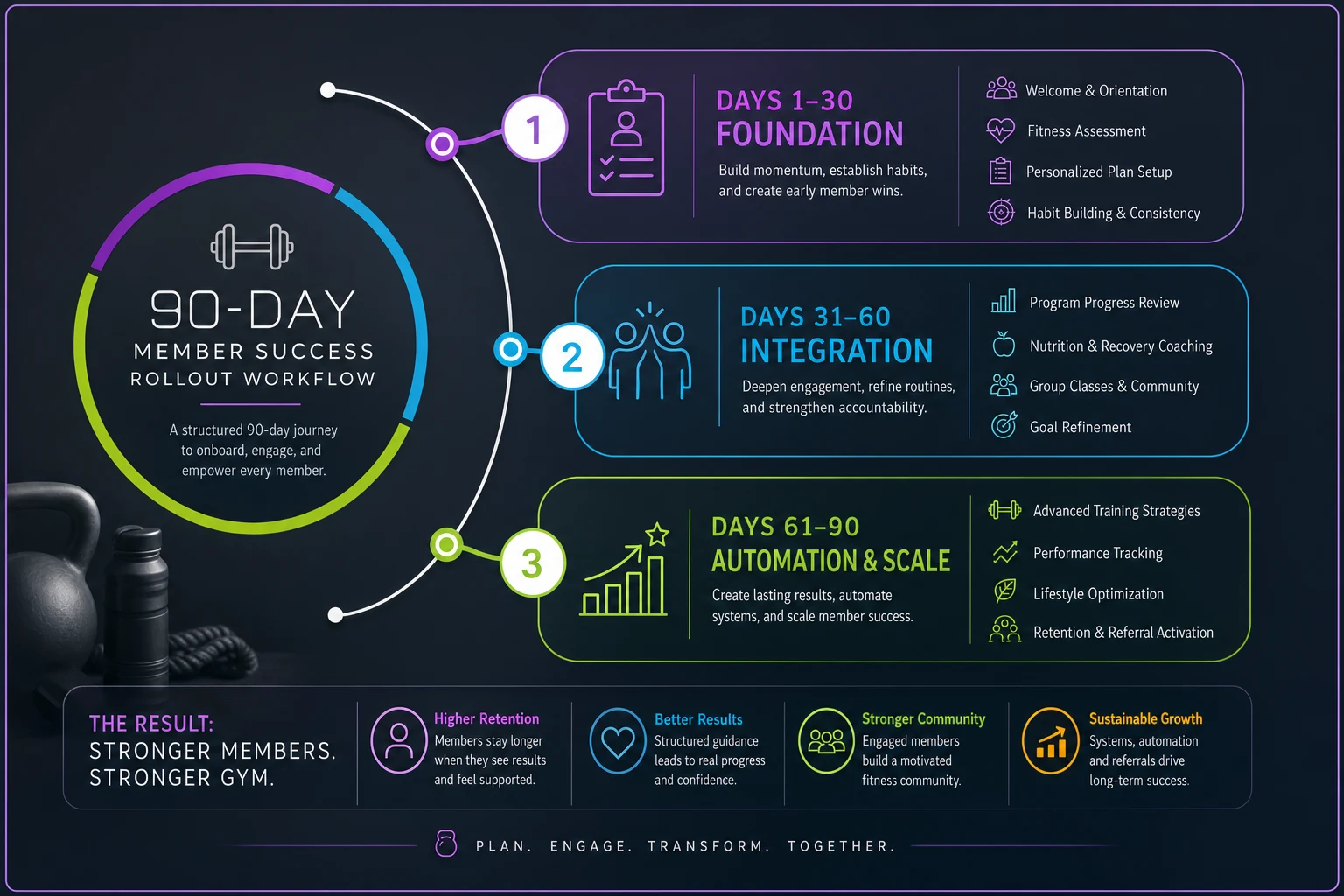
This diagram shows the three-phase progression and where to concentrate resources during each period.
Days 1-30: Foundation and Baseline
Week 1: Define exact touchpoint requirements. Map out when members should hear from you—not just during onboarding, but at day 30, 60, 90, 180. Create templates for each interaction type. Build your baseline metrics: current retention rate, average member lifespan, usage patterns by cohort.
Weeks 2-3: Audit your current member data. Most gyms discover their database is messier than expected—duplicate entries, missing contact info, outdated preferences. Clean it now, before your member success person inherits the chaos. Set up proper tracking so check-ins, class attendance, and PT sessions all feed into one view.
Week 4: Create intervention triggers. When should member success step in? Common triggers include: no visits in 14 days for previously active members, declining visit frequency (dropping from 3x to 1x weekly), membership freeze requests, or missed personal training sessions. Document exactly what happens when each trigger fires.
Days 31-60: Operational Integration
This phase kills most member success initiatives. Your front desk needs to know when to loop in member success versus handling issues themselves. Trainers need clear handoff points for members who might benefit from additional support.
-
Morning huddle integration (5 minutes on at-risk members)
-
Trainer referral process (when and how to flag concerns)
-
Class instructor feedback loops (identifying struggling members)
-
Billing coordination (who handles what types of issues)
The critical piece here is protecting the member success function from operational creep. The moment they become backup front desk or emergency sales support, the function fails. Their calendar should be blocked for member-facing activities, not filling gaps elsewhere.
Days 61-90: Automation and Scale
Month three is where you add the leverage that makes this sustainable. Manual tracking works at 50 members. At 400, you need systems.
-
Welcome sequences tied to join date (not requiring manual initiation)
-
Usage alerts that flag declining attendance automatically
-
Birthday and milestone messages queued monthly
-
Progress check-ins based on stated goals
Automation isn't abdication, though. Each automated touchpoint should create an opportunity for human intervention when needed. A member who doesn't respond to two automated check-ins gets a personal call. Someone who freezes their membership twice in six months triggers a retention conversation.
Start with a small set of high-impact automated triggers (welcome, 14-day drop, 30-day check) and iterate based on response rates.
This is also when you establish your KPI review rhythm—weekly reviews of leading indicators (usage patterns, touchpoint completion rates) and monthly reviews of lagging indicators (retention, lifetime value, upgrade rates).
The four member lifecycle journeys you must map
Most gyms think of the member lifecycle as join → use → renew or cancel. That's too simple. Real member success requires mapping four distinct journeys, each with different touchpoints, risks, and opportunities.
Journey 1: The Activator (Days 0-30)
These members just joined and need to build habits fast. Their risk point is week 2-3, when initial enthusiasm wanes but habits aren't established yet. Touchpoints here focus on removing friction and celebrating small wins.
-
Day 3 check-in call (not sales, just "how was your first workout?")
-
Day 7 goal-setting session (15 minutes, in-person if possible)
-
Day 14 usage review and adjustment
-
Day 21 habit celebration
-
Day 30 progress review and pathway discussion
The 14-day onboarding sequence provides the detailed daily breakdown, but member success owns ensuring it actually happens—not just that it's scheduled.
Journey 2: The Maintainer (Months 2-12)
These members have basic habits but need variety and progression to stay engaged. They're past the initial risk period but not yet loyal. This is where most gyms quietly lose members—not because they're unhappy, but because they're bored.
-
Quarterly goal reviews with program adjustments
-
Class variety recommendations based on attendance patterns
-
Small group or buddy system introductions
-
Challenge participation invitations
-
Equipment orientation for underutilized areas
Journey 3: The Declining (Usage Drop Detected)
This journey triggers when established members show declining engagement—dropped from 4x weekly to 1x, stopped attending their regular class, that kind of thing. Traditional gyms wait for these members to cancel. Smart operators intervene early.
-
Soft touch at 25% usage decline (automated check-in)
-
Personal outreach at 50% decline (phone call or in-person)
-
Retention conversation if no response (value review, not discount offer)
-
Win-back sequence if cancelled (distinct from cold re-engagement)
The difference between step 3 and a standard sales call matters more than most people realize. A retention conversation is about understanding what changed—schedule, motivation, life circumstance—not pitching a discount and hoping they stay.
Journey 4: The Advocate (12+ Months, High Usage)
Your best members often get the least attention, which is backwards. These members drive referrals, create culture, and stabilize revenue. Member success should nurture these relationships systematically.
-
Quarterly appreciation touchpoints (not selling, just thanking)
-
Beta program invitations for new classes or services
-
Referral program activation (making it easy, not pushy)
-
Community leadership opportunities
-
Success story development for marketing
Advocates don't stay advocates by accident. They stay because someone kept paying attention.
KPI guardrails that actually predict success
Most gyms track the wrong metrics. They obsess over monthly retention rate while ignoring leading indicators that predict problems months in advance. Here's the framework that actually drives operational improvement:
Leading Indicators (Weekly Monitoring)
Engagement Velocity: Average visits in first 30 days. Target: 8-10 visits. Below 6 visits correlates with significantly higher cancellation risk in months 2-4.
Touchpoint Completion Rate: Percentage of scheduled member success interactions actually completed. Target: 85%+. This measures operational discipline, not just intent.
Response Rate: Member response to outreach attempts. Target: around 40% for automated, 65% for personal. Low response rates usually indicate messaging or timing problems, not necessarily member disengagement.
Activation Rate: Members completing key milestones (profile setup, goal setting, second visit). Target: 75% within the first week. Each uncompleted milestone increases cancellation risk meaningfully.
Lagging Indicators (Monthly Review)
Cohort Retention Curves: Track each join month separately for 12 months. January joiners typically show different patterns than July joiners. Understanding these patterns informs intervention timing.
Revenue per Member Journey: Not just average revenue per member, but revenue by lifecycle stage. A well-run member success function shows increasing revenue as members mature—upgrades to PT, class packages, and so on.
Reactivation Rate: Percentage of at-risk members saved through intervention. Target: 30-35% save rate. Lower suggests weak interventions; higher might mean you're flagging too many false positives.
Operational Health Metrics (Quarterly)
Cost per Retained Member: Total member success cost divided by members retained through intervention. Should sit below 3 months of membership revenue.
Lifetime Value Extension: Average member lifetime with versus without member success function. Target: 4-6 month extension.
Cross-sell Attachment Rate: Percentage of members purchasing beyond base membership. Strong member success drives 15-20% attachment versus roughly 8-10% without.
Concrete automation triggers and handoff protocols
The difference between a scalable member success function and an overwhelmed employee drowning in tasks comes down to clear automation triggers and handoff protocols. Here's the framework that holds up at scale:
Automated Trigger Framework
Time-based Triggers
-
Join date + 3 days
Welcome check-in
-
Join date + 14 days
Goal review scheduling
-
Join date + 30, 60, 90 days
Progress check-ins
-
No visit in 10 days
Re-engagement sequence start
-
Birthday - 1 week
Celebration message queue
Behavior-based Triggers
-
First class attendance
Class-specific follow-up
-
10th visit milestone
Celebration and habit reinforcement
-
Usage decline >40%
Personal intervention required
-
Freeze request
Retention conversation trigger
-
Referral made
Thank you and reward processing
Integration-based Triggers
-
PT package purchase
Handoff to training coordinator
-
Class package upgrade
Introduction to instructor
-
Billing failure
Coordinate with billing (not handle directly)
-
Injury report
Modified program discussion
Handoff Protocols That Prevent Drops
The handoff is where member success most commonly breaks. A trainer mentions a member is struggling, but nothing happens. Front desk notes someone seemed frustrated, but it never reaches member success. You need explicit handoff protocols with no ambiguity:
From Front Desk to Member Success
-
Member complaint escalation (within 2 hours)
-
Freeze/cancellation request (immediate warm transfer if possible)
-
Observed struggle or confusion (end of shift report)
-
Special situation awareness (injury, life event, schedule change)
From Trainers to Member Success
-
Client considering stopping PT (within 24 hours)
-
Member expressing broader gym concerns (same day)
-
Opportunity identified (member ready for more services)
-
Success story potential (member hitting major goals)
From Member Success to Operations
-
Equipment issues affecting experience
-
Schedule gaps causing member friction
-
Policy confusion requiring clarification
-
Systematic problems affecting multiple members
Each handoff needs three things: trigger condition, communication method, and response timeline. Without all three, handoffs fail and members fall through the cracks.
When to hire dedicated versus distributed member success
Most gym owners wait too long to create the member success function, then hire too senior too fast. The right model depends on membership size and operational complexity:
Under 250 members: Distributed model works. Owner or manager handles member success with 10-15 hours weekly allocated. Use automation for basic touchpoints, personal intervention for critical moments. The cost is essentially just time.
250-500 members: Hybrid model. Part-time member success specialist (20-25 hours) or full-time staff with split responsibilities. This is the transition zone where systemization becomes critical. Budget roughly $1,500-2,500 monthly for this role.
500-800 members: Dedicated role required. Full-time member success manager focused entirely on retention and engagement. They might coordinate with trainers, but their primary metric is member lifetime value. Budget $3,500-4,500 monthly.
800+ members: Team model. Lead member success person plus support staff, often with some specialization—someone for new member activation, someone for at-risk intervention, someone for advocate development. Total budget typically runs 4-6% of membership revenue.
The hiring profile matters more than most owners realize. Stop looking for "people persons" and start looking for process thinkers who happen to like people. The best member success managers often come from retail management, healthcare coordination, inside sales, or operations roles in service businesses.
Avoid hiring from pure customer service backgrounds. They often lack the strategic thinking needed to build systems, not just respond to issues.
Technology architecture without vendor lock-in
Building member success operations means choosing tools carefully. Your operational architecture should enhance your member success function, not constrain it.
Core capabilities you need:
-
Unified member view (check-ins, purchases, interactions in one place)
-
Automated trigger monitoring and alerting
-
Communication sequencing with personal override options
-
Cohort analysis and retention reporting
-
Task management with priority queuing
The trap gyms fall into is buying an "all-in-one" platform that does everything poorly. Better to integrate focused tools that excel at specific functions—your member management system handles the basics, you layer on communication automation for sequences, add analytics for deeper insights, and connect them through workflows rather than getting locked into a single vendor.
AI-powered operational software becomes genuinely useful here—not as a magic solution, but as the coordination layer. It can monitor multiple data streams, surface patterns that would take a human hours to find, and queue up the right interventions at the right time. Instead of your member success manager manually checking who hasn't visited, the system surfaces a prioritized list each morning. Instead of guessing why certain cohorts cancel, pattern recognition reveals the common factors.
What matters is maintaining operational control. Your workflows, triggers, and protocols should live in your operations manual, not buried in vendor settings. When you switch tools—and eventually you will—your member success function should port over in days, not months.
Common failure points and how to prevent them
Even with solid planning, member success initiatives fail in predictable ways.
Role Contamination: Member success gets pulled into sales, front desk coverage, or admin tasks. Prevention: clear role boundaries, documented and enforced. Block calendar time for member-facing activities. Track time allocation weekly. When contamination exceeds 20%, address it immediately.
Intervention Fatigue: Too many touchpoints overwhelm both staff and members. The team starts skipping what feels less important. Prevention: quality over quantity. Five meaningful touchpoints beat fifteen generic ones. Monitor response rates—declining rates are usually the first sign of fatigue.
Metric Fixation: Obsessing over retention rate while ignoring actual member experience. Teams start gaming numbers instead of serving members. Prevention: balance quantitative and qualitative measures. Include satisfaction scores, not just completion rates. Review actual member conversations periodically.
Technology Dependence: Over-automating to the point where genuine connection disappears. Members feel like they're interacting with a bot. Prevention: maintain a roughly 60/40 balance—systematic versus human. Always offer easy escalation to a real person. Review automated messages monthly for relevance and tone.
Success Scaling: What works at 400 members breaks at 600. The member success person who excelled in startup mode struggles at scale. Prevention: document processes as you build them. Plan for role growth or division at clear membership thresholds. Hire for future scale, not just current needs.
Prevention: document processes as you build them. Plan for role growth or division at clear membership thresholds. Hire for future scale, not just current needs.
The financial model that justifies investment
A typical single-location gym with 500 members and $49 average monthly membership generates roughly $24,500 monthly revenue. At standard 65% annual retention, you're losing around 175 members per year—replacing them just to stay flat.
| Item | Figure |
|---|---|
| Monthly investment | $3,500 (salary + tools + training) |
| Retention improvement | 65% → 75% (conservative) |
| Additional members retained annually | ~50 |
| Monthly revenue retained | $2,450 |
| Annual revenue retained | $29,400 |
| Lifetime value extension (avg 4 months) | $9,800 |
| Total additional annual revenue (retention only) | ~$39,200 |
That doesn't include increased PT sales from better member relationships, higher class package attachment, more referrals from happier members, or reduced acquisition costs from lower churn. The full financial impact typically reaches 2.5-3x the investment within 12 months. By year two, it's usually closer to 4-5x.
Making member success sustainable
The final piece most gyms miss: keeping the function alive long-term. Building member success isn't a project—it's an operational capability that needs continuous refinement.
Process Documentation: Every trigger, template, and handoff should be documented. Not hundred-page manuals, but clear, actionable guides. When your member success person takes vacation or leaves, operations shouldn't collapse. New hires should reach productivity within 30 days.
Continuous Improvement Rhythm: Monthly reviews of what's working and what's not. Quarterly process updates based on data and feedback. Small iterations beat massive overhauls every time.
Cultural Integration: Member success can't be one person's job—it needs to be everyone's mindset. Front desk understands their role in the ecosystem. Trainers see themselves as retention partners. Management prioritizes member success metrics alongside sales targets.
The gyms that get this right treat member success like any other operational function—it gets budget, attention, and systematic improvement. It's measured, managed, and refined on a regular basis.
Most importantly, it's protected from the daily chaos that kills most gym initiatives. When three trainers call in sick or a pipe bursts, member success keeps running. Because keeping members engaged is what keeps gyms alive.
The gyms thriving in competitive markets aren't winning on equipment or price. They're winning on member experience delivered through operational discipline. Building a real member success function—with clear roles, systematic processes, and measured outcomes—turns retention from a hope into something predictable. It just takes the discipline to build it right from the start.
Ready to elevate your gym operations?
Join 2,000+ gyms using Gymioly to reduce admin overhead, improve member experience, and grow revenue.