



Most gym owners don't think about their month-end close until someone asks for numbers they can't produce fast enough. A lender wants trailing twelve-month statements. A potential buyer's accountant asks for a membership deferred revenue schedule. Your bookkeeper goes on leave and suddenly nobody remembers how the POS totals get tied back to the bank deposits.
That's the moment you realize your close isn't really a close. It's a monthly scramble where someone downloads a few reports, eyeballs the totals, and calls it done. Works fine — until it doesn't. And when it fails, it tends to fail in the most expensive rooms: financing, valuation, audits.
This is a walkthrough of how a proper gym month-end close actually runs, day by day, with reconciliation logic specific to how gyms make money. Membership dues, POS sales, event revenue, and prepaid packages all behave differently, and each one has its own way of quietly breaking your books.
Why gym books break differently than other small businesses
A restaurant's revenue is mostly same-day. You sell a meal, you collect cash, the transaction closes. A gym's revenue is a mess of timing mismatches, and that's the root of most close problems.
Think about what's actually happening inside a single month:
-
Members are billed on different anniversary dates, not all on the 1st
-
Some paid annually in January but "consume" the membership across all twelve months
-
Freezes and plan changes create partial-month proration that rarely matches what the billing system charged
-
Personal training packages are sold as prepaid blocks but earned session by session
-
Retail and café sales run through a POS that batches to the bank on a delay
-
A weekend competition or workshop collects money weeks before the event date
Every one of those is a spot where cash received and revenue earned don't line up. If your close treats "money hit the bank" as "revenue earned," your financials will look fine month to month and fall apart the second anyone with accounting training looks closely.
What shows up repeatedly across gym books is that the errors aren't random — they cluster in the same four buckets: deferred membership revenue, POS-to-bank reconciliation, prepaid PT and package liability, and event/deposit timing. Nail those four and your close goes from "hope it's right" to "here's the evidence."
The operator-first close calendar
The mistake most owners make is trying to knock out the entire close in one sitting on the 5th, staring at a spreadsheet until it balances. A better approach spreads the work across the first business week and puts each task on the day when the data is actually ready.
End appointment chaos and boost attendance.
Gymioly streamlines booking, confirms sessions, and manages memberships effortlessly.
- Unified class and membership management
- Automated member notifications
- Trainer scheduling and availability
No credit card required
| Business Day | Focus | What actually happens |
|---|---|---|
| Day 1 | Cutoff & data lock | Freeze the prior month in your billing and POS systems. No backdated edits after this point. Pull raw exports. |
| Day 2 | Cash & POS reconciliation | Match every POS batch to bank deposits. Flag deposits-in-transit. |
| Day 3 | Membership & dues | Reconcile billing run totals to revenue; build deferred schedule for annual/prepaid plans. |
| Day 4 | PT packages & events | Recognize earned sessions, roll forward unearned liability, handle event deposits. |
| Day 5 | Exceptions & journal entries | Clear the exception queue, post adjusting journals, tie out subledgers. |
| Day 6 | Review & sign-off | Owner or manager reviews the close pack, signs the checklist, files audit evidence. |
The point of spreading it out isn't to make it slower. Each day's task depends on clean data from a specific source, and those sources settle on different timelines. Bank deposits from the last weekend of the month often don't clear until the 2nd or 3rd. Trying to reconcile POS on Day 1 just means you'll redo it on Day 3.
This visual shows the day-by-day workflow for the close.
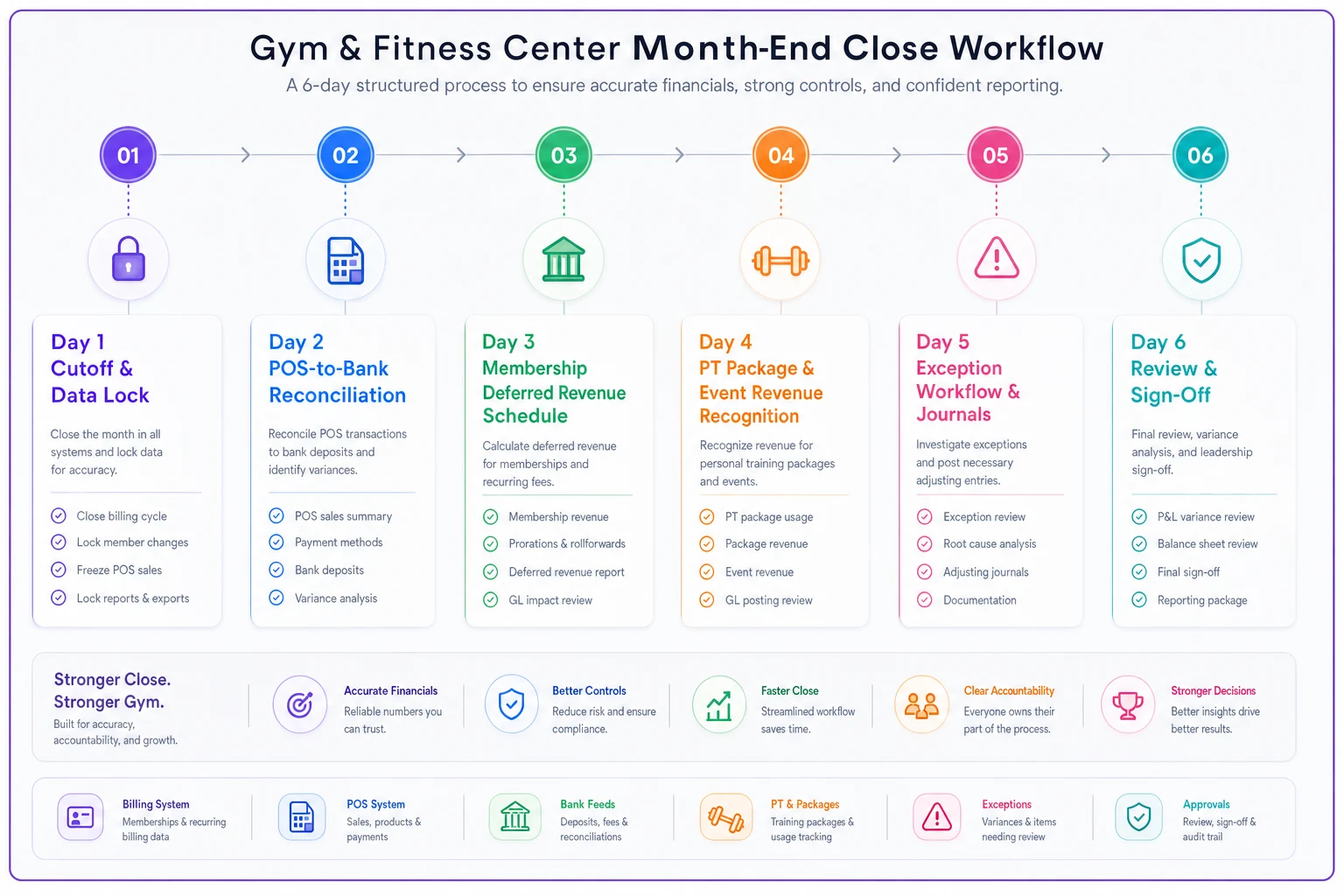
When the tasks are placed on the day the data is ready, the close becomes a set of short checks rather than a week-long reconstruction project.
Day 1: Cutoff and the discipline of locking the period
The single biggest source of "why don't last month's numbers match anymore" is backdated edits. A front-desk staffer issues a refund on the 8th and the system dates it to the last day of the prior month. Now your closed books and your live system disagree, and nobody knows why.
Day 1 is about drawing a hard line. Export the raw data — membership billing runs, POS transaction logs, refund reports, and the bank statement — and treat those exports as the frozen source of truth. If a correction is needed after cutoff, it goes into the current month as an adjustment, never back into a closed period.
A pattern worth noting: gyms that let staff issue refunds and comps without a dated approval trail almost always have the messiest closes. The fix isn't more micromanagement — it's making the system record when a decision was made, separately from when the transaction originally happened.
Day 2: POS and cash — the reconciliation everyone underestimates
Retail, café, guest passes, and drop-ins usually run through a POS that batches to your bank on a one-to-three-day delay. That delay is where money goes missing on paper.
Here's the reconciliation logic that actually holds up:
-
Pull the POS batch report for the full month, grouped by settlement date.
-
Pull the corresponding bank deposits.
-
Match each batch to its deposit. Anything from the last few days of the month that hasn't hit the bank yet becomes deposits in transit — recorded as a receivable, not lost.
-
Subtract processor fees so your recorded revenue is gross, with fees as a separate expense line (not netted invisibly).
-
Investigate any batch that doesn't have a matching deposit within the expected window.
A pretty common example: a gym runs $9k–$11k a month through retail and café. The owner assumes it reconciles because "the money shows up." But when you match batch-by-batch, somewhere between $600–$900 of end-of-month sales are consistently sitting in transit, and processor fees of a few hundred dollars are being quietly netted out — which understates both revenue and expenses. Neither error is huge on its own, but a buyer's accountant will find it in ten minutes, and it makes them wonder what else is loose.
Keep a one-month rolling list of expected but-not-deposited batches to avoid rework each close.
If retail is a meaningful line for you, the margin side matters just as much as the reconciliation — this is where a tight SKU and month-end POS reconciliation approach pays for itself twice.
Day 3: Membership dues and the deferred revenue schedule
This is the section that separates a real close from a fake one.
For monthly members billed and consuming in the same month, recognition is simple — billed is earned. The trouble is everyone else: annual prepays, quarterly plans, and anyone whose freeze or plan change created a partial month.
The rule is straightforward even if the bookkeeping is tedious. Money collected for future access is a liability until the access is delivered. An annual membership sold for $840 in March isn't $840 of March revenue — it's $70 recognized each month across the year, with the remaining balance sitting as deferred.
Build a schedule that tracks:
-
Opening deferred balance
-
New prepayments collected this month (adds to liability)
-
Revenue recognized this month (reduces liability)
-
Closing deferred balance
Then tie that closing balance back to the actual outstanding prepaid contracts. If the schedule says you owe $14k of future access but your active prepaid contracts add up to $16k, you have a $2k gap to explain before you sign off.
Freezes and plan changes are the usual culprits for gaps here. When a member pauses mid-cycle, the proration your system charged and the revenue you should recognize often disagree by a few dollars — and across a few hundred members that adds up. Getting the freeze and proration rules consistent at the policy level is what keeps this schedule from drifting every month.
Day 4: Prepaid PT packages and event revenue
Personal training and small-group packages work the same way as annual memberships: sold as a block, earned session by session. A 20-session package sold for $1,000 is a $1,000 liability the day it's sold. Each completed session moves $50 from liability to revenue.
The failure mode is treating the sale as revenue and never tracking consumption. Two things go wrong:
-
Revenue is overstated in the month of sale and understated afterward
-
You lose visibility into your real outstanding session liability — which is money you owe in service, not cash you get to keep
At month-end, roll forward every open package: sessions sold, sessions delivered, sessions remaining, dollar value remaining. That closing liability is something a lender or buyer will ask about, because it represents future labor cost you've already been paid for.
Events and workshops add a timing wrinkle. Money collected for a competition happening next month is a deposit — a liability — until the event actually runs. The clean rule: event revenue is recognized in the month the event occurs, regardless of when tickets sold. A simple event ledger with the event date, total collected, and recognition month keeps nothing from getting recorded early.
Day 5: The exception workflow
No close is clean. There will always be a deposit that doesn't match, a refund with no approval, a package with more sessions delivered than sold. The difference between a good close and a sloppy one is whether those exceptions go into a queue or get silently "fixed" and forgotten.
An exception workflow is just three columns and a discipline:
-
Log it — every mismatch gets a row
what it is, the dollar amount, the source, the date found.
-
Assign and resolve — someone owns it, investigates, and writes the resolution (adjusting journal, correction next month, or "confirmed correct, here's why").
-
Document the evidence — attach the screenshot, the export, the approval, whatever proves the resolution.
The reason this matters isn't tidiness. Unexplained adjustments are exactly what auditors and buyers dig into. A $300 adjusting entry with a one-line note and a supporting screenshot is a non-event. The same $300 entry with no explanation becomes an hour-long conversation and a note in someone's file that your controls are weak.
Worked journal entry templates
Here are the entries a gym close actually needs, in plain form.
-
Recognizing a portion of an annual membership - Debit Deferred Revenue $70 - Credit Membership Revenue $70
-
Recording POS sales with fees separated - Debit Cash/Bank $9,400 - Debit Processor Fees (expense) $280 - Credit Retail/Café Revenue $9,680
-
Deposits in transit at month-end - Debit Undeposited Funds / In-Transit $740 - Credit Retail Revenue $740
-
Delivering PT sessions from a prepaid package - Debit Deferred PT Revenue $150 - Credit PT Revenue $150
-
Event deposit collected for next month - Debit Cash $1,200 - Credit Event Deposits (liability) $1,200
None of these are exotic. The value is having them written down so the close doesn't depend on one person remembering how it's supposed to work.
The audit-evidence checklist
When someone asks for proof, this is what should already be sitting in a folder for each closed month:
-
[ ] Frozen month-end exports
billing runs, POS logs, refund report
-
[ ] Bank statement and matched deposit reconciliation
-
[ ] Deferred membership revenue schedule with opening/closing balances
-
[ ] PT and package liability roll-forward
-
[ ] Event ledger with recognition months
-
[ ] Exception log with resolutions and attached evidence
-
[ ] All adjusting journal entries with supporting notes
-
[ ] Signed close checklist with reviewer name and date
If you can hand over that folder without a scramble, you're audit-ready. The scramble itself is usually the problem — not the numbers.
A real scenario
A single-location gym doing roughly $85k–$95k in monthly revenue was trying to refinance equipment debt. The lender asked for a deferred revenue schedule and a reconciliation of POS to bank. The owner had neither. Their "close" was downloading a P&L from the billing software.
The gaps weren't fraud — they were timing. Annual memberships were booked as revenue on the sale date, which made January look enormous and the following months look weak. PT packages were recognized up front, so the roughly $22k of unearned sessions sitting on the books wasn't reflected as a liability at all. And POS deposits in transit made December revenue look about $800 low.
It took around three weeks to rebuild six months of closes properly — building the deferred schedules, separating processor fees, documenting the package liability. Once that was done, the smoothed revenue picture was actually stronger for lending purposes because it showed stable recurring revenue instead of a spiky mess. The refinance went through. But the bigger change was what happened the following month: the close took a couple of hours instead of a panic, because the schedules just rolled forward.
When a lightweight close is fine — and when it isn't
Not every gym needs a six-day close. A small studio, mostly monthly billing, no prepaid packages, minimal retail — a simplified close focused on cash-to-billing reconciliation is genuinely enough.
A full close is worth building when:
-
You sell annual or prepaid memberships
-
You run meaningful PT or package revenue
-
You have retail/café volume through a POS
-
You're within 12–24 months of seeking financing or selling
-
You have more than one person touching money
A lighter version is fine when:
-
Revenue is almost entirely same-month monthly dues
-
No prepaid liabilities to track
-
You're not near any financing or sale event
The mistake is assuming you'll build the real version later, when you actually need it. You can't retroactively create clean closes for months that already happened without weeks of reconstruction. The best time to start is a boring month with nothing on the line.
How the close connects to the rest of your operation
A month-end close isn't a standalone accounting chore — it's the audit layer that validates everything else you track. Your deferred revenue schedule is what makes your revenue reporting trustworthy. Your PT liability roll-forward feeds directly into how you think about labor you've already been paid for. And your reconciled cash position is the foundation of any forward planning.
That last one matters more than most owners expect. A close tells you what happened; a rolling 13-week cash model tells you what's coming. But the forecast is only as good as the closed numbers feeding it. A sloppy close means your cash model is confidently wrong. The two reinforce each other — a clean close gives you a trustworthy starting point, and the forecast gives that starting point a purpose.
This is also where operational software quietly earns its place. When your billing system, POS, and package tracking all export clean, dated, frozen data — and when freezes, refunds, and proration follow consistent rules automatically — the close stops being a reconstruction project and becomes a review. You're not hunting for what happened; you're confirming it. The manual matching, the deferred schedules rolling forward, the exception logging — that can happen in the background instead of eating your first week every month.
The takeaway
Gym books break in predictable places — deferred memberships, POS timing, prepaid packages, and event deposits. A real close is just a disciplined way of catching those four before someone else does. Spread the work across the first business week, lock the period on Day 1, keep an exception queue instead of silent fixes, and file the evidence as you go.
Do that consistently, and the next time a lender, a buyer, or an auditor asks for numbers, you won't be scrambling. You'll just open the folder.
Gym books break in predictable places — deferred memberships, POS timing, prepaid packages, and event deposits. A real close is just a disciplined way of catching those four before someone else does. Spread the work across the first business week, lock the period on Day 1, keep an exception queue instead of silent fixes, and file the evidence as you go.
Do that consistently, and the next time a lender, a buyer, or an auditor asks for numbers, you won't be scrambling. You'll just open the folder.
Ready to elevate your gym operations?
Join 2,000+ gyms using Gymioly to reduce admin overhead, improve member experience, and grow revenue.