
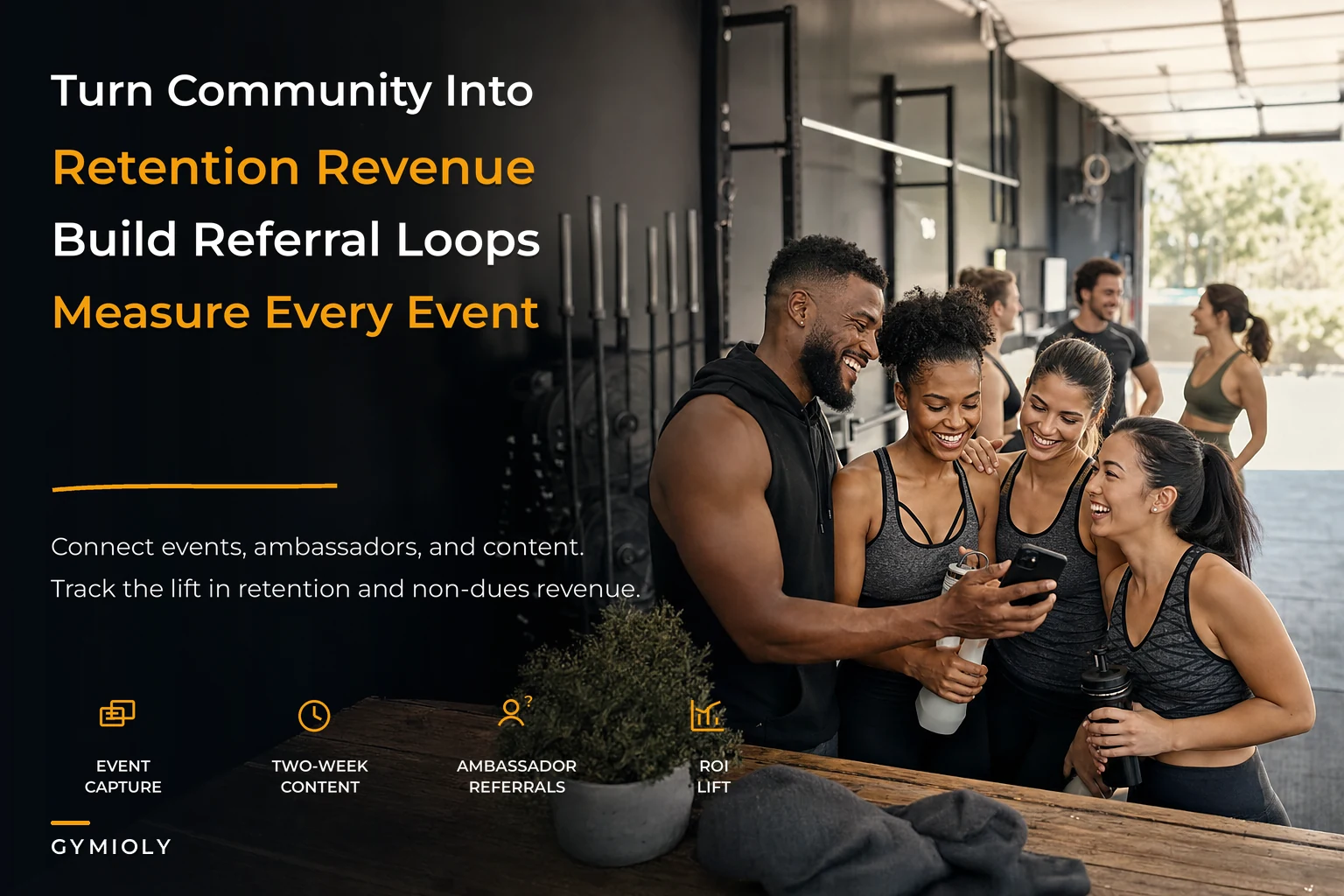

Most gyms treat "community" like a vibe. It's the thing you point to when your NPS survey comes back nice, or the reason a member says they stay even though the treadmills are older than half your staff. But when you ask an owner what their community costs and what it returns, you usually get silence. That gap is the whole problem.
A gym community growth strategy isn't a Facebook group and a member appreciation day. It's a system with inputs (money, staff hours, floor space), a middle layer (events, ambassadors, content), and outputs that show up on your P&L (retention, referrals, non-dues revenue). When those three layers aren't wired together, you get activity without ROI — a lot of effort, a lot of goodwill, and no clear line back to revenue.
This is a pillar piece on how to build that wiring: an ROI model, investment tiers, a measurement plan, and scaling rules. By the end, you should be able to look at any community spend and answer one question — what did that dollar do?
The reason community spend feels unmeasurable
Community breaks down financially for a boring reason: the cost and the payoff live in different places and different timeframes.
You spend on an event in March. The retention benefit shows up as a member not cancelling in August. Nobody attributes an August save to a March event, so the event gets remembered as "fun but expensive." Multiply that across a year and community becomes the first line item cut when cash gets tight — even though it might be one of your highest-return activities.
The other issue is that community outputs are indirect. Events don't make money directly (usually). They increase the odds that a member attends more, refers a friend, or buys into a paid program. Those second-order effects are real, but they require a measurement chain to see. Without that chain, community looks like a cost center. With it, you can defend the budget and — more importantly — decide what to scale.
Gyms with "great community" and gyms with "expensive community we can't justify" are often doing nearly identical activities. The difference isn't the events. It's whether anyone connected those events to a number.
The three engines and how they connect
Community isn't one thing. It's three engines that feed each other, and most gyms only run one or two.
End appointment chaos and boost attendance.
Gymioly streamlines booking, confirms sessions, and manages memberships effortlessly.
- Unified class and membership management
- Automated member notifications
- Trainer scheduling and availability
No credit card required
Events create shared experience and reasons to show up beyond the workout. They're your top-of-funnel for belonging.
Ambassadors (your most engaged 3–8% of members) turn that experience into reach — referrals, social proof, peer accountability. They're your distribution.
Content is the connective tissue. It documents events, features ambassadors, and gives lapsing members a reason to re-engage without paying for another ad. It's your compounding asset.
The connection people miss: these engines only produce ROI when they hand off to each other. An event with no content afterward is a one-time cost. Content with no ambassadors amplifying it is a post nobody sees. Ambassadors with no events to invite people to are just enthusiastic members with nowhere to point their energy.
The workflow in practice:
An event happens → staff and ambassadors capture 4–6 pieces of raw content (photos, short clips, a testimonial) → content gets published over the next two weeks → ambassadors share it, which drives referral conversations → new trials show up citing "my friend posted about your thing" → those trials convert better because they arrive warm → existing members have a reason to stay engaged, which is the retention payoff.
A visual of that workflow:
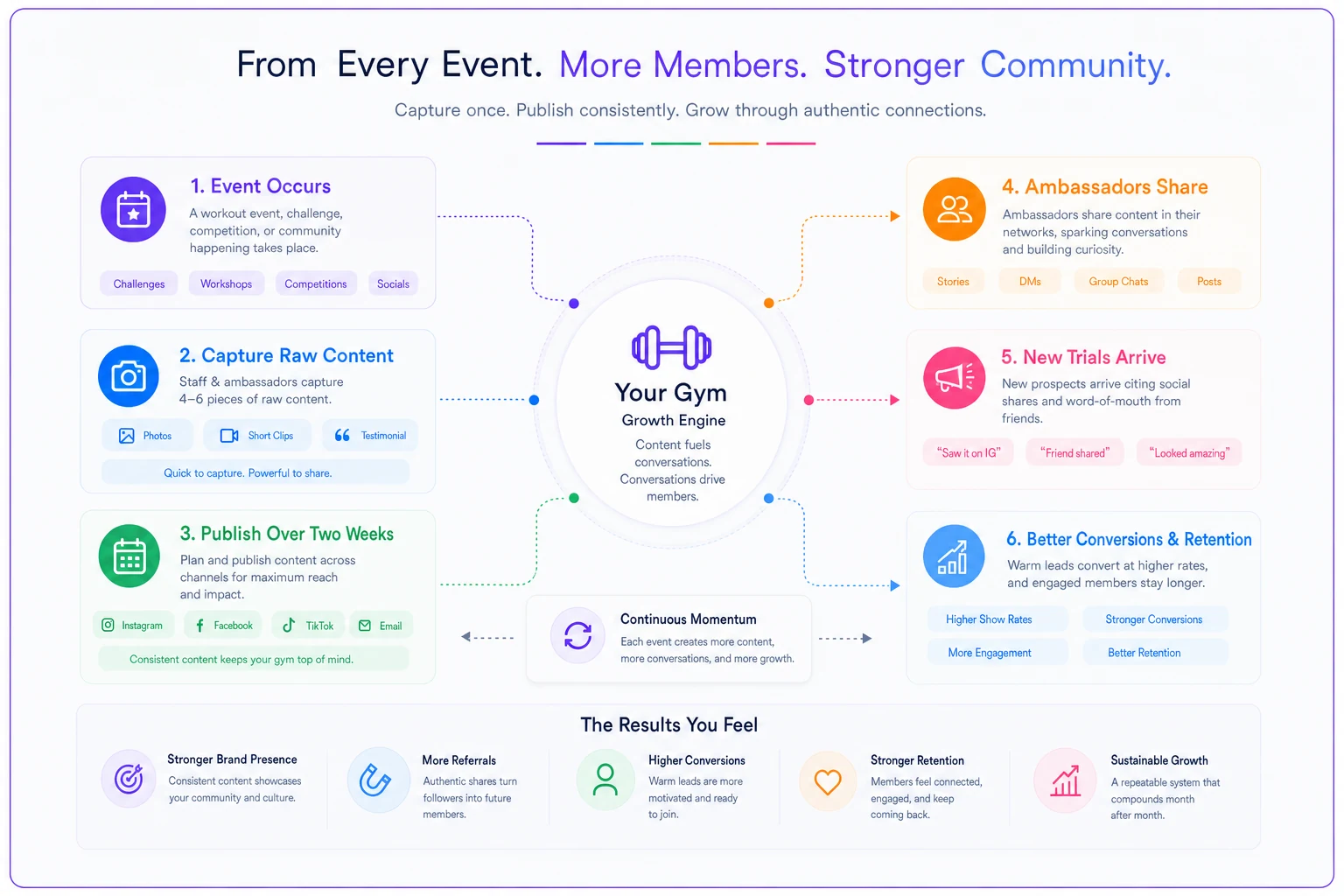
Break any link in that chain and the ROI collapses. Most gyms break the "capture" and "publish" links because they're busy actually running the event. That's the most common failure point, and it's operational, not strategic.
The Community ROI model
The ROI model has three return streams, and you should track all three — a single event usually touches more than one.
Stream 1 — Retention value. If community engagement reduces monthly churn even slightly, the value compounds fast. A member who stays an extra four months at $80/month is $320 you didn't have to re-acquire.
Stream 2 — Referral value. Community-driven referrals convert better and cost less than paid acquisition. The value is the lifetime margin of members you wouldn't have gotten otherwise.
Stream 3 — Non-dues revenue. Events and programs members pay to attend, plus the halo effect on retail, PT packages, and paid series.
A simplified worked example. Say you run a quarterly member challenge that costs roughly $1,200 all-in — staff time, small prizes, printed materials, a bit of food.
| Return stream | Assumption | Value |
|---|---|---|
| Retention | 6 members retained ~3 extra months at $80 | ~$1,440 |
| Referrals | 4 referred trials, 2 convert, ~$700 annual margin each | ~$1,400 |
| Non-dues | 18 members buy a $25 challenge add-on | $450 |
| Total return | ~$3,290 | |
| Cost | $1,200 | |
| ROI | ~2.7x |
Haircut those numbers by 40% for optimism and you're still above break-even. But notice — the retention and referral streams are estimated because they require the measurement plan below to become real. That's the part gyms skip, and it's why the same event that returns 2.7x at one gym gets cut at another.
Investment tiers: how much to spend and when
You shouldn't spend the same on community at 180 members as you do at 600. Tiering the investment keeps you from over-building before you have the base to support it — and from under-investing once community is clearly working.
Tier 1 — Foundation (roughly under 250 members). Budget around $200–$400/month including staff time. One recurring event type. Identify your most engaged members informally. Content is low-production — phone photos, a monthly member spotlight. The goal here isn't ROI yet, it's building the habit and the raw material.
Tier 2 — System (roughly 250–450 members). Budget $500–$900/month equivalent. Formalize the ambassador group with actual roles and light perks. Establish a content cadence of 2–3 published pieces per week. Add one paid non-dues event per quarter. This is where you start measuring seriously, because you finally have enough volume for the numbers to mean something.
Tier 3 — Engine (roughly 450+ members). Budget scales with returns, not a fixed cap. Multiple event tracks, a structured ambassador program with tiers, content that's genuinely a marketing channel. At this point community should be a measurable acquisition and retention driver, defended by data.
The mistake is jumping tiers to skip the boring foundation. A gym at 200 members that launches a formal ambassador program with a points ledger and quarterly paid events usually ends up with an over-engineered system serving 12 people. Build the base first.
Measurement plan: making indirect returns visible
This is the part that turns "nice vibe" into a defensible line item. You don't need perfect attribution — you need good enough attribution to make decisions.
-
Event attendance rate as a % of eligible members (tells you reach and relevance)
-
Engaged-member churn vs. non-engaged churn — the single most powerful number you can produce
-
Referral source tagging — when a trial signs up, capture "how did you hear about us" as structured data, not a free-text field nobody reviews
-
Content-to-conversation rate — rough, but track when content posts correlate with trial inquiries
-
Non-dues event revenue and margin — the only fully direct number, so nail it
The one metric that changes everything is engaged vs. non-engaged churn. If you can show that members who attend at least one community event per quarter churn at, say, 2.1% monthly versus 3.8% for non-attendees, you've just quantified the entire program. That gap is your retention ROI. Everything else supports it.
To get that number you need clean data — event check-ins tied to member records, churn tracked by cohort. This is where a lot of gyms stall, because the event sign-up lives in a Google Form and the membership data lives somewhere else and nobody ever joins them. A member management platform that keeps event attendance, membership status, and referral tags in one record makes this a report instead of a weekend project. The tech isn't the strategy — but without connected data, the measurement plan stays theoretical.
A real scenario
A single-location strength gym, around 380 members, was running events roughly monthly but had never tied them to anything. Turnover felt manageable but was quietly running around 3.6% monthly, and paid acquisition costs were creeping up.
They didn't add more events. They did three things: tagged every event attendee against their member record, started capturing referral source as a required field at trial sign-up, and committed to publishing content from every event within ten days.
Over about five months, the picture got clear. Members who'd attended two or more events were churning around 2%, while non-attendees sat near 4%. Referral-sourced trials, which had been maybe 15% of new leads, climbed toward 30% once ambassadors had content to actually share. A quarterly paid workshop that had been breaking even started clearing a few hundred dollars once they treated it as a product with follow-up.
Nothing dramatic happened. No revenue doubled. But they went from "community is something we do" to "community reduces churn by roughly 1.5 points and supplies about a third of our referrals" — and that sentence is what protected the budget when spring cash got tight.
Scaling rules: what to add, and when to stop
Growth breaks community programs in predictable ways. The event that felt intimate at 150 members feels chaotic at 500. The ambassador who was a natural leader at a small gym gets overwhelmed once you've added 200 more members around them. Scale requires rules, not just enthusiasm.
-
Scale content capacity before scaling events. More events without more capture-and-publish capacity just produces more untracked cost. Fix the bottleneck first.
-
Cap ambassador span. One ambassador shouldn't be responsible for more than roughly 25–30 members. Beyond that, add ambassadors, don't add load.
-
Kill events that don't clear their return stream after two runs. If an event isn't moving attendance, referrals, or non-dues revenue after two attempts, it's a hobby, not a program.
-
Graduate free events into paid ones once demand is proven. If a free workshop consistently fills, that's a signal there's non-dues revenue on the table.
-
Re-measure engaged-vs-non-engaged churn every quarter. The gap will drift as your member base changes. Don't run last year's numbers.
The deeper pattern: community that scales is community that got systematized early, while it was small enough to fix cheaply. Gyms that wait until 500 members to build the measurement layer are trying to install plumbing after the house is finished.
Where the engines reinforce each other at scale
Once you're past the foundation tier, the three engines stop being separate line items and start subsidizing each other.
Ambassadors don't just refer — they help run events, which drops your staff cost per event. Content doesn't just market — it becomes onboarding material that helps new members feel like insiders faster, which improves early retention. Events don't just build belonging — they generate the content and give ambassadors something worth talking about.
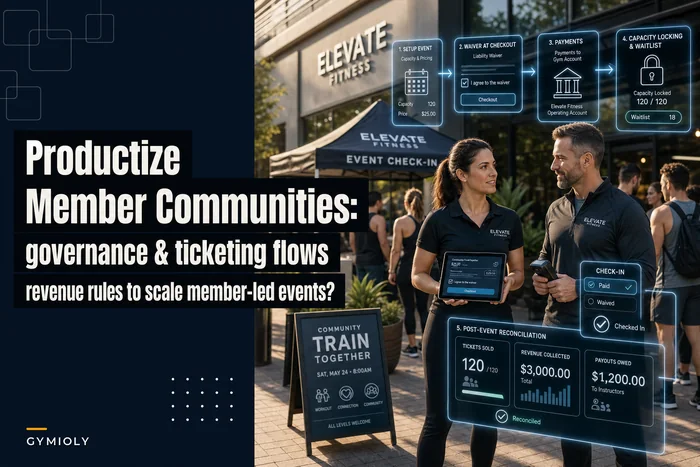
If you're formalizing member-led events, the governance side matters more than the vibe — who's allowed to run what, how tickets and liability work, how revenue gets split. There's a full breakdown in productizing member communities with governance, ticketing flows, and revenue rules that pairs directly with this ROI framing.
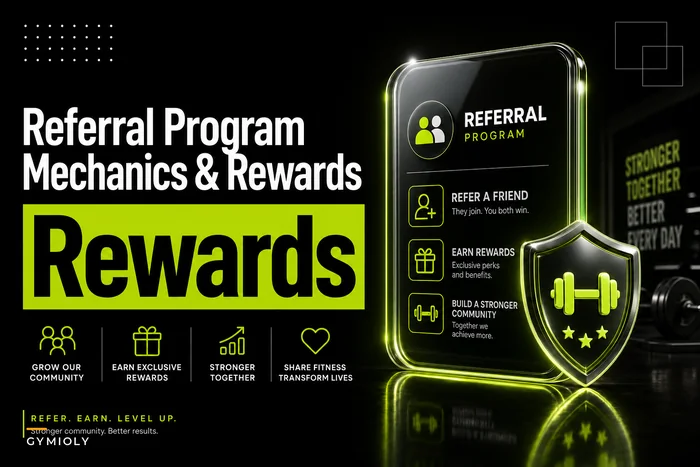
The referral engine deserves its own discipline too, because community-driven referrals are exactly where reward fraud and messy accounting creep in once volume grows. If you're planning to lean on ambassadors for referrals, set up the referral program mechanics — antifraud rules, reward accounting, and reconciliation before you scale it, not after.
Retention through community is also closely tied to how your programming is structured. A great event calendar won't save a class experience that doesn't hook people — the two work together. The logic behind designing 4/8/12-week series with cohort onboarding and conversion triggers is essentially the same retention machine applied to programming instead of events.
When a community investment makes sense — and when it doesn't
When it makes sense: You have a stable membership base past the churn-heavy early months, your onboarding already works, and your core product is solid. Community amplifies a good gym. It's leverage on something that's already functioning.
When it's a bad idea: Your fundamentals are broken. If members are leaving because classes are overcrowded, equipment is unreliable, or the front desk is a mess, community spend is lipstick. Fix the leaks first. No amount of member appreciation covers for a gym people don't actually enjoy using.
Who should hold off: Owners who can't currently answer "what's my monthly churn by cohort?" If you don't have that number, you can't measure community ROI, which means you'll be spending blind. Get your basic membership and attendance data clean first. The measurement plan in this article assumes you can actually pull those reports.
The bottom line
Community stops being a soft, unjustifiable expense the moment you connect the three engines to three return streams and actually measure the middle. Events, ambassadors, and content aren't separate initiatives — they're one loop, and the loop only produces ROI when the handoffs work and someone is tracking engaged-versus-non-engaged churn.
Start where your member count says you should. Measure the one metric that matters most. Scale with rules, not vibes. Do that, and the next time cash gets tight and someone eyes the community budget, you'll have a number instead of a shrug.
Ready to elevate your gym operations?
Join 2,000+ gyms using Gymioly to reduce admin overhead, improve member experience, and grow revenue.