



Most gyms don't have a testing problem. They have a test-tracking problem. Somebody tried a new class format in March, the front desk changed the trial length in June without telling anyone, and a trainer started offering ad-hoc discounts to fill Tuesday mornings. Six months later revenue looks flat, nobody can explain why, and there's no clean record of what was actually running when.
That's the real cost of ungoverned experimentation. Not the failed tests — the invisible ones. The changes that happen without a plan, run without a stop condition, and blend into your P&L so thoroughly you can never untangle cause from noise.
Governance is what separates "we tried a bunch of stuff" from "we know exactly what moved the needle and we can do it again." For a single-site gym that means a portfolio view of what you're testing, a way to prioritize, evidence requirements before anything scales, and hard rollback triggers tied to your accounting so a bad test can't quietly bleed for months.
Here's how the whole system fits together — and where it usually falls apart.
Why gym testing turns into chaos
The gym business is unusually prone to messy experimentation because so many people can change so many things independently.
A group fitness lead can tweak class times. A membership advisor can adjust a promo on the fly to close a sale. A trainer can restructure PT packages. Marketing spins up a new intro offer. Each of these is a change to a live system that affects billing, attendance, staffing, and retention — but none of them get treated like experiments. They get treated like decisions.
The pattern repeats constantly: three or four changes land in the same 60-day window, results come in mixed, and the owner has no way to attribute anything. Did retention dip because the new 7-day trial attracted worse-fit leads? Because the class schedule shifted and regulars lost their favorite slot? Because a billing change caused more failed payments? All three happened. You can't A/B your way out of confounded tests you didn't know were running.
The second problem is that gyms rarely define what "done" looks like before starting. A test with no decision cutoff never ends — it just becomes the new normal by default. Often a worse normal nobody actually chose.
Good gym experimentation governance solves both: it forces every change into a visible portfolio, and it forces every test to declare its success criteria and kill conditions up front.
The experiment portfolio map
Before you prioritize anything, you need to see everything. A portfolio map is just a running inventory of every active and proposed test, organized so you can spot collisions.
End appointment chaos and boost attendance.
Gymioly streamlines booking, confirms sessions, and manages memberships effortlessly.
- Unified class and membership management
- Automated member notifications
- Trainer scheduling and availability
No credit card required
At minimum, track each experiment by:
-
Domain it touches — pricing, scheduling, retention, non-dues revenue, staffing
-
Systems it affects — billing, POS, access control, CRM messaging
-
Member cohort exposed — new joins, specific class attendees, PT clients, a location zone
-
Start date and hard end date
-
Primary metric and the guardrail metrics it must not break
-
Owner — one named person, always
The map's real job is collision detection. If two tests hit the same cohort's billing simultaneously, you've poisoned both. If three scheduling changes overlap, your attendance data is garbage for the quarter. A portfolio view makes those overlaps obvious before launch, not after.
One thing worth flagging: gyms almost always underestimate how many "small" tweaks are actually experiments. That free-week extension the desk offers "sometimes" is an untracked variable messing with your intro-offer numbers. If it changes member behavior or touches money, it goes on the map.
Prioritization: what to test first
Once you can see everything, you have to decide what's worth the attention. Most owners over-test low-leverage stuff — button colors on the booking page — and under-test the things that actually move money: pricing architecture, retention triggers, non-dues bundles.
| Factor | What you're judging | Weight |
|---|---|---|
| Revenue/retention impact | If it works, how much does it actually move? | High |
| Confidence | Do we have a real reason to think it'll work? | Medium |
| Effort & risk | Staff time, system changes, downside if it flops | Inverse |
Score, then sort. High-impact and low-effort runs now. High-impact but high-risk goes through a tighter evidence process. Low-impact stuff mostly shouldn't run at all — it consumes governance bandwidth you'll want for the tests that matter.
The mistake is treating prioritization as a one-time exercise. Your portfolio shifts constantly. A cash crunch changes what "high impact" means. A staffing shortage changes what "low risk" means. Re-score monthly.
If you're testing promotions specifically, the mechanics of cohort design and decision cutoffs deserve their own treatment — we went deep on that in our guide to testing promotions without creating churn.
The evidence pack: what a test must prove before it scales
This is the piece almost everyone skips, and it's the one that keeps you safe.
An evidence pack is the standardized bundle of proof a test has to produce before it graduates from "running on a small cohort" to "rolled out to everyone." No pack, no rollout. It sounds bureaucratic for a single site — it isn't. It's the difference between scaling a real win and scaling a coincidence.
A workable evidence pack for a gym includes:
-
The hypothesis as written at launch — not rewritten after seeing results
-
Cohort definition — exactly who was exposed, and the control group
-
Sample size and duration — did it actually run long enough to mean anything?
-
Primary metric result with the pre-declared success threshold
-
Guardrail metrics — did retention, no-shows, refunds, or failed payments move the wrong way?
-
Accounting reconciliation — does the revenue the test claims it made match what actually hit your books?
That last point is where a lot of "wins" fall apart. A trainer package test looks great on bookings but never reconciles against deposits collected. A promo shows more joins but the discount math means contribution margin actually dropped. Tie every experiment's claimed result back to real numbers before you believe it. The reconciliation discipline covered in the gym dashboard data governance guide is what makes evidence packs trustworthy instead of decorative.
Cohort gates and rollback triggers
Governance isn't just about deciding to scale — it's about being able to stop fast.
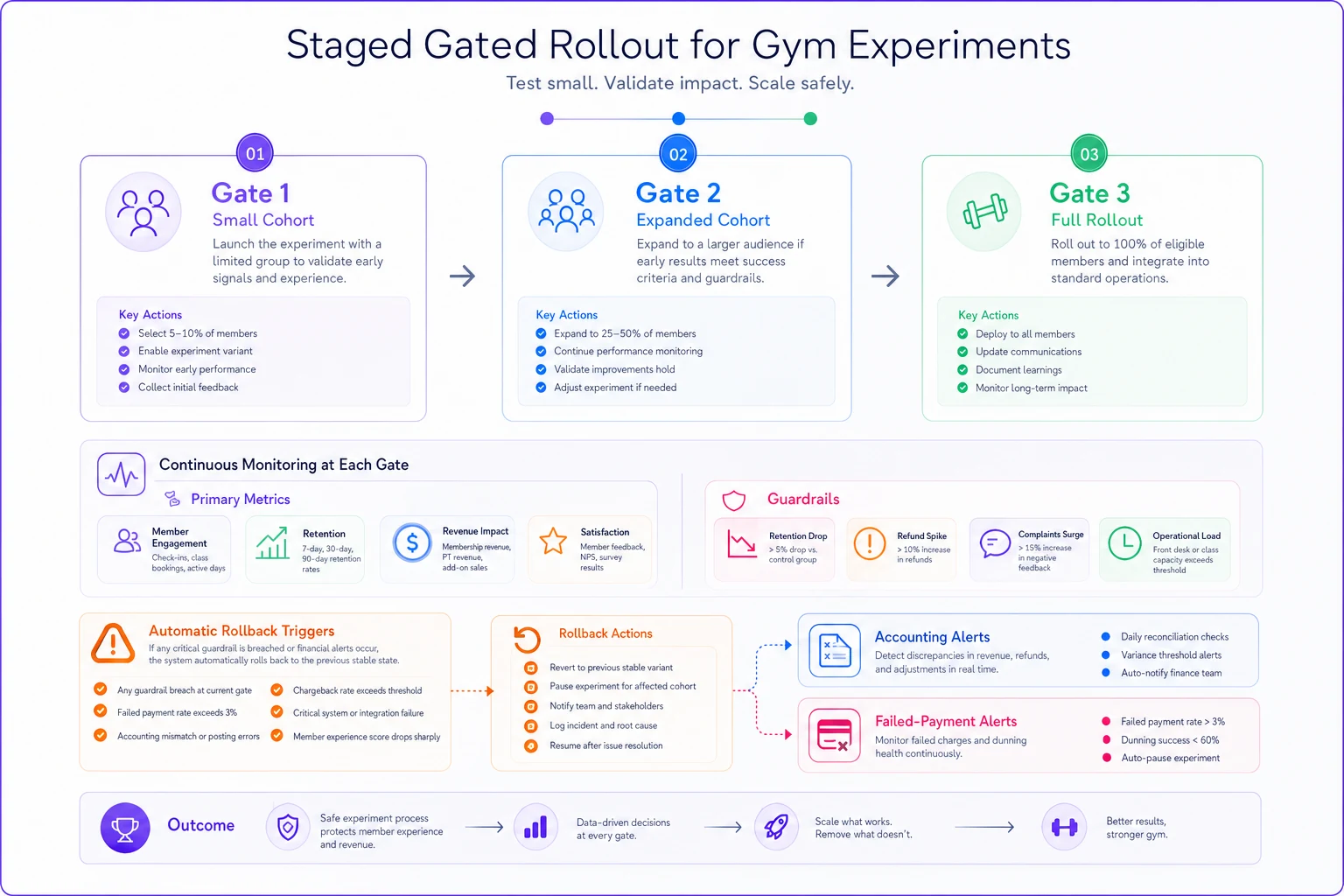
Cohort gates are the staged rollout steps. You don't go from 20 members to your whole base overnight. A typical gate structure:
-
Gate 1 small cohort (one class time, or new joins for two weeks)
-
Gate 2 expanded cohort (all new joins, or one member segment) once Gate 1 clears its evidence pack
-
Gate 3 full rollout, only after Gate 2 holds up
Each gate has to pass on both its primary metric and its guardrails before the next one opens. This is boring on purpose. Boring rollouts don't blow up your billing.
-
Failed-payment rate on the test cohort rises above your normal baseline by a set margin
-
Refund or dispute volume crosses a threshold
-
30-day retention in the test cohort drops below control
-
Any KPI drifts past a defined band versus the pre-test period
That last one — KPI-drift control — is the safety net for the slow bleeds. Not the dramatic failures, but tests that quietly shave a couple points off retention or margin every month. Set a band around your key metrics; if a test pushes one outside that band, it trips. This is what catches the "worse normal" before it becomes permanent.
Here's a quick visual you can use to align the team on gate progression and automatic rollback points.
This is what catches the "worse normal" before it becomes permanent.
A real scenario
A single-location gym, roughly 900 members, decided to test a restructured PT package: fewer sessions per pack but a higher per-session rate, aimed at improving trainer utilization.
Before governance, they'd have just switched everyone over. Instead they gated it. Gate 1 ran on new PT clients only for three weeks — around 40 people. Bookings looked strong. But the evidence pack's reconciliation step caught something: deposit collection on the new packs was lagging, and refund requests ticked up because clients felt locked into fewer, pricier sessions.
The KPI-drift trigger on refund rate tripped at Gate 1. They rolled back before it ever touched the broader base. Net damage: a few weeks of a small cohort and roughly $1,200–$1,500 in adjustments, instead of a base-wide mess that could've cost multiples of that and months of cleanup.
The test "failed" — but the governance succeeded. They learned the price structure was wrong, kept the damage contained, and redesigned it. The redesign, gated the same way, held up and rolled to full base a quarter later.
Failed tests are cheap when they're caught at Gate 1. They're expensive when they run unmonitored to Gate 3.
When rigorous governance makes sense — and when it doesn't
When it makes sense:
-
Anything touching billing, pricing, or contracts
-
Tests exposed to a large share of members
-
Changes with slow-burn effects on retention
-
Non-dues revenue experiments where margin math is easy to get wrong — the unit-economics discipline in validating non-dues revenue pairs directly with an evidence-pack approach
When it's overkill:
-
Cosmetic changes with no money or retention exposure
-
Reversible, low-blast-radius tweaks a single staffer can undo instantly
-
Content and messaging tone tests (govern the offer, not the wording)
Who should NOT try to run all of this at once: A gym doing its first-ever structured test. Don't build a nine-gate portfolio system on day one. Start with one test, one evidence pack, one rollback trigger. Get comfortable with the discipline on something small before you scale the process itself.
Where software quietly helps
You can run all of this in a spreadsheet — plenty of gyms do at the start. It works until you have more than a couple tests running and the manual reconciliation eats your week.
The friction shows up in three places: keeping the portfolio map current, catching cohort collisions before launch, and monitoring KPI drift in real time instead of noticing it at month-end. That's where an operational platform with AI-assisted monitoring earns its keep — flagging when a test cohort's failed-payment rate drifts out of band, surfacing overlapping experiments touching the same billing group, and pulling the accounting reconciliation into each evidence pack automatically so you're not hand-matching numbers. The goal isn't to replace your judgment. It's to make sure a rollback trigger actually fires the day it's supposed to, not three weeks later when you finally look.
Automate accounting reconciliation into your evidence packs to avoid manual errors and speed rollbacks.
The goal isn't to replace your judgment. It's to make sure a rollback trigger actually fires the day it's supposed to, not three weeks later when you finally look.
The bottom line
Experimentation governance isn't about slowing your gym down. It's about being able to move fast without losing the thread. A visible portfolio means no more invisible, confounded tests. Prioritization means you spend attention where it pays. Evidence packs mean you scale wins, not coincidences. Cohort gates and rollback triggers mean a bad test costs you a week and a small cohort — not a quarter and your whole member base.
Build the discipline small, tie every test back to your actual books, and give every experiment a clear way to end. Do that, and testing stops being a source of mystery in your P&L and becomes something you can actually rely on.
Experimentation governance isn't about slowing your gym down. It's about being able to move fast without losing the thread. A visible portfolio means no more invisible, confounded tests. Prioritization means you spend attention where it pays. Evidence packs mean you scale wins, not coincidences. Cohort gates and rollback triggers mean a bad test costs you a week and a small cohort — not a quarter and your whole member base.
Build the discipline small, tie every test back to your actual books, and give every experiment a clear way to end. Do that, and testing stops being a source of mystery in your P&L and becomes something you can actually rely on.
Ready to elevate your gym operations?
Join 2,000+ gyms using Gymioly to reduce admin overhead, improve member experience, and grow revenue.