


Most gym owners don't have an operations problem. They have a dependency problem. The business technically works — members show up, payments clear, classes run — but almost every decision, exception, and fire still routes back through the owner. Take that person out for two weeks and the whole thing wobbles.
That's not a character flaw or a sign you hired badly. It's a predictable stage of growth. The trouble is most owners stay stuck in that stage for years because nobody hands them a map showing what "the next level" actually looks like operationally.
This is that map. Four stages, what breaks at each one, what to invest in and in what order, roughly how long the payback takes, and the decision gates that tell you when you're actually ready to move up. It's less about ambition and more about sequencing — because doing Stage 3 things while you're still operating like Stage 1 is how gyms burn cash and confuse their teams.
Why gyms get stuck between stages
The reason maturity stalls isn't ignorance. It's that each stage feels fine right up until the volume tips it over.
A founder-run gym with 250 members feels manageable. The owner knows every regular by name, remembers who's on a freeze, and can eyeball the schedule to catch a coverage gap. That personal knowledge is genuinely an asset — until it becomes the only system that exists. Cross 400, 500 members and the human RAM that held everything together starts dropping information. Billing errors slip through. A trainer quits and takes three years of client context with them. The owner starts working more hours to compensate, which is exactly the wrong direction.
What tends to happen across small operators is that the jump between stages almost always requires giving something up before it feels safe. You have to document a process you currently do from memory. You have to let a manager make a call you'd normally make. Owners who won't let go early enough end up forced to let go later, during a crisis, which is far more expensive.
The core pattern: capability has to be built one stage ahead of where your volume actually is. If you wait until you're drowning to build systems, you're building them while drowning.
The four stages at a glance
Before getting into each stage individually, it helps to see the full picture side by side. Owners tend to underestimate how different each stage actually is — not just in complexity, but in what you're spending money on and what you're trying to protect against.
End appointment chaos and boost attendance.
Gymioly streamlines booking, confirms sessions, and manages memberships effortlessly.
- Unified class and membership management
- Automated member notifications
- Trainer scheduling and availability
No credit card required
| Stage | What it feels like | Primary risk | What you're investing in | Rough payback |
|---|---|---|---|---|
| 1. Founder-run | You are the system | Owner burnout, single point of failure | Documentation, basic tooling | 1–3 months |
| 2. Documented | Written SOPs exist | SOPs ignored, inconsistent execution | Enforcement, roles, accountability | 3–6 months |
| 3. Systemized | Processes run without you | Coordination gaps between departments | Data flow, automation, dashboards | 4–9 months |
| 4. Scalable | Repeatable across people/locations | Governance drift, quality dilution | Standards, audits, leadership layer | 6–12 months |
The mistake most owners make is self-diagnosing one stage higher than reality. "We have SOPs" is only Stage 2 if people actually follow them. A binder nobody opens is still Stage 1 with extra paperwork.
Stage 1: Founder-run — get it out of your head
What this stage actually is: the business lives in your memory and your phone. There's no real separation between you and the operation.
Nothing is wrong with starting here — every gym does. The failure mode is staying here past roughly 300 members, because the human brain is a terrible database and an even worse redundancy plan.
Priority investments, in order:
-
Write down the money-losing exceptions first. Not the whole operation — start with the workflows where mistakes cost cash. Failed payment handling, freezes and prorations, cancellation rules. These are where founder-run gyms leak the most.
-
Get one source of truth for member data. If member info lives across a spreadsheet, your POS, and text messages, you're already in trouble. Consolidate before you document anything else.
-
Basic scheduling and billing tooling that doesn't depend on you personally approving every change.
Expected ROI timeline: fast. Documenting your billing exception process alone usually pays for itself within a month or two just by cutting the errors you're currently eating.
Decision gate to move to Stage 2:
-
Could a competent new hire handle a member freeze correctly using only your written process, without asking you?
-
Is your member data in one place both you and staff can access?
-
Have you documented at least your top five most frequent operational tasks?
If you can't answer yes to all three, you're not ready to move up — you're ready to keep documenting.
Governance checklist for Stage 1:
-
[ ] Top 5 recurring tasks written down
-
[ ] Single member database established
-
[ ] Billing exceptions documented with exact rules
-
[ ] One backup person knows how to open/close and handle emergencies
-
[ ] Owner has identified which decisions only they currently make
If you can't answer yes to all three, you're not ready to move up — you're ready to keep documenting.
Stage 2: Documented — make the SOPs actually stick
A huge number of gyms plateau right here. They've got SOPs. They spent a weekend writing them. And then nothing changes, because writing a process and operating a process are completely different things.
The gap at Stage 2 isn't documentation — it's enforcement and ownership. A process without a named owner and a check for compliance is just a suggestion.
What breaks here: inconsistency. One front-desk person follows the cancellation script, another improvises. Two members in the same situation get two different outcomes, and now you've got a fairness problem and a chargeback problem. The owner, meanwhile, thinks the system is "done" because it exists on paper.
Priority investments, in order:
-
Assign an owner to every core process. Not "the team" — a person. Onboarding has an owner. Retention outreach has an owner. Payment recovery has an owner.
-
Build role clarity. People follow processes when they understand what they're accountable for. This is also where hiring scorecards and structured onboarding for staff start earning their keep.
-
Add lightweight compliance checks. A weekly five-minute review
are the SOPs being followed? Where did we deviate and why?
Real scenario: A single-location strength gym, around 480 members, had written SOPs for months but was still eating roughly $1,800–$2,400 a quarter in avoidable billing losses. The documents existed; nobody owned the follow-up. They assigned failed-payment recovery to one front-desk lead, gave her a simple daily checklist, and added a weekly review. Within about two months the quarterly leakage dropped to a few hundred dollars. The SOP hadn't changed. The ownership did.
Decision gate to move to Stage 3:
-
Does every core process have a named owner who is measured on it?
-
Can you point to evidence — not vibes — that SOPs are followed more than 80% of the time?
-
Are exceptions being logged instead of silently handled?
Governance checklist for Stage 2:
-
[ ] Every core process has one accountable owner
-
[ ] Roles and responsibilities documented per position
-
[ ] Weekly compliance/deviation review in place
-
[ ] Staff onboarding includes SOP training, not just shadowing
-
[ ] Exceptions get logged, not improvised
The SOP hadn't changed. The ownership did.
Stage 3: Systemized — connect the parts so they talk to each other
Stage 2 gets each department working consistently on its own. Stage 3 is about the connections between them — because that's where growing gyms quietly hemorrhage efficiency.
Think about how information actually moves through your operation. A member joins. Sales knows. Does the onboarding sequence trigger automatically, or does someone have to remember to start it? A member's attendance drops off. Does that signal reach whoever handles retention, or does it just disappear? A payment fails. Does billing, the front desk, and the member's trainer all end up with the same picture, or three different ones?
The core Stage 3 problem is coordination. Individual processes work, but the handoffs between them are manual — and manual handoffs are where things fall through at volume.
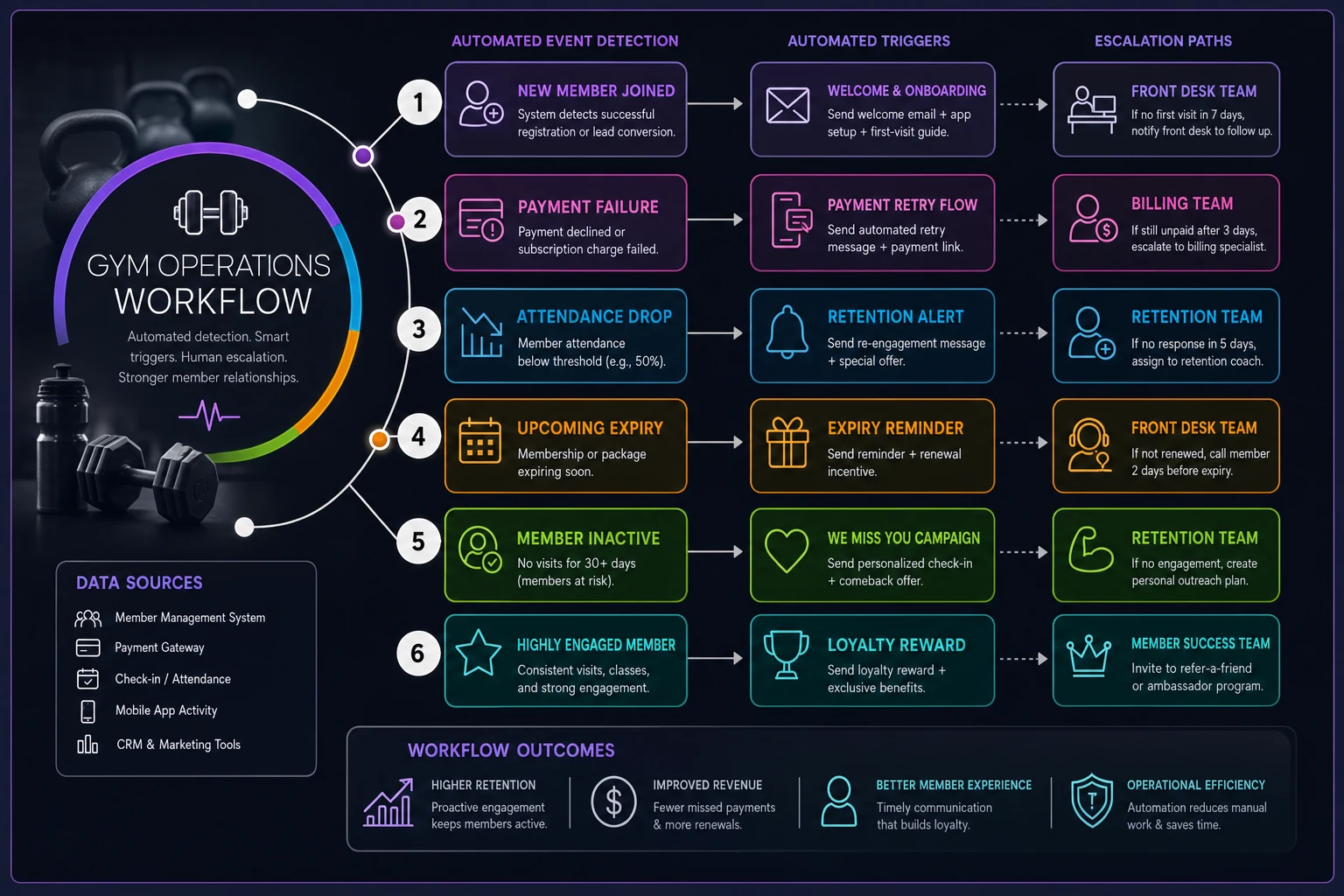
A workflow example: In a Stage 2 gym, when a member's card fails, the front desk finds out at their next check-in — awkwardly — and manually starts a recovery conversation. In a Stage 3 gym, the failed payment is detected the day it happens, the member automatically gets a friendly retry message, the front desk sees a flag on their account before the member walks in, and if it's not resolved within a set window it escalates to a specific person. Same event — but one version depends on someone remembering, and the other doesn't.
This is where AI-assisted operational platforms start doing real work — not as a gimmick, but as connective tissue. The value isn't "AI" for its own sake. It's that the boring, error-prone handoffs — triggering onboarding, flagging at-risk attendance patterns, routing a billing exception to the right person — stop depending on human memory. The system watches the signals and moves information where it needs to go, so your team spends time on members instead of on remembering to update three different places.
Here's a simple workflow visualization.
Priority investments, in order:
-
Dashboards that surface the right numbers daily, so decisions stop being reactive. A clear measurables hierarchy matters more than adding more tools.
-
Automate the handoffs, not the whole job. Onboarding triggers, at-risk member alerts, payment recovery flows, freeze processing.
-
Reconciliation and data hygiene so the automated system is acting on trustworthy data.
Expected ROI timeline: medium. Automating handoffs pays back over a few months, but the bigger return is the owner's time — this is often the first stage where the founder genuinely steps back from daily firefighting.
This is also the stage where turning member retention into a real, staffed function starts to pay off. If you want the deeper version of that, the breakdown on how to turn member success into a repeatable function covers the hiring, rollout, and automation guardrails specifically.
Decision gate to move to Stage 4:
-
Do key member events — join, drop-off, payment failure — trigger the right response without someone manually kicking it off?
-
Can you run the gym for two weeks without being physically present?
-
Do you make weekly decisions from a dashboard rather than from gut feel?
Governance checklist for Stage 3:
-
[ ] Core cross-department handoffs are automated or systematically triggered
-
[ ] Daily/weekly dashboard reviewed by an accountable person
-
[ ] Nightly data reconciliation running
-
[ ] At-risk member signals reach retention automatically
-
[ ] Owner has stepped out of at least one full operational area
This is also the stage where turning member retention into a real, staffed function starts to pay off. If you want the deeper version of that, the breakdown on how to turn member success into a repeatable function covers the hiring, rollout, and automation guardrails specifically.
Stage 4: Scalable — make it repeatable beyond you and beyond one room
Stage 4 is where a systemized gym becomes something you can replicate — a second location, a second shift lead running things identically, or genuinely stepping into an ownership-only role.
What breaks here is drift. You've built great systems, but without governance, quality slowly dilutes. Location two does onboarding "mostly" the way location one does. A new manager tweaks the schedule logic "just a little." Six months later you've got two gyms running two different operations wearing the same logo.
Preventing drift requires a layer most owners skip: standards enforcement. Audits, scorecards, and a leadership cadence that catches deviation before it becomes the norm.
Priority investments, in order:
-
Turn your best SOPs into transferable modules that can be handed to a new location or manager as a package, not passed down as folklore. The full method for doing that is in the guide on converting single-site SOPs into franchisable modules.
-
Build a governance and audit rhythm. Regular reviews, scorecards per location or manager, clear escalation paths.
-
Vendor and cost discipline at scale. When you're running multiple sites, sloppy vendor management multiplies. Getting structured with vendor SLAs and scorecards keeps procurement and CAPEX from becoming a per-location free-for-all.
Expected ROI timeline: longer and more strategic. Stage 4 investments don't pay back in a single quarter — they pay back by making each additional unit of growth cheaper and less risky than the last.
Governance checklist for Stage 4:
-
[ ] Core operations packaged as transferable modules
-
[ ] Regular audit/scorecard cadence per location or manager
-
[ ] Standards violations have a defined escalation path
-
[ ] Leadership layer exists between owner and floor staff
-
[ ] Vendor and CAPEX decisions run through consistent criteria
Expected ROI timeline: longer and more strategic. Stage 4 investments don't pay back in a single quarter — they pay back by making each additional unit of growth cheaper and less risky than the last.
When moving up a stage is actually a bad idea
Not every gym should chase Stage 4. Progression isn't automatically good — it's good when it matches your reality.
Chasing the next stage before the current one is solid is one of the more expensive mistakes a gym owner can make. Buying automation tools while your data lives in four disconnected places doesn't make you Stage 3 — it makes you a Stage 1 gym with an expensive dashboard showing garbage. Every stage assumes the previous one is genuinely solid.
When advancing makes sense: you're consistently hitting volume ceilings, the owner is the bottleneck on growth, and you have the cash to build capability ahead of need rather than during a crisis.
When it's a bad idea: you're jumping stages to skip the boring work. And honestly, some owners should just stay put. If you actually want a small, owner-operated, high-touch gym and enjoy running it hands-on, park comfortably at a well-run Stage 2. There's nothing wrong with a business built around the owner by choice. The problem only shows up when you want to grow or step back but can't, because the systems were never built.
How to figure out where you really are
Skip the flattering self-assessment and answer these honestly:
-
If you disappeared for two weeks with no phone, what's the first thing that breaks? That's your weakest stage.
-
When something goes wrong, does the fix depend on a process or on a person?
-
Are your numbers something you check on a dashboard, or something you feel?
-
Could you hand a new manager your operation and get consistent results?
Whatever the lowest honest answer is — that's your real stage. Maturity is set by your weakest link, not your best department.
The gyms that scale cleanly aren't the ones with the fanciest tools or the biggest ambitions. They're the ones that built each stage properly before reaching for the next — turning founder knowledge into documented process, documented process into consistent execution, consistent execution into connected systems, and connected systems into something repeatable. Do it in order, respect the decision gates, and the business slowly stops needing you to hold it together — which was the whole point of building it in the first place.
Ready to elevate your gym operations?
Join 2,000+ gyms using Gymioly to reduce admin overhead, improve member experience, and grow revenue.