
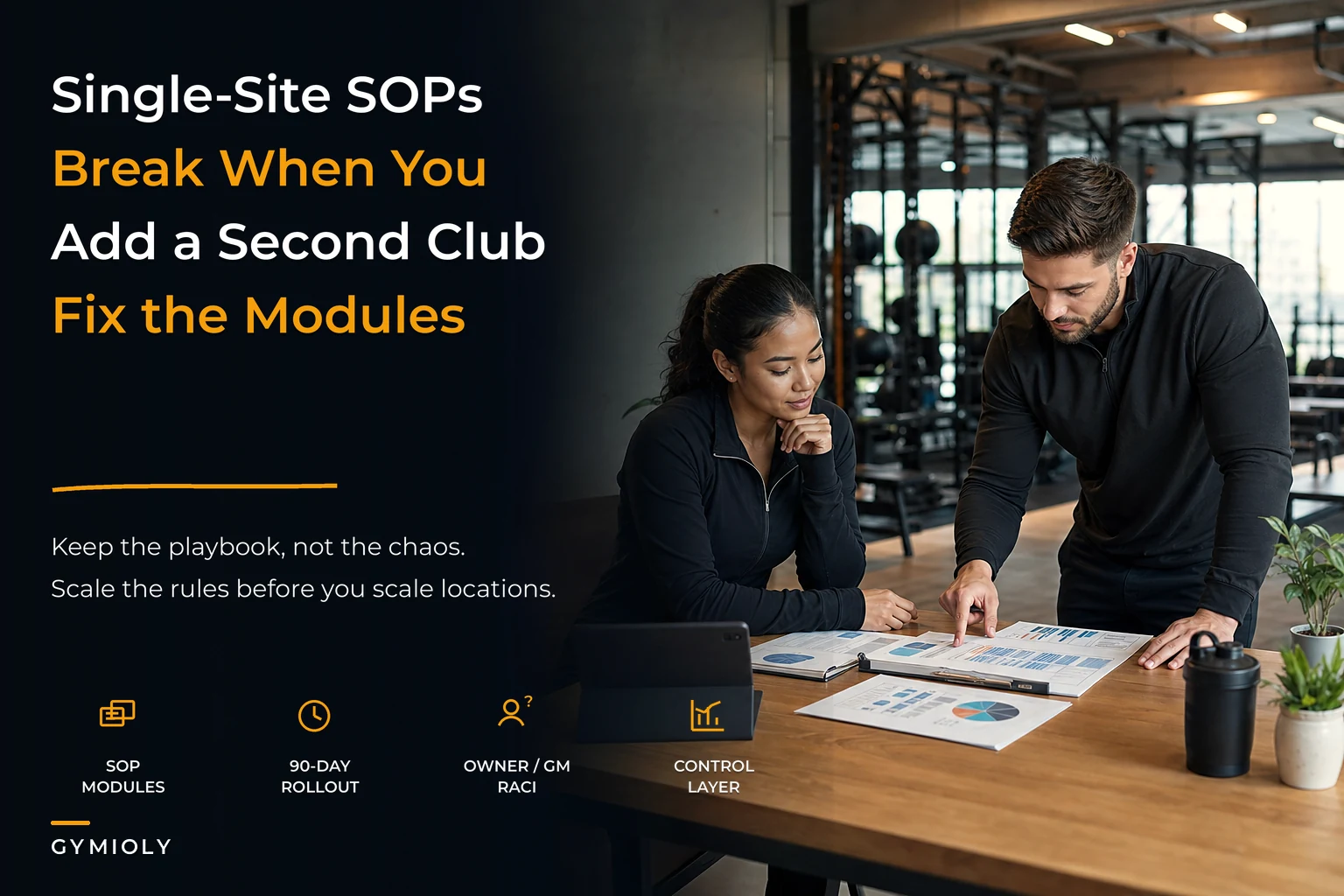

Nobody tells you this before you open a second location: your first gym was never really a system. It was you. You were the escalation path, the culture, the schedule fixer, the person who noticed the front desk was running low on towels before anyone said anything. That works fine at one site. It falls apart the moment you're driving between two buildings trying to exist in both places at once.
Most gym owners figure this out around month three of running two locations. The second site doesn't fail because the market is wrong or the buildout was off. It fails because everything that made site one work lived in the owner's head, and you can't duplicate that.
This is fundamentally a translation problem. You have working SOPs — assuming you built solid ones for your single-location — and now you need to convert them into modules other people can actually run without you nearby. That conversion is where the real work is, and it's almost never about writing more documents.
Why single-site SOPs don't survive copy-paste
The pattern is pretty consistent. Owner builds a great gym, documents their processes, feels ready to scale. They photocopy the whole operations binder, hand it to a second GM, and expect the same result. Six weeks later the second site is billing members wrong, running classes half-empty, and staff has quietly invented their own way of handling things.
The binder wasn't wrong. It was incomplete in a way that only shows up under scale.
Single-site SOPs assume shared context. They say "handle freezes according to policy" because everyone at site one already knows the policy, knows who approves exceptions, knows the general vibe of when rules bend. None of that travels with the document. When you copy the SOP without copying the judgment, you get staff who either follow the rule too rigidly — angry members — or ignore it entirely — revenue leaks.
There's also a decision-rights problem. At one location, you make nearly every non-trivial call. Refund dispute, scheduling conflict, a member who wants a custom deal — it all flows to you. Multi-site means you either stay the bottleneck across every building, or you define which decisions each site can make on its own. Most owners never draw that line explicitly, so it gets drawn by accident, usually badly.
The three-bucket sort: what becomes a module, what stays local
Before writing a single franchisable module, sort everything your gym does into three buckets. This sort is the whole game.
End appointment chaos and boost attendance.
Gymioly streamlines booking, confirms sessions, and manages memberships effortlessly.
- Unified class and membership management
- Automated member notifications
- Trainer scheduling and availability
No credit card required
Standardize (identical everywhere): Anything tied to brand, safety, legal exposure, or financial control. Billing rules, refund limits, cleaning standards, emergency procedures, contract language, data handling. These should be byte-for-byte identical across sites. No local creativity.
Frame (same structure, local numbers): Class schedules, staffing levels, pricing tiers, promotional calendars. The method is standardized but the inputs shift by market. A downtown gym runs a different class grid than a suburban site, but both should be filling that grid using the same demand-driven logic.
Localize (fully local): Community relationships, local partnerships, hiring within labor markets, the specific personality of the front desk. Trying to standardize these things makes every location feel like a soulless clone and kills what made members loyal in the first place.
| Function | Bucket | Who controls it |
|---|---|---|
| Refund & freeze limits | Standardize | Corporate policy |
| Contract & waiver language | Standardize | Corporate/legal |
| Cleaning & safety checklist | Standardize | Corporate policy |
| Class grid structure | Frame | Corporate method, local fill |
| Staffing ratios | Frame | Corporate method, local numbers |
| Promo calendar | Frame | Corporate calendar, local execution |
| Local partnerships | Localize | Site GM |
| Community events | Localize | Site GM |
| Front-desk personality | Localize | Site GM |
Getting this sort right matters more than almost anything else in the whole process. It determines where you'll waste energy and where you'll lose money.
Owner handoff rules: the part everyone skips
The hardest module to build isn't operational — it's the one that defines how you personally stop being involved. If you don't formalize your own handoff, you'll keep pulling decisions back to yourself out of habit, and your GMs will quietly learn that their authority is fake.
-
What you no longer decide. List the categories that now belong to the site GM outright. If a member wants a two-week freeze and it's within policy, the GM approves it — full stop, without checking with you. Write the actual dollar and time thresholds.
-
What still comes to you, and how fast. Escalation isn't failure — it's a defined path. A refund above a certain amount, a staff termination, a lease or vendor decision. Define the threshold and the response window so GMs aren't guessing whether something is "big enough" to bring up.
-
What you'll never delegate. Usually brand decisions, corporate-level pricing strategy, and anything that changes the model across all sites. Naming these protects both sides.
Owners who write down what they keep actually delegate more successfully than owners who only write down what they're giving away. When the limits of your own role are clear, letting go of everything else feels a lot safer.
Local-autonomy boundaries: give room without losing control
Autonomy boundaries are where most franchise-style setups either strangle their managers or lose the plot entirely. Too tight and your best GMs quit because they feel like button-pushers. Too loose and site three is running a pricing experiment that undercuts site two.
-
Pricing GM can run local promos from an approved menu, but can't create new membership tiers or discount below a floor.
-
Scheduling GM owns the class grid and staffing, but must hit minimum coverage rules and can't drop safety-required certifications. Getting this right is easier when the capacity and waitlist logic is already standardized, so local scheduling decisions build on a common foundation.
-
Spending GM has a monthly discretionary budget for small operational needs. Above that threshold, it escalates.
-
Policy exceptions GM can grant a defined number of goodwill exceptions per month within limits. Track them. When a site consistently maxes out its exception budget, that's a signal worth examining.
The exception-budget idea is worth stealing. Instead of a binary "follow the policy or ask permission," you give each GM a small monthly allowance of judgment calls. It respects that real members have real edge cases, keeps total exposure bounded, and creates data. A site burning through its entire goodwill budget every month is telling you something about that market or that manager.
Give each GM a small monthly goodwill budget of judgment calls and track its use.
A site burning through its entire goodwill budget every month is telling you something about that market or that manager.
The governance checklist: keeping five sites honest
Once you're past two locations, you can't personally inspect everything. Governance is how you stay confident that standards are actually being followed when you're not in the building. It's not about distrust — it's about visibility.
-
[ ] Billing exceptions and refunds within policy limits (any outliers flagged)
-
[ ] Freeze and plan-change volume in normal range for the site
-
[ ] Safety and cleaning checklists completed and logged, not backfilled
-
[ ] Staffing coverage met minimum ratios every operating hour
-
[ ] Certifications current for every trainer and instructor
-
[ ] Member complaints logged and resolved within response window
-
[ ] Local promos pulled only from the approved menu
-
[ ] Discretionary spend within budget
-
[ ] Data and access handled per standard (no shared logins, no rogue exports)
That last point matters more as you scale. Every new site is a new set of software logins, integrations, and places data can leak or fragment. Before connecting a fifth location's systems, it's worth reviewing the kind of integration traps that create operational friction — because a mess that's annoying at one site becomes genuinely dangerous at five.
The governance failure that shows up most often: checklists that get "completed" retroactively. A manager fills in the whole month's cleaning log on the 30th. The paperwork looks clean and means nothing. Governance that relies on self-reported binders always drifts toward theater. This is where operational software earns its keep — when completion timestamps, exception logs, and coverage data are captured as the work happens instead of reconstructed later, you're looking at what actually occurred, not what someone remembered to write down.
Role RACI: who actually owns what across sites
Multi-site coordination breaks on ambiguity. Two people think someone else is handling the failed-payment recovery, so nobody does. A RACI grid — Responsible, Accountable, Consulted, Informed — sounds like corporate overhead, but at five sites it's the difference between things getting done and things falling into the gaps between buildings.
| Function | Site GM | Regional/Owner | Front Desk | Corporate Admin |
|---|---|---|---|---|
| Daily class execution | A | I | R | — |
| Failed-payment recovery | C | I | — | A/R |
| New member onboarding | A | I | R | C |
| Hiring & staff discipline | R | A | — | C |
| Freeze/refund exceptions | A | C | R | I |
| Monthly reporting | R | A | — | C |
| Facility maintenance | A | C | R | — |
| Marketing & promos | R | A | — | C |
Notice that billing recovery and reporting concentrate accountability at the corporate level rather than the site. That's deliberate. Functions where consistency matters most and local variation helps least should be pulled toward the center. Functions that depend on local relationships stay with the GM. When you're standardizing something like freeze and plan-change handling, the RACI keeps the policy corporate-owned while letting the site execute it — which is the balance you want.
Consolidated reporting: seeing five sites as one business
At one location you feel the numbers. Attendance is down, you notice bodies aren't in the building. At five sites you can't feel anything — you can only see what your reporting shows you, and most owners' reporting shows them the wrong things.
-
Revenue per active member
-
Attendance as a percentage of capacity
-
Member churn rate (not raw count)
-
Trainer utilization
-
Cost per acquisition by channel
-
Exception and refund rate per 100 members
When every site reports the same normalized metrics on the same cadence, patterns jump out. One site's churn creeping while the others hold steady is a specific, actionable signal. You go look at that site instead of drowning in data from four others.
The reporting failure that quietly kills multi-site owners: every location tracks slightly different things in slightly different spreadsheets, and consolidating them becomes a two-day monthly nightmare. By the time the report is assembled it's stale, and nobody trusts it enough to act on it. A shared operational platform where all sites feed into a single normalized dashboard turns that reconstruction into something you glance at over coffee — which is the whole point. Reporting you have to fight to produce is reporting you'll eventually stop producing.
A real scenario: the two-site owner who almost quit
A fitness studio owner in a mid-size metro opened a second location about ten miles from the first. Site one had run smoothly for years — roughly 480 members, healthy retention, the owner knew every regular by name.
Six weeks into site two, things were quietly falling apart. Billing exceptions at the new site were running around three times higher than site one because the new front desk didn't know when to say no. Class attendance sat near 55% of capacity because nobody had built the grid from actual demand — they'd just copied site one's schedule into a different neighborhood. The owner was driving between buildings four days a week and still felt behind on both.
The fix wasn't more visits. It was doing the three-bucket sort properly and writing real handoff rules. Billing exceptions got standardized with hard limits and a small monthly goodwill budget per site — the new front desk stopped improvising and the exception rate dropped back toward site one's baseline within about two months. The class grid got rebuilt from local demand instead of copied, and attendance climbed into the low 70s% over a quarter. Most importantly, the owner defined what the site-two manager could decide alone, which cut the "quick question" calls down sharply.
Nothing about this was a growth hack. It was translation — taking systems that assumed the owner's presence and rebuilding them to run without it.
The 90-day rollout playbook
Days 1–30: Document and sort.
-
Run the three-bucket sort across every function you have.
-
Rewrite standardize-bucket SOPs to be context-free — assume the reader has never met you.
-
Draft your owner handoff rules
what you keep, what you delegate, what escalates.
-
Build the first draft of your RACI grid.
Days 31–60: Build the control layer.
-
Define local-autonomy corridors and exception budgets per role.
-
Build the monthly governance checklist.
-
Standardize your reporting metrics and set up a single consolidated view all sites will feed.
-
Pilot the whole thing at your existing site first — run your original location as if it were "just another franchise" for a full month. This is the step everyone skips and everyone regrets skipping.
Days 61–90: Launch and correct.
-
Onboard the second site's GM using the modules, not by osmosis.
-
Run the governance checklist weekly at first, then settle into monthly.
-
Hold a short weekly cross-site review using the consolidated dashboard.
-
Log every place the modules broke or someone had to ask you a question that "should have been" answered in the docs — those gaps are your revision list.
The piloting step in days 31–60 deserves emphasis. Running your flagship location under the new modules exposes every hidden assumption while you still control all the variables. If your own gym can't run cleanly on the modules with you right there, a new site with a new manager has no chance.
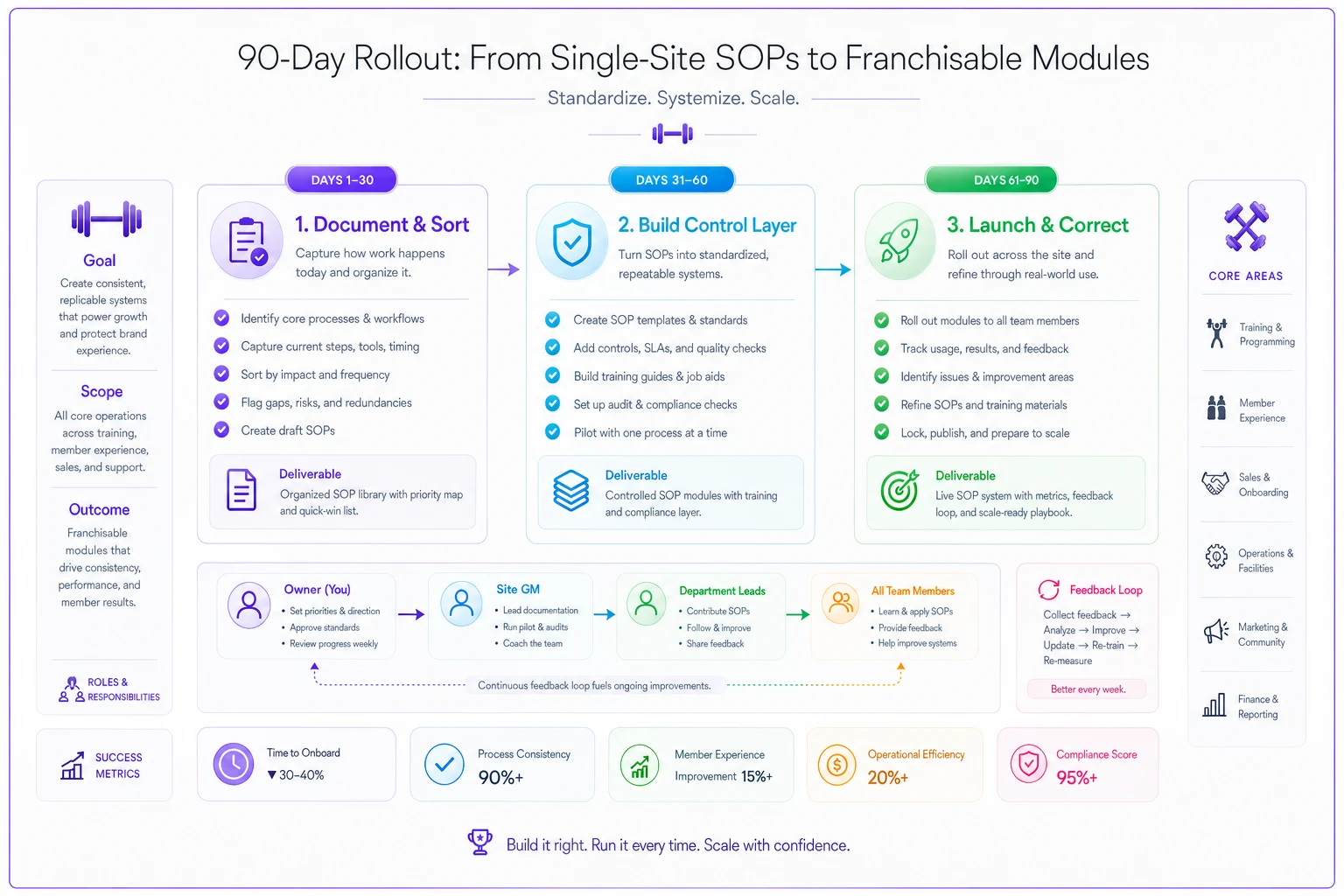
This visual summarizes the phases and feedback loops so teams see when piloting and correction should happen.
When this makes sense — and when it really doesn't
When to build franchisable modules: You have a genuinely stable single site with documented, working SOPs. Your first location can run for a week without you and not degrade. You have the cash to absorb a second site being unprofitable for its first several months. And — critically — you actually want to be an operator of a system, not a hands-on owner of one great gym.
When this is a bad idea: Your first site still depends on you personally to hit its numbers. You're expanding to escape problems at site one rather than to replicate success — problems don't dilute across locations, they multiply. Or you're doing it because a competitor opened nearby and you're reacting emotionally rather than from strength.
Who should not do this: Owners whose entire competitive advantage is their personal presence. If members come specifically because you are there — you coach, you greet, you're the draw — a second site splits the one thing that makes the business work. That's not a systems problem you can solve with better SOPs. It's a business-model reality, and there's no shame in running one exceptional location instead of five average ones.
The real work is translation, not documentation
Scaling a gym isn't about writing more. Most owners already have more documentation than they realize. The work is converting systems that quietly assume your presence into modules that run on defined rules, bounded autonomy, and honest visibility.
Get the three-bucket sort right. Draw decision-rights lines explicitly so your GMs have real authority. Build governance that catches drift before it compounds. Consolidate your reporting so you're managing one business across five buildings instead of five separate businesses you can barely see.
Do that, and the second location isn't a coin flip — it's a copy of a system that already knows how to run without you.
Ready to elevate your gym operations?
Join 2,000+ gyms using Gymioly to reduce admin overhead, improve member experience, and grow revenue.