

Most gym owners don't discover their integrations are broken. They discover their numbers are broken — usually three weeks after the fact, when the monthly close doesn't tie out, or when a "high performing" class turns out to have been double-counting attendance since a silent API change back in August.
That gap — between something breaking and you noticing — is the whole problem. Integration governance is basically the discipline of shrinking that gap to near zero. Not by hiring an engineer, but by writing down what your systems are supposed to send each other, then automatically checking that they actually do it every night.
Gym integration governance sounds like an IT topic. It isn't. It's an operations topic that happens to live in your data pipes. When your billing system, access control, class booking app, and CRM all talk to each other, every handoff is a place where a member's plan status, a payment, or a check-in can quietly get mangled. And the businesses that get burned worst aren't the ones with bad tools — they're the ones who never defined what "correct" looks like in the first place.
The failure mode nobody sees coming: silent KPI drift
Loud failures are easy. When your booking widget goes down, the phone rings. When a payment processor throws errors, you get support tickets. Those get fixed fast because everyone feels the pain immediately.
Silent drift is different. Here's the shape it usually takes: your access control system starts sending check-in events with a slightly different timestamp format after a firmware update. Your reporting layer can't parse maybe 8% of them, so it drops them. Nothing errors out. No alert fires. Your daily check-in count just… runs a little low. Not enough to notice on any given day. But your retention model uses attendance as a churn signal, so now your at-risk flags are miscalibrated, and outreach goes to the wrong people.
Three months later someone asks why win-back campaigns stopped working, and the honest answer is: the underlying data quietly rotted and no one wrote a test that would've caught it.
The drift almost never comes from the systems people watch closely. It comes from the boring integrations — the ones that "just work" and therefore get ignored. The nightly export from your PMS to your accounting tool. The webhook that marks a membership as frozen. The sync that pushes new leads into your CRM.
If you've already read the data governance for gym owner dashboards piece, think of this article as the layer underneath it. Dashboards tell you what your numbers are. Integration governance tells you whether those numbers can be trusted in the first place.
Start with the data contract, not the tool
The single most useful thing you can do — and almost nobody does it — is write a data contract for each integration. A data contract is just a plain agreement about what one system will send another: which fields, what type each field is, what's required vs. optional, and what a valid value looks like.
End appointment chaos and boost attendance.
Gymioly streamlines booking, confirms sessions, and manages memberships effortlessly.
- Unified class and membership management
- Automated member notifications
- Trainer scheduling and availability
No credit card required
Without a contract, "working" is defined by vibes. The integration is working if nothing's obviously on fire. With a contract, "working" is defined by a spec you can actually test against.
Here's a concrete example. Say your booking system sends class attendance events into your data warehouse. The contract might look like this:
{ "contract": "classattendanceevent", "version": "1.3", "source": "bookingapp", "destination": "warehouse.factattendance", "fields": { "eventid": { "type": "string", "required": true, "unique": true }, "memberid": { "type": "string", "required": true, "fk": "members.id" }, "classid": { "type": "string", "required": true }, "checkints": { "type": "datetime", "required": true, "format": "ISO8601", "tz": "UTC" }, "status": { "type": "enum", "required": true, "values": ["attended", "noshow", "latecancel", "waitlistpromoted"] }, "bookedchannel": { "type": "enum", "required": false, "values": ["app", "web", "frontdesk", "kiosk"] }, "sourcesystemv": { "type": "string", "required": true } }, "rowvolumeexpected": { "minperday": 180, "maxperday": 900 }, "freshnesssla_minutes": 90 }
Notice what that buys you. status is an enum — so if the vendor ever adds a new value like "cancelledbygym" without telling you, your test catches an unexpected value the next morning instead of you finding out during month-end. rowvolumeexpected gives you a sanity band, so if attendance events suddenly drop to 40 a day, something flags. freshnessslaminutes means you'll know if the feed stalls.
{ "contract": "paymentsettledevent", "version": "2.0", "source": "billingprocessor", "destination": "warehouse.factpayments", "fields": { "paymentid": { "type": "string", "required": true, "unique": true }, "memberid": { "type": "string", "required": true, "fk": "members.id" }, "amountcents": { "type": "integer", "required": true, "min": 0 }, "currency": { "type": "enum", "required": true, "values": ["USD"] }, "type": { "type": "enum", "required": true, "values": ["dues", "pt", "retail", "latefee", "daypass"] }, "status": { "type": "enum", "required": true, "values": ["settled", "refunded", "partialrefund", "chargeback"] }, "settled_ts": { "type": "datetime", "required": true, "format": "ISO8601" } } }
The amount_cents as an integer detail isn't pedantic — floating-point money fields are a classic source of penny-level drift that compounds over time. And keeping refund/chargeback as explicit statuses means your revenue reconciliation can actually net them out instead of you wondering why the processor deposit never matches your gross.
Write these contracts once, store them in a shared doc or repo, and version them. When a vendor pushes a change, the contract is your reference point for "did this break our assumptions?"
Field-matching rules: where two systems disagree about the same person
Contracts define each feed in isolation. The next layer is field-matching rules — how you reconcile the same entity across systems that each have their own idea of the truth.
-
Primary match
member_id(canonical, from PMS) -
Secondary match normalized email (lowercased, trimmed) when
member_idis missing -
Tertiary match phone (digits only, last 10) as a last resort
-
Conflict rule if a keyfob maps to two active
member_ids, flag for manual review — never auto-merge -
Normalization emails lowercased; phones stripped to digits; names not used for matching (too fuzzy)
Favor canonical IDs over fuzzy matches; names should not be used for automated joins.
The classic gym example: a member exists in your PMS, your access control system, and your email platform. Are they the same person in all three? Your PMS keys on an internal member ID. Access control might key on a keyfob number. Your email tool keys on email address. If nothing enforces the mapping, you get orphans — a keyfob that scans in every day but maps to no active membership, or a member paying dues who somehow can't badge into the building.
The mistake operators make here is trusting fuzzy matching on names. "Mike Sanders" and "Michael Sanders" and "Mike Sander" will generate false merges that quietly combine two people's attendance and billing history. Names are for humans to read, not for machines to join on.
Nightly reconciliation tests: your early-warning system
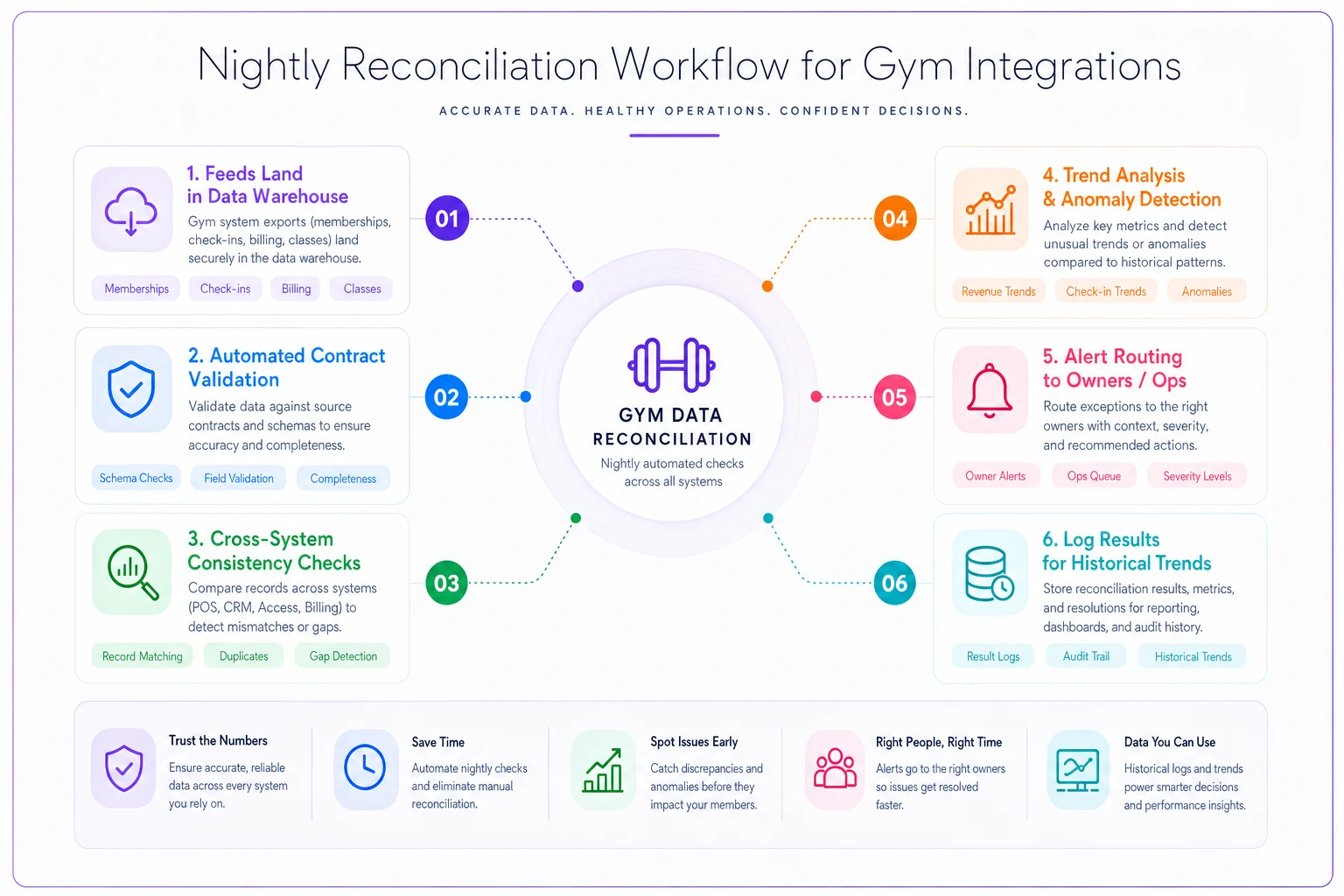
This is the part that actually catches drift. Every night, after your feeds land, you run a batch of checks that compare what you expected against what you got. Anything outside tolerance generates an alert before anyone looks at a dashboard the next morning.
Think of reconciliation in three buckets: within-feed validity (does this data match its contract?), cross-system consistency (do systems agree with each other?), and trend sanity (does today look plausible vs. history?).
Here's a set of nightly checks written as plain SQL-style assertions. The idea isn't the exact syntax — it's that each check has a clear pass/fail and a threshold.
-- 1. Contract check: no unexpected status values in attendance SELECT status, COUNT() AS n FROM factattendance WHERE eventdate = CURRENTDATE - 1 AND status NOT IN ('attended','noshow','latecancel','waitlistpromoted') GROUP BY status; -- EXPECT: 0 rows. Any row = contract violation, page it. -- 2. Freshness: did the billing feed actually land? SELECT MAX(settledts) AS latestpayment FROM factpayments; -- EXPECT: latestpayment within 90 minutes of run time. -- 3. Volume sanity: attendance not wildly off historical band SELECT COUNT() AS todayscheckins FROM factattendance WHERE eventdate = CURRENTDATE - 1; -- EXPECT: between 180 and 900 (contract band). -- WARN if within 15% of either bound; ALERT if outside. -- 4. Cross-system: active members who can't badge in SELECT m.memberid FROM members m LEFT JOIN accesscredentials a ON m.memberid = a.memberid WHERE m.status = 'active' AND a.credentialid IS NULL; -- EXPECT: 0 (or a tiny known band for brand-new signups). -- 5. Revenue tie-out: gym-side dues vs processor settlements SELECT (SELECT SUM(amountcents) FROM factpayments WHERE type='dues' AND status='settled' AND settledts::date = CURRENTDATE - 1) AS processordues, (SELECT SUM(expectedcents) FROM billingschedule WHERE duedate = CURRENTDATE - 1) AS scheduleddues; -- EXPECT: difference within a small tolerance (declines/retries explain gaps). -- 6. Orphan credentials: fobs scanning with no active membership SELECT a.credentialid, COUNT(*) AS scans FROM accessevents e JOIN accesscredentials a ON e.credentialid = a.credentialid LEFT JOIN members m ON a.memberid = m.memberid WHERE e.eventdate = CURRENTDATE - 1 AND (m.memberid IS NULL OR m.status <> 'active') GROUP BY a.credentialid; -- EXPECT: 0. Non-zero = either data drift or actual access-control leak.
A simple nightly reconciliation workflow:
Check #6 is worth pausing on, because it's a governance win that's also a money-and-safety win. Fobs that scan but map to no active membership are either broken data or people using the gym for free. Single-location gyms have found a dozen or more of these once they started running the check — a few were data artifacts, but some were genuinely lapsed members still badging in for months.
Run these on a schedule, log every result, and store the history so you can see when a metric started sliding. A single failing night is noise. A metric that's been trending 3% lower every week for a month is drift, and the log is how you catch it.
Setting alert thresholds so people don't ignore them
The fastest way to make reconciliation useless is to alert on everything. If your team gets 40 emails a night, they'll filter the folder and never look. Threshold design is really about protecting attention.
A workable tiering:
| Severity | Example trigger | Who gets it | Response window |
|---|---|---|---|
| P1 — Page | Billing feed missing, or contract violation on payments | Owner + ops lead, SMS | Same night / next AM |
| P2 — Alert | Attendance volume outside band, revenue tie-out off > tolerance | Ops lead, email | Within 1 business day |
| P3 — Warn | Metric within 15% of a threshold bound; slow trend | Logged + weekly digest | Reviewed weekly |
| P4 — Info | Schema version bump detected but still valid | Logged only | Reviewed at monthly check |
The principle: page for money and safety, alert for trends, log everything else. A missing payment feed is a P1 because you could misstate revenue or fail to retry declines. A slightly low check-in count is a P3 — worth watching, not worth waking anyone.
One pattern worth stealing: make P3 warnings fire before something becomes a P2. If your attendance band bottoms at 180 and you warn at 207 (15% above the floor), you often catch a degrading feed while it's still limping instead of after it's fully dead.
Observability checks: watching the pipes, not just the data
Reconciliation checks the output. Observability watches the plumbing so you know why output went wrong. For a gym, you don't need a fancy monitoring stack — you need a handful of signals logged consistently:
-
Feed latency how long between the source event and it landing in your warehouse. Creeping latency is an early tell that a vendor's system is straining.
-
Payload error rate what fraction of records got rejected for failing the contract. Should hover near zero; a jump means a schema change.
-
Row counts per feed, per run logged every night, so volume anomalies are obvious in hindsight.
-
API response codes from each vendor a rising rate of 429s (rate limiting) or 5xxs is a warning that syncs are silently dropping.
-
Last-successful-sync timestamp per integration the single most useful gauge. If any feed's "last success" is older than its SLA, something's wrong right now.
Most owners have zero visibility into feed latency and error rate because their tools don't surface it. The vendor dashboard says "connected" and everyone assumes that means "delivering complete, correct data." Connected and correct are not the same thing. A connection can be perfectly healthy while dropping 6% of records due to a parsing quirk.
If you're setting up integrations from scratch, the provider-neutral integration traps checklist pairs well with this — governance is a lot easier when you didn't paint yourself into a corner during setup.
A step-by-step rollout you can actually do
You don't stand this whole thing up in a weekend. Here's a realistic order:
-
Inventory every integration. List each system, what it sends where, and how often. Most owners are surprised it's 8–12 connections, not 3.
-
Rank by blast radius. Anything touching money or access goes first. A broken retail-inventory sync can wait; a broken payment feed cannot.
-
Write contracts for the top 3–4. Don't boil the ocean. Billing, access control, and attendance cover most of the risk.
-
Define field-matching rules for member identity across systems. Pick your canonical key.
-
Build 6–10 nightly reconciliation checks from the examples above. Start with tie-outs and volume bands.
-
Set thresholds and routing. Decide what pages you vs. what waits.
-
Turn on observability logging — latency, error rate, last-success timestamp per feed.
-
Review weekly for the first month, then move to a monthly governance check once it's stable.
Expect the first two weeks to surface embarrassing stuff: duplicate members, fobs with no owners, a "settled" revenue number that never actually matched the bank. That's not the system failing — that's it working. Those problems were always there. You just couldn't see them.
Scripted vendor-exit steps (the part everyone skips)
Governance isn't only for when things run smoothly. It's also for the day you fire a vendor — or they discontinue a product, get acquired, or jack up pricing. This is where a lot of gyms get held hostage, because their data lives inside a system they no longer want but can't cleanly leave.
-
Confirm export rights in writing. Before signing anything, know you can extract members, billing history, and attendance in a standard format (CSV/JSON), not a proprietary blob.
-
Do a test export now, not at exit. Pull a full export today and confirm it actually contains what your contracts expect. Vendors love to say "you can export" and then hand you an incomplete dump.
-
Map every field to your contract. If their export column names differ from your canonical schema, write the mapping in advance.
-
Freeze and snapshot. On exit day, snapshot final states — active memberships, next bill dates, freeze status, outstanding balances, stored payment tokens (or the migration path for them).
-
Reconcile the migration. After moving to the new system, run your nightly checks against both the old snapshot and the new feed. Member counts, active dues totals, and next-bill dates should tie out. Any gap is a member who's about to get double-billed or not billed at all.
-
Verify recurring billing continuity. The single highest-risk item in any migration. Confirm every active member's payment method and schedule carried over before you cut the old system off.
-
Retain a read-only copy. Keep the old data accessible for at least a year for disputes, chargebacks, and tax questions.
The costly mistake is treating a vendor switch as an IT cutover instead of a governed reconciliation. A migration that "went fine" but silently dropped 30 members' billing schedules will cost you a quiet chunk of monthly recurring revenue that you won't notice until the next close — the exact silent drift this whole discipline exists to prevent.
If your vendor relationships are already tiered and scored per the vendor SLAs and scorecards approach, you'll already know which ones are exit risks worth scripting first.
A real scenario: the class that wasn't as full as it looked
A single-location gym running around 60 classes a week noticed something odd: their most "popular" strength class kept showing near-full attendance on the dashboard, but the room felt half-empty and retail/PT upsells from that class were flat.
The reconciliation check that would've caught it was cross-system consistency between booking status and actual check-ins. When they finally compared the two, the story came out: after a booking-app update, waitlist_promoted bookings were being logged as attended in the export whether the person showed or not. Roughly one in five "attended" records was a no-show that had been auto-promoted off the waitlist.
The practical damage wasn't dramatic revenue loss — it was decisions made on bad data. They'd been about to add a second session of that class based on demand that didn't fully exist, and their at-risk churn scoring was crediting attendance to members who hadn't set foot in the building. After adding a nightly status-integrity check and a volume band, the corrected attendance ran about 15–20% lower than the inflated number. Not a catastrophe — but the difference between staffing and pricing a second class that would've run half empty.
The point isn't the exact figures. It's that a schema quirk they never agreed to created a KPI they trusted for months. One contract and one nightly check would've flagged it the first morning.
When this level of governance makes sense — and when it's overkill
When it's worth it: you're running more than a couple of integrations, money moves through automated syncs, and you make real decisions (staffing, pricing, class scheduling) off dashboard numbers. The moment your reporting drives spending, your reporting needs to be trustworthy.
When it's overkill: if you're a very small studio with one system that does everything and no cross-tool syncs, you don't need nightly reconciliation across feeds. A weekly manual tie-out is fine. Governance scales with integration complexity — don't build a monitoring apparatus for a business that has nothing to monitor.
Who should not go all-in yet: if you haven't nailed down your basic KPI definitions — what counts as an active member, how you define a no-show — fix that first. Reconciling to a definition nobody agrees on just produces confident-looking garbage. Get your measurables straight, then govern the pipes that feed them.
The through-line across all of this: broken integrations rarely announce themselves. They erode your numbers a fraction at a time until a decision built on those numbers goes sideways. Data contracts, field-matching rules, nightly reconciliation, sane alert thresholds, and a pre-written exit plan aren't glamorous — but together they mean the day something drifts, you find out that night, on your terms, instead of three weeks later during a close that won't tie out.
Ready to elevate your gym operations?
Join 2,000+ gyms using Gymioly to reduce admin overhead, improve member experience, and grow revenue.