



Most price changes at gyms fail quietly. Not with a wave of angry emails, but with a slow bleed: a handful of cancellations you can't quite explain, a billing batch that charged the wrong amount for 40 people, and a general ledger that no longer ties to your member management system. Three months later you're staring at a reconciliation that's off by $1,800 and nobody can tell you which price change caused it.
The reason this happens isn't the price itself. It's that most owners treat a price migration as a single flip-the-switch event instead of a controlled rollout with cohorts, checkpoints, and a way to back out. You raise everyone's rate on the first of the month, send one email, and hope.
This playbook is about doing the opposite—migrating members onto new pricing in cohorts, tying each cohort directly to the journal entries it creates, building rollback triggers that fire before damage spreads, and scripting member communication so churn stays inside the range you predicted. If you've already read about experiment-driven membership architecture, this is the operational layer underneath it—the part that keeps the experiment from breaking your accounting.
Why price migrations break the ledger, not just the member relationship
The member-facing damage is obvious and people plan for it. The accounting damage is what catches owners off guard, and in dollar terms it's usually worse.
When you change a recurring price, you're not changing one number—you're changing a stream of future journal entries. Every active member on the old plan has deferred revenue, a billing schedule, and in many cases a proration event the moment their plan changes mid-cycle. If you migrate 300 members at once, you've just generated 300 proration calculations, some number of failed payments at the new rate, and a deferred revenue balance that shifted overnight.
A typical example: a gym raises its standard membership from $59 to $69 effective the 1st. About 280 members are on monthly billing with staggered renewal dates. Instead of everyone renewing at $69 on the 1st, each member renews on their own anniversary date—so for the first month you've got a mix of $59 and $69 charges hitting the same revenue account with no tag telling you which is which. The GL shows a number that's neither the old MRR nor the new MRR, and when your accountant asks "what's your recurring revenue run-rate now?" you genuinely can't answer.
That's the real problem a migration runbook solves. Not "will members be upset," but "can I still trust my numbers while this is in motion."
Cohort-gating: the core idea that makes everything else work
Instead of migrating everyone at once, you move members in deliberate groups—cohorts—and you don't advance to the next group until the current one clears a set of checks.
End appointment chaos and boost attendance.
Gymioly streamlines booking, confirms sessions, and manages memberships effortlessly.
- Unified class and membership management
- Automated member notifications
- Trainer scheduling and availability
No credit card required
-
Cohort A (pilot) 5–8% of affected members. Your least price-sensitive segment—long-tenured, high-attendance members who rarely question anything.
-
Cohort B ~20%, a representative mix across tenure and usage.
-
Cohort C ~30%, including some known price-sensitive members so you see real resistance before full rollout.
-
Cohort D the remainder, only after A–C clear.
The reason you gate is straightforward: each cohort is a live experiment whose results tell you whether to continue. Cohort A gets the new price; a matched holdout group stays on the old price. You compare churn, downgrade requests, and payment-failure rates between them. If the gap stays inside your predicted range, you advance. If it blows past your threshold, you stop—and you've only exposed 8% of members to the problem instead of 100%.
This is the discipline that most "we raised prices and lost members" stories are missing. There was never a checkpoint between the decision and full exposure.
Tying each cohort to its ledger entries
This is the part nobody writes about, and it's the part that saves your close.
Before you migrate a single member, assign each cohort a tracking tag that follows the revenue all the way into your accounting. Every charge, proration, refund, and failed-payment retry from Cohort A should be identifiable as Cohort A revenue. When you can do this, your month-end reconciliation stops being a guessing game.
Here's the mapping that needs to exist:
| Event in member system | Journal impact | What it must be tagged with |
|---|---|---|
| Member moved to new plan | New billing schedule created | Cohort ID + migration date |
| Mid-cycle proration charge | Revenue recognized partial period | Cohort ID + "proration" flag |
| First full charge at new rate | Deferred revenue → earned over period | Cohort ID + new price point |
| Failed payment at new rate | AR aging / dunning entry | Cohort ID + failure reason |
| Downgrade back to old tier | Reverses expected revenue delta | Cohort ID + "rollback" flag |
Make the cohort tag a distinct dimension in both your billing system and your GL to avoid lookup mismatches.
The point of that table isn't the specific accounts—your chart of accounts will differ. The point is that every financial event carries the cohort ID. When your close shows an unexpected $600 variance, you query by cohort and immediately see it came from Cohort C's proration charges, not from some mystery elsewhere in the business.
Without this tagging, a price migration turns your deferred revenue into a black box. With it, you can reconcile each wave independently and sign off on the close with the migration still half-finished.
Rollback triggers: deciding in advance when to stop
The biggest mistake owners make is deciding whether to continue a rollout emotionally and in the moment. One loud cancellation email arrives, panic sets in, and the whole thing gets reversed—even though the numbers were fine. Or the opposite: churn is quietly climbing past the danger zone, but because no single day looked alarming, nobody pulls the plug.
Rollback triggers fix this by setting the stop conditions before you start, in writing, with actual numbers. If a trigger fires, you halt the next cohort. No debate.
-
1. Churn delta trigger If the migrated cohort's cancellation rate exceeds the holdout group by more than ~2.5 percentage points within 21 days, pause.
-
2. Downgrade trigger If more than ~12% of a cohort requests a downgrade to a cheaper tier, pause. A downgrade is churn wearing a disguise—it's revenue you lost without the member leaving.
-
3. Payment-failure trigger If the failed-payment rate on the new price runs more than ~3 points above baseline, pause. This usually means the new amount tripped card limits or auto-pay caps you didn't anticipate.
-
4. Comms-volume trigger If inbound complaints exceed a set count per 100 migrated members, pause and review the messaging before continuing.
-
5. Reconciliation trigger If the cohort's revenue doesn't tie to the ledger within your tolerance at the first mini-close, pause everything—because now you have a data integrity problem, not just a pricing one.
Trigger #5 isn't about members at all. It's the accounting safeguard. If you can't reconcile Cohort A, you absolutely do not want to layer Cohorts B, C, and D on top of a broken foundation.
One useful discipline: write the trigger thresholds down and get them agreed before Cohort A launches. Triggers you invent mid-crisis are just anxiety with a number attached.
Member communication sequences that keep churn predictable
Price increases don't cause churn. Surprise price increases cause churn. The communication sequence exists to remove surprise, give members agency, and route the price-sensitive ones toward a retention path instead of the cancel button.
Each cohort gets the same sequence, offset by their migration date.
Message 1 — 30 days out (the heads-up): Direct, no spin. State the old price, the new price, the effective date for that member specifically, and what's staying the same or improving. The specific-date detail matters a lot—generic "prices are changing" emails generate far more confused replies than "your rate changes on [your renewal date]."
Message 2 — 14 days out (the value + option reminder): Reinforce what they get, and quietly surface the lower-tier or annual option for anyone who'd rather change than leave. This is where you give price-sensitive members a landing spot. Pairing a migration with a well-designed set of trial and tier options means resistance converts to a downgrade or an annual prepay instead of a cancellation.
Message 3 — 3 days out (the confirmation): Short. "Your new rate of $X begins on [date]. Nothing you need to do." This cuts the "I didn't know this was happening" disputes that otherwise show up as chargebacks.
Message 4 — day of, only if payment fails: Separate from the increase messaging entirely. A failed payment at the new rate needs its own recovery flow.
Message 5 — for freeze/downgrade requests: Have a scripted, no-friction path ready. The members asking to freeze or downshift are the ones you can still keep. Handling freezes and plan changes cleanly, with correct proration, is what turns a would-be cancellation into retained—smaller but real—revenue.
The pattern across all of these: specificity reduces churn. Vague messages generate confusion, and confusion is the emotion right before cancellation.
A short real scenario
A single-location strength gym with around 420 members wanted to move its base plan from $64 to $74—a meaningful raise after three years flat. Their first instinct was an all-at-once flip on the 1st.
Instead they ran it cohort-gated over six weeks. Cohort A (around 30 longtime members) plus a matched holdout launched first. The churn delta came in around 1.8 points—under the 2.5 trigger—so they advanced. Cohort C surfaced the real resistance: downgrade requests hit roughly 9%, close to the trigger but under it, and most of those members ended up taking an annual prepay option instead of leaving.
The accounting side is where it paid off most. Because every charge carried a cohort tag, their month-end close—which landed mid-migration—reconciled cleanly. The variance they did find, about $500, traced immediately to Cohort B proration charges and was resolved in under an hour instead of becoming a multi-day hunt.
Net result: churn across the full migration landed around 3–4% above normal baseline, which was within what they'd modeled. MRR rose by roughly $3,000+ a month once fully migrated, and the close stayed clean throughout. The all-at-once version would have hit the same MRR if nothing went wrong—but with no checkpoint, no way to isolate the accounting, and no early warning if churn had run hot.
When cohort-gating makes sense—and when it doesn't
When it makes sense:
-
You're changing price on more than ~50 active recurring members.
-
Your billing dates are staggered (they almost always are).
-
You care about keeping the ledger reconcilable during the change.
-
The increase is large enough that churn risk is real.
When it's overkill:
-
You're changing price only for new members going forward and grandfathering everyone existing. That's not a migration—it's just a new rate card, and you can skip most of this.
-
You have a very small member base where "cohorts" would be five people each and the statistics are meaningless. In that case, migrate in two small waves with a one-week gap and watch manually.
Who should not run this as-is:
If you can't currently tag revenue by cohort and tie it back to your GL, fix that first. Running a gated migration without the ledger tagging gives you the member-side discipline but leaves the accounting black box intact—which is the more expensive half of the problem.
The workflow, start to finish
Here's how the whole thing runs in order, so you can hand it to a staff member and have it execute the same way every time:
-
1. Define cohorts and pull a matched holdout group for the first two waves.
-
2. Set rollback triggers in writing with specific numbers, agreed before launch.
-
3. Set up cohort tagging so every charge, proration, and failure carries its cohort ID into the ledger.
-
4. Schedule the comms sequence per cohort, offset to each member's renewal date.
-
5. Launch Cohort A plus holdout. Hold 21 days.
-
6. Run a mini-reconciliation on Cohort A—does its revenue tie to the GL within tolerance?
-
7. Check every trigger. If any fired, stop and diagnose. If all clear, advance.
-
8. Repeat for B, C, D, reconciling each wave before advancing.
-
9. Final close confirm total migrated MRR matches the sum of cohort-level revenue, with no untagged mystery balance.
Here's a visual of the workflow.
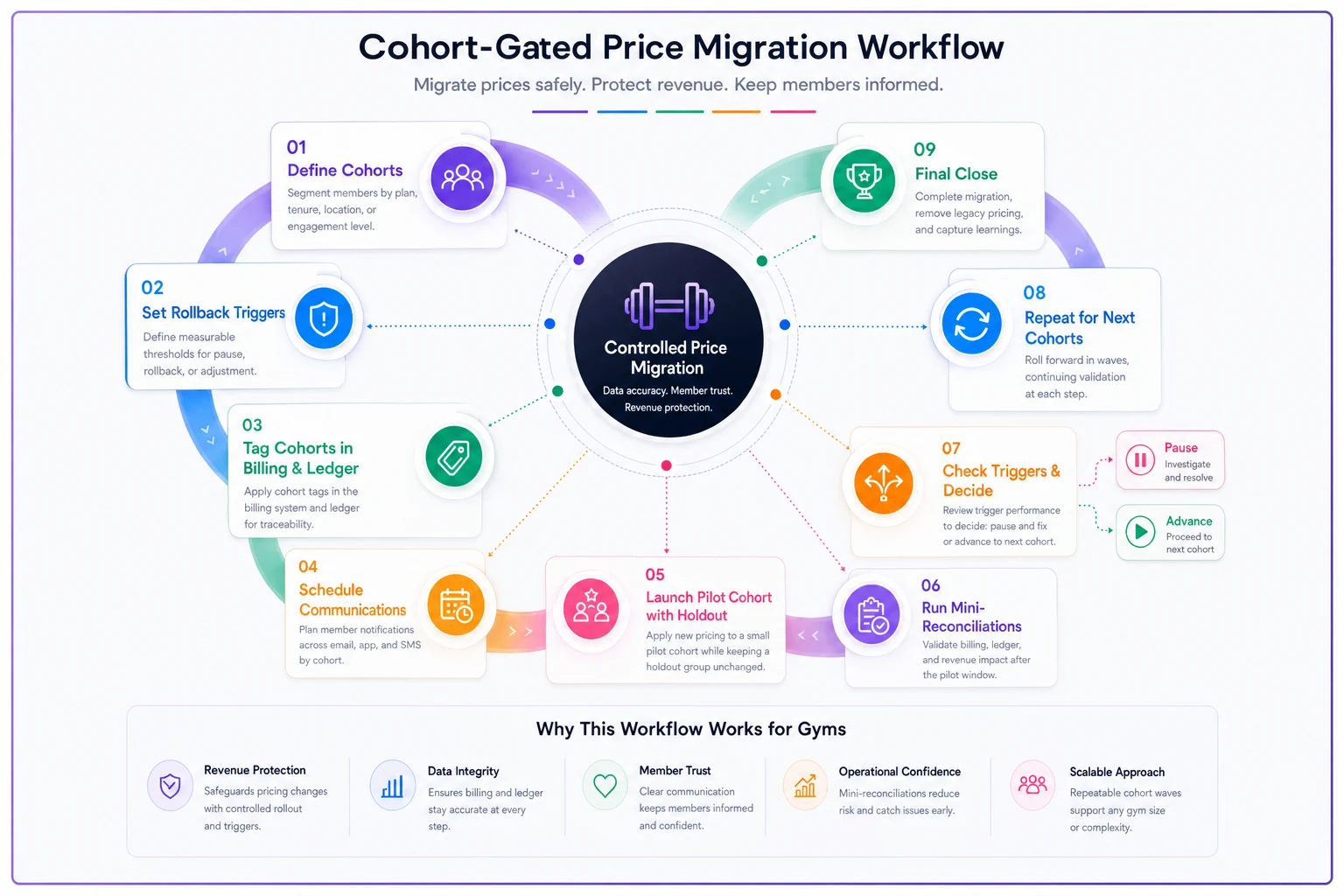
The whole point of writing it out as a sequence is that the discipline lives in the process, not in someone's memory. The owner who flips the switch and hopes is making a bet. The owner running this runbook is making a controlled change they can stop at any point and still reconcile cleanly.
Bottom line
A price increase is one of the highest-leverage moves a gym can make, and also one of the few that can simultaneously damage retention and your books if you do it blind. Cohort-gating turns it from a single risky event into a series of small, reversible steps—each one tied to its own ledger entries, each one gated behind triggers you set in advance, each one wrapped in communication specific enough that members don't feel ambushed.
Do it this way and the worst case is you stop after Cohort A having exposed 8% of members, learned something real, and kept your close intact. That's a very different outcome than discovering in month three that your revenue doesn't reconcile and you no longer know which price change caused it.
Ready to elevate your gym operations?
Join 2,000+ gyms using Gymioly to reduce admin overhead, improve member experience, and grow revenue.