

Most gyms didn't plan their hybrid model. It arrived. First it was streaming a few classes during a slow patch, then an app got bolted on, then somebody sold a "digital-only" tier because a competitor did, and suddenly the front desk is fielding questions like "I'm digital but can I still book the 6pm spin?" and nobody has a clean answer.
That gap — the fuzzy space between what a member thinks they bought and what your system actually lets them do — is where hybrid gym operations get expensive. Not dramatically. In a slow, hard-to-see way: a few unentitled bookings here, a livestream that started eight minutes late there, a churned member who "never used the online stuff" because nobody ever matched their access to their actual behavior.
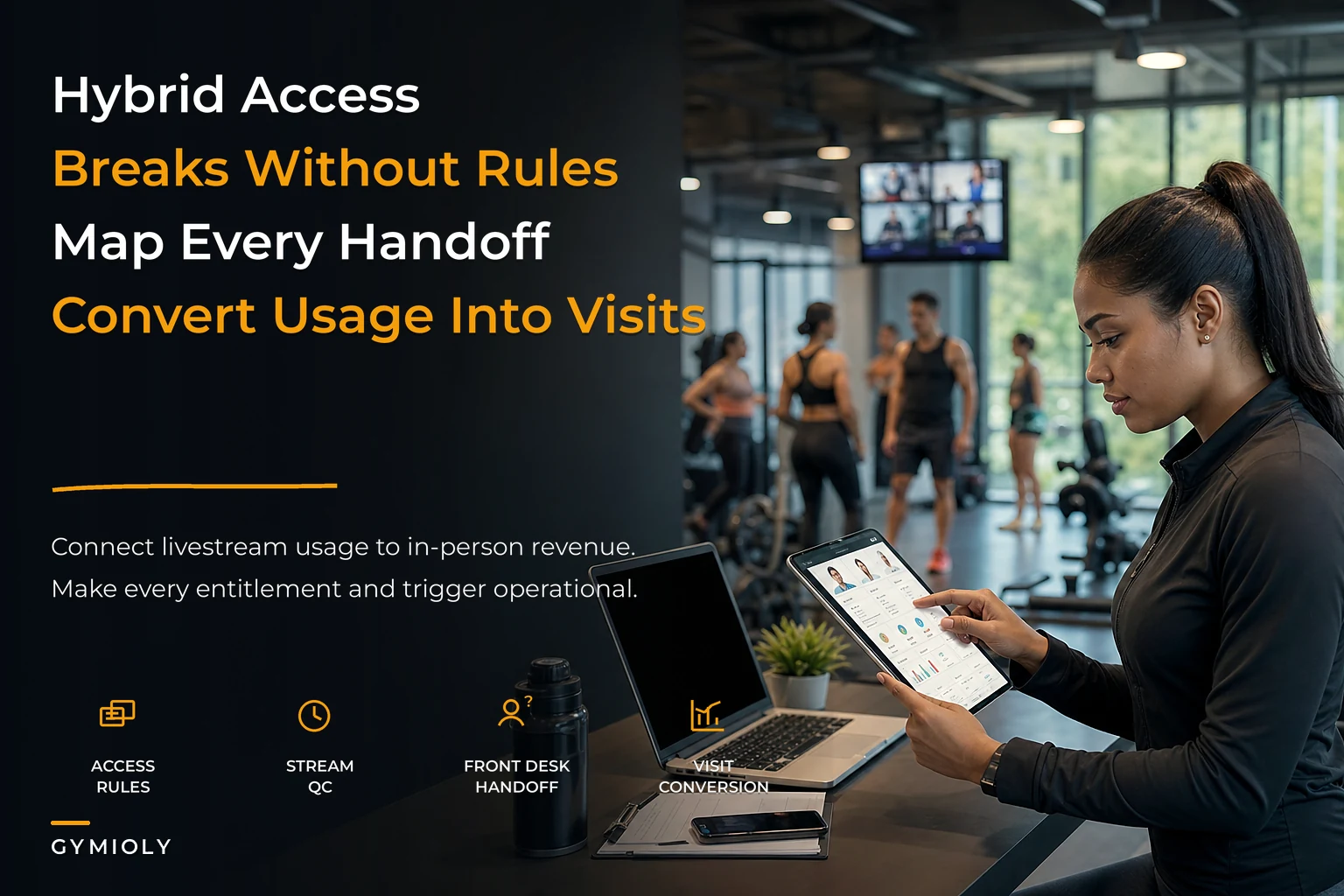
This piece is about the connective tissue. Not "should you do hybrid" — you already are, whether you admit it or not — but how the pieces need to lock together so digital usage feeds in-person revenue instead of quietly cannibalizing it.
The core problem: entitlements are guesses, not rules
Walk into most hybrid setups and ask a simple question: what exactly does each tier get? You'll usually get a verbal answer that's slightly different from what the app enforces, which is slightly different from what the front desk allows, which is slightly different from what the sales team promised during signup.
Four versions of the truth for one membership. And every version drifts over time.
A pattern that shows up constantly: a gym launches three tiers — in-person, digital, and "all-access" — but the entitlement logic lives in someone's head and a Google Doc. The booking system doesn't actually know that digital members shouldn't reserve a physical class spot. So it lets them. Then a floor class that seats 14 has three digital members holding spots they can't use, and two in-person members on the waitlist who are paying more.
That's not a software bug. It's a mapping failure. Nobody built the rule that says entitlement type → what it unlocks → where that gets enforced.
Entitlement mapping just means writing that down as an actual system, not a verbal description. For every tier you sell, you need three columns filled in with zero ambiguity:
| Tier | Digital access | Physical access | Booking rights |
|---|---|---|---|
| Digital-only | Full library + live streams | Guest-pass only (paid) | Cannot reserve floor class spots |
| In-person | Floor classes + gym access | Full | Reserve floor, no on-demand library |
| All-access | Full library + live streams | Full | Reserve floor + join live remotely |
Looks obvious on paper. The problem is almost nobody enforces the "booking rights" column at the system level. They enforce it socially — a staff member notices and untangles it manually. That works at 200 members. It falls apart somewhere around 600.
Why this breaks the same way across almost every gym
The reason hybrid entitlements drift isn't laziness. It's that the digital and physical sides usually grew on different tools, at different times, owned by different people.
End appointment chaos and boost attendance.
Gymioly streamlines booking, confirms sessions, and manages memberships effortlessly.
- Unified class and membership management
- Automated member notifications
- Trainer scheduling and availability
No credit card required
The app came from one vendor. Access control and class booking from another. Billing from a third. Each one has its own idea of what a "member" is. So "digital member" in your app might just be an email address with no connection to the person who badges in at 5:45am for the barbell class. Two records, one human, no wire connecting them.
When those records aren't connected, you can't answer basic operational questions:
-
Does app usage predict whether someone will show up in person?
-
Are digital-only members ever converting, or just quietly churning?
-
Which live streams are actually driving floor attendance versus replacing it?
In practice, this surfaces as a retention mystery. A member cancels. You look at their in-person attendance and it's fine — three visits a week. But their app engagement flatlined two months earlier, and you never saw it because the two systems never talked. The warning signal existed. It just lived somewhere your retention process couldn't reach. If you've already built attendance-based churn signals, digital usage belongs in that same scoring model — it's just another input stream most gyms leave sitting there unused.
Broadcast logistics: the unglamorous part that decides everything
Everyone wants to talk about content. Almost nobody wants to talk about the boring logistics that determine whether a livestream is an asset or a liability. And it's always the logistics that break.
A livestream is not "point a camera at the class." It's a small production with a dozen failure points, and at a gym those failure points cluster in predictable spots:
-
Start-time drift. The in-room class starts when the instructor is ready. The stream is supposed to start at a fixed clock time. These are different clocks. Remote members log in at 6:00 to a black screen because the instructor is still adjusting mics at 6:04.
-
Audio, not video. Bad audio kills a gym livestream faster than bad video. If remote members can't hear cues over the music, they leave and don't come back.
-
No fallback. Wifi drops mid-stream. What happens? In most gyms
nothing. The stream dies and remote members get silence. There's no "we'll email the replay" trigger, no apology, no recovery.
-
Nobody owns it. The instructor is teaching a live room. They cannot also monitor stream health. If there's no second person — or no automated check — the stream is effectively running unmonitored the entire class.
That fourth one is the real killer. The instructor's attention is correctly 100% in the room. So the stream needs its own owner, or it will silently fail and you'll find out only when someone complains days later.
A minimal QC checklist for livestreams
-
- [ ] Stream key/link tested 10 minutes before start
-
- [ ] Audio confirmed by someone listening on the member side (not the instructor)
-
- [ ] Camera framing checked — can remote members see the movement they're supposed to copy?
-
- [ ] Start-time buffer built in (stream opens 3–5 min early with a holding screen)
-
- [ ] Fallback message ready to fire if the stream drops
-
- [ ] Post-class
replay uploaded and attendance logged within a defined window
The gyms that do this consistently aren't more talented. They just won't run a stream that hasn't passed the checklist.
You don't need a broadcast studio. You need a repeatable pre-flight so the same failures stop happening.
Same discipline you'd apply to opening the physical floor — you wouldn't unlock the doors without checking the lights work.
Attendance accounting: counting people who were never in the room
Here's a question that trips up almost every hybrid operation: who counts as "attended"?
In-person is straightforward — they badged in. But a live-stream member who joined for four minutes and left? A member who watched the replay two days later? Someone who "attended" from the app but muted it and did dishes? Your attendance number is now a soft, squishy thing, and you're probably making real decisions off it.
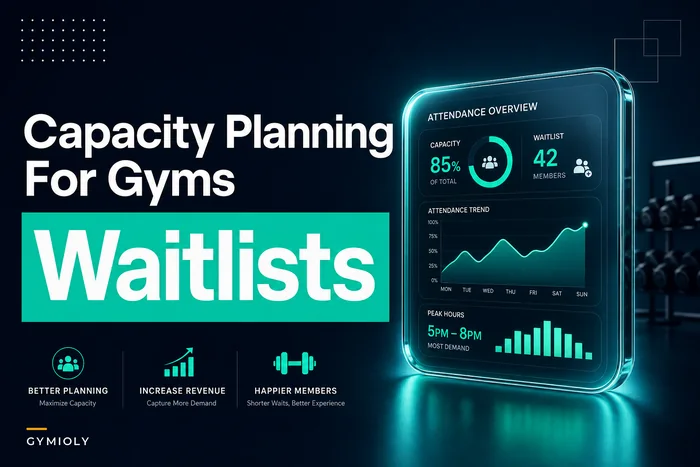
This matters more than it sounds. Class viability, instructor pay, capacity planning — all of it depends on attendance being a real number. If you're setting class limits and waitlists from historical attendance, mixing in unqualified digital "attendance" quietly corrupts that data. A class that looks healthy at 38 attendees might be 14 in the room and 24 people who opened a tab. Two completely different operational realities, and only one of them fills your floor.
So you need attendance tiers, defined explicitly:
-
Physical attended — badged in, was in the room
-
Live engaged — joined the stream and stayed past a meaningful threshold (something like 50% of runtime)
-
Live drop — joined but left early (a signal worth tracking, not attendance)
-
Replay — watched on-demand later (useful data, but not live capacity)
Each tier should drive different operations. Physical attendance drives floor capacity decisions. Live engagement tells you which streams to keep running. Live drops are a QC alarm — if half your remote audience bails in the first five minutes, something broke, probably audio or start-time drift. The point isn't to track more numbers for their own sake, it's to stop letting soft data masquerade as real operational signal.
Conversion triggers: turning a screen habit into a floor visit
This is the part that actually makes hybrid pay off, and it's the part gyms skip most often. A digital-only member at a low price point is thin margin on its own. The value is using digital as an on-ramp to the higher-margin in-person relationship — personal training, physical classes, retail, all the things that happen inside the building.
A conversion trigger is just a defined rule: when a member does X digitally, offer them Y in person. The key is making it behavior-based instead of blast-based. You're not emailing everyone. You're responding to a specific signal.
Some triggers that actually work:
-
A digital-only member streams the same class type four or more times in three weeks → invite them to attend that class in person, once, free. They already like the format. Give them the room.
-
A member watches a mobility or recovery video → offer a single in-person assessment. The content revealed the intent.
-
A remote live participant hits their sixth live stream → send a "you clearly love these — here's a floor spot held for you" message.
-
App engagement drops for an all-access member who used to come in regularly → this isn't a conversion trigger, it's a save trigger. Route it to your retention flow, not your sales one.
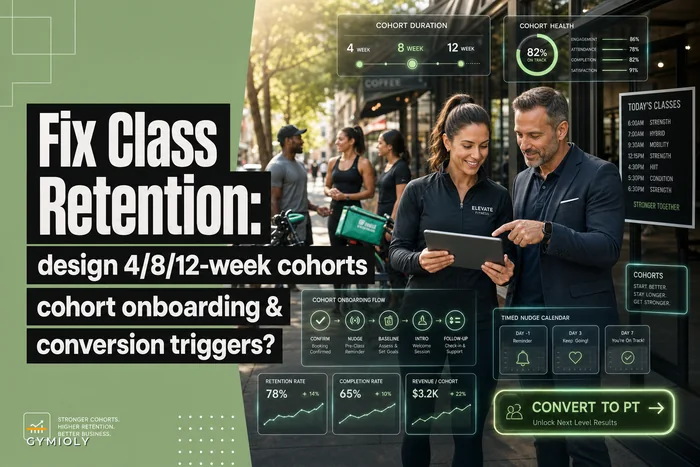
The mistake is treating digital as a separate product with a separate lifecycle. It's not. It's the top of the same funnel. If your class design already uses conversion triggers to move people from a trial series into committed membership, digital behavior is just an earlier, richer signal feeding that exact same process.
A simple conversion workflow, start to finish
-
Digital member streams a class → attendance accounting logs it as live engaged
-
System counts repeat engagement against the same class type → hits the trigger threshold
-
Entitlement mapping confirms this person is digital-only (eligible for a conversion offer, not already all-access)
-
Trigger fires
one free in-person session of that class
-
Front desk sees a flag when they check in — this is a conversion attempt, not a walk-in
-
If they attend and enjoy it → upgrade conversation, priced against the value they've already demonstrated
-
Outcome logged so you can measure conversion rate per trigger type
Every step depends on the previous system being in place. You can't fire a smart trigger if your attendance data is mush, and you can't route the offer correctly if your entitlements are a guess. This is why hybrid is a systems problem, not a marketing problem.
Visual workflow of the conversion process:
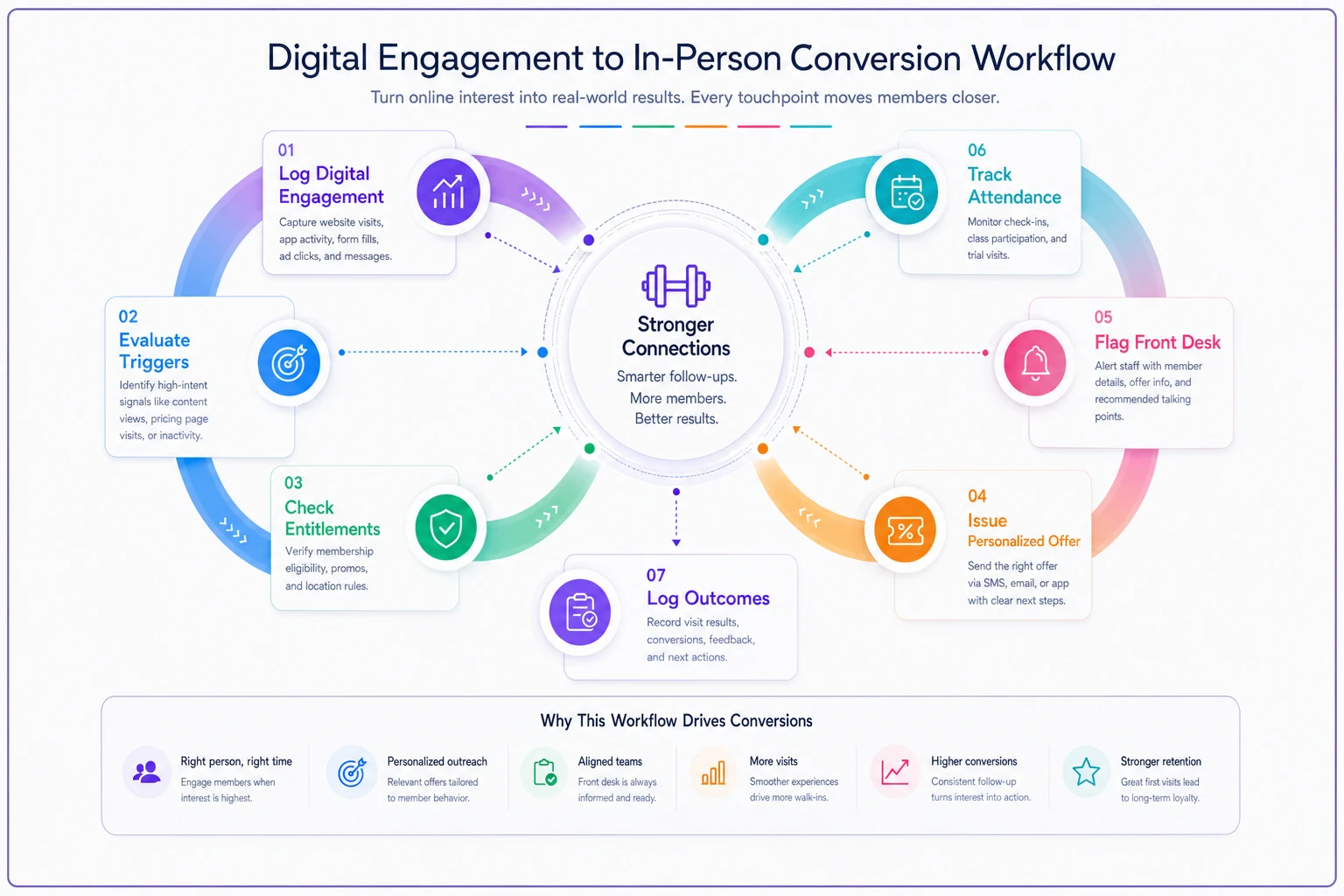
Every step depends on the previous system being in place. You can't fire a smart trigger if your attendance data is mush, and you can't route the offer correctly if your entitlements are a guess. This is why hybrid is a systems problem, not a marketing problem.
A real scenario
A single-location strength-and-conditioning gym, roughly 480 members, added a digital tier during a slow stretch and let it run basically untouched for about a year. Digital-only was priced low — around $19/month — and sat at around 90 members. On paper it looked like decent passive revenue.
The problems showed up in two places. First, the booking system was letting digital members hold physical class spots with nobody catching it — a manual audit found somewhere between 15 and 20 phantom reservations a month across their busier classes, which meant paying in-person members were getting waitlisted out of classes they were entitled to. Second, digital-only churn was quietly brutal. Those members were canceling at a much higher rate than anyone realized, because no one had built a single trigger to pull them toward the floor.
The fix wasn't complicated. They mapped entitlements so the booking system enforced the rules instead of front-desk staff catching them manually. They defined attendance tiers so their class capacity numbers stopped being polluted by drop-in stream viewers. And they built exactly two conversion triggers around repeat streamers.
Over the following months, they converted roughly a quarter of engaged digital-only members into in-person or all-access tiers — not overnight, and not everyone, but a steady drip that turned a thin-margin tier into a real acquisition channel. The phantom-booking problem basically vanished once the rules lived in the system instead of in someone's memory.
When hybrid actually makes sense — and when it doesn't
Not every gym should push hard on this. A few honest checks:
This makes sense when:
-
You have class formats that translate to a screen (conditioning, mobility, yoga, cycling)
-
You're already dealing with capacity constraints and digital gives overflow room
-
You have someone who can own broadcast QC, even part-time
This is a bad idea when:
-
Your core value is heavy coaching correction that can't happen over a stream — bad remote coaching is a liability, not a feature
-
You can't connect your digital and physical member records at all. Running hybrid on two disconnected systems means flying blind on every decision above.
-
You're launching digital purely because a competitor did, with no plan for how it feeds the floor
Who should skip this entirely for now: a gym still fighting basic operational fires — messy billing, no attendance data discipline, unclear tiers. Hybrid doesn't fix a shaky operation. It adds a whole second surface for things to break. Get the physical side's data clean first, then layer digital on top of a foundation that can actually hold it.
Hybrid doesn't fix a shaky operation. It adds a whole second surface for things to break. Get the physical side's data clean first, then layer digital on top of a foundation that can actually hold it.
What changes as you grow
At 200 members, most of this can run on human attention. One person notices the phantom bookings, the instructor's friend monitors the stream, and conversion is just the owner nudging regulars personally. It works because the surface area is small.
Somewhere past 500 or 600 members with an active digital tier, that breaks down. Too many entitlement combinations to hold in one head, too many streams to babysit, too many behavior signals to catch by eye. At that point, the connective tissue has to become rules the system enforces rather than things people remember to do.
The gyms that scale hybrid cleanly treated it as an operations problem from the start — entitlements as enforced logic, streams with a real QC routine, attendance tiered honestly, and conversion triggers wired to actual behavior. The ones that struggle treated hybrid as a marketing add-on and let the operational debt pile up quietly until it showed up as churn and confused staff. The difference usually isn't resources. It's whether someone sat down early and decided how the pieces connect.
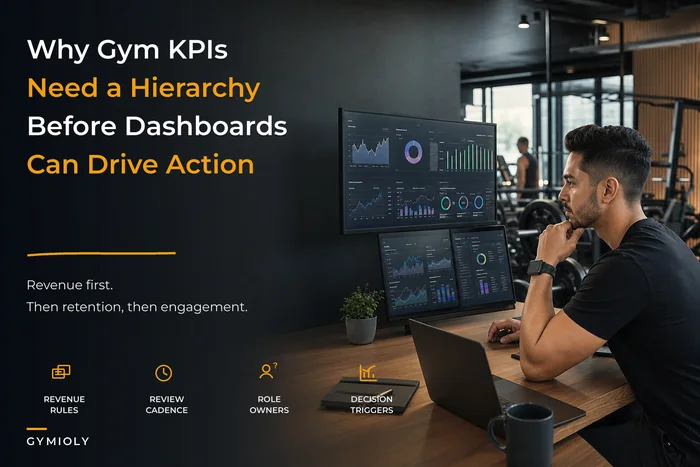
None of this is glamorous. Entitlement tables and pre-flight checklists don't feel like growth. But they're exactly the kind of unglamorous system work that decides whether your digital side feeds the floor or slowly drains it. If you're designing class experiences to move members through defined stages, the same logic applies to digital-to-floor conversion — worth reading how other gyms have approached 4–8–12 week series structures to see how progression mechanics apply here too. And before you drown in metrics, it's worth working through your measurables hierarchy — hybrid gives you ten times more data and only a fraction of it should actually drive decisions.
Build the connections deliberately. That's the whole game.
Ready to elevate your gym operations?
Join 2,000+ gyms using Gymioly to reduce admin overhead, improve member experience, and grow revenue.