



Most gym owners think their people costs are high because wages went up or they hired too many people. That's rarely the real story. What's actually happening is that pay, promotions, bonuses, and role changes get made one at a time, with no connection back to revenue or the P&L. A raise here. A "manager" title there. A trainer bonus someone verbally promised in the parking lot. Three years later you've got a payroll structure that no spreadsheet can explain and margins that keep sliding no matter how many members you sign.
This is the part of gym operations that almost nobody governs on purpose. Everyone builds SOPs for the front desk and the sales floor. Almost no one builds governance around how compensation ties to competency, how leadership gets developed, and how retention actually shows up in someone's paycheck. That gap is where cost leakage lives.
The core problem: compensation grows faster than accountability
This pattern shows up in a huge number of single-site and small multi-site gyms. In the early days the owner does everything, so pay decisions are simple. You hire a coach, you pay them what feels fair, done. There's no framework because there doesn't need to be — you're the framework.
Then you grow. You promote your best trainer to "head coach." You give the front desk lead a bump because they've been loyal. You add a sales manager. Every one of those was a reasonable decision in isolation. But none of them were tied to a defined level of responsibility, a measurable outcome, or a line on the P&L. You didn't buy accountability. You bought a higher fixed cost.
What tends to happen across these businesses is that labor as a percentage of revenue creeps from a healthy 38–44% up into the low 50s over roughly two to three years — and the owner can't point to a single decision that caused it. That's the tell. Cost leakage almost never comes from one big mistake. It comes from twenty small pay decisions nobody wrote down or connected to anything.
The fix isn't cutting pay. It's building a structure where every dollar of compensation maps to a competency level and a revenue outcome. When those two things aren't linked, you're just paying for tenure and titles.
Where the gaps actually form
There are four connected failure points, and they feed each other. Miss one and the others get worse.
End appointment chaos and boost attendance.
Gymioly streamlines booking, confirms sessions, and manages memberships effortlessly.
- Unified class and membership management
- Automated member notifications
- Trainer scheduling and availability
No credit card required
1. No competency ladder. Roles exist as titles ("coach," "senior coach," "manager") but nobody defined what separates the levels. So promotions become emotional or political instead of based on demonstrated skill. A coach who's great with people but never learned to run a class business gets promoted anyway, and now you're paying manager money for coach output.
2. Comp not linked to the P&L. Bonuses and raises get decided based on how the owner feels about the month, not against a defined revenue or margin target. This is the biggest leak. You end up rewarding activity, not results.
3. Leadership developed by accident. Nobody has a plan for turning a good coach into someone who can run a shift, own a KPI, or develop other staff. So when you need a leader, you either promote someone unready or hire externally at a premium.
4. Retention that isn't anyone's paid job. Everyone "cares about retention" but no one's compensation actually moves based on it. If retention is everyone's responsibility, it's no one's.
These four aren't separate problems. A missing competency ladder makes leadership development harder, which makes retention accountability harder, which means comp drifts further from outcomes. It's a chain. Governance is what holds the chain together.
Building the competency ladder that comp attaches to
Before you touch a single pay number, you need levels that mean something. The point of a ladder isn't hierarchy for its own sake — it's so that when someone moves up, you know exactly what new value you're paying for.
Keep it simple. Most single-site gyms need three or four levels per function, not eight. Here's a workable structure for coaching staff:
| Level | Owns | Comp basis | Example indicators |
|---|---|---|---|
| Coach I | Their own sessions and members | Base + session rate | Delivers programmed sessions, hits attendance basics |
| Coach II | Own book + retention of their members | Base + retention component | Manages a member book, low session no-shows, strong renewals |
| Lead Coach | A time block / shift + junior coach support | Higher base + block KPI bonus | Runs a shift profitably, mentors Coach I staff |
| Coaching Manager | Full function P&L line | Salary + margin-linked bonus | Owns coaching payroll %, staffing mix, and retention outcomes |
The critical rule: you don't get the pay of the next level until you're demonstrating the outputs of the next level. Not the title first and hope. The behavior first, then the title and pay. This single governance rule eliminates more cost leakage than almost anything else, because it stops you from paying for potential you never collect on.
If you've already worked through hiring scorecards and structured onboarding — which pairs directly with the thinking in people-ops mistakes that spike turnover — the ladder becomes the natural next layer. Onboarding gets someone to competent. The ladder defines what "beyond competent" is worth paying for.
Linking compensation frameworks to the P&L
A raise or bonus should be traceable to a specific line on your profit and loss. If you can't draw that line, you're guessing.
The cleanest way to think about it: every variable comp dollar should be funded by the outcome it's meant to drive. Retention bonuses come out of retained revenue. Class-block bonuses come out of that block's contribution margin. Sales incentives come out of new revenue net of whatever discount was offered. When comp is self-funding, it can't leak — because it only pays out when the money that funds it has already shown up.
A typical example looks like this. Say a Lead Coach owns the 5–8pm block. That block does roughly $18k–$22k in attributable monthly revenue. You set a margin target for the block, and if it clears the target, the Lead Coach earns a bonus that's a defined slice of the margin above target — not top-line revenue. Their bonus is literally paid for by performance you can see on the P&L. If the block underperforms, the bonus doesn't fire, and you're not out of pocket.
Compare that to the common version: "You've been doing great, here's an extra $400 a month." That $400 is now a permanent fixed cost with no revenue attached to it. Multiply by five staff over two years and you've built a five-figure annual leak that renews itself automatically.
Governance rules that prevent comp leakage:
-
No permanent raise without a competency level change on the ladder
-
No bonus without a defined funding source on the P&L
-
No verbal comp promises — everything in writing, dated, and tied to a metric
-
Variable pay is preferred over fixed pay for anything performance-driven
-
Every comp change gets a single owner who signs off (usually you, until you build the manager layer)
-
Annual review of total labor % against revenue, not just individual salaries
That fifth rule matters more than it looks. In a lot of gyms, three different people can effectively grant pay changes — the owner, a manager, and sometimes a senior coach making promises. Governance means one approval path. Multiple approval paths are how you end up with pay you don't remember agreeing to.
Leadership 90-day sprints instead of vague "development"
"Developing leaders" is one of those things everyone agrees with and nobody does, because it has no shape. The fix is to make it a defined 90-day sprint with a specific outcome, tied to a ladder move.
When you decide a Coach II is ready to become a Lead Coach, you don't just change their title. You run a 90-day sprint where they take on the leadership responsibilities before the full pay change, with support and a clear scorecard. At the end, either they've demonstrated the outputs — and the comp change is now justified and self-funding — or they haven't, and you've learned that cheaply instead of by carrying a mispriced salary for a year.
Here's a workable sprint structure:
-
Weeks 1–2 Shadow the responsibility. Lead Coach candidate sits in on shift-level decisions, staffing, and the KPIs they'll own. Define exactly which numbers they'll be accountable for.
-
Weeks 3–6 Co-own with a safety net. They start running their block or function with the current leader reviewing decisions. First real KPI reads come in.
-
Weeks 7–10 Own it with reduced support. They're driving the outcome; you're reviewing weekly, not daily. The KPI trend tells you if this is working.
-
Weeks 11–13 Decision window. Did the block margin, retention, or staffing metric hold or improve under them? If yes, confirm the ladder move and the funded comp change. If no, keep them at current level and reassess.
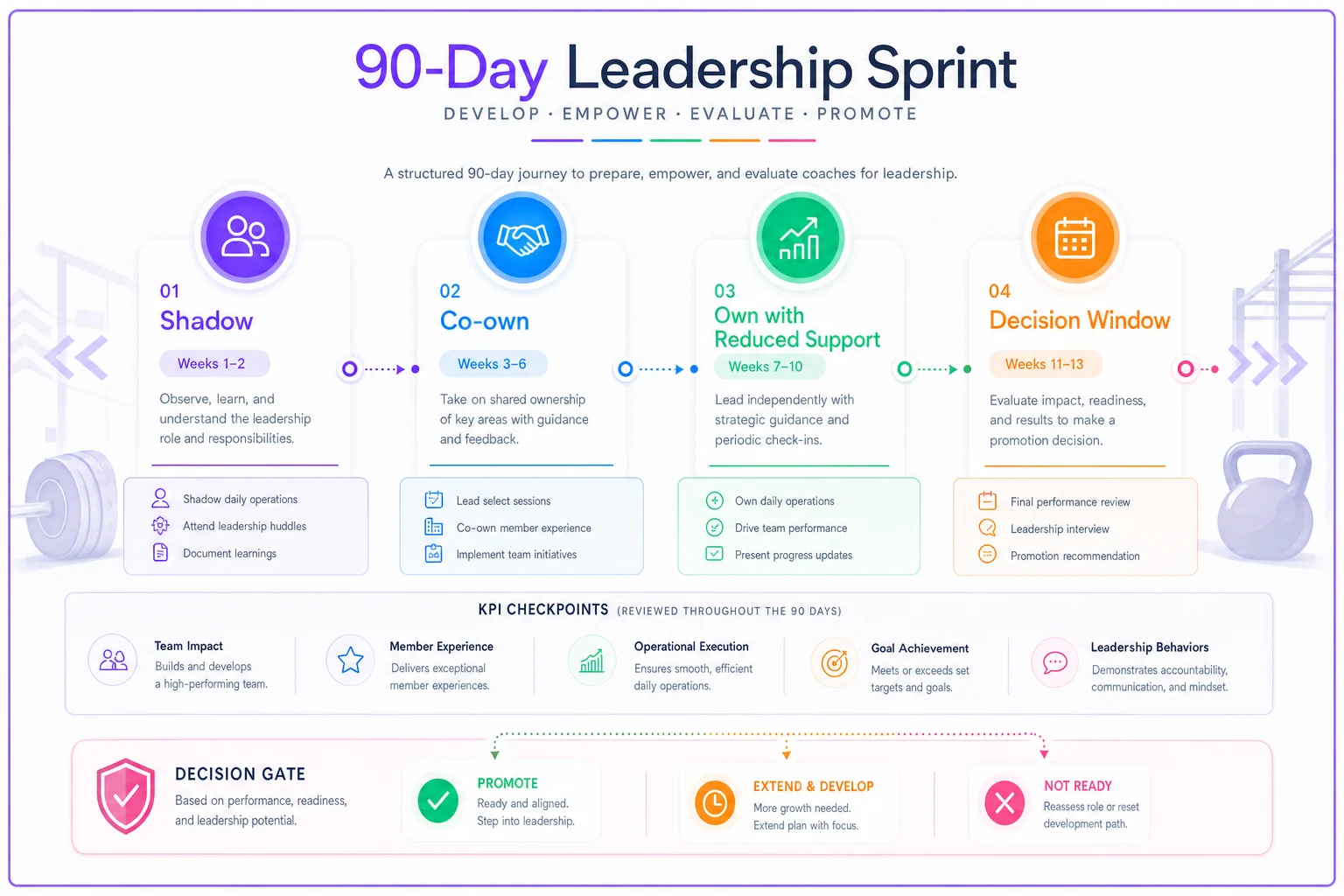
The 90-day frame isn't arbitrary — it's long enough for a retention or margin trend to show up, short enough that a bad fit doesn't become an expensive permanent cost. This same rollout logic mirrors what works when you build any repeatable function; the approach in turning member success into a repeatable function applies the same 90-day discipline to a different role, and it's worth reading alongside this.
Retention KPIs that actually move a paycheck
This is where the whole system either earns its keep or falls apart. Retention is the single biggest revenue lever most gyms have, and it's almost never in anyone's variable comp. Everyone gives it lip service. Nobody's pay changes when it moves.
The problem is usually that owners tie comp to metrics staff can't control, or to metrics that are too slow to be motivating. If you bonus a coach on gym-wide retention, they'll rightly point out that half of churn has nothing to do with them. If you bonus on annual retention, the feedback loop is too long to change behavior.
The fix is attaching retention to the smallest unit of accountability that still connects to revenue — usually a coach's own member book or a specific class block. A coach can genuinely influence whether their members keep showing up. That's the number to pay against.
The last one is underrated. Retention outcomes are lagging; the behavior that drives them is leading. Paying partly on whether someone did the retention work — the check-in, the reschedule save, the re-engagement message — gives you something to reward now instead of three months from now. Trainer time discipline connects here too; a lot of retention quietly leaks through no-shows and unrecovered reschedules, which is the terrain covered in stopping wasted trainer hours.
A retention KPI structure that holds up:
-
Book-level retention for Coach II and up — % of their assigned members active at 90 days
-
Block-level retention for Lead Coaches — the block's rolling retention against a set floor
-
Attendance-signal follow-up — did outreach happen when a member's visits dropped (a leading indicator you can pay on before churn even shows in revenue)
Pay a small variable amount for timely outreach when a member's visits drop — it's a leading indicator you can reward immediately.
That last one is underrated. Retention outcomes are lagging; the behavior that drives them is leading. Paying partly on whether someone did the retention work — the check-in, the reschedule save, the re-engagement message — gives you something to reward now instead of three months from now.
A quick real scenario
A single-location gym, around 520 members, roughly $95k monthly revenue. Labor had drifted to about 51% of revenue. When we mapped their payroll against actual responsibility, three "senior" staff were being paid at a lead level but only delivering coach-level output — leftover from loyalty raises given two years earlier. There was no ladder, so nothing had ever forced the question.
They rebuilt comp around a three-level ladder, ran two 90-day leadership sprints, and moved retention onto book-level KPIs for their senior coaches. They didn't cut anyone's base. What changed was that new comp dollars only went out when they were funded by margin or retention, and two of the three overpaid staff either stepped up into the responsibility their pay implied or moved back to a rate that matched their actual output.
Over the following couple of quarters, labor settled back toward the mid-40s as a percentage of revenue — not from firing, but from stopping the leak and aligning pay with what people actually owned. Retention on the senior coaches' books improved noticeably once it was a paid, tracked number instead of a general hope. The owner's words afterward were something like: "I wasn't overstaffed. I was under-organized."
When this system makes sense — and when it doesn't
When it makes sense: You have five or more staff, you've promoted people without a clear framework, or your labor percentage is drifting up without an obvious cause. If you can't explain every raise on your payroll in one sentence tied to an outcome, you need this.
When it's a bad idea to over-build it: If you're a two-person operation, don't construct a four-level ladder and a formal sprint process. You'll spend more time governing than operating. Keep it in your head and one document until the headcount justifies structure. Governance should match your scale, not exceed it.
Who should NOT do this yet: Gyms in pure survival mode with cash flow problems this month. Fix the cash and the immediate revenue first — comp governance is a stabilizing system, not a rescue system. Build it when you have enough breathing room to run 90-day sprints properly instead of reacting week to week.
Where the software layer quietly helps
None of this requires fancy tooling to design — it requires it to hold. The reason comp governance breaks in practice isn't that owners don't understand it. It's that tracking ladder levels, funding sources, block-level margin, and book-level retention across a dozen staff by hand is genuinely hard, and the tracking slips first. Once the tracking slips, the leaks come back.
An operational platform that ties staff KPIs to actual attendance, retention, and revenue data earns its place here. When retention numbers, block margins, and follow-up activity get surfaced automatically — instead of reconstructed from memory at bonus time — the governance rules can actually be enforced without you personally auditing everything. AI-assisted operational software mostly earns its keep by removing the manual reconciliation that causes owners to abandon the framework after two months. The system isn't what makes the decisions; it's what makes sure the decisions you already committed to don't quietly stop happening.
Bringing it together
People and culture costs don't spike because your team is expensive. They spike because pay, promotions, and retention drift apart from the P&L one small decision at a time, and nothing pulls them back. A competency ladder gives every pay level a meaning. P&L-linked comp makes sure every dollar is funded by an outcome. Leadership sprints let you test readiness before you price it in. And retention KPIs tied to real books and blocks turn your biggest revenue lever into something someone actually gets paid to protect.
Build those four so they reinforce each other, keep the governance rules boring and consistent, and your labor line stops being a mystery. The gyms that get this right aren't paying less — they're paying on purpose. That's the difference between people cost as a leak and people cost as an investment you can actually see returning on the P&L.
People and culture costs don't spike because your team is expensive. They spike because pay, promotions, and retention drift apart from the P&L one small decision at a time, and nothing pulls them back. A competency ladder gives every pay level a meaning. P&L-linked comp makes sure every dollar is funded by an outcome. Leadership sprints let you test readiness before you price it in. And retention KPIs tied to real books and blocks turn your biggest revenue lever into something someone actually gets paid to protect.
Build those four so they reinforce each other, keep the governance rules boring and consistent, and your labor line stops being a mystery. The gyms that get this right aren't paying less — they're paying on purpose. That's the difference between people cost as a leak and people cost as an investment you can actually see returning on the P&L.
Ready to elevate your gym operations?
Join 2,000+ gyms using Gymioly to reduce admin overhead, improve member experience, and grow revenue.