

Most gyms don't have a non-dues revenue problem. They have a too-many-unmanaged-experiments problem. Someone sells a workshop. A trainer launches a small-group program. The front desk starts stocking shaker bottles. A local employer asks about a corporate rate. Each makes a little money, so nobody kills them — and nobody really scales them either. They just sit there, half-alive, eating staff attention and never showing up cleanly in the P&L.
The gyms that actually build a durable gym non-dues revenue strategy treat these channels like a product portfolio, not a pile of side hustles. They decide — on purpose — what gets to exist, what gets funded, what gets killed, and when. This article is about the system behind that: the portfolio map, the validation thresholds, the go/no-go rules, the micro-P&L gates, and the lifecycle governance that keeps your non-dues lineup from turning into clutter.
The real problem: you're running a portfolio but managing it like a to-do list
Think about how a retailer manages SKUs. Every product has a cost, a margin, a shelf-space cost, a sell-through rate, and a lifecycle — introduction, growth, maturity, decline. When a SKU underperforms, it gets delisted. Space is finite, so weak products get cut to make room for stronger ones.
Gyms almost never apply this thinking to their non-dues lineup. The typical operation looks like this: events live in one person's head, retail lives in a POS nobody reconciles, PT funnels live in whatever the trainers feel like doing that month, and corporate contracts live in the owner's email. There's no single view where you can say "these four channels made us $X, cost us $Y in labor and space, and here's which one deserves more investment next quarter."
-
Zombie channels. Programs that technically generate revenue but lose money once you load in trainer time, admin, and space. Nobody kills them because "it still brings in a few hundred bucks."
-
Starved winners. The one channel that's actually profitable never gets more staff, better scheduling, or marketing budget, because attention is spread evenly across everything.
-
Invisible cannibalization. A new small-group program quietly pulls members out of 1:1 PT (higher margin) into the cheaper offering, and net revenue drops even though "attendance is up."
You can't fix any of this one program at a time. You fix it by building the layer above the programs.
Step one: build the portfolio map
Before you optimize anything, you need to see everything on one page. A portfolio map is just a structured inventory of every non-dues channel, grouped by type, with the handful of numbers that actually matter.
End appointment chaos and boost attendance.
Gymioly streamlines booking, confirms sessions, and manages memberships effortlessly.
- Unified class and membership management
- Automated member notifications
- Trainer scheduling and availability
No credit card required
Group your channels into four buckets. Most gyms have all four, even if they've never named them:
-
Events — workshops, seminars, challenges, member socials with a ticket price, bring-a-friend days, competitions.
-
Retail — apparel, supplements, recovery gear, grab-and-go, branded merch.
-
PT / program funnels — 1
1 training, semi-private, small-group, specialty programs (nutrition, rehab, sport-specific).
-
Corporate / partnerships — employer contracts, onsite classes, local business revenue-shares.
For each channel, track five things and nothing more for now:
| Channel | Monthly gross | Loaded cost (labor + space + COGS) | Contribution margin | Staff hours/week | Lifecycle stage |
|---|---|---|---|---|---|
| Intro workshop series | ~$1,800 | ~$1,100 | ~$700 | 6 | Growth |
| Supplement retail | ~$2,400 | ~$1,950 | ~$450 | 3 | Mature/declining |
| Small-group PT | ~$5,200 | ~$2,800 | ~$2,400 | 14 | Growth |
| Corporate onsite | ~$3,000 | ~$1,600 | ~$1,400 | 5 | Introduction |
The loaded cost is where most owners cheat themselves. They'll count the trainer's pay but not the fact that the small-group program occupies the floor during a slot that could've held two 1:1 sessions. Space has an opportunity cost. So does the front desk's time ringing up protein bars. If you don't load those in, every channel looks more profitable than it is, and your delisting decisions will be wrong.
The point of the map isn't precision to the dollar — it's relative ranking. Once you can see that supplement retail produces $450/month on 3 staff hours while small-group produces $2,400 on 14, you can start making real allocation decisions. If you want a deeper framework for building these micro-models before you commit, the unit-economics approach to validating non-dues revenue pairs directly with this map.
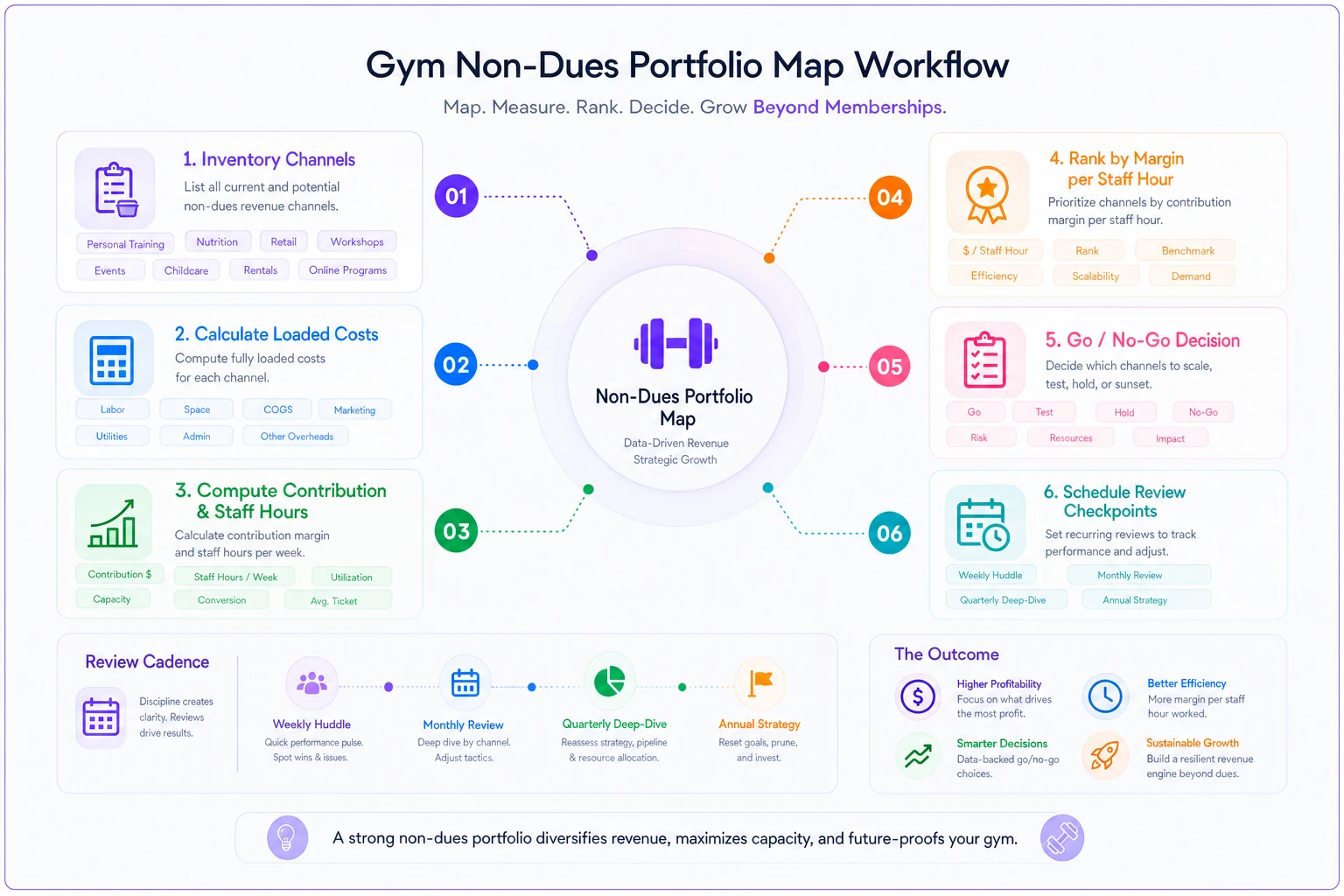
A quick visual of the portfolio-map workflow to reference during your first pass.
The gyms that actually act on the map use it to make quick allocation choices each quarter rather than debating individual programs in isolation.
Step two: validation thresholds (so you stop funding guesses)
New non-dues ideas are cheap to launch and expensive to maintain. The validation stage exists to answer one question: does this deserve to become a real channel, or was it a one-time novelty?
The mistake almost everyone makes — they validate on revenue instead of on repeatability. A workshop that sold out once tells you almost nothing. A workshop that sold 70% of capacity three times in a row with declining marketing effort tells you something real.
Set thresholds before you launch, not after. A workable validation frame for a new channel:
-
Demand threshold Can it hit at least 60–70% of planned capacity without discounting, across a minimum of 3 runs?
-
Margin threshold Does contribution margin clear a floor you set in advance (say, 35–40% after loaded cost)?
-
Effort threshold Does it require less than a defined number of founder/manager hours per cycle to run? If it only works when you personally babysit it, it isn't a channel yet.
-
Repeat signal Do you see the same members coming back, or new members entering, without reinflating ad spend each time?
A real example of how this plays out: a mid-sized gym ran a "6-week nutrition challenge" that grossed roughly $2,600 the first time and felt like a hit. Second run, gross dropped to around $1,400 and it ate nearly 20 hours of staff time between coaching and admin. The margin looked fine on paper, but the effort threshold blew up and demand didn't repeat. Under a proper validation rule, that program never graduates — it stays an occasional event, not a core channel. Without the rule, the gym would've kept pouring staff hours into it out of sunk-cost loyalty.
Step three: go/no-go rules that are actually enforceable
Validation tells you whether something can work. Go/no-go rules decide whether you proceed — and critically, who gets to make that call.
The failure here is squishy decisions. "Let's give it another quarter" is how zombie channels get born. A go/no-go rule needs three components to be real:
-
A metric. Not a feeling. Contribution margin, capacity fill, repeat rate — whatever you defined at validation.
-
A cutoff. The specific number that triggers action.
-
An owner. One named person accountable for making the call on the review date, not "the team."
A simple go/no-go structure:
| Decision | Trigger condition | Action |
|---|---|---|
| Go / scale | Clears all validation thresholds for 3 consecutive cycles | Allocate more hours, formalize SOP, add to portfolio map as "growth" |
| Hold / iterate | Clears demand but misses margin | One iteration cycle to fix pricing or cost; re-review in 30 days |
| No-go / sunset | Misses demand OR effort threshold twice | Kill it or demote to occasional event |
The discipline that matters most: a "hold" can only be used once before it must resolve into a go or a no-go. Gyms that let things sit in "hold" indefinitely are just avoiding the kill decision. Put an expiration date on indecision.
Step four: micro-P&L thresholds per channel
A portfolio map gives you the bird's-eye view. A micro-P&L gives each channel its own small income statement so you can manage it like its own little business.
This matters because channels fail at different points. Retail usually fails on inventory and shrink, not demand. Events usually fail on labor-to-attendance ratio. PT funnels usually fail on trainer utilization. A single P&L format across all four lets you compare them, but each needs channel-specific thresholds baked in.
For retail specifically, margin leaks hide in slow-moving SKUs and sloppy reconciliation far more than in pricing. If retail is a meaningful chunk of your portfolio, the mechanics in why gym retail leaks margin — SKU targets and POS reconciliation go deeper than what I'll cover here.
Build each micro-P&L with these lines:
-
Gross revenue
-
COGS (for retail) or direct delivery labor (for events/PT/corporate)
-
Allocated space cost (opportunity cost of the slot/floor)
-
Allocated admin/front-desk cost
-
Marketing/acquisition cost
-
Contribution margin (the number that drives decisions)
-
Staff hours consumed (tracked separately — margin per staff hour is often more revealing than margin alone)
Track margin per staff hour as a primary column in your portfolio map so reallocation choices are obvious during monthly reviews.
The insight that tends to actually change behavior: margin per staff hour is usually a better ranking metric than total contribution margin. A channel might produce $2,400/month and look like your star, but if it burns 60 staff hours while another produces $900 on 8 hours, the second one is your real engine for scaling. Staff time is the constraint, not revenue.
Step five: SKU and product lifecycle governance
Every non-dues offering ages. The challenge-based program that crushed last January gets tired by its fourth run. The supplement line that sold well now has three dead SKUs cluttering the shelf. Without lifecycle governance, you accumulate dead weight and never make room for new winners.
Treat every channel — and within retail, every SKU — as moving through four stages:
-
Introduction Being validated. Minimal investment, close monitoring, strict go/no-go timeline.
-
Growth Clearing thresholds, deserves more hours, marketing, and formalized SOPs so it doesn't depend on one person.
-
Maturity Stable and profitable. Goal shifts from growth to efficiency — same output, fewer staff hours, tighter costs.
-
Decline Falling demand or margin. Decision point: refresh it, reprice it, or sunset it.
The governance mistake almost nobody catches: gyms obsess over introduction and growth but completely ignore maturity and decline. Nobody reviews the mature channels because "they're fine." Meanwhile, a mature small-group program slowly drifts from 85% full to 55% full over eight months, and nobody notices until the margin craters. Mature channels need a quarterly review specifically to catch early decline, not just a check-in on the new stuff.
For retail SKUs, the rule is more mechanical: set a sell-through window (any SKU that doesn't move 70% of a reorder quantity within 90 days gets flagged), and run a disciplined delist/discount decision. Dead SKUs don't just tie up cash — they make your retail space look stale, which quietly suppresses the whole category's sales.
A note on member-led and community revenue
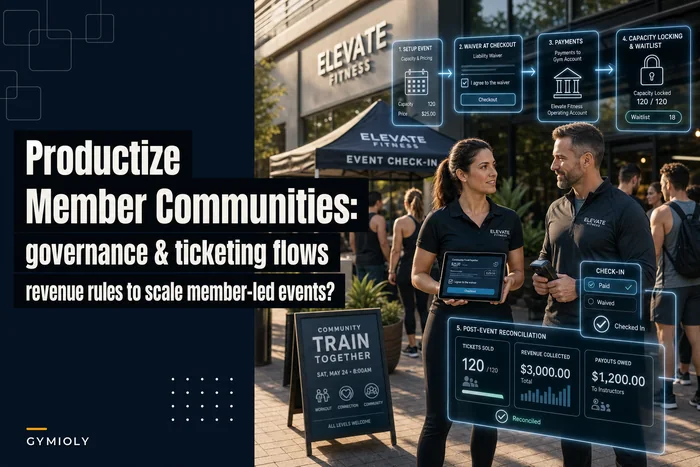
Some of your best non-dues channels won't be things you run — they'll be things your members run with your infrastructure: member-organized events, community challenges, social meetups that drive ancillary spend. These need lighter governance but clearer revenue rules, because the accountability is shared. The approach to productizing member communities with governance and revenue rules fits into this portfolio as its own distinct channel type with its own thresholds.
Lighter governance doesn't mean no governance. You still need to know who owns the ticketing, where the money goes, and what happens when an event flops. The only difference is the accountability structure — it's shared rather than internal.
How this breaks as you scale
At a single location with one owner, you can run the portfolio in a spreadsheet and your head. The coordination cost is low because it's all one person. The system still helps, but it's survivable without it.
The moment you add a second location — or even a second manager at one site — the informal system collapses. Each location starts spawning its own events and retail choices. Validation gets applied inconsistently. One manager kills programs fast, the other never does. Corporate deals get negotiated with no shared pricing discipline. You end up with a portfolio that's technically bigger but harder to read than when you were smaller.
What scales cleanly is the governance, not the programs. The programs should vary by location and local demand. The thresholds, the go/no-go rules, the micro-P&L format, and the review cadence need to be identical everywhere. That's the difference between a franchise-ready operation and a collection of gyms that happen to share a logo.
This is also where centralizing the data stops being optional. When your portfolio map, micro-P&Ls, and lifecycle stages live in one place instead of four disconnected systems, the review meetings get fast and the kill decisions get easier. Operational platforms that pull revenue, labor hours, and POS data together let you see margin-per-staff-hour per channel without someone rebuilding a spreadsheet every month — which is usually the hidden reason these reviews stop happening at all. The review doesn't die because owners don't care; it dies because assembling the numbers takes four hours nobody has.
When this system makes sense — and when it doesn't
When it makes sense:
-
You have at least three distinct non-dues channels and can't cleanly say which is most profitable.
-
Non-dues revenue is more than a rounding error — say, north of 10–15% of total revenue.
-
You're planning to add staff, locations, or significantly expand programming.
When it's overkill:
-
You run one small retail shelf and nothing else. You don't need portfolio governance for a single channel — you need good reconciliation.
-
You're pre-product-market-fit on your core membership. Fix dues and retention first; non-dues is a multiplier, not a foundation.
Who should NOT do this yet:
Gyms still losing members faster than they acquire them. Non-dues channels built on top of a leaky membership base just add complexity to a sinking operation. Stabilize the core first, then productize the edges.
A short real scenario
A single-location strength gym was running five non-dues channels: 1:1 PT, small-group, a supplement shelf, periodic workshops, and one small corporate contract. Total non-dues was somewhere around $11k–$12k a month, and the owner assumed PT and supplements were the stars.
When they built the portfolio map and loaded in space and admin costs, the picture flipped. Supplements were netting around $400/month on real margin after shrink and front-desk time. The workshops looked break-even but consumed 15–18 staff hours per run. Small-group, which the owner treated as secondary, was producing the best margin per staff hour by a wide margin.
They applied go/no-go rules. Supplements got cut to three fast-moving SKUs and shifted to a near-zero-maintenance setup. The weakest workshop format was sunset. The freed-up staff hours — roughly 20 a week — got reallocated to expanding small-group slots. Over the next quarter, non-dues contribution margin rose by somewhere in the 25–30% range even though total non-dues revenue barely moved. They weren't making more money by doing more. They were making more by doing less of the wrong things.
That's the whole point of portfolio governance. Growth isn't the goal. Allocation is.
Where to start
Don't try to build all five layers at once. Start with the portfolio map — just get every channel onto one page with honest loaded costs. That single exercise usually reveals one zombie channel and one starved winner within an afternoon. Make those two decisions first. Then add validation thresholds for your next new idea, so you stop launching things you can't measure. The go/no-go rules, micro-P&Ls, and lifecycle reviews layer on naturally from there.
The gyms that win at non-dues aren't the ones with the most programs. They're the ones who can look at their lineup and tell you, without hesitation, which three channels deserve more investment and which two are getting cut next quarter. That clarity — not any single clever offer — is what turns scattered side revenue into a real, scalable part of the business.
The gyms that win at non-dues aren't the ones with the most programs. They're the ones who can look at their lineup and tell you, without hesitation, which three channels deserve more investment and which two are getting cut next quarter. That clarity — not any single clever offer — is what turns scattered side revenue into a real, scalable part of the business.
Ready to elevate your gym operations?
Join 2,000+ gyms using Gymioly to reduce admin overhead, improve member experience, and grow revenue.