

Most gym owners get into employer deals backwards. They land a verbal "yes" from an HR manager, scramble to put together a one-page proposal, and then spend the next six months improvising everything that follows the signature. The sale was the easy part. What breaks — quietly, expensively — is the machinery underneath: who verifies eligibility, how invoices get reconciled, what happens when headcount shifts mid-term, and whether anyone can actually prove the program is worth renewing.
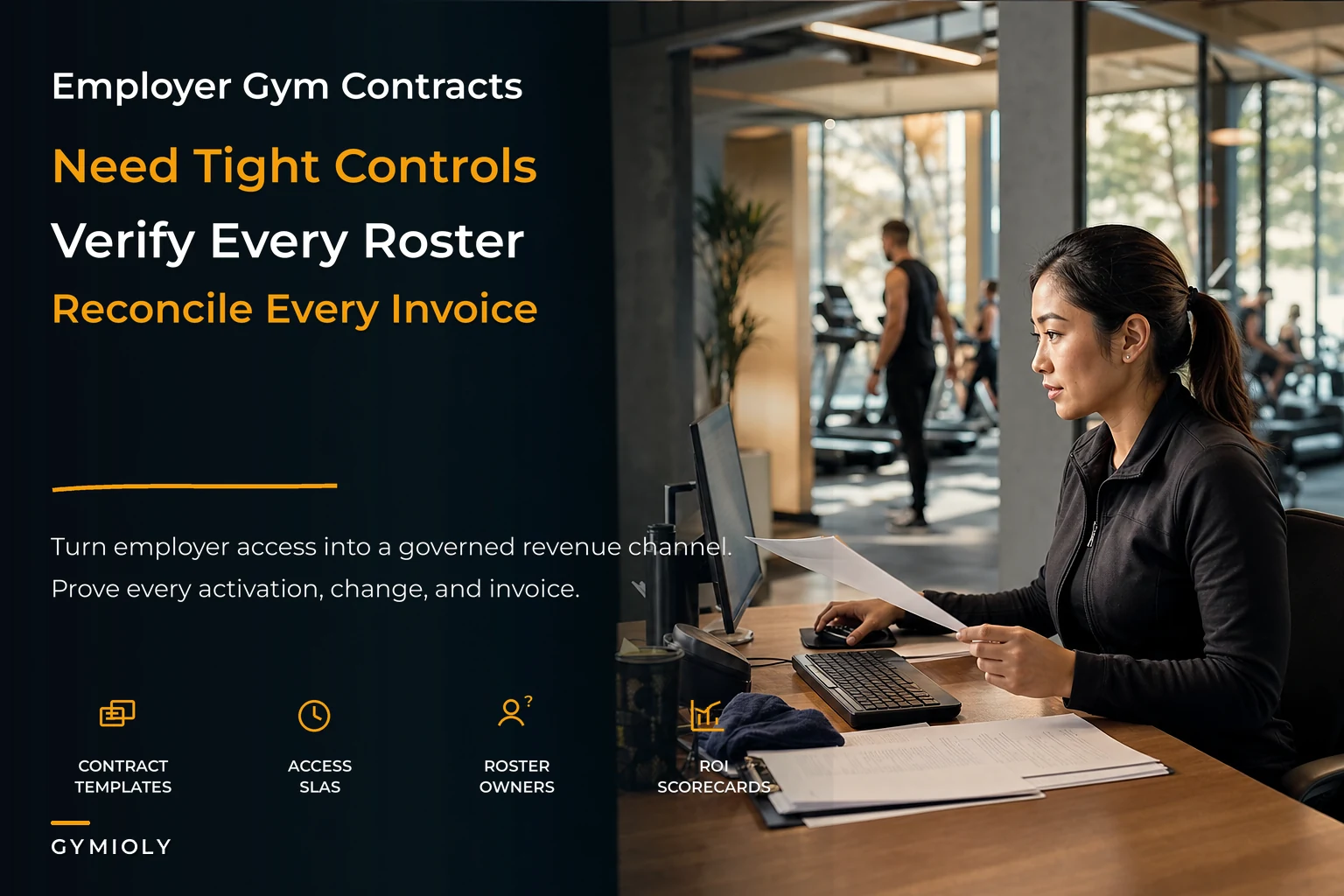
A corporate wellness deal isn't a transaction. It's a commercial relationship with a lifecycle, and if you don't design that lifecycle intentionally, it decays on its own schedule. The whole point of a gym enterprise partnerships playbook is to treat the contract, the verification process, the billing rhythm, and the performance reporting as one connected system — because when one piece drifts, the rest follow.
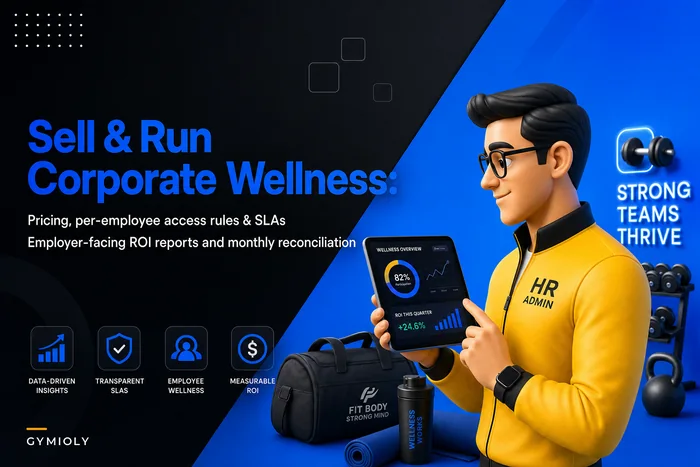
If you haven't already built the pricing and per-employee access logic underneath these deals, that foundation comes first — the mechanics of pricing, per-employee access rules, and employer-facing ROI reports are the layer this playbook sits on top of. This article is about everything that happens after you've figured out what to charge: the contract, the SLAs, the billing cadence, and the scorecards.
The core problem: you're now running a B2B operation inside a B2C business
A standard gym runs on individual memberships. Someone signs up, their card gets charged monthly, and if it fails you chase them directly. Simple loop.
Employer and B2B channels break that loop in three ways at once:
-
The payer isn't the user. The employer pays, but the employee shows up. That split means your billing and your verification are now two separate workflows that have to stay in sync.
-
The volume arrives in batches. Instead of one signup, you onboard 40 people in a week. Instead of one card decline, you get a single invoice dispute that threatens the entire account.
-
The relationship has a decision-maker who never walks through your door. The HR or benefits lead renews or kills the contract based on a report, not on how the gym feels.
Gyms are excellent at the first loop and have essentially zero muscle for the second. They sell the deal with consumer instincts and then get blindsided when the operational demands look nothing like managing memberships.
If you haven't already built the pricing and per-employee access logic underneath these deals, that foundation comes first — the mechanics of pricing, per-employee access rules, and employer-facing ROI reports are the layer this playbook sits on top of. This article is about everything that happens after you've figured out what to charge: the contract, the SLAs, the billing cadence, and the scorecards.
Start with the contract template — because everything downstream inherits its mistakes
The contract is where most of the future pain gets written in, usually by omission. A thin contract doesn't just create legal risk — it creates operational ambiguity, which is worse because it shows up every single month.
End appointment chaos and boost attendance.
Gymioly streamlines booking, confirms sessions, and manages memberships effortlessly.
- Unified class and membership management
- Automated member notifications
- Trainer scheduling and availability
No credit card required
Here's what a workable employer contract template needs to nail down, and why each piece connects to operations later:
1. Eligibility definition and headcount basis. Who counts as "covered"? Full-time only? Dependents? Contractors? This single clause drives your entire verification workflow. If it's vague, your front desk becomes the de facto eligibility police, and they will get it wrong.
2. Billing model and true-up mechanics. Are you charging a flat access fee, per-active-employee, or per-enrolled? And critically — what happens when headcount changes mid-term? A true-up clause (a scheduled reconciliation of actual usage vs. billed amount) prevents the awkward quarterly argument about why the invoice doesn't match their roster.
3. Verification SLA. How fast do you confirm a new employee's eligibility, and how fast does the employer confirm terminations? If an employee leaves the company but keeps swiping their access for three months, you're either eating the cost or clawing it back — neither option is great.
4. Performance reporting commitments. What do you report, how often, and by when. This is the clause that protects the renewal. Promise a quarterly scorecard and deliver nothing, and the renewal conversation starts from a deficit.
5. Term, renewal, and exit. Auto-renew vs. active renewal, notice periods, and what happens to employees' access during a wind-down.
The mistake that compounds: gyms copy a generic membership agreement, slap a company name on it, and never define the true-up or verification SLA. Then month three arrives and nobody knows whose job it is to reconcile the roster.
Verification SLAs: the invisible workflow that decides your margin
This is the part almost everyone underestimates. In a B2B deal, verification is a continuous process, not a one-time setup — and it directly determines whether you're billing accurately.
The workflow in plain terms:
-
Employer sends a roster (new hires, terminations, status changes).
-
You reconcile that roster against your active access list.
-
You activate the adds and deactivate the drops within the SLA window.
-
You flag discrepancies back to the employer (people on your list who aren't on theirs, and vice versa).
-
You log everything so the monthly invoice reflects real, verified access.
Here's a quick flow of that verification process.
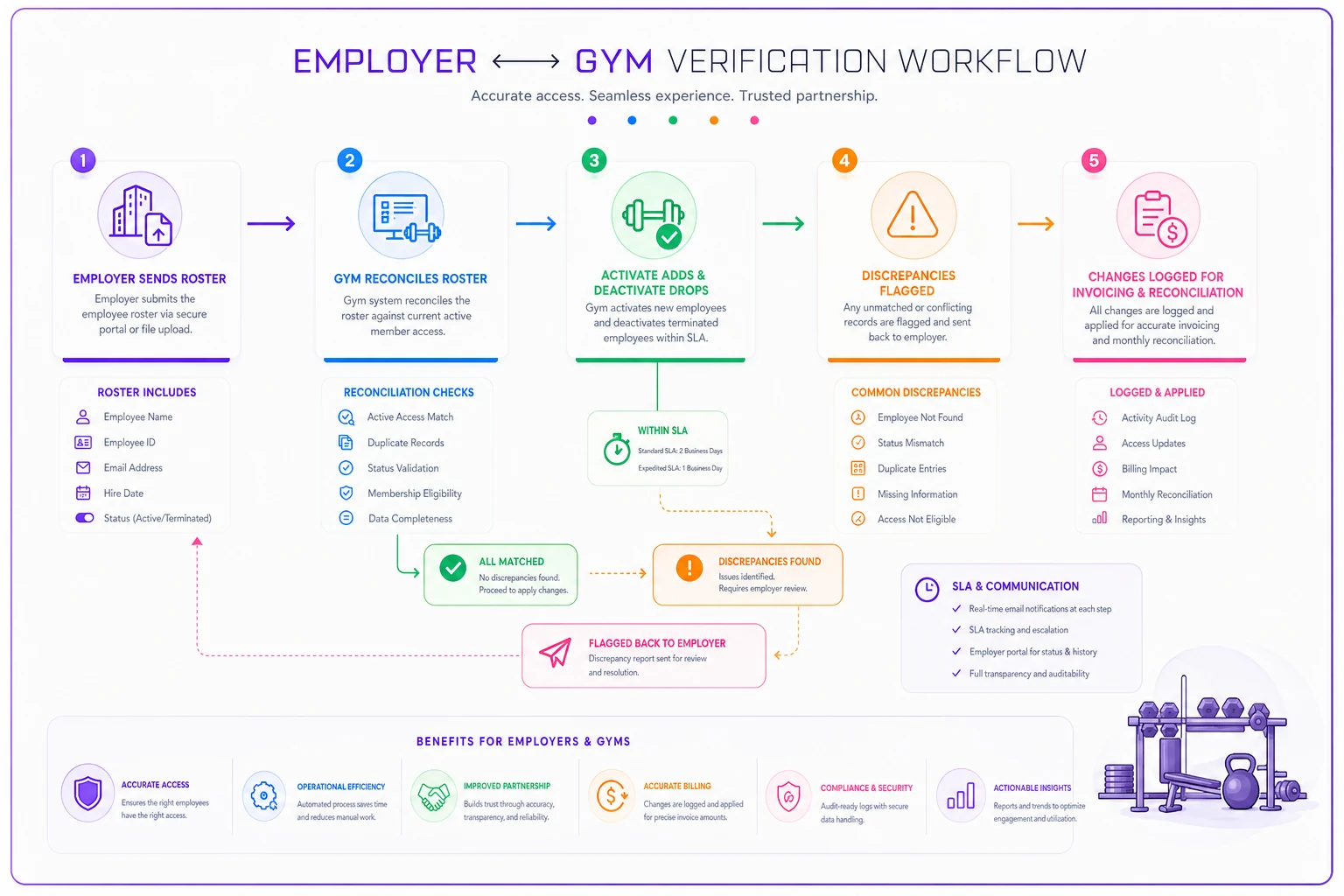
The failure point sits between steps 1 and 3. In practice, this usually happens when the roster arrives as an emailed spreadsheet that lands in a staff inbox and sits there. Terminations don't get processed. People keep accessing the facility. The employer's HR team runs their own audit, finds a dozen ex-employees still active, and suddenly you're defending your billing integrity instead of discussing renewal.
A realistic verification SLA looks like this:
| Event | Employer obligation | Gym obligation | SLA window |
|---|---|---|---|
| New hire enrollment | Submit on roster update | Activate access | 2 business days |
| Termination | Report within 5 days of exit | Deactivate access | 2 business days of notice |
| Roster reconciliation | Provide full roster | Match & flag discrepancies | Monthly |
| Dispute on billed count | Raise within invoice period | Investigate & resolve | 10 business days |
Notice the asymmetry: the employer carries the obligation to tell you about terminations promptly, because they're the only ones who know. If your contract doesn't put that on them explicitly, you absorb the lag. Across a portfolio of employer accounts, verification lag is one of the quietest margin leaks there is.
Billing and reconciliation cadence: where B2B deals actually get paid (or don't)
Consumer billing is automatic. B2B billing is a cadence — a repeating cycle of invoice, reconciliation, dispute window, and payment. Each step has a failure mode.
The cadence that holds up looks roughly like this:
-
Day 1 of the cycle Pull verified access counts from the reconciled roster.
-
Day 2–3 Generate the invoice matching those counts, with a line-item breakdown so disputes are specific rather than vague.
-
Day 5 Send invoice with the supporting access report attached.
-
Day 5–15 Dispute window — employer flags discrepancies, you resolve against your verification log.
-
Day 30 Net-30 payment due.
-
Monthly or quarterly True-up reconciliation against actual headcount changes.
B2B payers don't just miss payments — they delay them around disputes. And disputes almost always trace back to a mismatch between what you billed and what their roster says. If your invoice ships without supporting access detail, you've handed them a reason to hold the whole thing while they "verify."
A typical scenario: a mid-sized gym signs a 60-employee corporate deal at a flat per-active rate. Three months in, the employer's finance team notices the invoice counts 58 employees but their active roster is 51. Seven people left and nobody told the gym. Now there's a credit owed, a trust issue, and a finance contact who scrutinizes every future invoice. The fix wasn't a better invoice template — it was a verification cadence that would have caught the drops before billing ran.
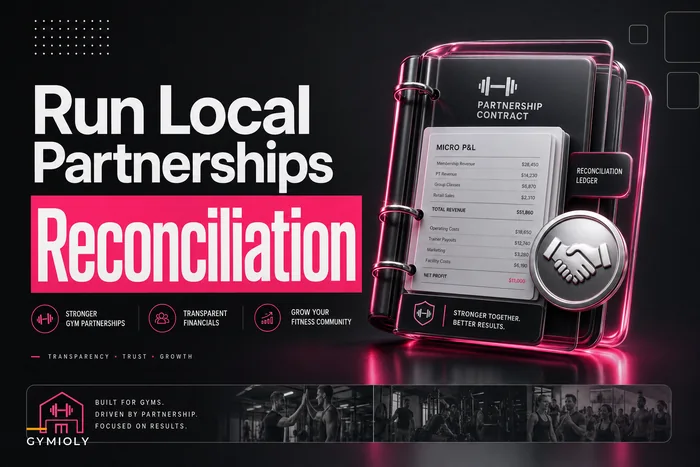
The underlying reconciliation discipline here mirrors what works for any external deal — the same thinking from running local partnerships with proper revenue-share micro-P&Ls applies, just scaled up to employer headcounts and formal invoicing.
Performance scorecards: the document that renews the deal
The uncomfortable reality about enterprise deals: the person who signs the renewal usually isn't the person using the gym. They're reading a report. If that report doesn't exist, or doesn't make the case clearly, the deal dies at renewal regardless of how happy the employees are.
A performance scorecard for an employer should answer the questions the benefits team actually has to justify internally:
-
Utilization How many enrolled employees are actively using the program? Enrollment without usage is the single biggest reason employers cut wellness spend.
-
Engagement trend Is usage growing, flat, or declining over the term?
-
Participation by segment If the employer cares about department-level or site-level breakdowns, give them that.
-
Cost-per-active-employee The number their finance team divides against the invoice.
-
Program highlights Qualitative wins — a challenge that landed, strong class attendance, member feedback worth sharing.
Sample employer ROI report structure
-
Headline "62 of 74 enrolled employees active this quarter (84% utilization)."
-
Trend line Utilization vs. prior quarter.
-
Cost math Total invoiced ÷ active employees = effective cost per active participant.
-
Benchmark framing How that cost compares to the employer's alternative (individual memberships, other wellness vendors).
-
One forward-looking line What you're doing next quarter to move the inactive employees into the program.
That last line matters more than people realize. It signals you're managing the account, not just billing it. Benefits leads renew vendors who feel like partners, not line items.
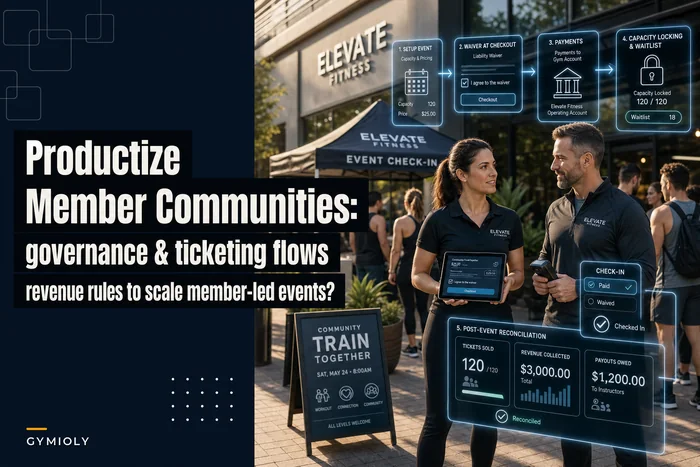
Scorecards don't have to be elaborate. A one-page PDF with real numbers is worth more than a polished deck with vague language. If your employer programs also include internal challenges or member-led events, the governance and ticketing mechanics behind productized member communities overlap directly — those engagement structures are often what drives the utilization numbers your scorecard ends up reporting.
When this makes sense — and when it doesn't
Employer and B2B channels aren't automatically a good fit. A few honest filters:
When it makes sense:
-
You have off-peak capacity to absorb new volume without degrading the experience for existing members.
-
You have (or can build) a verification and billing process that doesn't depend on one person remembering to check a spreadsheet.
-
There's a cluster of employers near your location — one deal makes the operational overhead worth building out properly.
When it's a bad idea:
-
You're already at capacity during the hours corporate users would show up. You'll dilute retail memberships to serve a lower-margin channel.
-
You can't commit to the reporting cadence. A deal you can't report on is a deal you'll lose at renewal anyway.
-
The employer wants deep per-head discounting and heavy administrative handholding. That combination almost never pencils out.
Single-location gyms still fighting basic billing reliability on the consumer side should probably wait. If failed-payment recovery and month-end close aren't solid yet, adding B2B invoicing with dispute windows and true-ups will overwhelm the back office. Get the consumer loop clean first.
How it all connects — and what breaks as you scale
One employer deal you can run on willpower. The owner remembers the roster, writes the invoice, emails a report. Three deals, and the cracks start showing. Ten, and it falls apart unless the system is actually built.
The scaling pattern looks like this:
-
1 deal Manual works fine. Spreadsheet roster, manual invoice, improvised report.
-
3–5 deals Verification lag starts leaking margin. Reports get skipped. Someone misses a termination.
-
10+ deals You need standardized contract templates, a verification SLA that's consistent across accounts, a billing cadence on a real calendar, and a repeatable scorecard format. Without that, every deal is a custom snowflake and the overhead eats the revenue.
The connective tissue is consistency. The contract defines the terms, the verification SLA keeps the roster accurate, the billing cadence turns the accurate roster into paid invoices, and the scorecard turns the whole thing into a renewal. Pull one out and the chain breaks — no verification means bad invoices, bad invoices mean disputes, disputes mean delayed payment, and no scorecard means no renewal conversation worth having.
This is where centralized systems earn their keep. When rosters, access logs, invoicing, and reporting all live in separate tools — a spreadsheet here, an email thread there, an invoice sitting in accounting software — reconciliation becomes a manual archaeology project every single month. Gyms that scale this cleanly tend to pull these workflows into one operational platform where a roster update automatically updates access, feeds the billing count, and populates the utilization data the scorecard needs. The automation matters less than the outcome: the person running the program stops being the integration layer between four disconnected systems.
A real scenario
A two-location gym picked up a regional employer with around 90 eligible employees, billed at a flat per-active rate, net-30. The first two quarters went fine on paper. Then problems stacked: terminations weren't being reported, so they were billing for roughly 8–10 people who'd already left; invoices went out without access detail, so the employer's finance team started holding payments 15–20 days past due while they "verified"; and no quarterly report ever got sent, so the benefits lead had nothing to defend the spend with internally.
At renewal, the employer floated cutting the contract entirely.
What turned it around wasn't a discount. It was rebuilding the lifecycle: a monthly roster reconciliation with a two-day deactivation SLA, invoices that shipped with a line-item access report attached, and a simple one-page quarterly scorecard showing utilization around 80% and a cost-per-active figure the finance team could actually work with. Disputed billing dropped to near zero, payment timing tightened back toward net-30, and the renewal went through — at a slightly higher rate, because the gym now looked like a managed program instead of a liability.
The revenue didn't jump dramatically. What changed was that the deal stopped leaking and stopped being at risk every ninety days.
Bringing it together
Enterprise and B2B channels can be some of the steadiest revenue a gym carries — predictable, batched, and insulated from the month-to-month churn of consumer memberships.
But that stability only shows up if you build the commercial lifecycle as one connected system instead of four separate afterthoughts.
Write the contract so it defines eligibility and true-ups explicitly. Run verification as a continuous SLA, not a one-time setup step. Put billing and reconciliation on a real cadence with supporting detail attached to every invoice. Deliver a scorecard that gives the person renewing the deal something to defend internally. Each piece protects the next, and the whole thing holds up precisely because it's designed to — not because someone remembered to check a spreadsheet on the right day.
Write the contract so it defines eligibility and true-ups explicitly. Run verification as a continuous SLA, not a one-time setup step. Put billing and reconciliation on a real cadence with supporting detail attached to every invoice. Deliver a scorecard that gives the person renewing the deal something to defend internally. Each piece protects the next, and the whole thing holds up precisely because it's designed to — not because someone remembered to check a spreadsheet on the right day.
Ready to elevate your gym operations?
Join 2,000+ gyms using Gymioly to reduce admin overhead, improve member experience, and grow revenue.